Since 1900
A short history of Stamford
While the town was named by Henry King McHarg for Stamford, Connecticut, the townsite was donated by the family of Swante Magnus Swenson. Mr. Swenson was the first Swedish immigrant to Texas. He became one of the largest landowners in Texas, and by 1860, his holdings in West Texas approached 500,000 acres (202,343 ha). These ranches, which spread across 12 Texas counties, became known as the SMS Ranches. Later reorganized as the Swenson Land and Cattle Company, it is headquartered in Stamford to this day. Mr. Swenson had two sons, Eric Pierson and Swen Albin, who became known as the Swenson brothers. They ran SMS Ranches, and even developed a Morab horse-breeding program near the city.
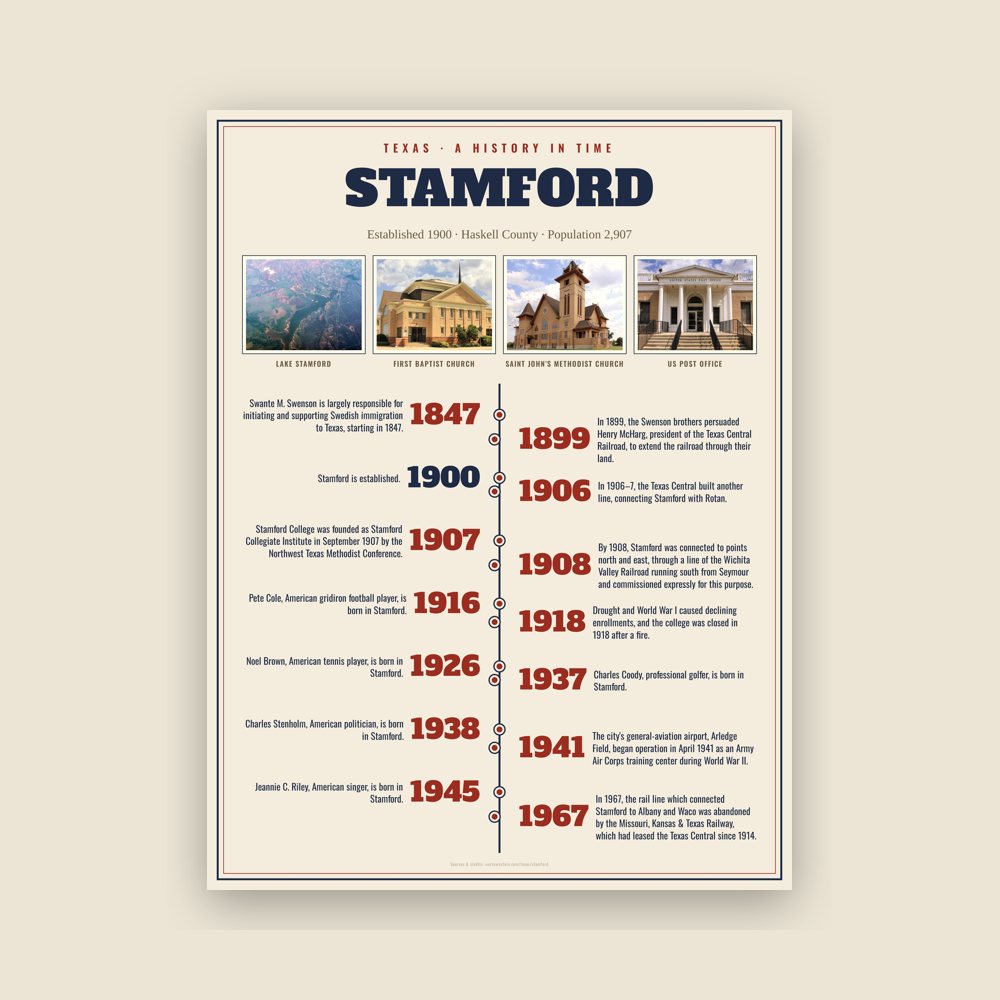
Swante M. Swenson is largely responsible for initiating and supporting Swedish immigration to Texas, starting in 1847. Mr. Swenson assisted Swedish immigrants with the cost of their passage from Sweden to Texas in exchange for their labor. In 1899, the Swenson brothers persuaded Henry McHarg, president of the Texas Central Railroad, to extend the railroad through their land. The brothers then founded Stamford in 1900 and provided the townsite of 640 acres (259 ha). The town and surrounding area were then partially settled by immigrants from Sweden. Many of the cotton farmers who moved to the area bought tracts of land from the Swenson brothers. Stamford's main street is named Swenson.
In 1900, the railroad arrived in Stamford, when the independent Texas Central Railway completed its 38-mile (61 km) line from Albany to the town. In 1906–7, the Texas Central built another line, connecting Stamford with Rotan. By 1908, Stamford was connected to points north and east, through a line of the Wichita Valley Railroad running south from Seymour and commissioned expressly for this purpose.
Stamford College was founded as Stamford Collegiate Institute in September 1907 by the Northwest Texas Methodist Conference. Drought and World War I caused declining enrollments, and the college was closed in 1918 after a fire. The president of Stamford College went on to found McMurry University in Abilene.
The city's general-aviation airport, Arledge Field, began operation in April 1941 as an Army Air Corps training center during World War II.
For the city's first half century, order was kept by police chief George G. Flournoy. A small, crippled, cigar-chewing man, Flournoy began each day's work with target shooting at a stump outside city hall.
In 1967, the rail line which connected Stamford to Albany and Waco was abandoned by the Missouri, Kansas & Texas Railway, which had leased the Texas Central since 1914. Though the line from Stamford to Rotan was reacquired by the Texas Central Railway, it was sold three years later to the Fort Worth & Denver Railway Company, and subsequently abandoned.
Adapted (trimmed) from the Wikipedia article Stamford, Texas, revision 1384886781 by its contributors, licensed CC BY-SA 4.0.