During the Civil War (1861–1865), they built the temporary fortress settlement of Mugginsville on Deep Creek 5 miles north of the future town site of Moran.
- CountyShackelford County
- Population226 (2020 U.S. Census)
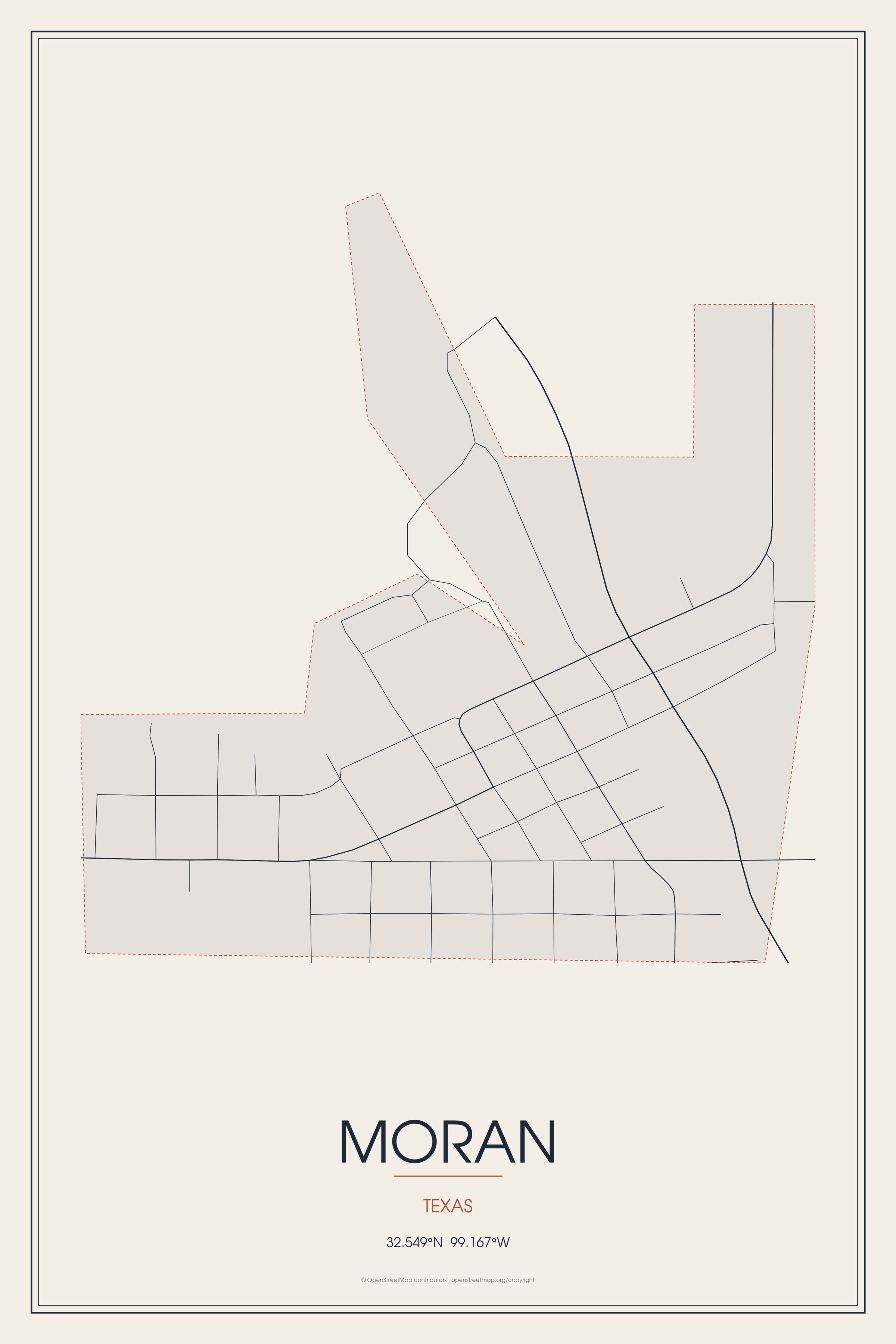
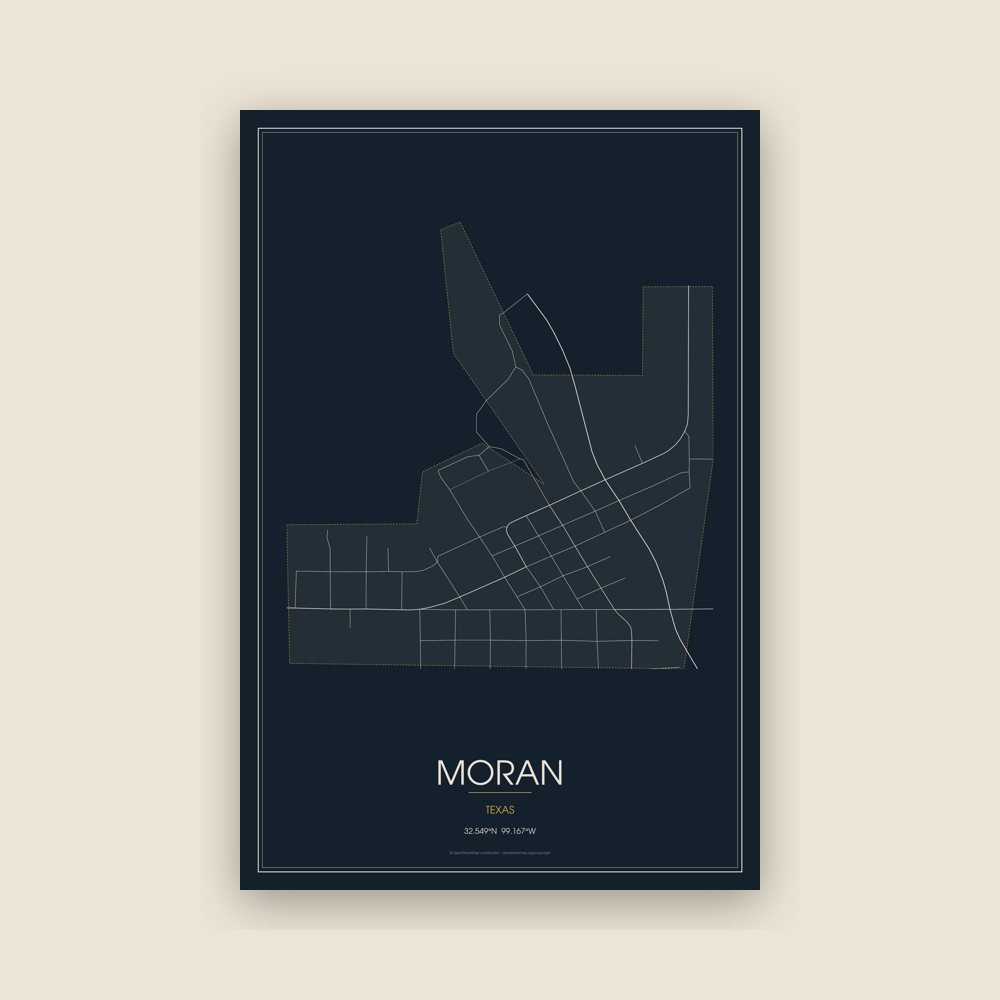
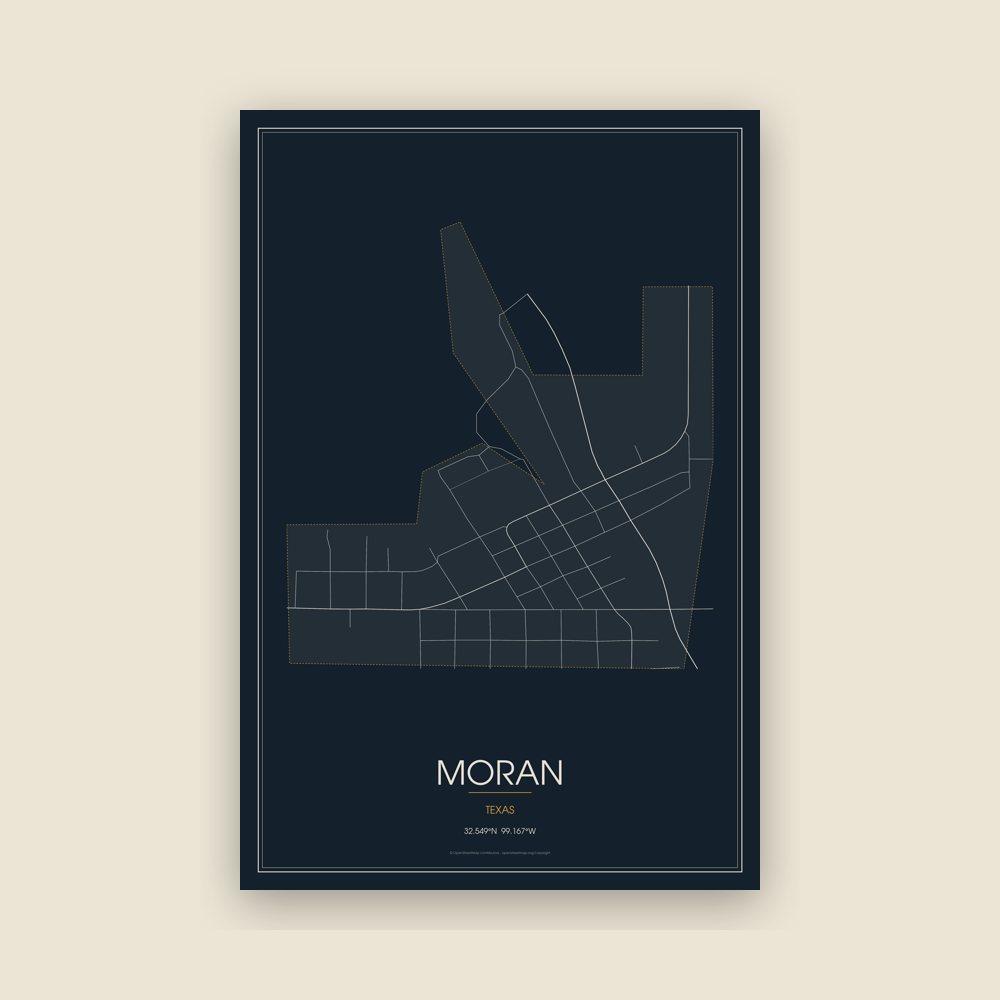
Moran, Texas gifts and souvenirs: 16 designs made from Moran's own map, landmarks and history, from $16 to $95. Printed to order and shipped free in the USA.
| Popular | Price |
|---|---|
| Moran Hometown Ornament | $23 |
| Moran Varsity Crewneck | from $57 |
| Moran Est. Tee | from $33 |
| Moran Town Line Mug | from $26 |
| Moran Market Tote | $37 |
Ceramic keepsake, gold ribbon
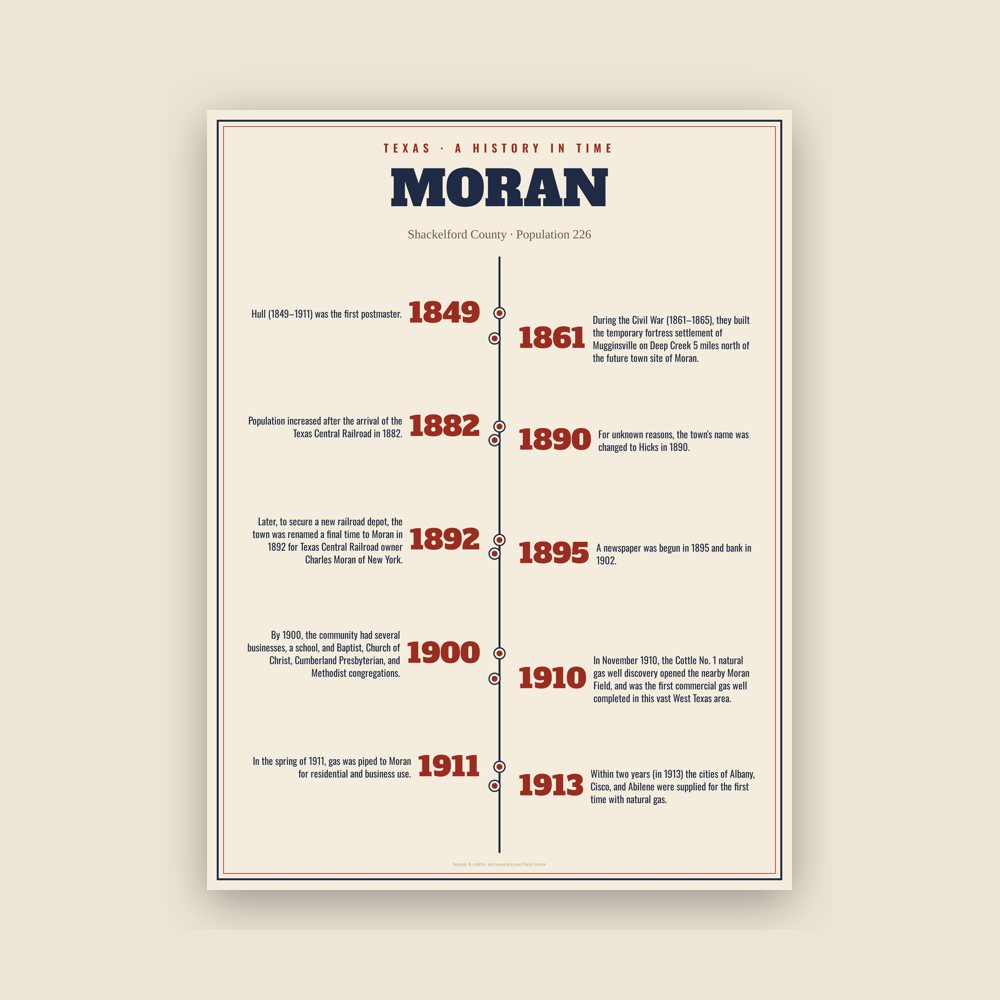
The town's story in dates, from its own records, for home or classroom
Heavy-blend fleece, street map printed on the back
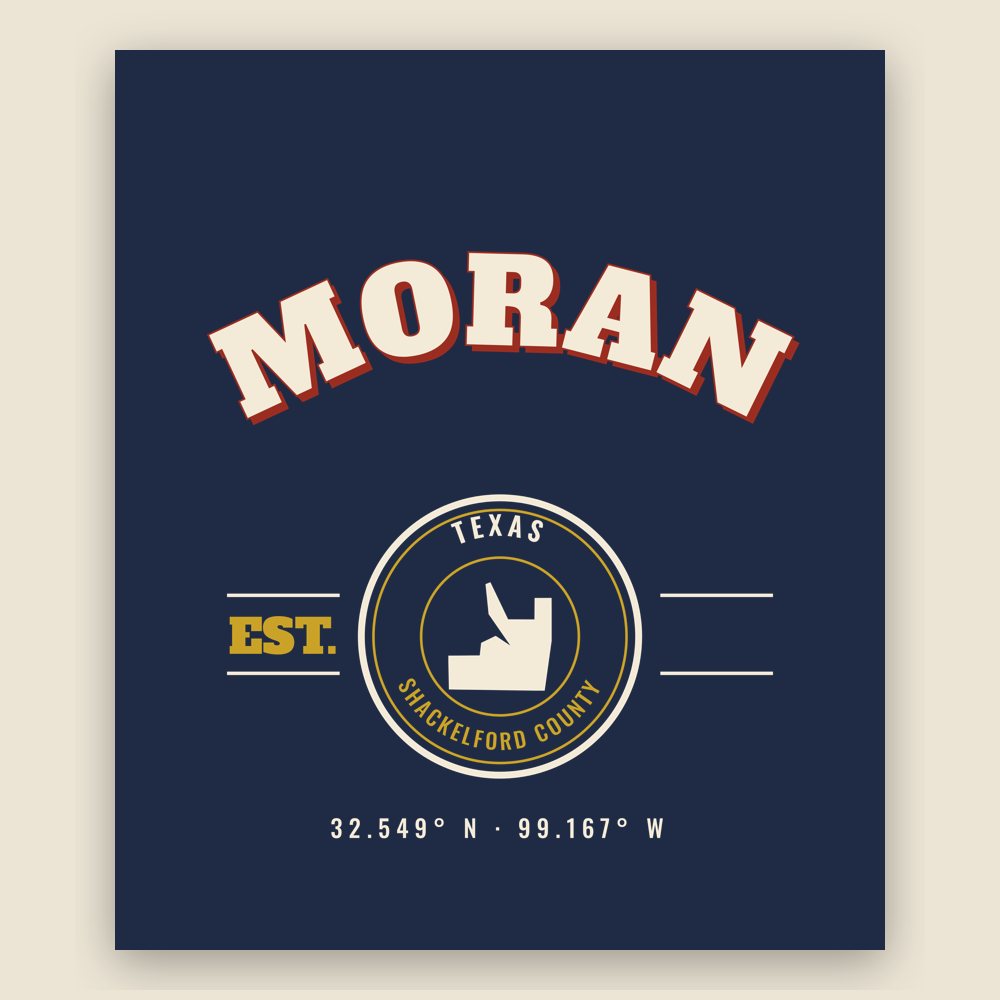
Soft Bella+Canvas jersey
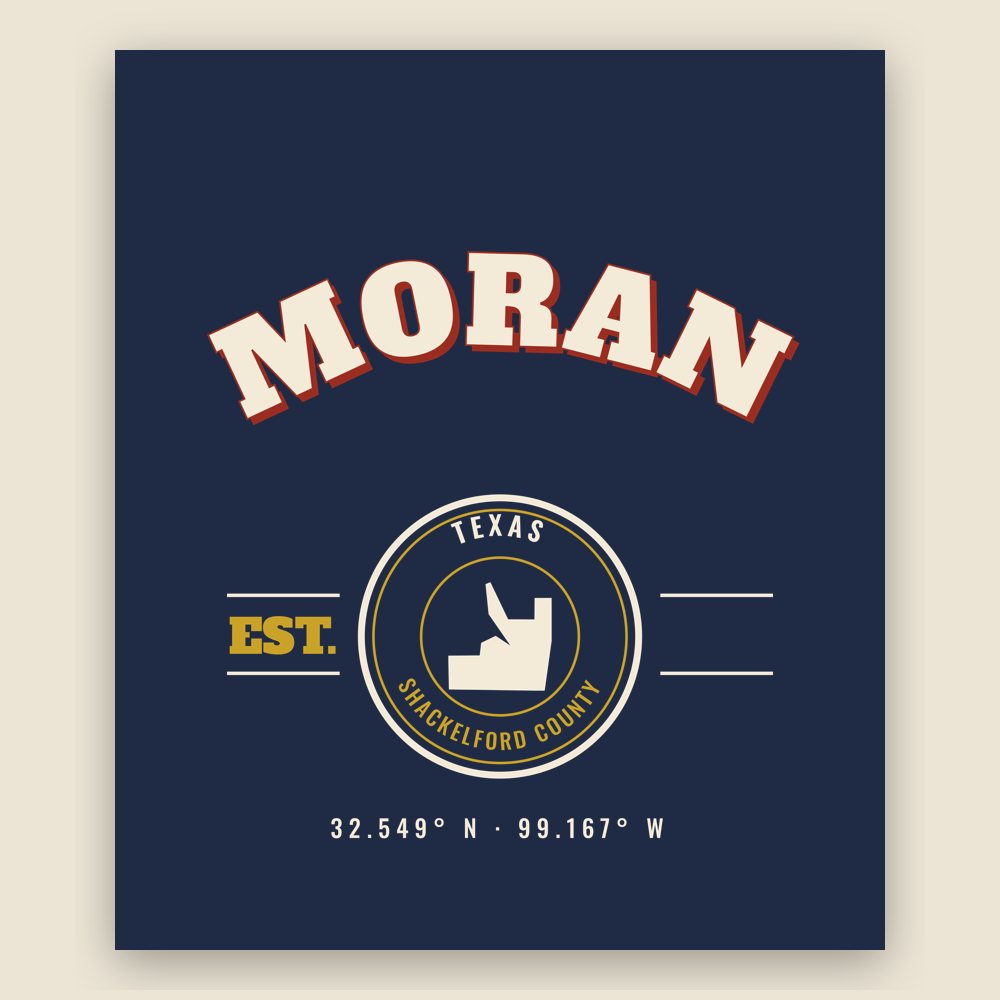
Kids' Bella+Canvas jersey, youth sizes
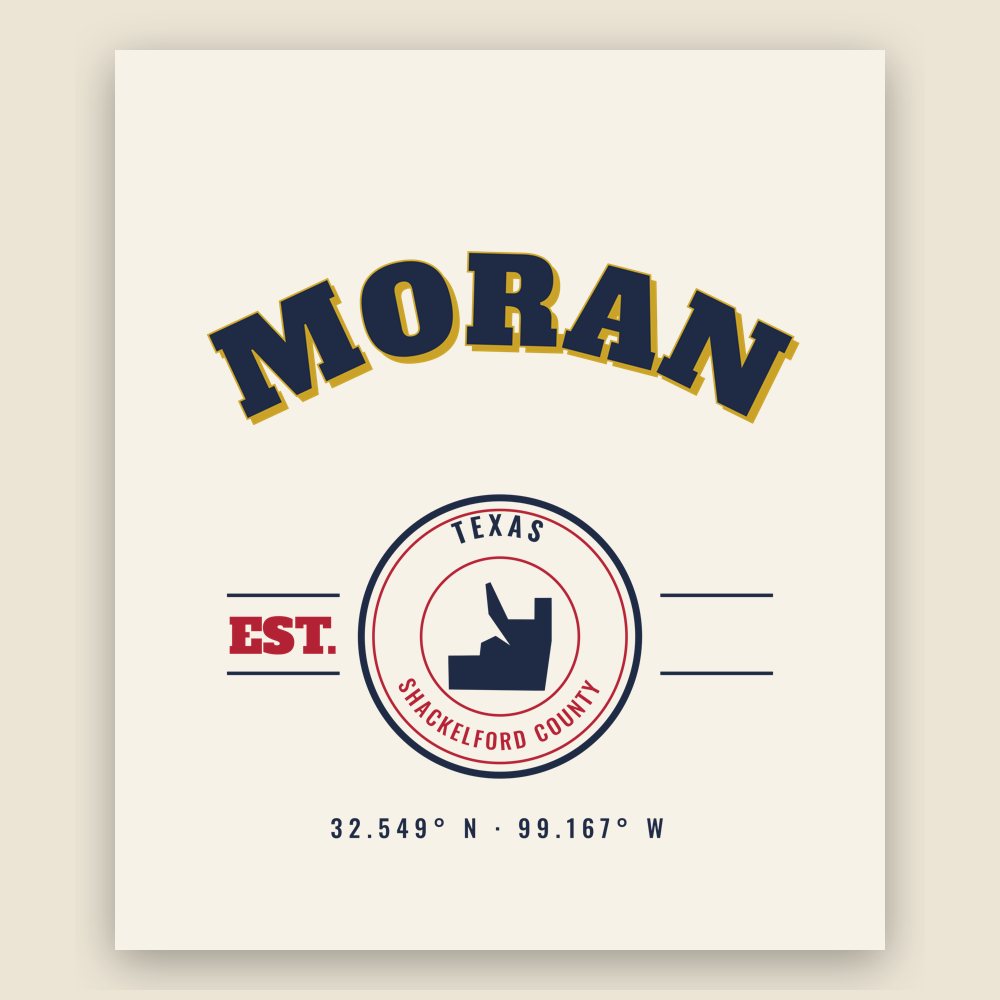
Bella+Canvas toddler jersey
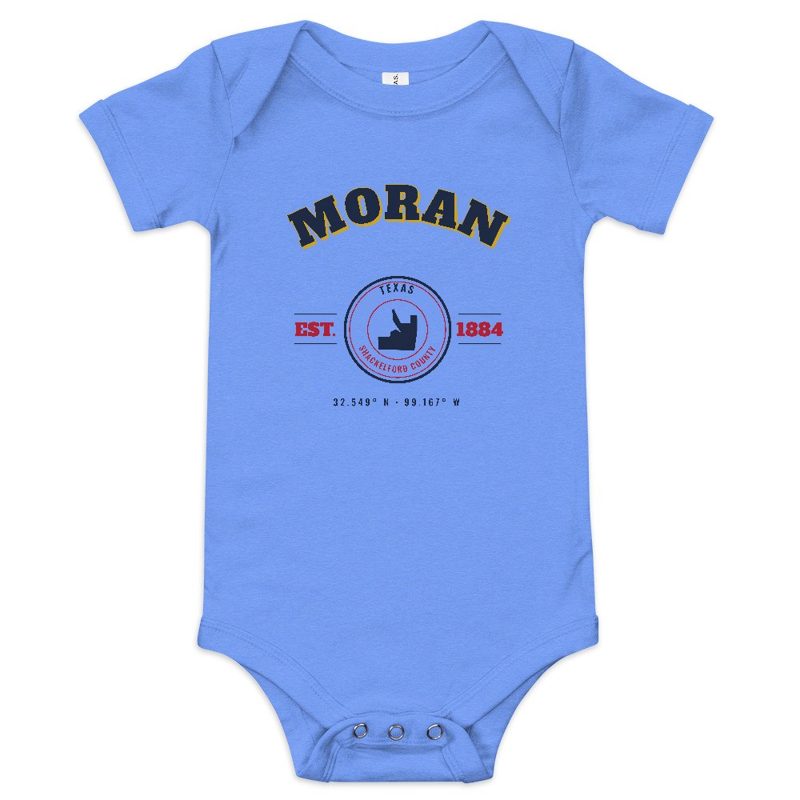
Bella+Canvas baby bodysuit
Glossy ceramic, dishwasher safe
Weatherproof, for the front walk
24″×16″, printed coir-look fibers, rubber back
12″×12″ printed wood, ready to hang
Soft-touch, zip cover
Sturdy all-over-print tote
Glossy top, cork back
Soft fleece, 50″×60″
20 oz, double-wall stainless
During the Civil War (1861–1865), they built the temporary fortress settlement of Mugginsville on Deep Creek 5 miles north of the future town site of Moran.
Pioneers came to this area as early as the 1860s. During the Civil War (1861–1865), they built the temporary fortress settlement of Mugginsville on Deep Creek 5 miles north of the future town site of Moran. At one time, a branch of the Western Cattle Trail passed nearby. Population increased after the arrival of the Texas Central Railroad in 1882. Hulltown, the original name of the town, was established by Mary and George Washington "Swope" Hull of McDowell, Virginia, who opened a general store at the rail crossing on Deep Creek in 1883. Hull (1849–1911) was the first postmaster. He bought 160 acres between Post Oak and Deep Creeks and platted a town site in March 1884 (his family and he later moved to Oakland, California). Most of the property was bought by Bem Scott, a real-estate developer from Indiana, who eventually sold his interests in 1890 to Matthew D. Bray (1845–1926), a prominent local merchant and landowner. For unknown reasons, the town's name was changed to Hicks in 1890. Later, to secure a new railroad depot, the town was renamed a final time to Moran in 1892 for Texas Central Railroad owner Charles Moran of New York.
By 1900, the community had several businesses, a school, and Baptist, Church of Christ, Cumberland Presbyterian, and Methodist congregations. A newspaper was begun in 1895 and bank in 1902. In November 1910, the Cottle No. 1 natural gas well discovery opened the nearby Moran Field, and was the first commercial gas well completed in this vast West Texas area. In the spring of 1911, gas was piped to Moran for residential and business use. Within two years (in 1913) the cities of Albany, Cisco, and Abilene were supplied for the first time with natural gas. By October 1913, with five producing gas wells, the Moran Field won recognition as one of the most important sources of fossil fuels in Texas. For the next 15 years, oil and gas discoveries in the area made Moran a boom town with a peak population of 5,000–10,000 at one point in the 1920s. By the 1930s, the boom was over and the population gradually began its decline to the present day.
In the late 1980s, Moran achieved fame as the home of the National Fajita Cook-off, which brought thousands of visitors from all over the world to the sleepy town. In the 2000s, Moran became home to Slide Fire Solutions, a multimillion dollar bump stock production company. The local economy remains tied to farming, ranching, and oil and gas production.
Local Texas historical markers are devoted to: Moran (#3468), Cottle No. 1 Natural Gas Well (#1076), Granville E. Waters (#13204), Moran Cemetery (#17708), and Moran Church of Christ (#17SF02).
Adapted (trimmed) from the Wikipedia article Moran, Texas, revision 1380735949 by its contributors, licensed CC BY-SA 4.0.
We share a part of every Moran sale with local partners, and we'd love to print from your collection. Old photographs, maps and postcards make the best keepsakes.
Partner with usA favorite landmark, your street, a school or team, an anniversary gift, a different product. Tell us and we'll get back to you by email.
Moran's population was 226 in the 2020 U.S. Census, down from 233 in 2000.