The H&TC set aside one acre of land along the rail line two miles west of Eutaw as a townsite, and named it for chief engineer Theodore Kosse. Kosse is the birthplace of Bob Wills, musician.
- CountyLimestone County
- Population458 (2020 U.S. Census)
Kosse, Texas gifts and souvenirs: 20 designs made from Kosse's own map, landmarks and history, from $16 to $95. Printed to order and shipped free in the USA.
| Popular | Price |
|---|---|
| Kosse Hometown Ornament | $23 |
| Kosse Vintage Travel Poster | from $40 |
| Kosse Varsity Crewneck | from $57 |
| Kosse Est. Tee | from $33 |
| Kosse Town Line Mug | from $26 |
| Kosse Market Tote | $37 |
Ceramic keepsake, gold ribbon
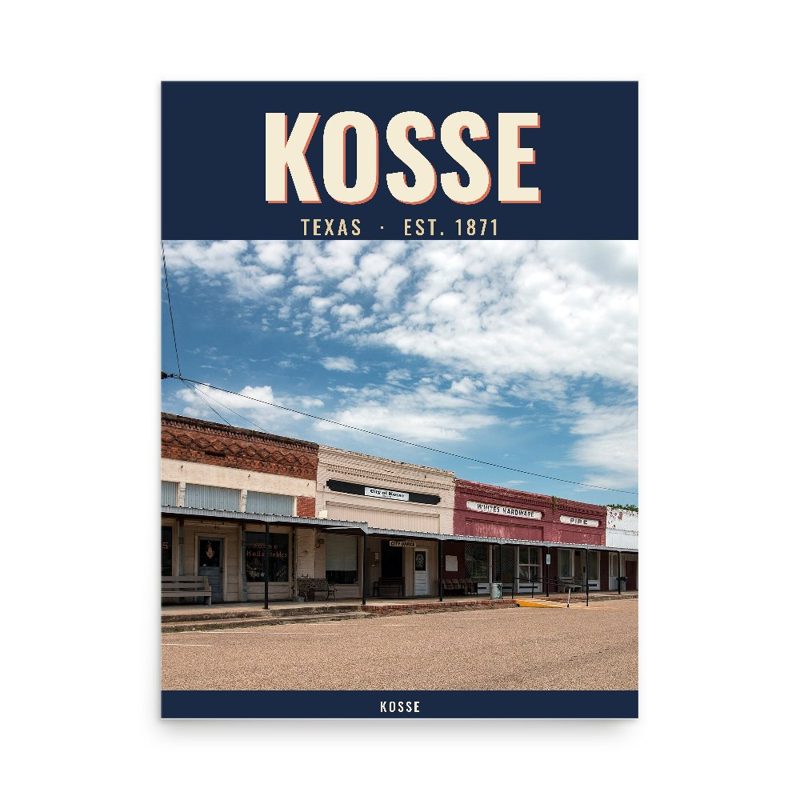
Its landmark photo in a classic travel-poster layout
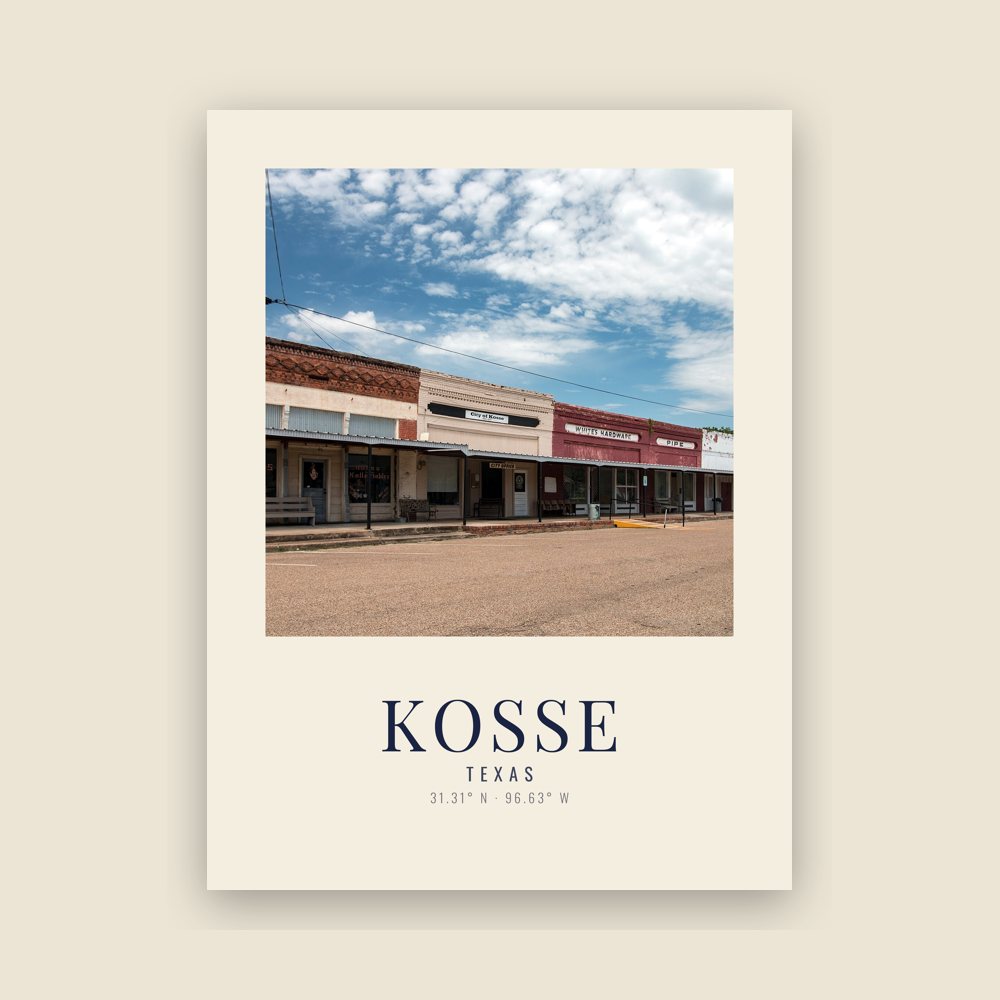
A local landmark photo as a gallery print
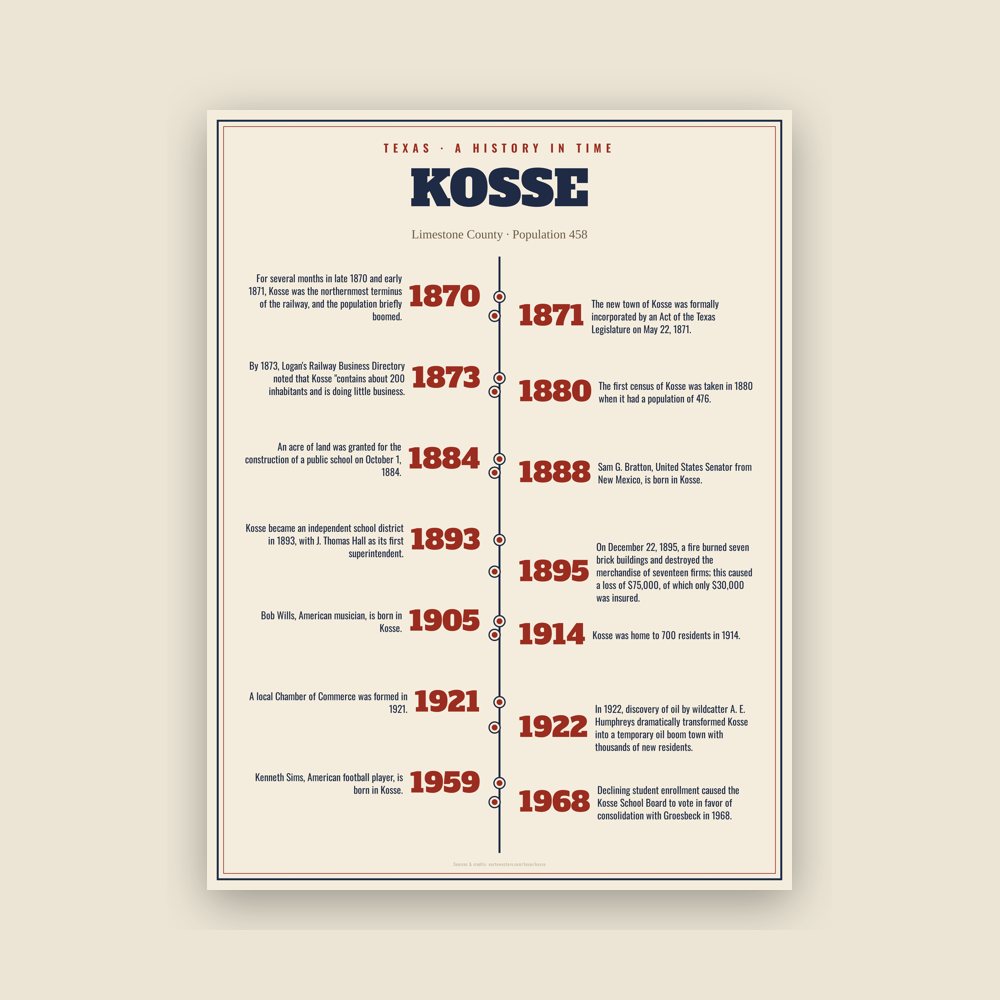
The town's story in dates, from its own records, for home or classroom

Heavy-blend fleece, street map printed on the back

Soft Bella+Canvas jersey

Kids' Bella+Canvas jersey, youth sizes

Bella+Canvas toddler jersey
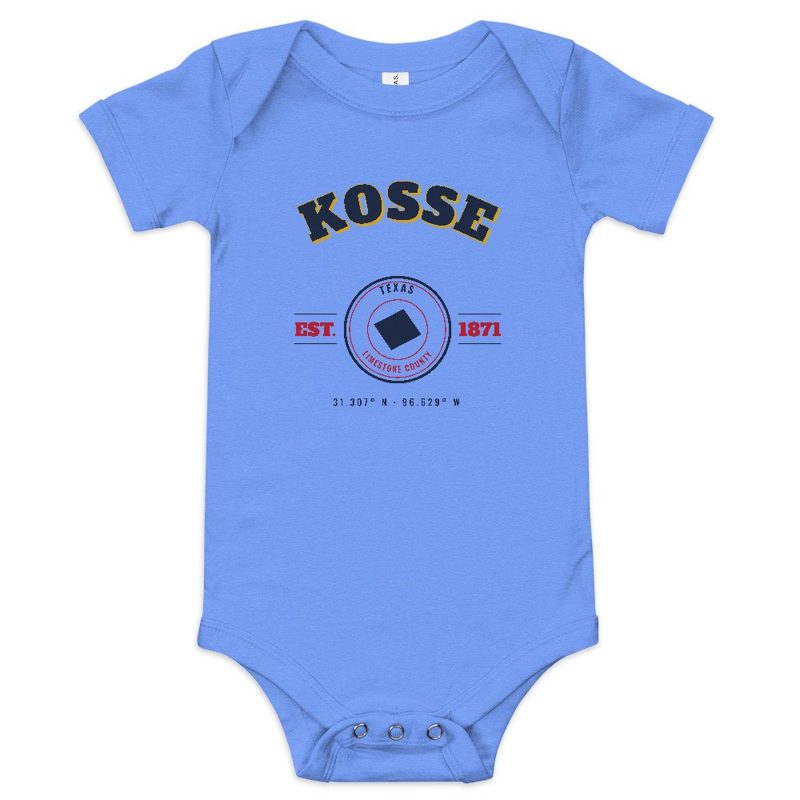
Bella+Canvas baby bodysuit
Glossy ceramic, dishwasher safe
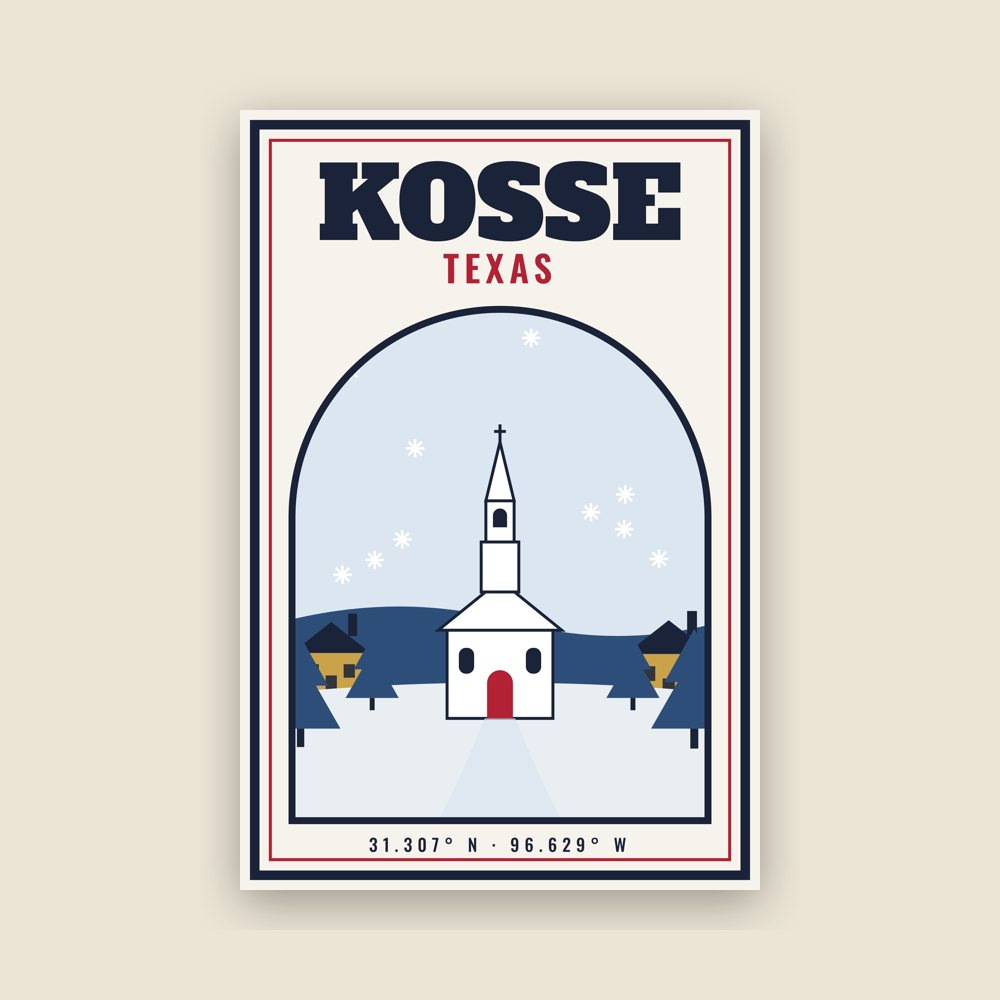
Weatherproof, for the front walk

24″×16″, printed coir-look fibers, rubber back
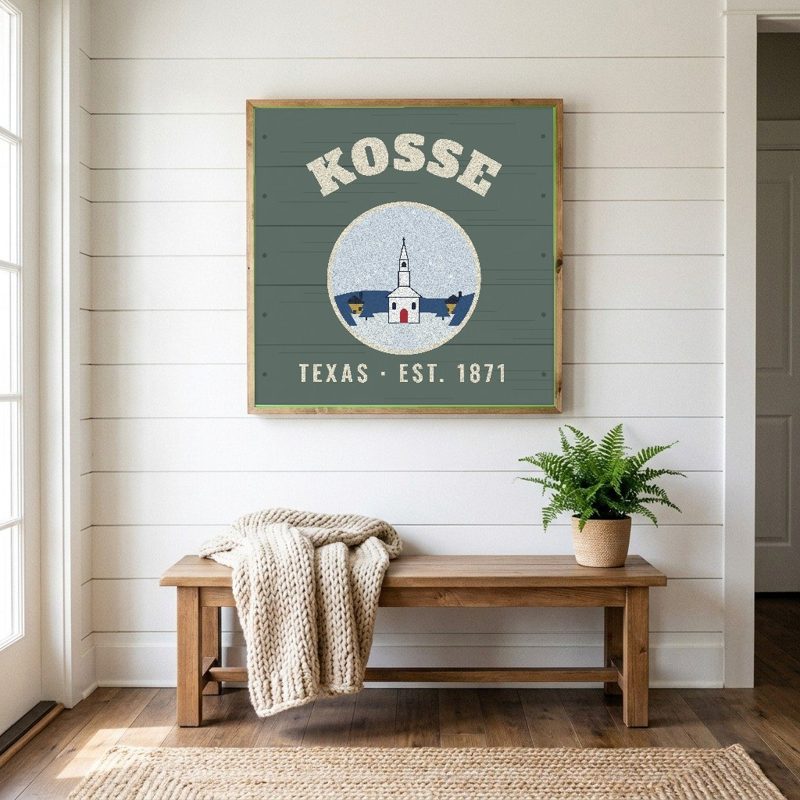
12″×12″ printed wood, ready to hang
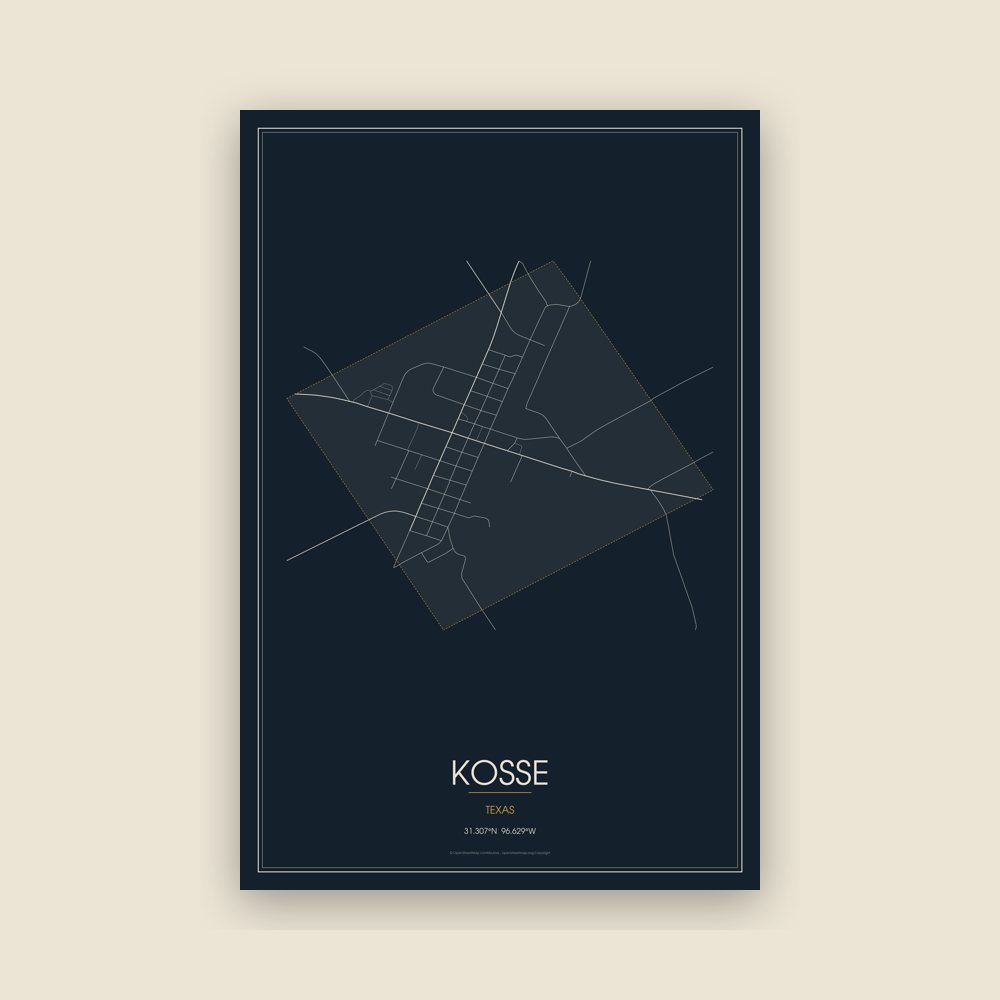
Soft-touch, zip cover
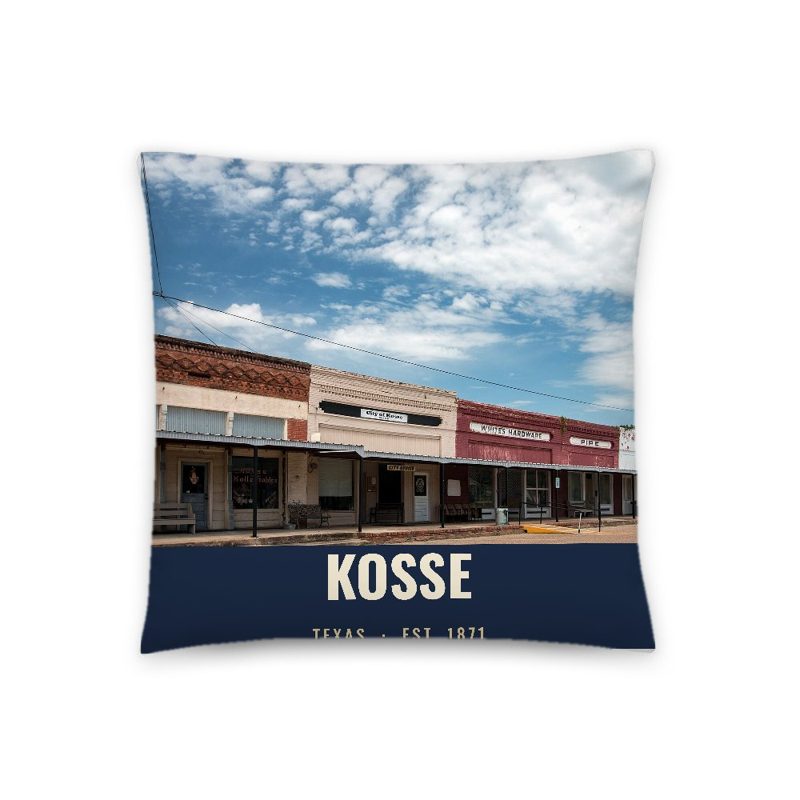
A local landmark photo with the town name, 18″×18″

Sturdy all-over-print tote
Glossy top, cork back
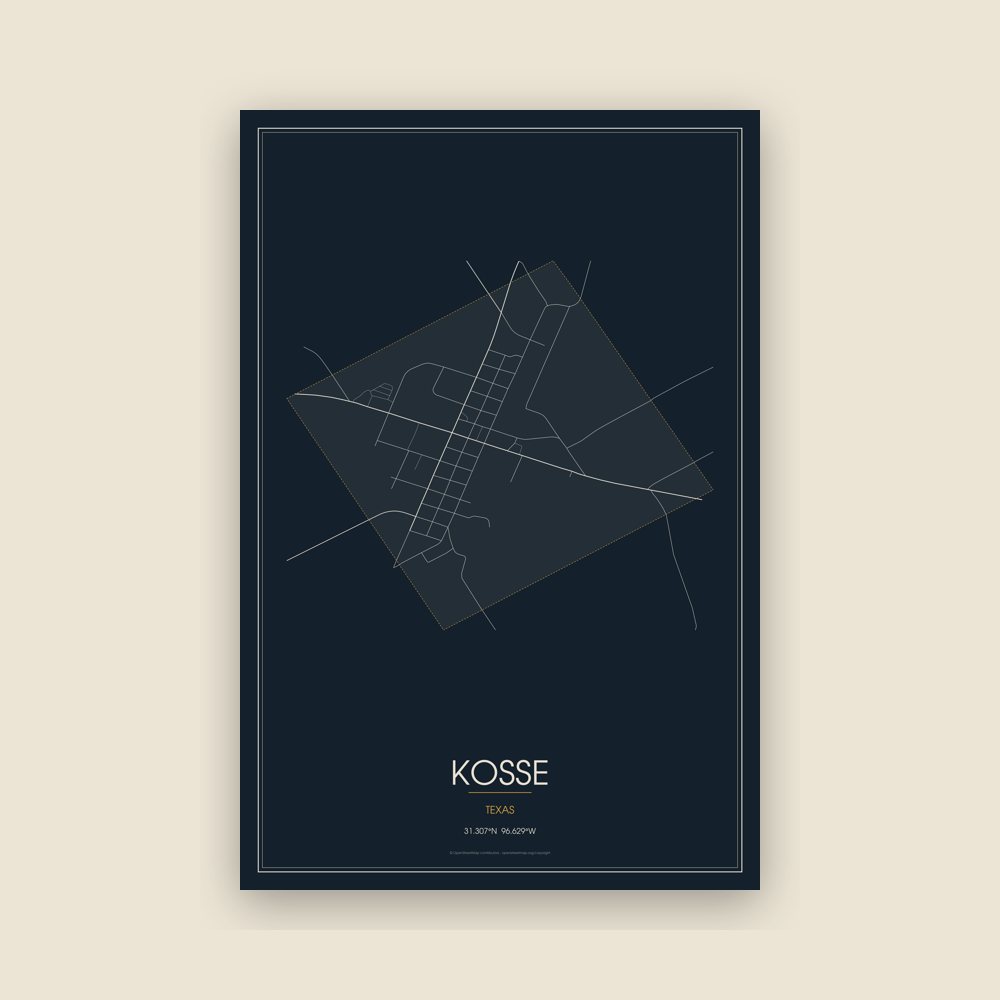
Soft fleece, 50″×60″

20 oz, double-wall stainless
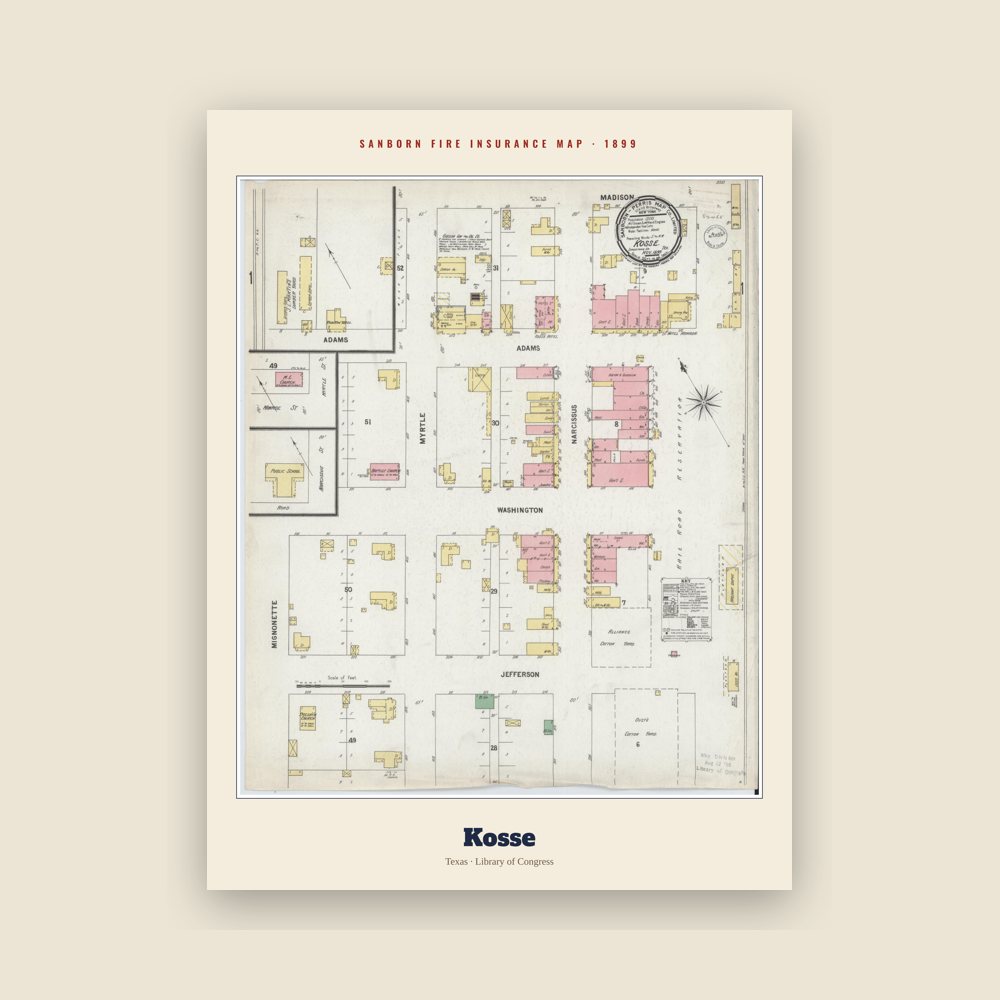
The town's earliest Sanborn fire-insurance map, drawn building by building and hand-coloured, from the Library of Congress
The H&TC set aside one acre of land along the rail line two miles west of Eutaw as a townsite, and named it for chief engineer Theodore Kosse. Kosse is the birthplace of Bob Wills, musician.
Population 2000: 497 → 2010: 464 → 2020: 458
From Wikidata (CC0).
Initial settlement of the area began in the mid-1840s as a community known as Eutaw. Settlers built homes near Duck Creek and Eutaw was a stage stop for the Franklin-Springfield and Waco-Marlin stage routes.
Following the Civil War, the area was in the planned route of the Houston and Texas Central Railway (H&TC) which was being constructed to link Houston to Dallas, Denison and the Red River. The H&TC set aside one acre of land along the rail line two miles west of Eutaw as a townsite, and named it for chief engineer Theodore Kosse. For several months in late 1870 and early 1871, Kosse was the northernmost terminus of the railway, and the population briefly boomed. But by the spring of 1871, the rail line had been extended further north to the new terminus of Groesbeck and Kosse's population was considerably reduced. By 1873, Logan's Railway Business Directory noted that Kosse "contains about 200 inhabitants and is doing little business. When it was the terminus it was a thriving place, now its glory has faded. Cattle constitute the bulk of shipments from here."
The new town of Kosse was formally incorporated by an Act of the Texas Legislature on May 22, 1871. The Act named G. N. Beaumont, D. T. Igleheart, J. Huey, R. H. Fielder and a Mr. Young to be commissioners to lay off the town and make a town plat. The town's first officers were appointed by the Governor, and the first general election was held on the second Tuesday in November 1872, at which time a mayor, constable and five aldermen were elected for a two-year term. The town was named for H&TC's chief engineer, Theodore Kosse.
The first census of Kosse was taken in 1880 when it had a population of 476. Five years later, Kosse had multiple cotton gins, two sawmills, and three gristmills. By 1890 there were 647 residents.
An acre of land was granted for the construction of a public school on October 1, 1884. Kosse became an independent school district in 1893, with J. Thomas Hall as its first superintendent. The district had a total of 225 students. A separate school with 80 students and two teachers served the area's black community.
On December 22, 1895, a fire burned seven brick buildings and destroyed the merchandise of seventeen firms; this caused a loss of $75,000, of which only $30,000 was insured.
By the turn of the 20th century, Kosse had emerged as a small but stable regional community that supported the surrounding farms and ranches of southern Limestone County.
Kosse was home to 700 residents in 1914. A local Chamber of Commerce was formed in 1921. In 1922, discovery of oil by wildcatter A. E. Humphreys dramatically transformed Kosse into a temporary oil boom town with thousands of new residents. However, the numerous wells drilled around Kosse did not turn out to be producers, and Kosse's oil boom came to a rapid close early in 1923.
The Great Depression severely impacted Kosse as businesses closed and people left in search of jobs. Declining student enrollment caused the Kosse School Board to vote in favor of consolidation with Groesbeck in 1968. Kosse had eleven businesses in 1989.
Adapted (trimmed) from the Wikipedia article Kosse, Texas, revision 1374455057 by its contributors, licensed CC BY-SA 4.0.
We share a part of every Kosse sale with local partners, and we'd love to print from your collection. Old photographs, maps and postcards make the best keepsakes.
Partner with usA favorite landmark, your street, a school or team, an anniversary gift, a different product. Tell us and we'll get back to you by email.
2 free coloring pages of Kosse, each traced from a photo of a local landmark. Print them at home, at school or for story hour.
Kosse's population was 458 in the 2020 U.S. Census, down from 497 in 2000.
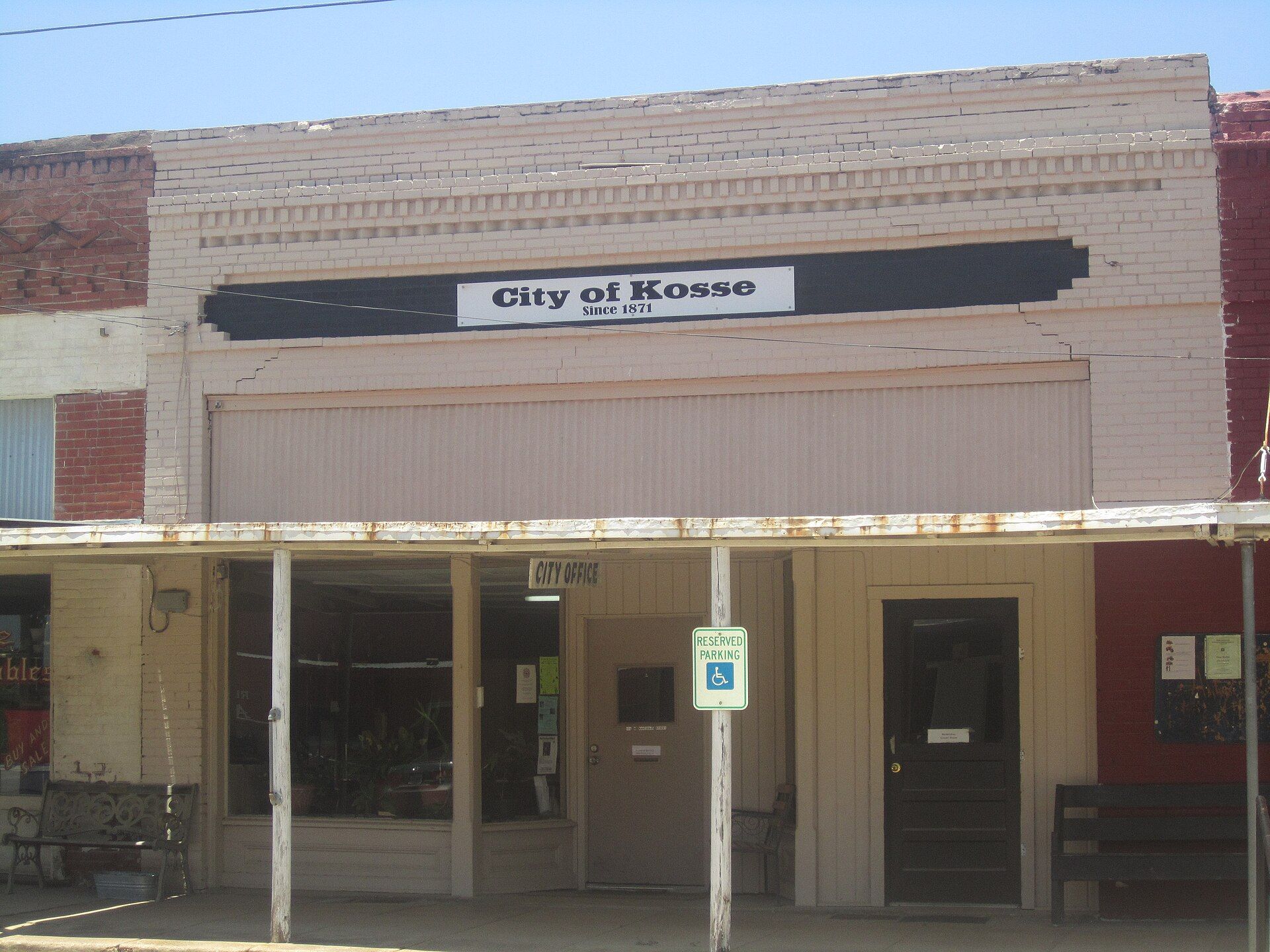
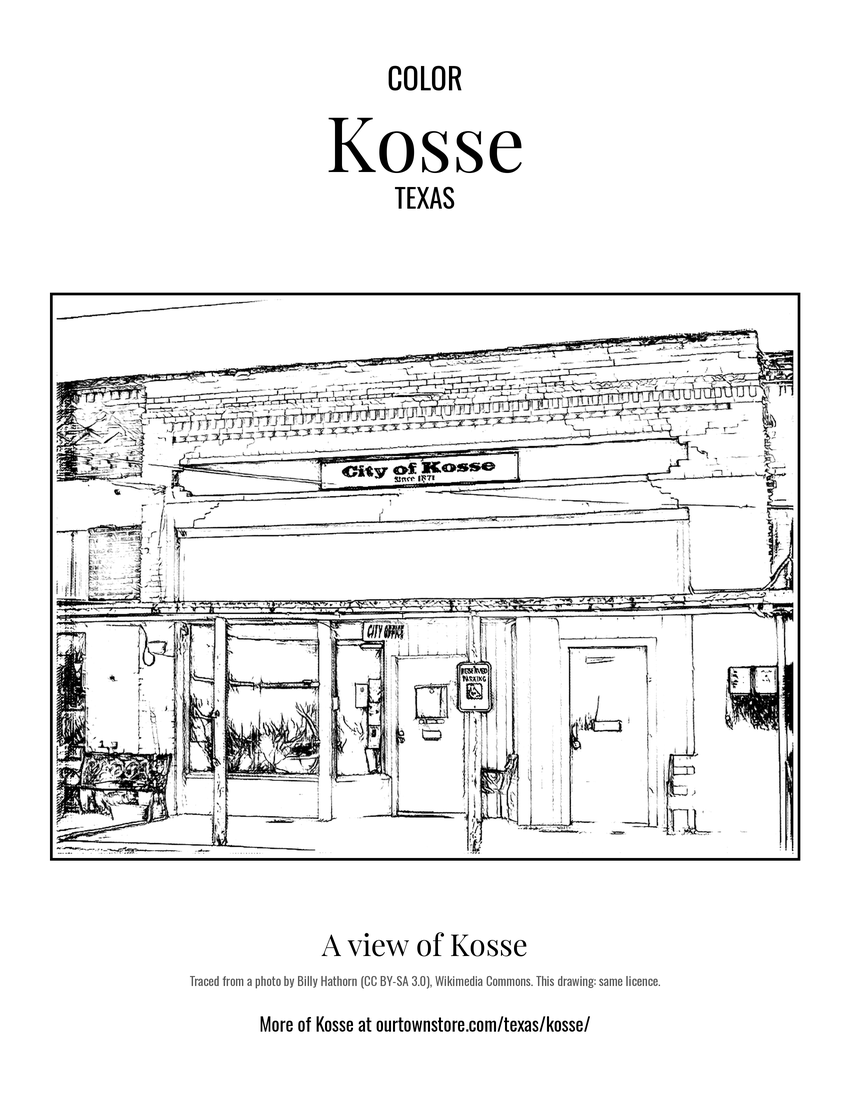 A view of Kosse
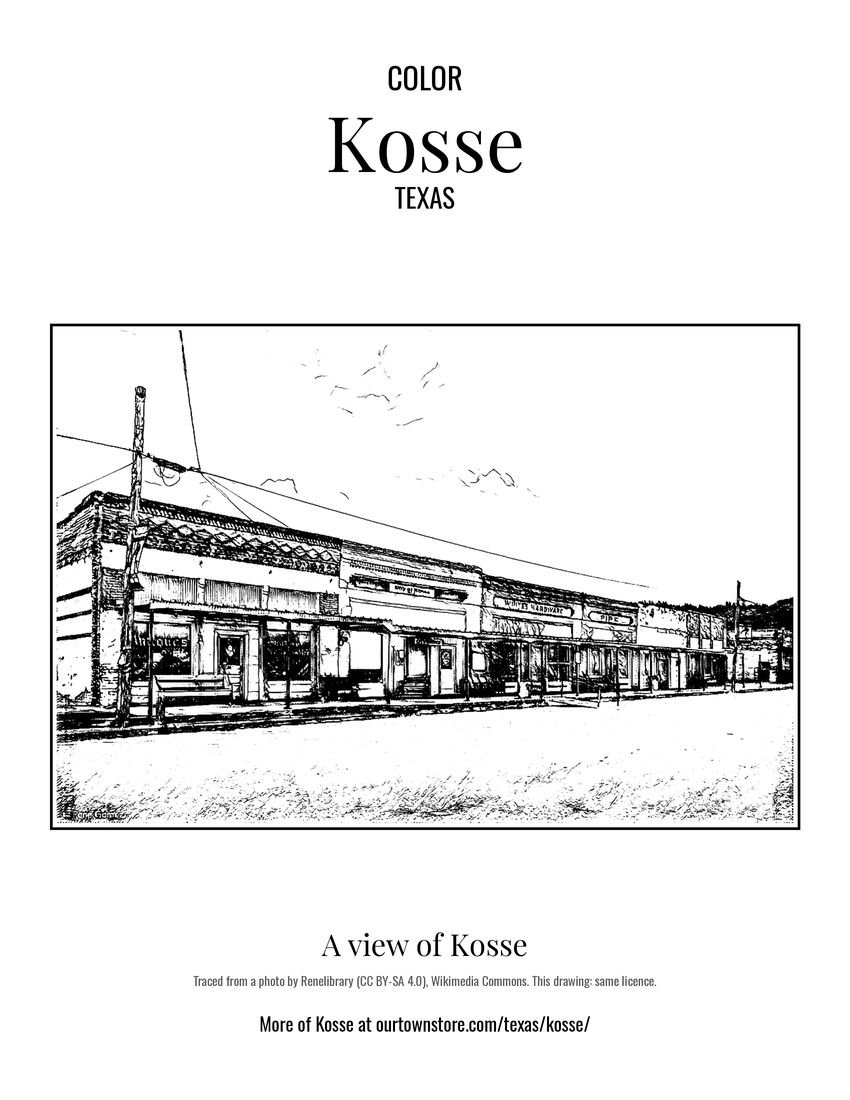 A view of Kosse