In 1884, Howe was incorporated, with George M. McCrary as mayor. Howe is the birthplace of Roswell G. Higginbotham, football and baseball player and coach.
- CountyGrayson County
- Population3,571 (2020 U.S. Census)
Howe, Texas gifts and souvenirs: 19 designs made from Howe's own map, landmarks and history, from $16 to $95. Printed to order and shipped free in the USA.
| Popular | Price |
|---|---|
| Howe Hometown Ornament | $23 |
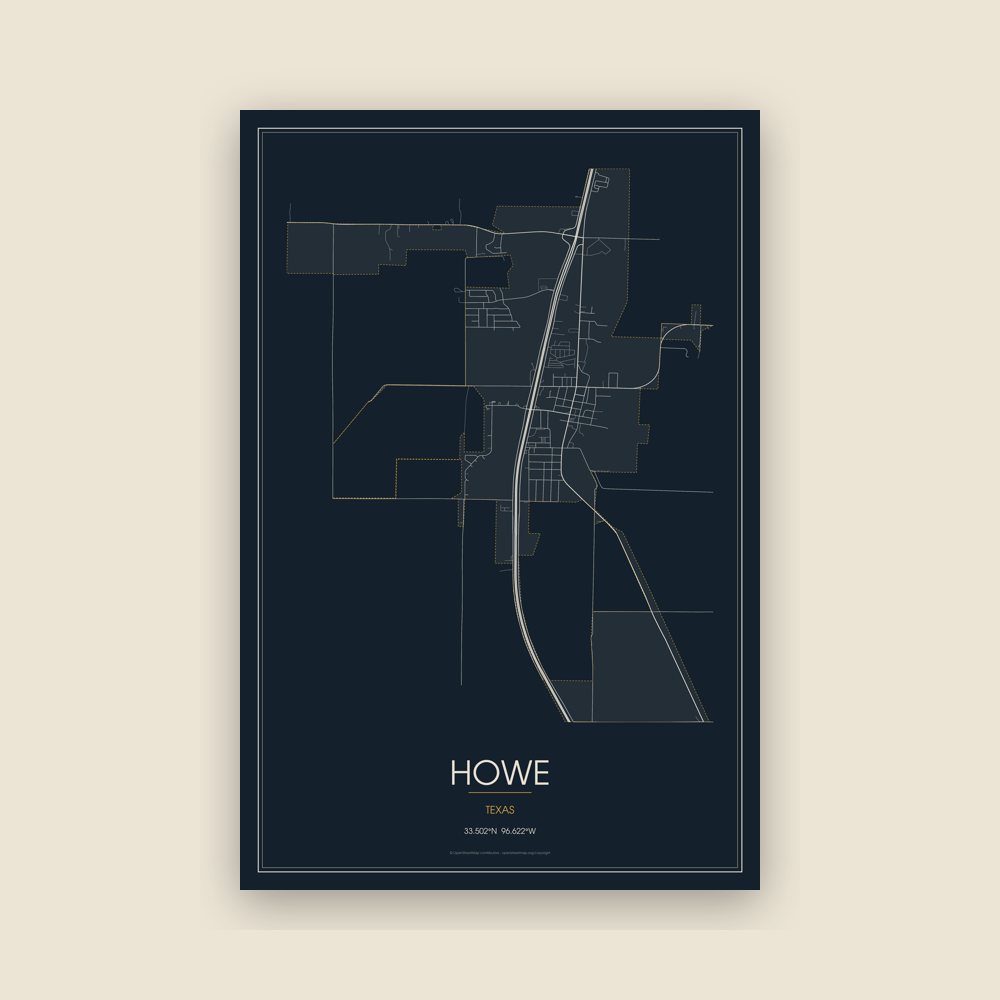
| Howe Vintage Travel Poster | from $40 |
| Howe Varsity Crewneck | from $57 |
| Howe Est. Tee | from $33 |
| Howe Town Line Mug | from $26 |
| Howe Market Tote | $37 |
Ceramic keepsake, gold ribbon
Its landmark photo in a classic travel-poster layout
A local landmark photo as a gallery print
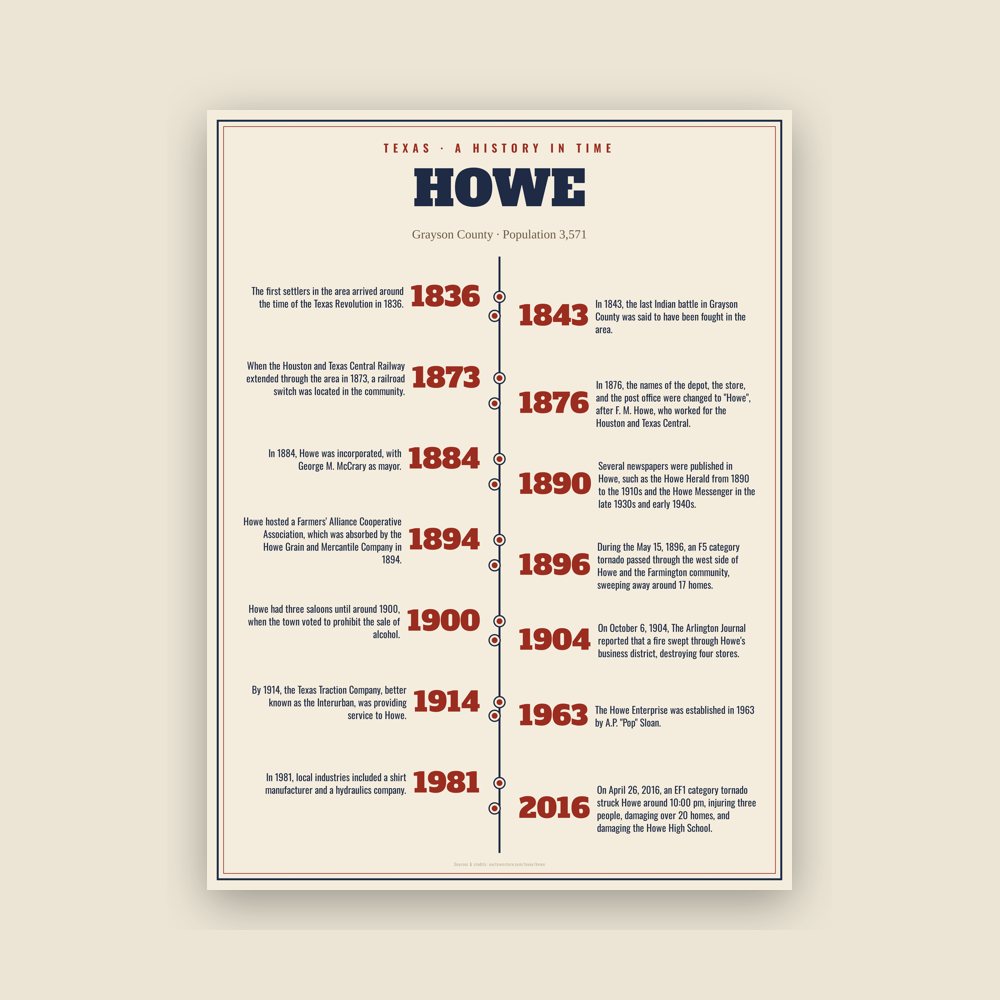
The town's story in dates, from its own records, for home or classroom
Heavy-blend fleece, street map printed on the back
Soft Bella+Canvas jersey
Kids' Bella+Canvas jersey, youth sizes
Bella+Canvas toddler jersey
Bella+Canvas baby bodysuit
Glossy ceramic, dishwasher safe
Weatherproof, for the front walk
24″×16″, printed coir-look fibers, rubber back
12″×12″ printed wood, ready to hang
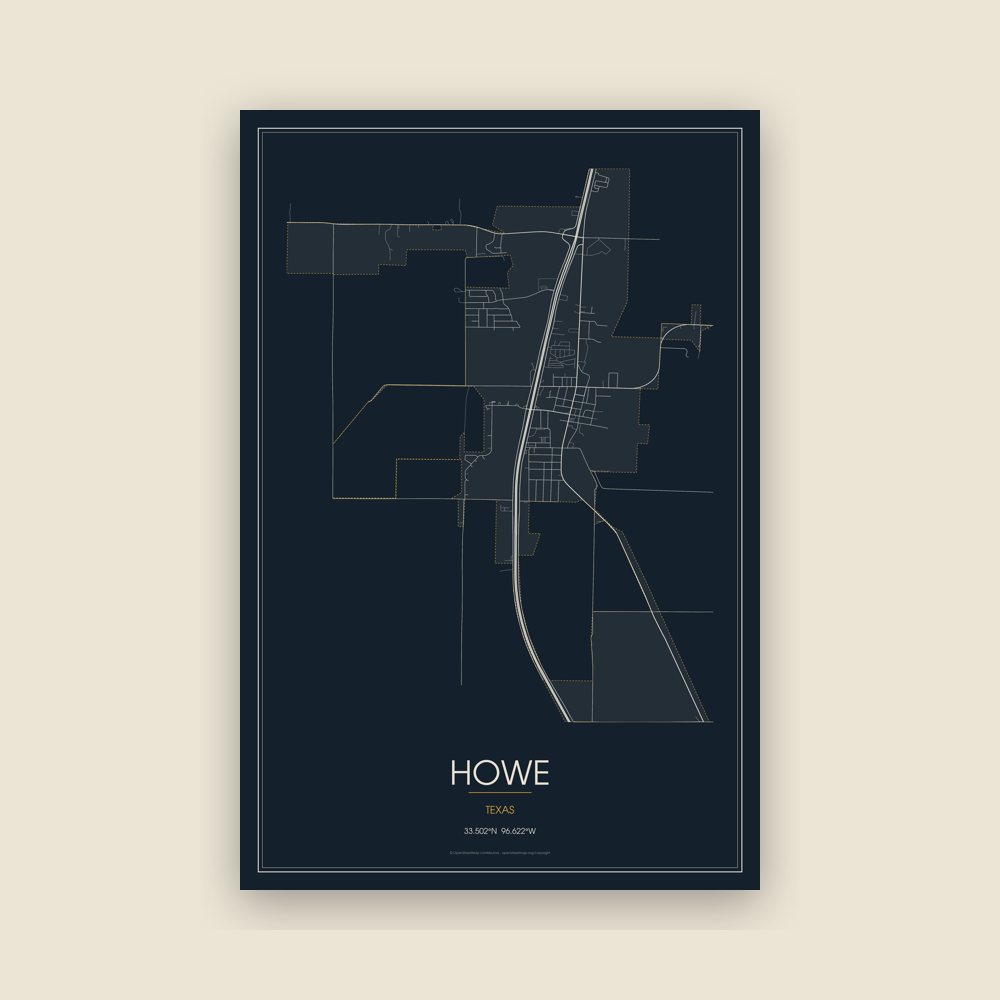
Soft-touch, zip cover
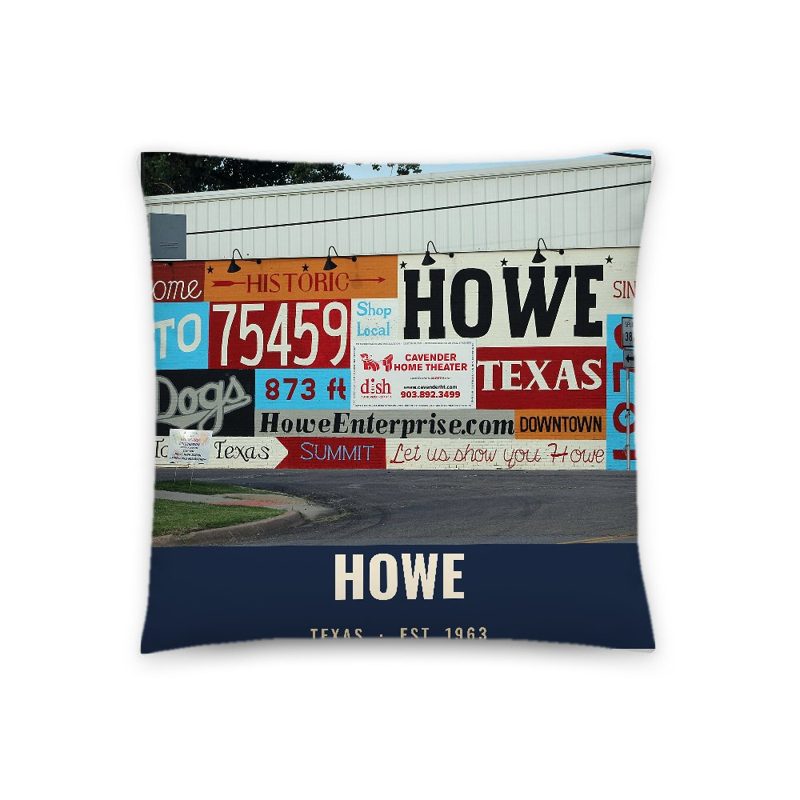
A local landmark photo with the town name, 18″×18″
Sturdy all-over-print tote
Glossy top, cork back
Soft fleece, 50″×60″
20 oz, double-wall stainless
In 1884, Howe was incorporated, with George M. McCrary as mayor. Howe is the birthplace of Roswell G. Higginbotham, football and baseball player and coach.
The first settlers in the area arrived around the time of the Texas Revolution in 1836. In 1843, the last Indian battle in Grayson County was said to have been fought in the area. The first settlers of Howe were Jabez and Harriet Haning, and Jabez's brother John. They received land through the Peters colony after arriving from Pennsylvania before 1850. When the Houston and Texas Central Railway extended through the area in 1873, a railroad switch was located in the community. It was called "Summit" because, at 810 feet (250 m) above sea level, it was believed to be the highest point between the Red River and the Gulf of Mexico. In 1873, when Summit received a post office, two businesses were located at the switch—a general store and a saloon. Several houses were built to the east of the switch. Jabez Haning persuaded the railroad to establish a depot on his land by donating every second lot in his newly platted town to the railroad. In 1876, the names of the depot, the store, and the post office were changed to "Howe", after F. M. Howe, who worked for the Houston and Texas Central. Howe had three saloons until around 1900, when the town voted to prohibit the sale of alcohol. Its first one-room school building opened in 1877 and was replaced by a two-story building in 1884.
In 1884, Howe was incorporated, with George M. McCrary as mayor. By the late 1880s, the town had become a major grain shipping center, notably for red rust-proof oats. Several seed companies were founded there in that decade. Howe hosted a Farmers' Alliance Cooperative Association, which was absorbed by the Howe Grain and Mercantile Company in 1894. In 1890, Howe's population reached 450. The town included a steam gristmill, a Farmers' Alliance Cooperative, and Baptist and Methodist churches, along with various businesses such as hotels, doctors, druggists, and barbers. Several newspapers were published in Howe, such as the Howe Herald from 1890 to the 1910s and the Howe Messenger in the late 1930s and early 1940s. During the 1930s, the Howe Chronicle was published by former Governor James E. Ferguson and his brother A. M. Ferguson. The Howe Enterprise was established in 1963 by A.P. "Pop" Sloan.
During the May 15, 1896, an F5 category tornado passed through the west side of Howe and the Farmington community, sweeping away around 17 homes. On October 6, 1904, The Arlington Journal reported that a fire swept through Howe's business district, destroying four stores.
By 1914, the Texas Traction Company, better known as the Interurban, was providing service to Howe. This electric train ran between Denison and Dallas with a stop in Howe. By 1914, Howe also had the Farmers National Bank, the Howe Herald, three grain elevators, and an ice plant. The community's population had grown from 521 in 1904 to 680 in the early 1960s. It then rose rapidly through the early 1980s, reaching 2,173 by 1990. By 2000, the population was 2,478.
Throughout most of its history, Howe remained primarily an agricultural center, though some oil has been produced in the area. During the early 1980s, Howe had approximately 30 businesses. In 1981, local industries included a shirt manufacturer and a hydraulics company. By 1991, the number of manufacturers in Howe had risen to five, including makers of plastics, electronics, and agricultural equipment.
On April 26, 2016, an EF1 category tornado struck Howe around 10:00 pm, injuring three people, damaging over 20 homes, and damaging the Howe High School. It began in a field behind the Summit Hill housing division, destroying a home off Smith Road. It then proceeded northeast, crossing US Hwy 75. Trucker Gene Marshall was filming it there; the storm tossed his truck and semitrailer, along with three cars, to the other side of the road. It then struck the north side of the high school before passing through Stark Lane. It then proceeded to the Luella/Ida area before dissipating.
Adapted (trimmed) from the Wikipedia article Howe, Texas, revision 1378761263 by its contributors, licensed CC BY-SA 4.0.
We share a part of every Howe sale with local partners, and we'd love to print from your collection. Old photographs, maps and postcards make the best keepsakes.
Partner with usA favorite landmark, your street, a school or team, an anniversary gift, a different product. Tell us and we'll get back to you by email.
1 free coloring page of Howe, each traced from a photo of a local landmark. Print them at home, at school or for story hour.
Howe's population was 3,571 in the 2020 U.S. Census, up from 2,173 in 1990.
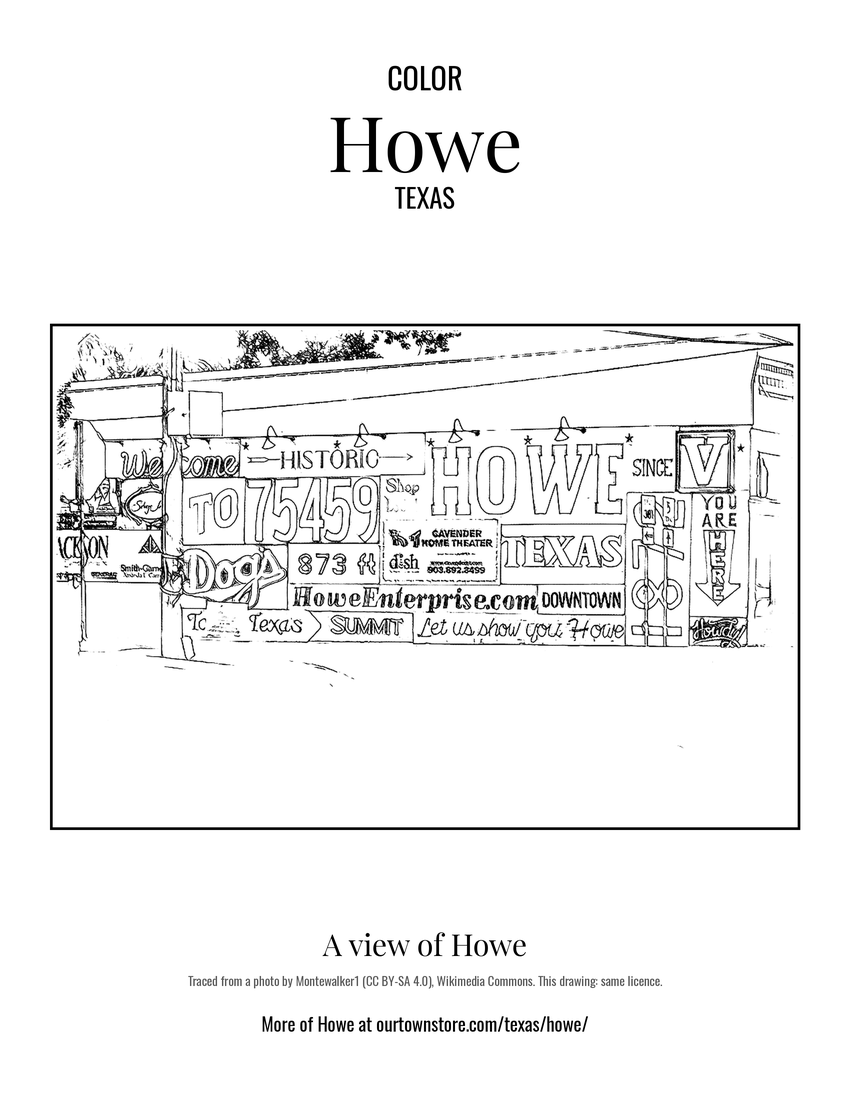 A view of Howe