A short history of Groom
Early exploration
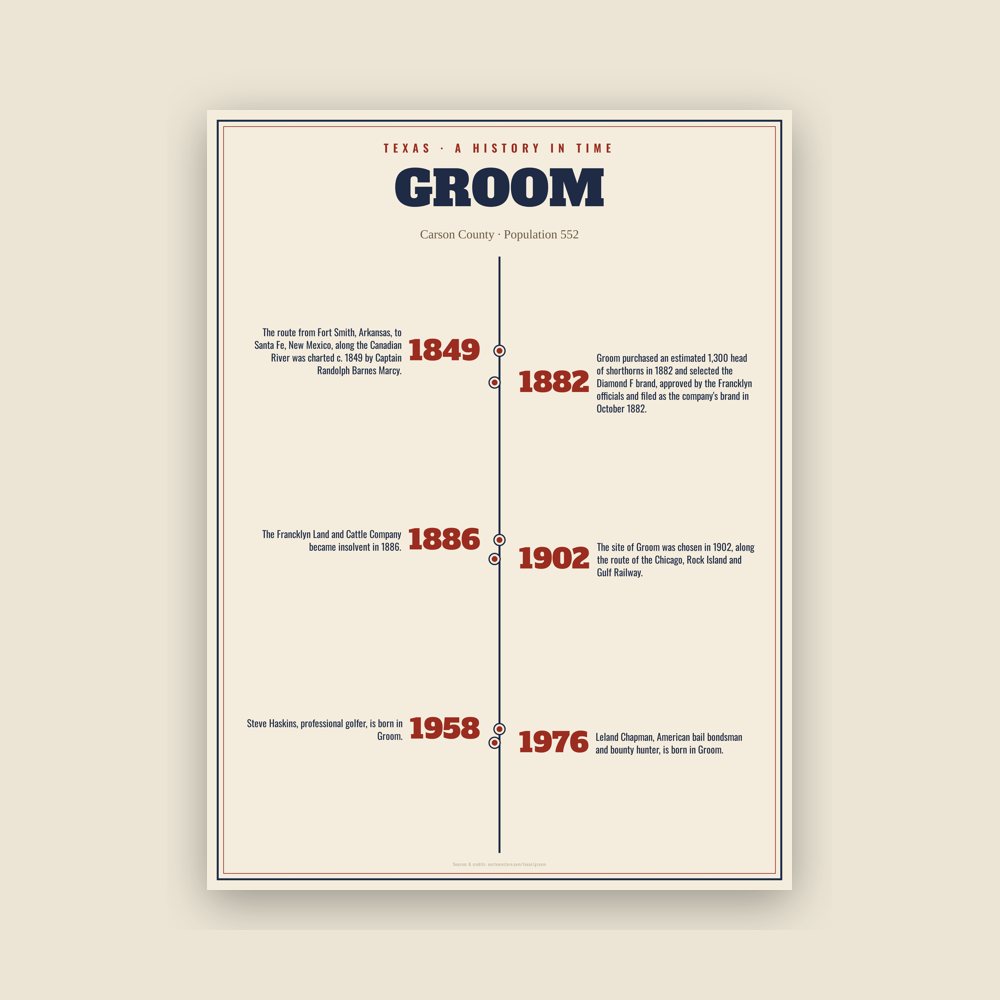
The route from Fort Smith, Arkansas, to Santa Fe, New Mexico, along the Canadian River was charted c. 1849 by Captain Randolph Barnes Marcy. Published in 1859, Marcy's book, The Prairie Traveler: A Handbook for Overland Expeditions, contained maps and illustrations of routes between the Mississippi and the Pacific and was used as a basic manual by westward-bound wagon trains and travelers for years.
Read the full history
Colonel B. B. Groom
Colonel B. B. Groom, an experienced cattleman near Lexington, Kentucky, leased from the New York and Texas Land Company 592,920 acres (2,399.5 km2) of land in Hutchinson, Carson, Gray, and Roberts Counties in the Texas Panhandle in 1882, resulting in the organization of the Francklyn Land and Cattle Company. Groom purchased an estimated 1,300 head of shorthorns in 1882 and selected the Diamond F brand, approved by the Francklyn officials and filed as the company's brand in October 1882. Unfortunately, Groom's vision of the finest and most desirable cattle ranch in the United States did not materialize for him. The Francklyn Land and Cattle Company became insolvent in 1886. The bondholders foreclosed and organized a new company known as White Deer Lands (later White Deer Land Company), under the management of the agent Timothy Dwight Hobart, one of the subsequent founders of Pampa, Texas.
Harrison Groom
Colonel Groom's son, Harrison Groom, established a camp at the edge of a little lake just west of the present town of White Deer.
The town
The site of Groom was chosen in 1902, along the route of the Chicago, Rock Island and Gulf Railway. Groom was first incorporated in 1911.
Adapted (trimmed) from the Wikipedia article Groom, Texas, revision 1378799730 by its contributors, licensed CC BY-SA 4.0.





















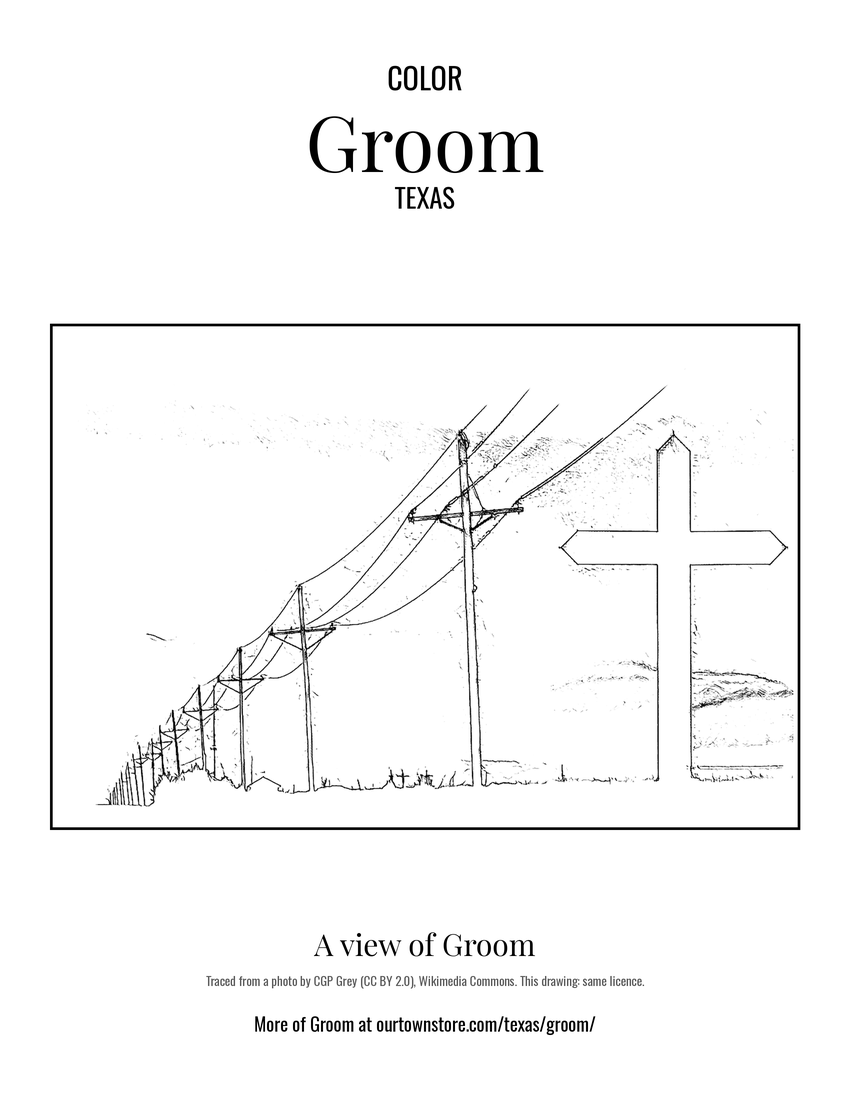
 A view of Groom
 A view of Groom
 A view of Groom