The history of Fulshear is closely intertwined with the historical events leading up to Texas Independence and eventual statehood within the United States of America. The small agricultural community traces its origins to the arrival of Churchill Fulshear, one of Stephen F. Austin's original Old Three Hundred. He moved from Tennessee to Texas in the summer of 1824 with his wife, Betsy Summers, daughter, Mary, and three sons, Benjamin, Graves, and Churchill Fulshear, Jr.
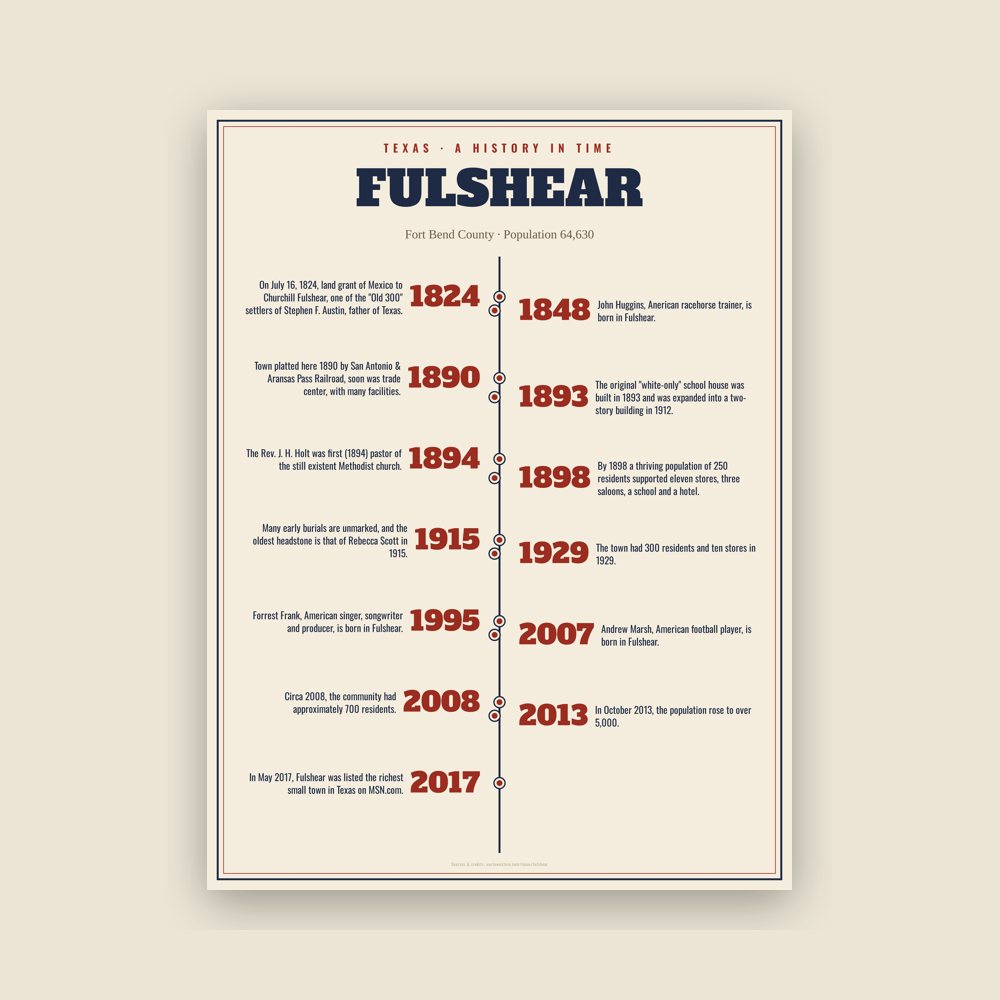
As a man with considerable wealth and property, Churchill Fulshear Sr. obtained on July 16, 1824, a land grant from the Mexican government and Stephen F. Austin that allowed him and his family to settle in Austin's colony. He established a slave plantation that raised cotton, corn, rice, pecans and livestock. Churchill Fulshear Sr. died on January 18, 1831, with the plantation ownership passed onto his youngest son, Churchill Fulshear Jr., who added a cotton gin and flour mill which flourished well into the late 1880s.
During the Texas Revolution, Churchill Jr. and his two brothers, Graves and Benjamin, served as scouts for the Texan army as the Mexican army under the command of Antonio Lopez de Santa Anna pursued Sam Houston's army and civilians who fled after Santa Anna's victory at the 1836 Battle of the Alamo. The Fulshear area was on the route of both the Mexicans and the Texan soldiers. Churchill and his brothers scouted Santa Anna's army as they crossed the Brazos River near their plantation on April 14, 1836.
According to one account, the Texan army trying to prevent Santa Anna and the Mexican army from crossing the Brazos River camped on the Fulshear plantation. They retreated when they learned that:1,500 Mexican soldiers had crossed nearby at Thompson's Ferry, they, too, had to retreat. Randolph Foster was one of the Old 300 settlers whose plantation was in the John Foster grant that lay between what is now FM 359 and FM 723 just south of Fulshear. He was a member of Martin's Company and, from William Harris Wharton's account, we ascertain that the Company "camped on the night of the 11th at Churchill Fulshear's." Churchill Fulshear's plantation lay on the north side of the Brazos River in what is now Fulshear township.
Read the full history
Texas Independence to the early 20th century
In the years after Texas Independence, Churchill Jr. expanded the plantation and commercial interests. This included a horse race track called "Churchill Downs" (not the same as the present-day Churchill Downs, which is in Kentucky) that he operated during the 1850s to 1870s in Pittsville, located several miles north of Fulsher. One of the most famous horses bred by Churchill Jr. was "Get-A-Way" (known as "Old Get"), which raced on numerous tracks throughout the United States and Europe. He also actively sold and purchased real estate, including the 654 acres sold to John Randon on May 10, 1844, for $4,000.
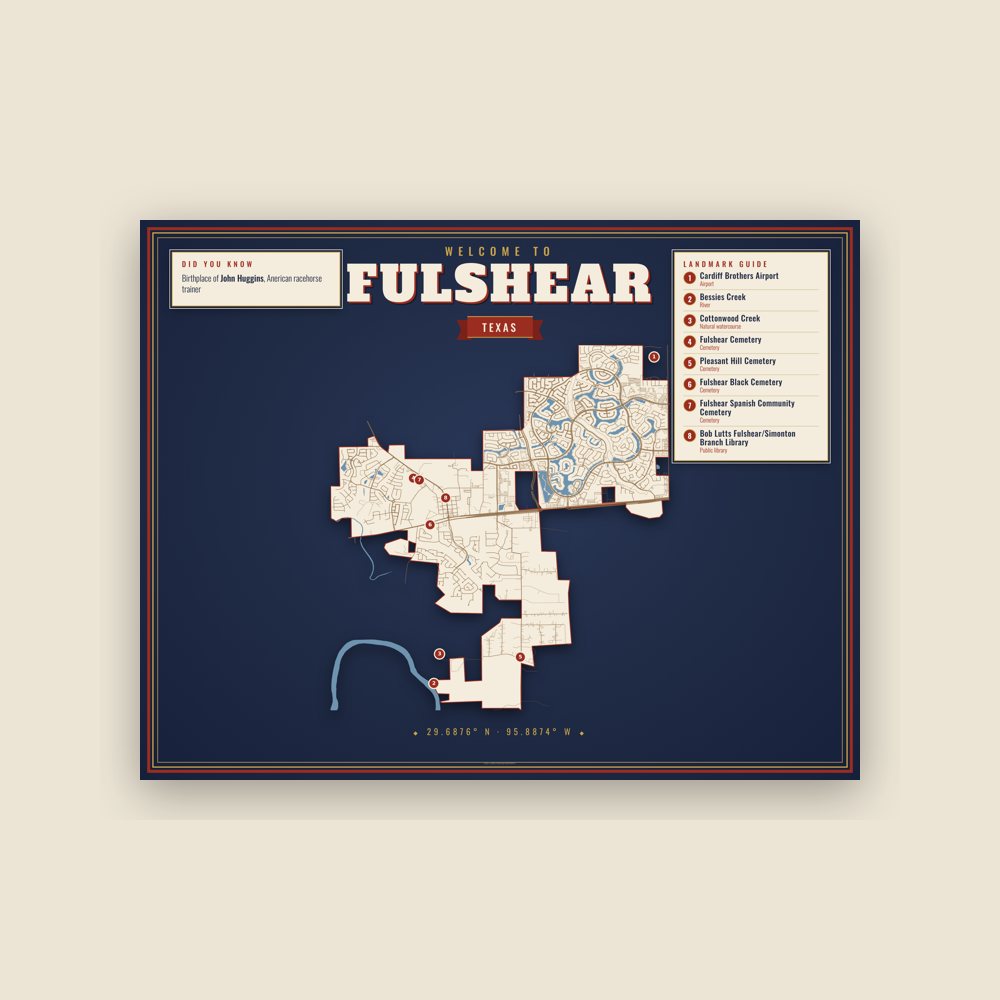
The old tombstones in the Fulshear Cemetery (previously called Union Chapel Cemetery Grounds) identify the names of some of the original pioneers who settled the Fulshear area: Andrews, Avery, Avis, Bains, Bond, Boone, Brasell, Bulwinkel, Cooper, Davis, Dozier, Edmonson, Everett, Gibson, Foster, Harris, Holmes, Hoskins, Huggins, Hunter, Jager, Kemp, Lovelace, Mayes, McElwee, McJunkin, McLeod, Miller, Nesbitt, Parker, Patton, Quinn, Rowles, Sass, Shieve, Sheriff, Simonton, Sparks, Thompson, Utley, Wade, Walker, Wilson, Wimberly, and Winner.Mention must be made of several men who made outstanding contributions to the Fulshear community and who are buried in this cemetery. They are: (l) Randolph Foster - an "Old 300" Settler of the area, (2) Rev. John Patton - the first Methodist Minister connected to Union Chappel, and (3) Dr. Robert Locke Harris - a Confederate War Surgeon who visited after the War in 1865 and remained to become a prominent doctor of the area.A significant historical development occurred in 1888 when Churchill Jr. granted the San Antonio and Aransas Pass (SA & AP) Railroad (SA&AP) the right of way through his plantation. The town of Fulshear grew around the railroad in the 1890s, a period that also saw the demise of other local communities which, like Pittsville, had rejected the SA & AP Railroad the right of way on their lands.
Churchill Fulshear Jr. died in 1892. In the same year, the Southern Pacific Railroad gained ownership of the SA & AP Railroad. In the decades following, the town established a public school district (1893), a Methodist church (1894) and business establishments that included a barber shop, doctor, drug store, blacksmith, saloon, hotel, and post office.
On July 16, 1824, land grant of Mexico to Churchill Fulshear, one of the "Old 300" settlers of Stephen F. Austin, father of Texas. Churchill Fulshear, Jr., veteran of Texas War for Independence, built 4-story brick mansion in the 1850s, bred and raced horses at Churchill Downs (at Pittsville, 2 mi. N). His pupil, John Huggins, won world fame by training first American horse to win the English Derby. Town platted here 1890 by San Antonio & Aransas Pass Railroad, soon was trade center, with many facilities. The Rev. J. H. Holt was first (1894) pastor of the still existent Methodist church.
American Civil War, slavery and sharecropping
While few historical records exist on the American Civil War and the people of Fulshear, there are accounts that local landowners, surgeons, and commercial business men actively supported and enrolled in the Confederate Army during the Civil War.
After the abolition of slavery with defeat of the Confederacy, many of the emancipated slaves became sharecroppers, which meant they rented land to farm it. Many grew cotton and potatoes, and supplemented their livelihood by raising chickens, eggs, and pigs as well as helping other farmers pick beans, potatoes, and peanuts. Many of these sharecroppers are buried in the Fulshear Black Cemetery. In 1995, Fulshear Mayor Viola Randle won a class-action lawsuit to legally define the Fulshear Black Cemetery as belonging to the Fulshear Black Cemetery Association and to prevent an attempt by a local property owner to restrict more burials in the cemetery.
The Spanish Cemetery, which was often referred to as the "Catholic Cemetery," is just south of the Fulshear Cemetery and has an estimated 300 grave sites.
Like elsewhere in Texas and the American South, the schools segregated based on race. The original "white-only" school house was built in 1893 and was expanded into a two-story building in 1912. The segregated school for Mexican students was located nearby. Two "black-only" school houses were built in rural areas several miles to the south and northwest of town. These Fulshear schools were merged into the Lamar Consolidated Independent School District in 1948.
Boom and bust, 1900s–1970s
By 1898 a thriving population of 250 residents supported eleven stores, three saloons, a school and a hotel. A block of businesses was destroyed by a fire in 1910 but the town recovered quickly and soon downtown consisted of several general stores, a drug store, a doctor's office, a post office, a millinery shop, three churches, an undertaker's supply store, a depot, a grist mill, a cotton gin, a blacksmith shop, a barber shop, six saloons, four schools, a boarding house, a hotel and a local telephone system. On Saturdays, when the local hands were paid, Fulshear was so busy that residents complained that the sidewalks were too crowded to walk on. The town had 300 residents and ten stores in 1929. But the population fell to 100 in 1933, around the time that the Fulshear plantation house was torn down. The Depression and a changed lifestyle caused residents to leave Fulshear. Fulshear did her share toward the war effort during WWII. Not only did she contribute men and women for the armed forces and war industries but an airplane lookout station was also manned daily on the roof of one of the brick buildings.Fulshear remained a rural agricultural town with population ranging from 300 to 700 into the 1970s.
Incorporated city, 1977–present
The city was incorporated in 1977. The town served as a marketing center for locally produced rice, cotton, soybeans, corn, poultry, sorghum, pecan, horses and cattle. Growth in Fulshear exploded in the 2000s, due to its proximity to Houston. Circa 2008, the community had approximately 700 residents. In October 2013, the population rose to over 5,000. By that time, traffic was commonplace while historically it had not been. In May 2017, Fulshear was listed the richest small town in Texas on MSN.com.