Since 1911
A short history of Tellico Plains
The area along the Tellico River was inhabited for thousands of years by indigenous peoples. The historic Muscogee settled here, before moving further south. In the late 18th century, the Cherokee settled in this area, displaced from the east and north by European colonial encroachment.
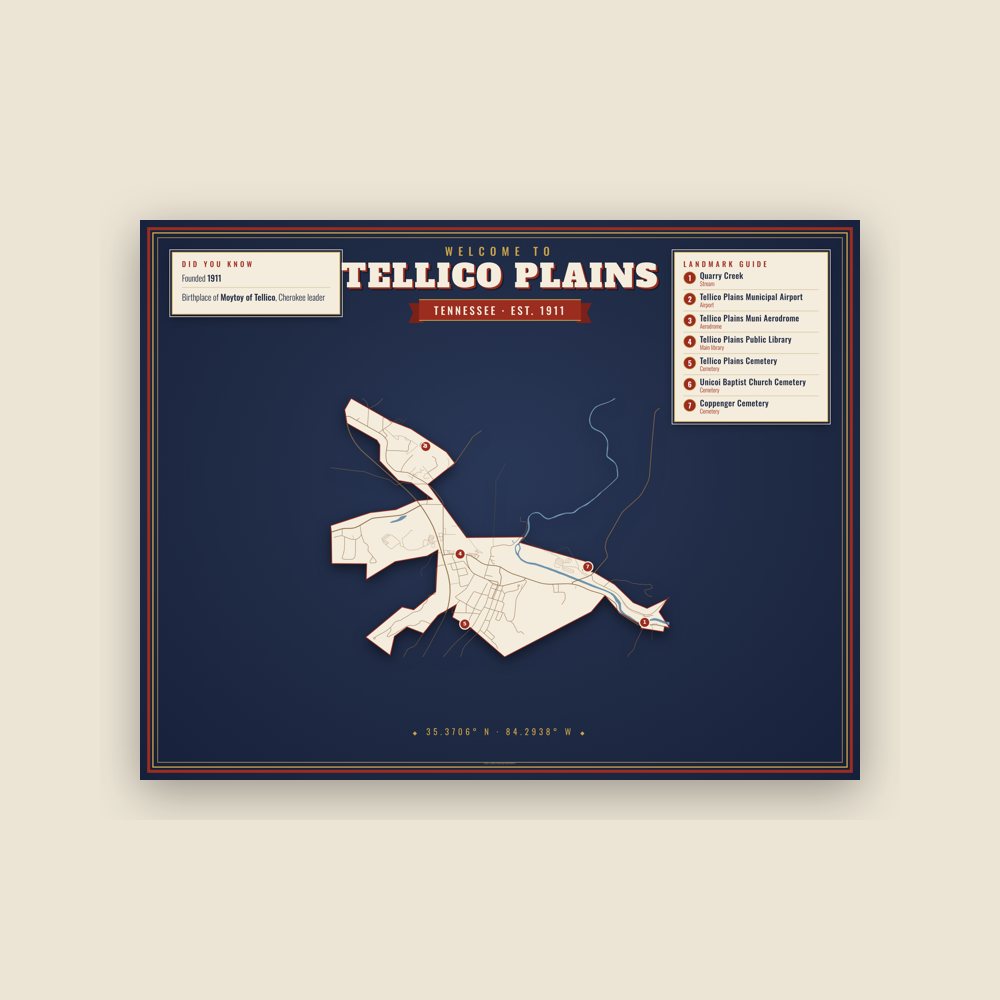
Tellico Plains occupies the former site of the Cherokee town of Great Tellico, which was one of the more important towns of the Overhill Cherokee during the late 18th century and before Indian Removal of the 1830s. Two important Native American trails met at Great Tellico, the Trading Path and the Warrior Path, which connected farflung communities.
European Americans moved into the area and developed the land for agriculture, chiefly subsistence farming. During the 1840s, Elisha Johnson, a former mayor of Rochester, New York, purchased a plantation here and built the Tellico River Mansion on his property. With his brother Ebenezer, the former mayor of Buffalo, New York, he purchased the Tellico Iron and Manufacturing Company.
During the Civil War, the Confederacy commandeered the iron works for production of munitions. General William Sherman's Union Army soldiers destroyed the Tellico Iron Works. Sherman pardoned Elisha Johnson for his part in supplying the Confederates because of Johnson's northern birth and sympathies. Johnson returned to the North, settling in Ithaca, New York, where he died in 1866.
The nearby Coker Creek was the site of a minor gold rush during the late 1800s. The small crossroads town of Coker Creek has a gold-panning tourist attraction. Visitors can rent pans and receive professional instructions from the proprietor of the souvenir shop. Visitors can also explore the old gold mines in the surrounding hills, although the mines are in a state of disrepair. Commercial gold mining continues on at least one private plot located slightly to the southwest of the tourist attraction.
In the late 19th and early 20th centuries, Tellico Plains became the base of operations for the Babcock Lumber Company, which ran logging operations throughout the Tellico River basin. When it finished clearcutting, it sold its land to the US Forest Service. It has worked for decades to restore the woods.
Tellico Plains is home to the Charles Hall Museum. The town is also the eastern terminus of the Trans America Trail, a popular OHV route to Oregon and the Pacific Ocean.
Adapted (trimmed) from the Wikipedia article Tellico Plains, Tennessee, revision 1384015898 by its contributors, licensed CC BY-SA 4.0.