Since 1820
A short history of Hickory Valley
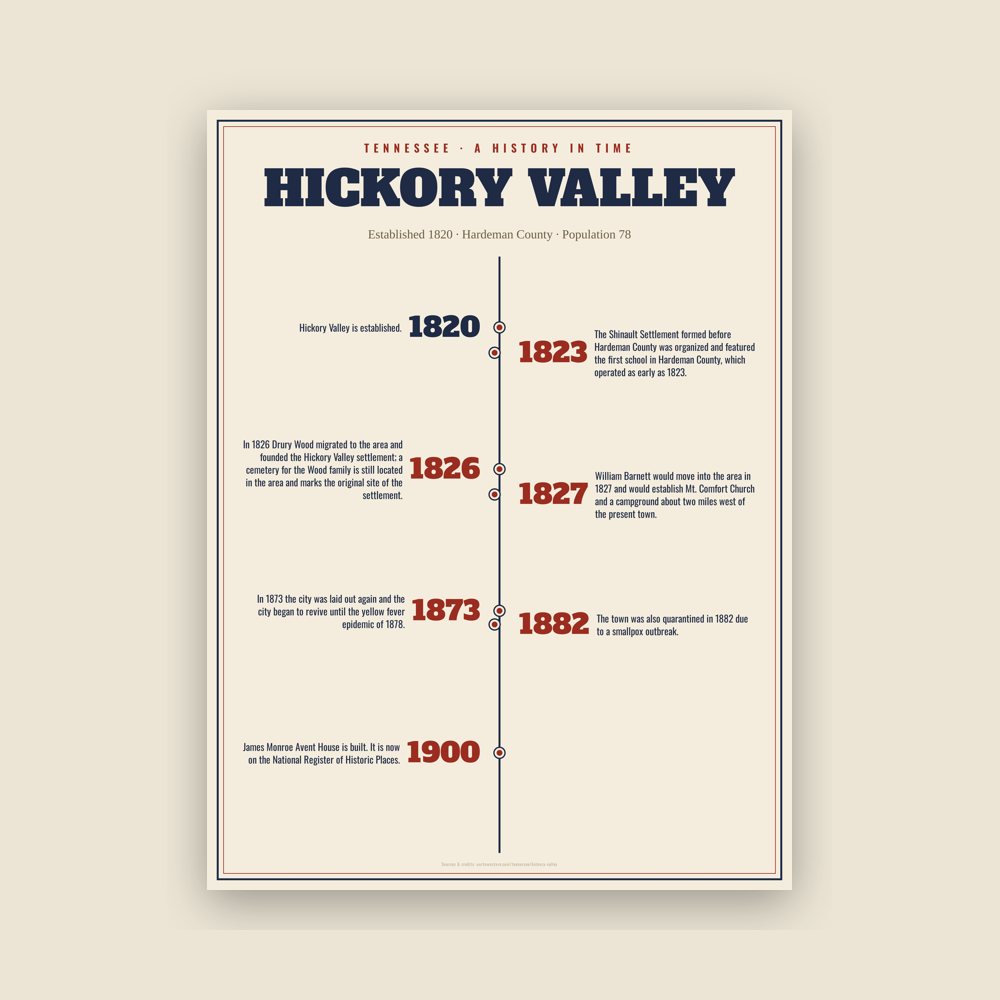
Hickory Valley's origin dates back to the blending of three independent pioneer settlements in the area that were founded by three men: William Shinault in 1820, Drury Wood in 1826 and William Barnett in 1827. The Shinault Settlement formed before Hardeman County was organized and featured the first school in Hardeman County, which operated as early as 1823. The main buildings of the settlement were located one mile southwest of the present town and a former Indian trail and the historical Boliver-LaGrange Road are still visible in some places south of Hickory Valley. In 1826 Drury Wood migrated to the area and founded the Hickory Valley settlement; a cemetery for the Wood family is still located in the area and marks the original site of the settlement. William Barnett would move into the area in 1827 and would establish Mt. Comfort Church and a campground about two miles west of the present town. The Chickasaw also resided in the area.
The construction of the railroad into the area in the 1850s brought a growth in population. A railroad levee that runs through the town is still visible, and is believed to have been built by slaves from a plantation owned by Darius Robinson. Railroad engineer Casey Jones was a frequenter of the town during his travels.
Hickory Valley was deeply affected by the Civil War. The railroad fell under the control of the Union Army after being abandoned by the Confederate Army. Skirmishes were fought in the area as well. In 1873 the city was laid out again and the city began to revive until the yellow fever epidemic of 1878. The town's population was described by the Bolivar Bulletin as "fleeing from the scourge". The town was also quarantined in 1882 due to a smallpox outbreak.
Adapted (trimmed) from the Wikipedia article Hickory Valley, Tennessee, revision 1378977599 by its contributors, licensed CC BY-SA 4.0.