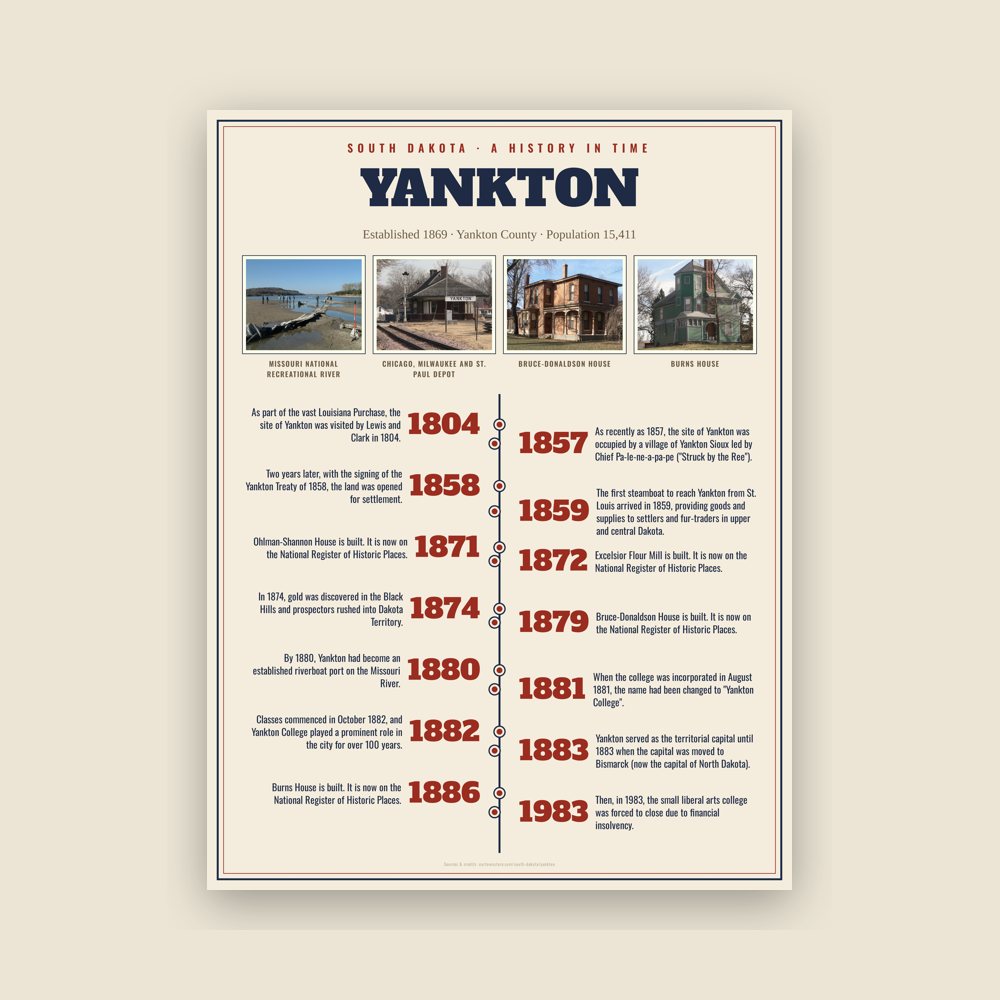
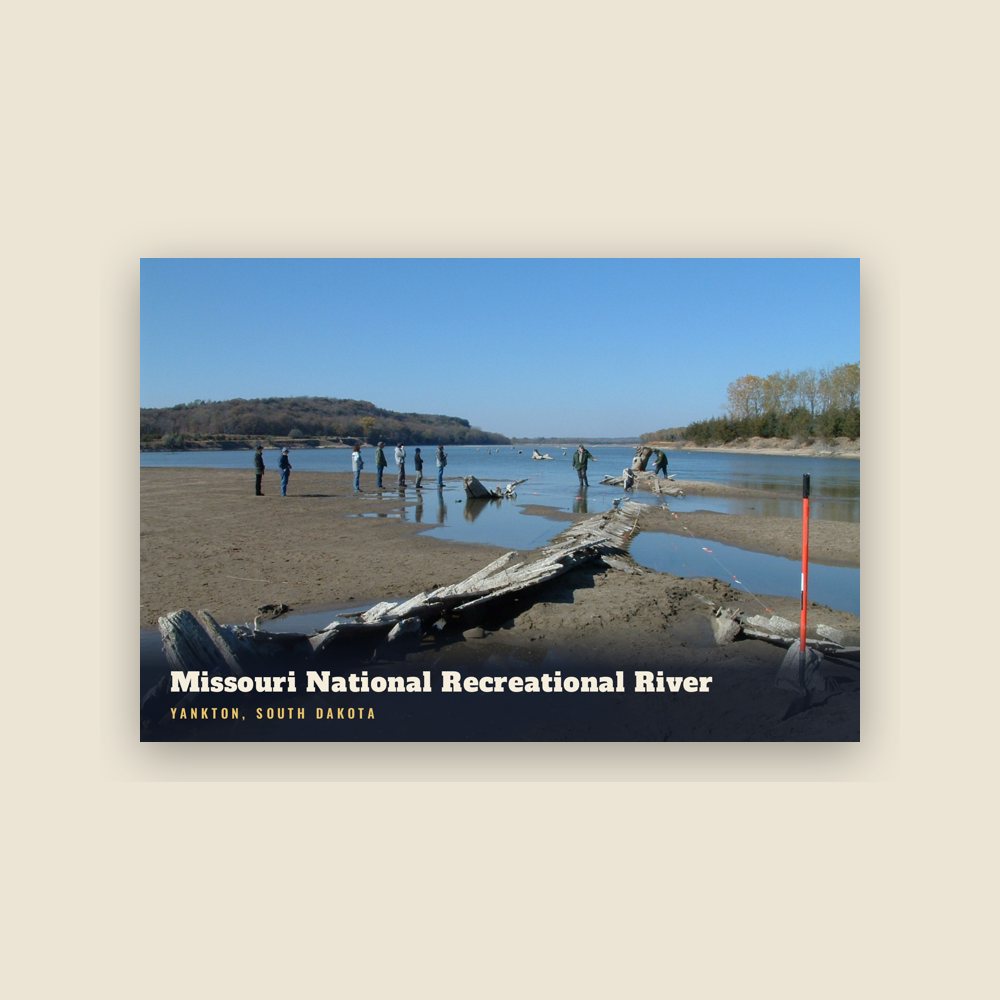
The site of Yankton was occupied by the Yankton Sioux (Dakota) prior to the arrival of European settlers. As part of the vast Louisiana Purchase, the site of Yankton was visited by Lewis and Clark in 1804. In the journals of the expedition, the explorers write of a meeting on August 30, 1804, with members of the Yankton Sioux Tribe on a Missouri River bluff known as Calumet Bluff. As recently as 1857, the site of Yankton was occupied by a village of Yankton Sioux led by Chief Pa-le-ne-a-pa-pe ("Struck by the Ree"). Two years later, with the signing of the Yankton Treaty of 1858, the land was opened for settlement. The city was founded where the small Rhine Creek (renamed Marne Creek in World War I) flowed into the Missouri River. The city grew as a stop for steamboats to take on fresh water and supplies, especially after steamboat traffic boomed when gold was discovered in the Black Hills.
Read the full history
Dakota territorial capital
With two days left in his term, President James Buchanan signed a law on March 2, 1861, creating the Dakota Territory. Yankton was designated as the territorial capital, and newly inaugurated President Abraham Lincoln appointed his personal physician, William A. Jayne of Springfield, Illinois, as the first territorial governor. The territorial capitol building, a plain, two-story wooden structure, was located at the intersection of Fourth and Capitol Streets; the original structure has been demolished, but a replica of the building has been constructed in Yankton's Riverside Park. Yankton served as the territorial capital until 1883 when the capital was moved to Bismarck (now the capital of North Dakota).
Yankton stockade
In response to the Dakota War of 1862 in western Minnesota, Governor Jayne issued a proclamation on August 30, 1862, requiring every male between the ages of 18 and 50 in every settlement in eastern Dakota, be formed into militias to protect against expected attacks from the Native Americans. In response, the Yankton militia built a stockade at the corner of Third Street and Broadway Avenue of approximately 200,000 square feet. Settlers from the surrounding area, and as far away as Sioux Falls and Bon Homme County, fled to Yankton to seek shelter in the structure.
Although roving bands of Native Americans did approach Yankton over the course of several weeks, no attack ensued, and the stockade was eventually abandoned and torn down. There is a historical marker at the site of the former stockade.
Among the most notable events that occurred in Yankton while capital, Jack McCall, murderer of Wild Bill Hickok in Deadwood on August 2, 1876, was tried in Yankton for Hickok's murder, found guilty, and was hanged on March 1, 1877, at the age of 24. His body is buried in a Yankton cemetery.
Yankton College
At the urging of the Reverend Joseph Ward of Yankton, the General Association of Congregational Churches in Dakota Territory voted in May 1881 to establish "Pilgrim College" in Yankton, which was to be the first private institution of higher learning in Dakota. When the college was incorporated in August 1881, the name had been changed to "Yankton College". Classes commenced in October 1882, and Yankton College played a prominent role in the city for over 100 years.
Then, in 1983, the small liberal arts college was forced to close due to financial insolvency. After remaining vacant for several years, the historic campus, which is listed on the National Register of Historic Places, was purchased by the United States Federal Bureau of Prisons for use as a minimum security prison. The Federal Prison Camp – Yankton houses approx 450 male inmates.
National Register of Historic Places