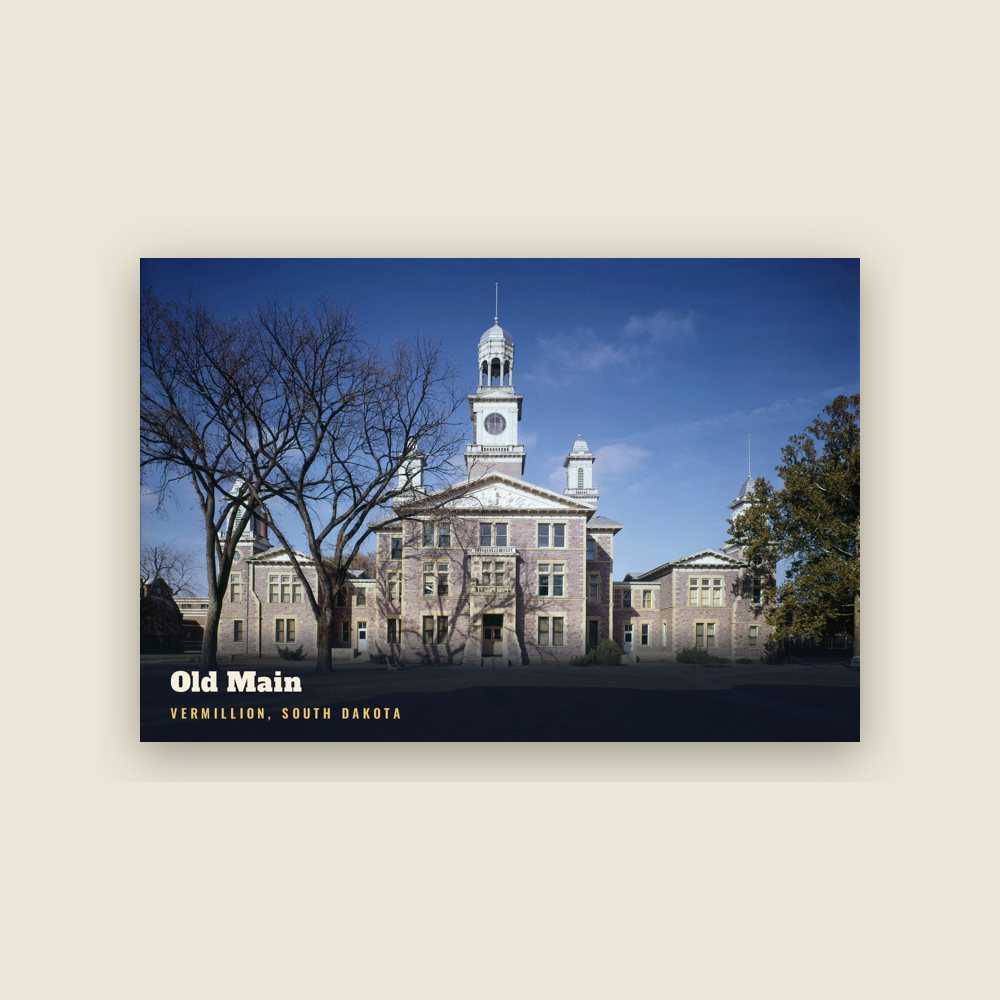
Since 1877
A short history of Vermillion
The area has been home to Native American tribes for centuries. In the late 1700s, the Sioux nations were driven from Minnesota to Dakota, and the Yankton Sioux cultivated corn and stored supplies near where Vermillion would be founded.
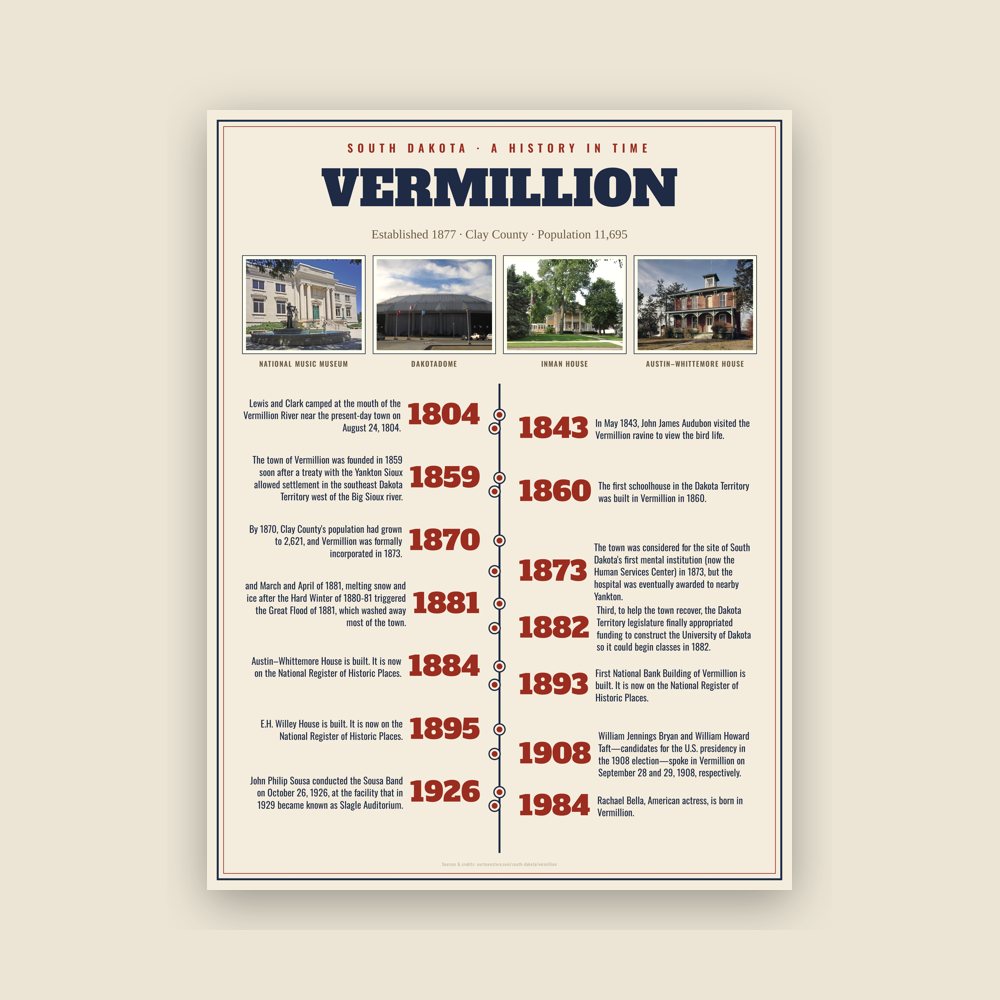
French fur traders came to the site in the late 18th century. Lewis and Clark camped at the mouth of the Vermillion River near the present-day town on August 24, 1804. The previous day, they had killed their first bison; the next day, they climbed Spirit Mound. By the 1820s the Missouri River had become a key route for fur traders and the Columbia Fur Company built a post near where the Vermillion River met the Missouri River's old channel just south of the bluffs. In May 1843, John James Audubon visited the Vermillion ravine to view the bird life.
The town of Vermillion was founded in 1859 soon after a treaty with the Yankton Sioux allowed settlement in the southeast Dakota Territory west of the Big Sioux river. The first schoolhouse in the Dakota Territory was built in Vermillion in 1860. In 1862, Vermillion residents lobbied to move the capital of the Dakota territories from Yankton to Vermillion, but instead the territorial legislature promised to put the territorial university there, though they did not provide the necessary funding. Over the next few years, Vermillion became the county seat of Clay County, was made headquarters of First Judicial District of the Dakota Territory, and was given a federal land office. By 1870, Clay County's population had grown to 2,621, and Vermillion was formally incorporated in 1873.
The town was considered for the site of South Dakota's first mental institution (now the Human Services Center) in 1873, but the hospital was eventually awarded to nearby Yankton.
In the 1870s, Vermillion's commerce was buoyed by military roads connecting Sioux City with Fort Randall including bridges crossing the Big Sioux, Vermillion, and James rivers, a telegraph line in 1870, a railroad stop for the Dakota Southern Railroad in 1872, wagon trains for the Black Hills Gold Rush, and a shift in the main channel of the Missouri River to the Dakota side in 1878.
and March and April of 1881, melting snow and ice after the Hard Winter of 1880-81 triggered the Great Flood of 1881, which washed away most of the town.
The flood transformed Vermillion in three ways. First, within a few weeks the residents voted to rebuild the town on top of the bluff. Second, the flooding shifted the Missouri river's flow to be several miles south of the town, reducing commerce from river traffic. Third, to help the town recover, the Dakota Territory legislature finally appropriated funding to construct the University of Dakota so it could begin classes in 1882.
William Jennings Bryan and William Howard Taft—candidates for the U.S. presidency in the 1908 election—spoke in Vermillion on September 28 and 29, 1908, respectively. Along with Eugene Chafin, they toured South Dakota by train, including stops in Mitchell, Tripp, Yankton, and Elk Point.
John Philip Sousa conducted the Sousa Band on October 26, 1926, at the facility that in 1929 became known as Slagle Auditorium.
Adapted (trimmed) from the Wikipedia article Vermillion, South Dakota, revision 1375076718 by its contributors, licensed CC BY-SA 4.0.