Since 1797
A short history of Sunbury
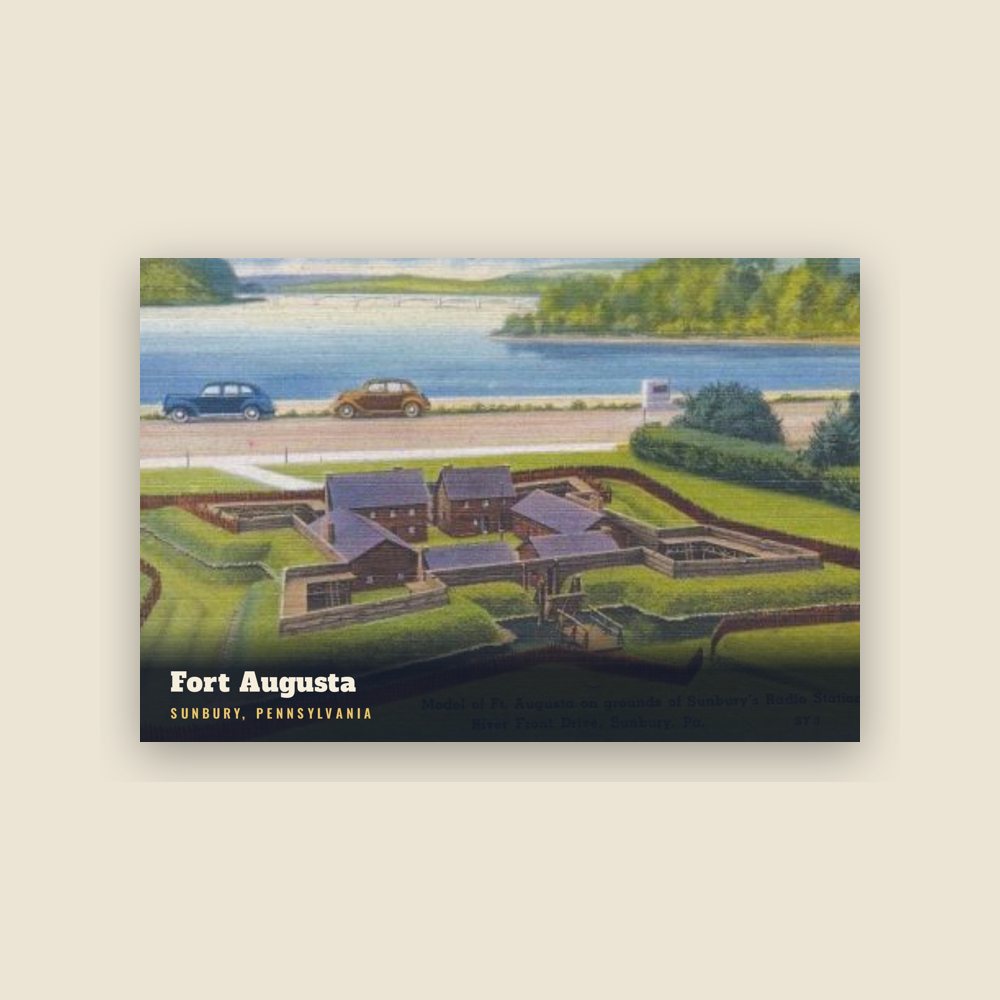
Shamokin and Fort Augusta
The first known settlers at the site of Sunbury were likely Shawnee migrants. A large population of Delaware Indians was also forcibly resettled there in the early 18th century after they lost rights to their land in the Walking Purchase. Canassatego of the Six Nations, enforcing the Walking Purchase on behalf of George Thomas, Deputy Governor of Pennsylvania, ordered the Delaware Indians to relocate to two places on the Susquehanna River, one of which was present-day Sunbury.
From 1727 to 1756, the village—known as Shamokin, not to be confused with the present-day city of Shamokin about 13 miles (21 km) to the east—was one of the largest and most influential Indian settlements in Pennsylvania. In 1745, Presbyterian missionary David Brainerd described the village as occupying both banks of the river and an island, and reported that it housed 300 Indians, about half of them Delawares and the remainder Senecas and Tutelos. The Oneida chief Shikellamy, who oversaw the region's tribes on behalf of the Six Nations, lived at Shamokin from about 1728 until his death there in 1748.
In 1754, much of the land west of the Susquehanna was transferred from the Six Nations to Pennsylvania at the Albany Congress. Shamokin, however, was not sold; the Six Nations reserved it "to settle such of our Nations as shall come to us from the Ohio or any others who shall deserve to be in our Alliance." According to Weslager, "the Pennsylvania authorities had no opposition to the Six Nations reserving Wyoming and Shamokin from the sale, since friendly Delawares, including Teedyuskung (also known as Teedyuscung) and his people living in those settlements—and any other Indians who might be placed there—constituted a buffer against Connecticut."
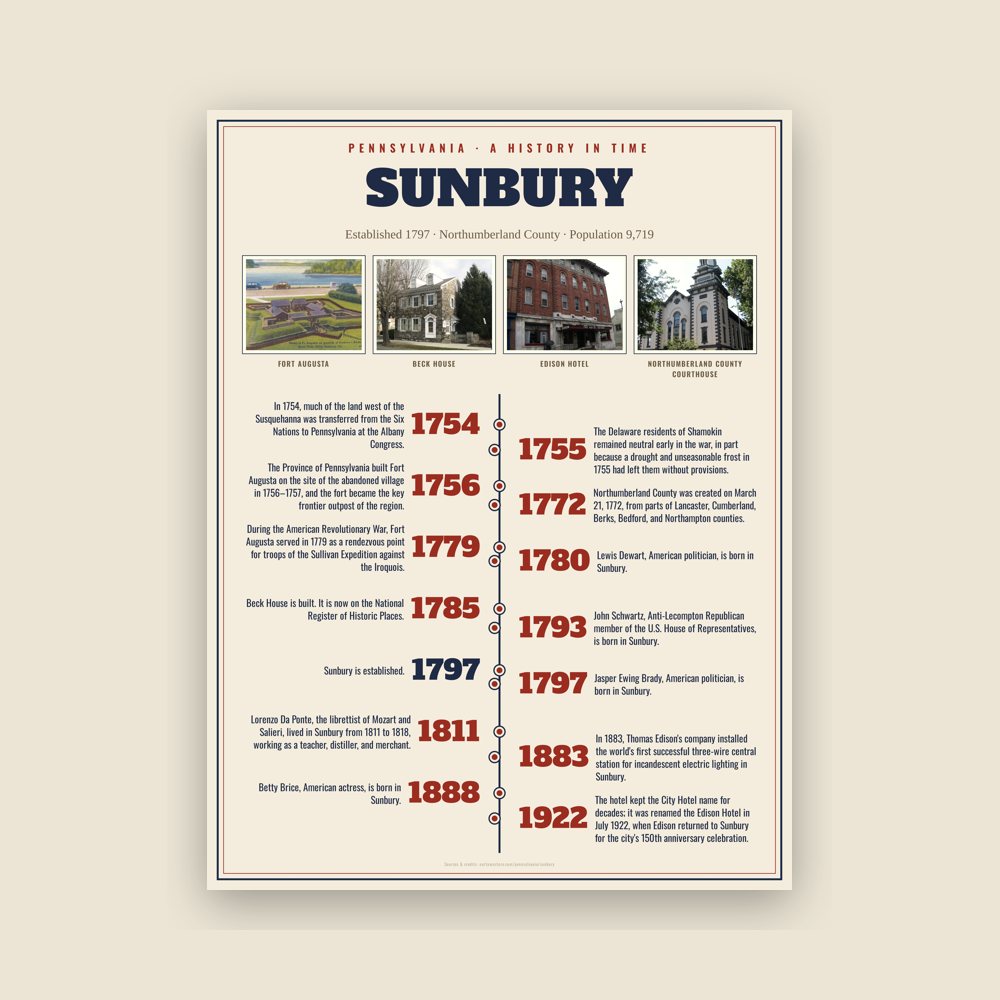
The French and Indian War brought fighting to much of the region. The Delaware residents of Shamokin remained neutral early in the war, in part because a drought and unseasonable frost in 1755 had left them without provisions. After the Gnadenhütten massacre in 1755, however, the Delawares at Shamokin joined the war against Pennsylvania and the English, and the village was abandoned in May 1756. The Province of Pennsylvania built Fort Augusta on the site of the abandoned village in 1756–1757, and the fort became the key frontier outpost of the region. The Bloody Spring, where a soldier from the fort's garrison is said to have been killed during the war, is a historic site from the era. During the American Revolutionary War, Fort Augusta served in 1779 as a rendezvous point for troops of the Sullivan Expedition against the Iroquois.
Read the full history
Founding and growth
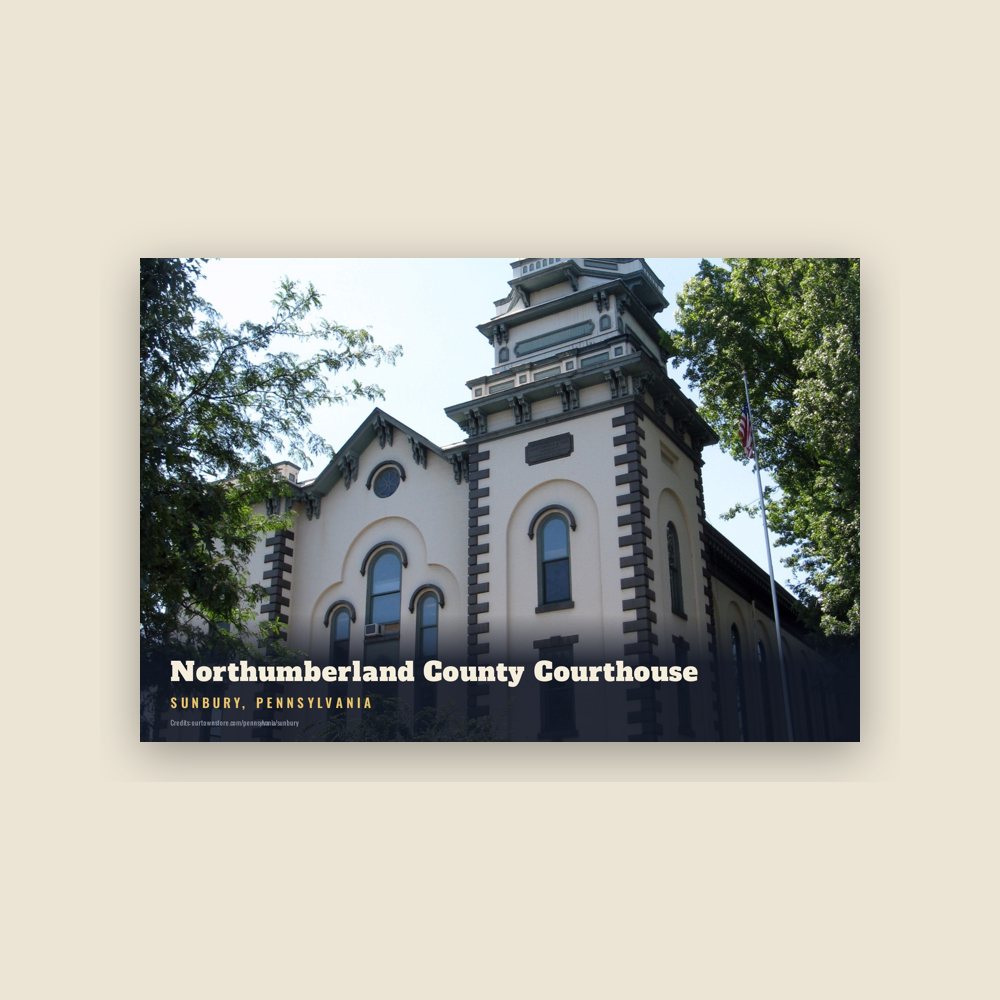
Northumberland County was created on March 21, 1772, from parts of Lancaster, Cumberland, Berks, Bedford, and Northampton counties. The town of Sunbury was laid out as the county seat later that year by Pennsylvania surveyor general John Lukens, assisted by William Maclay, and the present-day city identifies 1772 as the date of its establishment. It was named after Sunbury-on-Thames in England, which was then in the county of Middlesex. Sunbury was incorporated as a borough on March 24, 1797, and as a city on December 29, 1920.
Lorenzo Da Ponte, the librettist of Mozart and Salieri, lived in Sunbury from 1811 to 1818, working as a teacher, distiller, and merchant.
During the 19th century, Sunbury grew as a transportation and industrial center. The Danville and Pottsville Railroad, a horse-powered line opened between Sunbury and Paxinos in 1835, brought anthracite coal to the riverfront, where it was loaded onto canal boats for shipment to Philadelphia and Baltimore. Later in the century the city became a busy railroad junction, and its industries came to include textiles, metal products, and building materials.
Edison and the first three-wire electric station
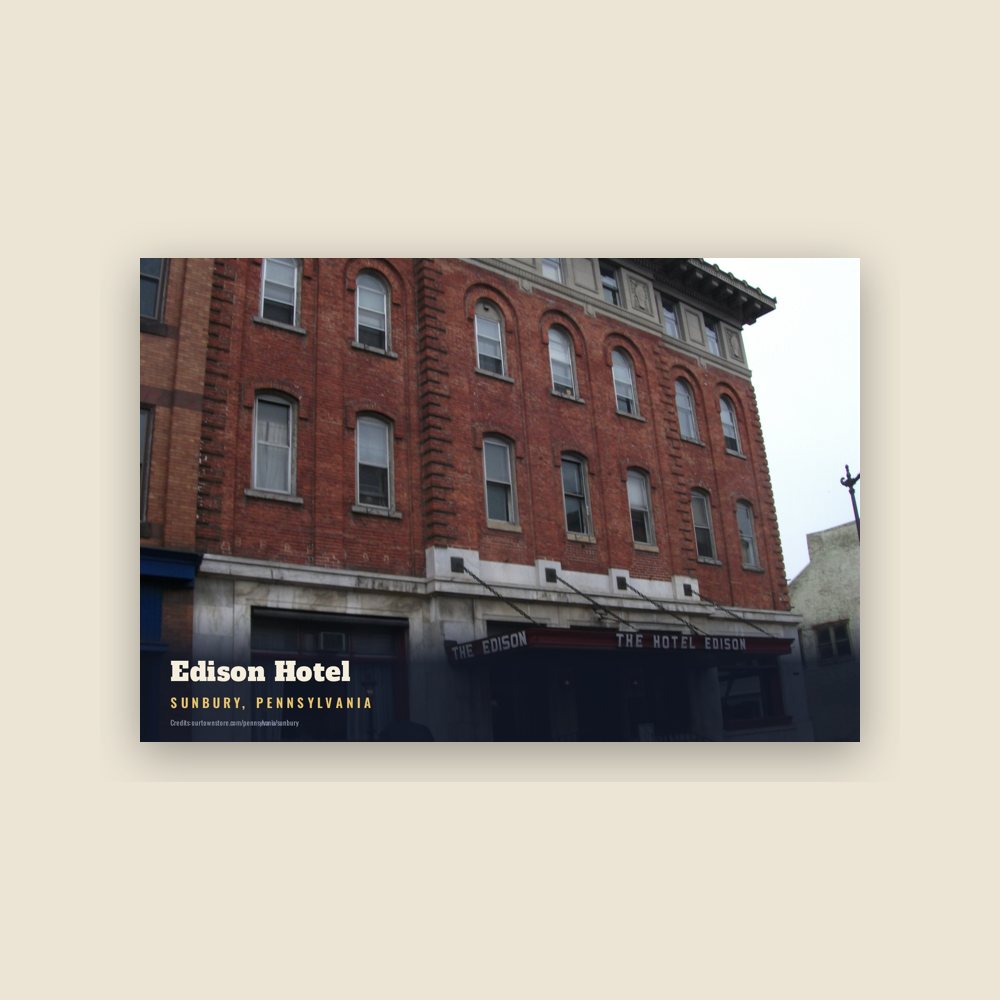
In 1883, Thomas Edison's company installed the world's first successful three-wire central station for incandescent electric lighting in Sunbury. On July 4, 1883, the City Hotel became the first building illuminated by the new system. The hotel kept the City Hotel name for decades; it was renamed the Edison Hotel in July 1922, when Edison returned to Sunbury for the city's 150th anniversary celebration.
Flooding and the floodwall
An extensive floodwall protection system was designed and built along the city's riverfront by the United States Army Corps of Engineers in 1951, and additional height was added to the wall in 2003. The system has protected the city from more than a dozen major flood events. In June 1972, floodwaters from Hurricane Agnes crested at 35.8 feet (10.9 m) at Sunbury, two feet higher than the record crest of 1936, but the wall held back the water, and residents wrote messages of gratitude on it afterward.
Adapted (trimmed) from the Wikipedia article Sunbury, Pennsylvania, revision 1377945788 by its contributors, licensed CC BY-SA 4.0.