A short history of Gladstone
Clackamas Indians
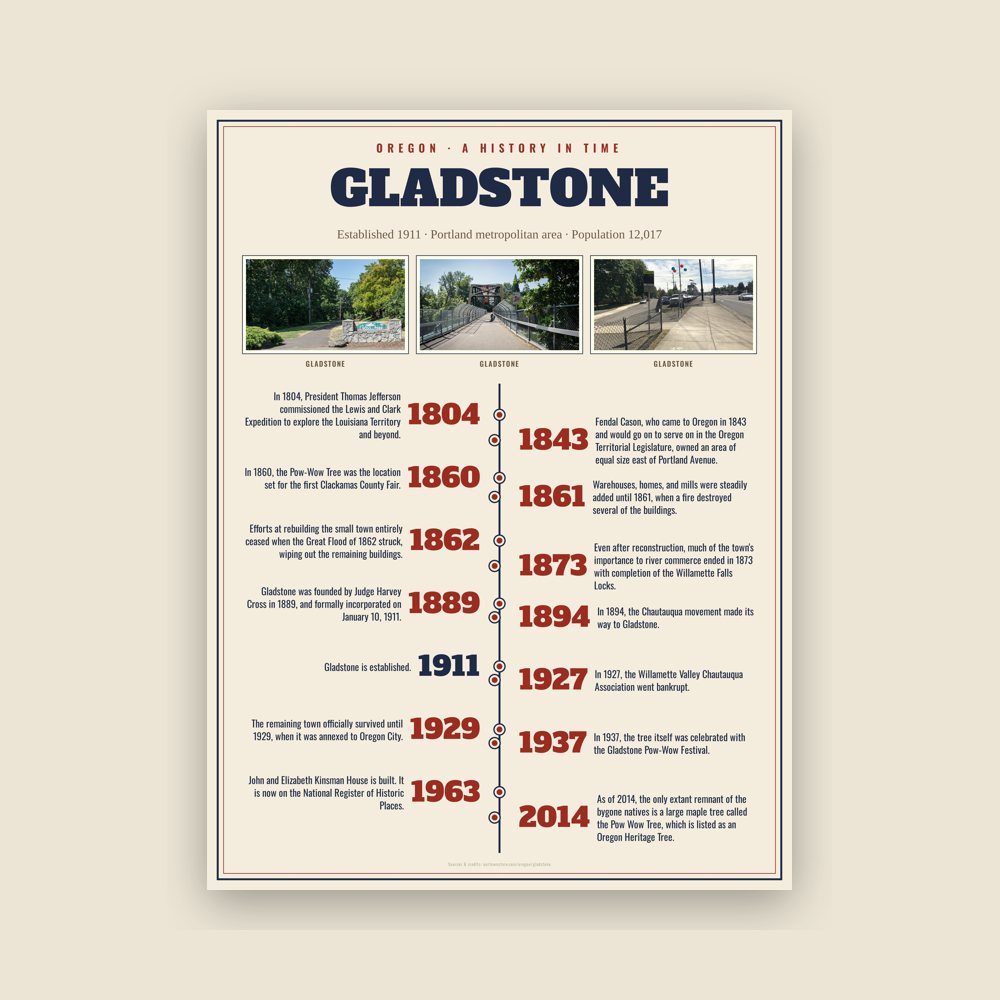
In 1804, President Thomas Jefferson commissioned the Lewis and Clark Expedition to explore the Louisiana Territory and beyond. Although the expedition passed only near the Gladstone – Oregon City locality on their way to and from the Pacific Ocean, via the Columbia River, natives such as the Kalapuya and the Clackamas people told them about the area.
In the subsequent years, successive waves of explorers and traders would introduce epidemics of cholera and smallpox, which would take a heavy toll on the native peoples and contributed to a substantial reduction in population.
As Oregon City was founded and European settlers began moving to the area, they petitioned their governments to remove the local natives from the land, so that the settlers could use it for farming and housing. The government allocated a reservation for the natives and re-appropriated Gladstone for redevelopment.
As of 2014, the only extant remnant of the bygone natives is a large maple tree called the Pow Wow Tree, which is listed as an Oregon Heritage Tree. The tree still stands at Clackamas Boulevard, and is said to have marked the place where the different native tribes, mainly Clackamas and Multnomahs, met to make trading agreements, settle community affairs, and conduct wedding ceremonies. In 1860, the Pow-Wow Tree was the location set for the first Clackamas County Fair. The following year, it was used as a parade ring for the first Oregon State Fair and marked the entrance. In 1937, the tree itself was celebrated with the Gladstone Pow-Wow Festival.
Read the full history
Early homesteaders
The earliest homesteads in the area were recipients of the Donation Land Claim Act. The Cason and the Rinearson families were the first settlers to receive their donation land claims in Gladstone. Peter M. Rinearson and his family owned the land between Jennings Lodge and the Clackamas River, and between the Willamette River and Portland Avenue. Fendal Cason, who came to Oregon in 1843 and would go on to serve on in the Oregon Territorial Legislature, owned an area of equal size east of Portland Avenue.
Unsuccessful early townships
Before Gladstone was formally founded, several small settlements were established in its vicinity. However, due to various natural disasters, such as fires and floods, few survived to become incorporated cities of today.
One such community was Linn City (originally named Robin's Nest). Settled in 1843 by Robert Moore, Robert himself built four flour and lumber mills along the banks of the Willamette. Warehouses, homes, and mills were steadily added until 1861, when a fire destroyed several of the buildings. Efforts at rebuilding the small town entirely ceased when the Great Flood of 1862 struck, wiping out the remaining buildings.
Another such ill-fated settlement was Canemah, located near the Willamette Falls. Canemah prospered until 1861, when the same great flood swept most of the town over the falls. Even after reconstruction, much of the town's importance to river commerce ended in 1873 with completion of the Willamette Falls Locks. Ships no longer needed to dock and unload goods and passengers for portage around the falls. The remaining town officially survived until 1929, when it was annexed to Oregon City.
Founding
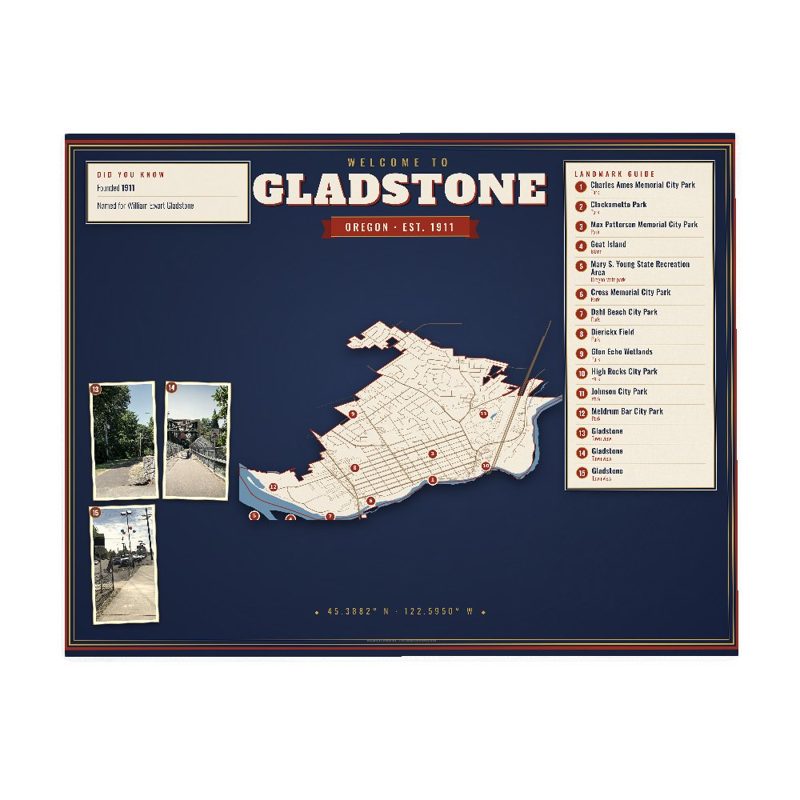
Gladstone was founded by Judge Harvey Cross in 1889, and formally incorporated on January 10, 1911. It was named after the UK Prime Minister William Ewart Gladstone.
Judge Cross laid out the city's first streets. Cross' home was built in the late 1840s by Fendal Cason, and Cross purchased it in 1862. The Cason-Cross House later became Cochran Mortuary. Currently, Mr. Rooter, a plumbing service, occupies the space. There is also a small park named after Cross, located at the same place one of the Indian tribes made its camp.
Chautauqua movement
In 1894, the Chautauqua movement made its way to Gladstone. Judge Cross established a fifty-year lease of Gladstone Park for this event after he was convinced by Oregon City author Eva Emery Dye that doing so would be a boon to the city and its people. Beginning on July 24–26, 1894, the newly formed Willamette Valley Chautauqua Association held an annual summer assembly that offered performances, lectures, and concerts. This event would recur annually, until Gladstone's Chautauqua Park grew to be the third-largest permanent Chautauqua assembly park in the United States.
In 1896, William Jennings Bryan drew a crowd of 6,000 to Gladstone's then 78-acre (32 ha) Chautauqua park to hear him give his popular lecture "The Prince of Peace", which stressed that Christian theology, through both individual and group morality, was a solid foundation for peace and equality.
With the advent of radio, improved transportation and the appearance of traveling vaudeville acts in Portland, attendance at the Chautauqua began to dwindle. In 1927, the Willamette Valley Chautauqua Association went bankrupt. Judge Cross died on August 7, 1927, and shortly thereafter, Gladstone Park, including its buildings and Chautauqua Lake, were sold to the Western Oregon Conference of Seventh-day Adventists.
Adapted (trimmed) from the Wikipedia article Gladstone, Oregon, revision 1373906118 by its contributors, licensed CC BY-SA 4.0.
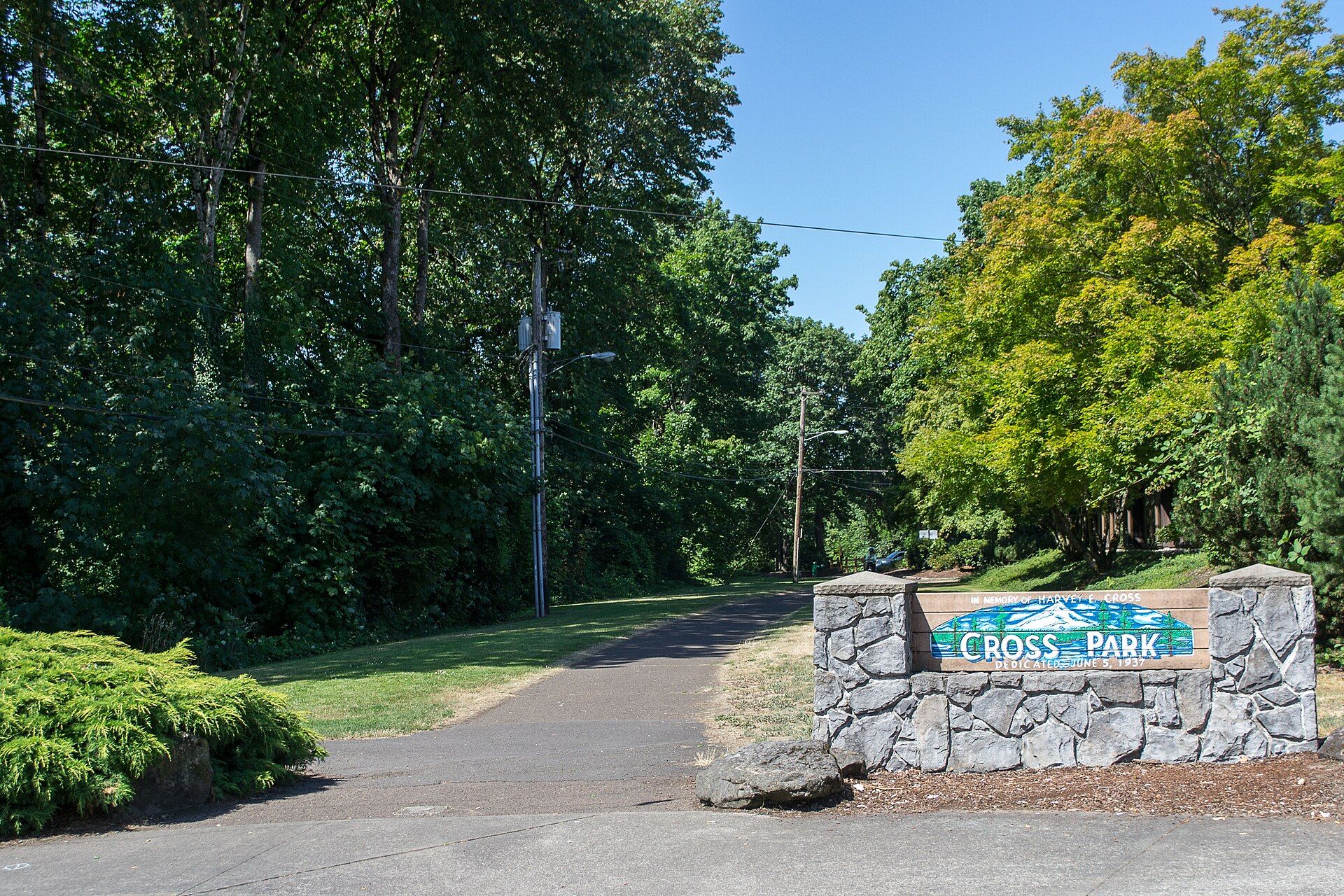
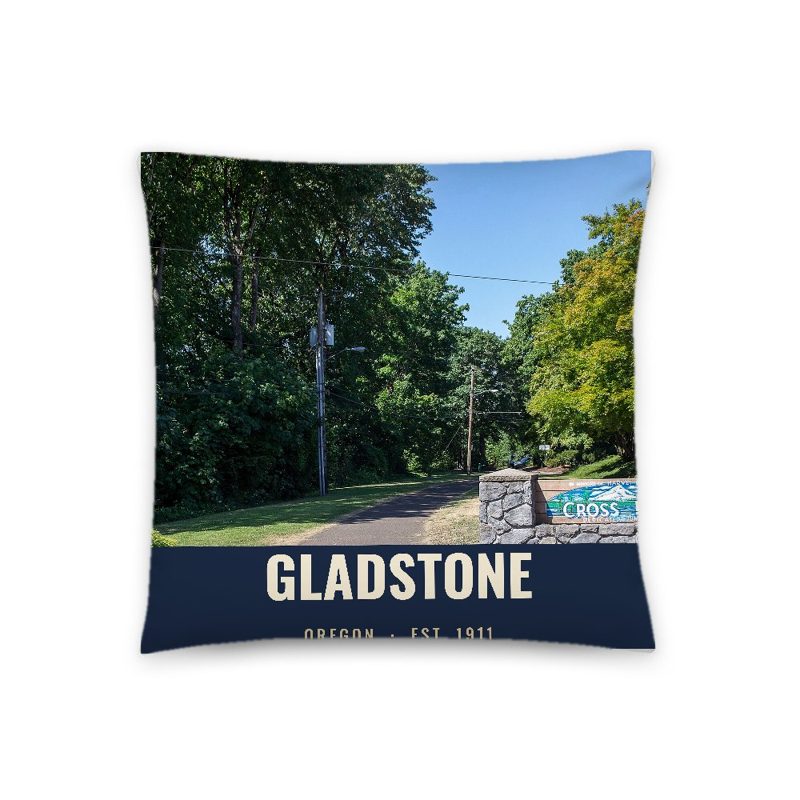
 A view of Gladstone
 A view of Gladstone
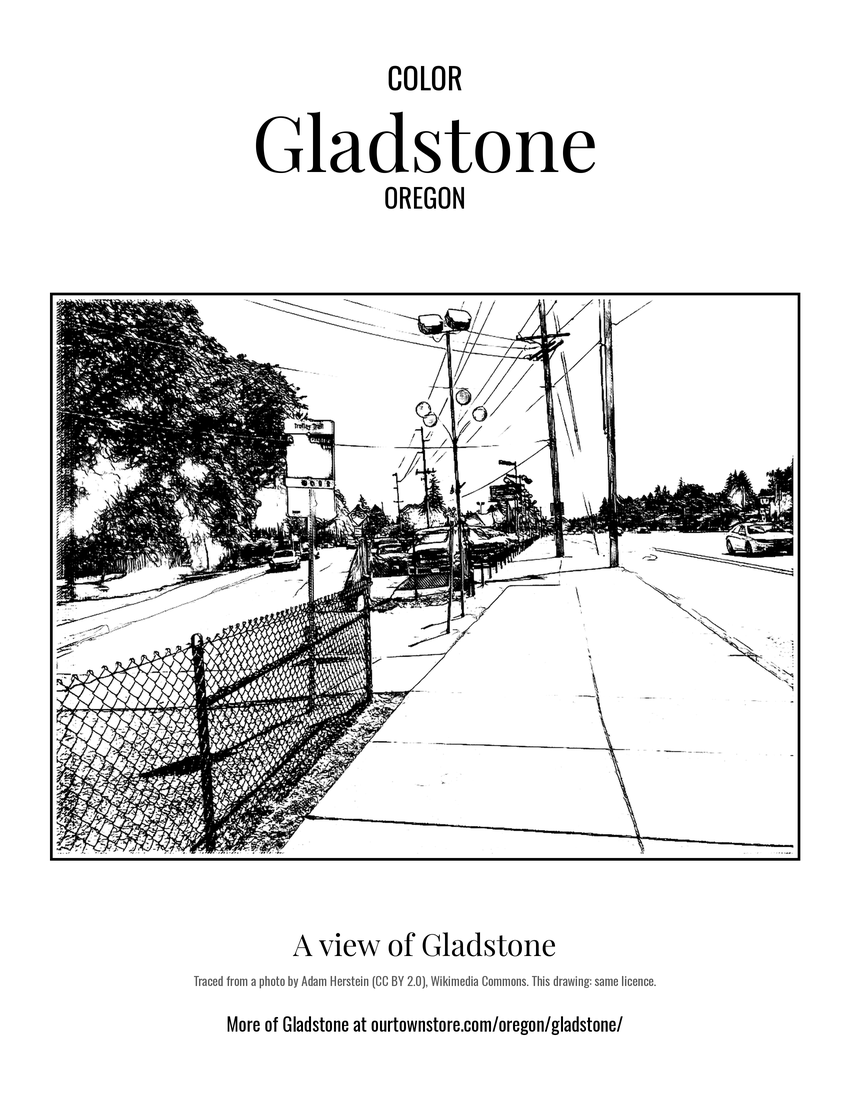 A view of Gladstone