A short history of Spiro
In 1895 and 1896, the Kansas City, Pittsburg and Gulf Railroad (later owned by the Kansas City Southern Railroad) established a station at the present site of Spiro, which connected the area to the city of Fort Smith, Arkansas. This railroad access attracted residents from the nearby town of Skullyville, and Spiro soon developed as the principal town in this area. The town population was 543 in 1900.
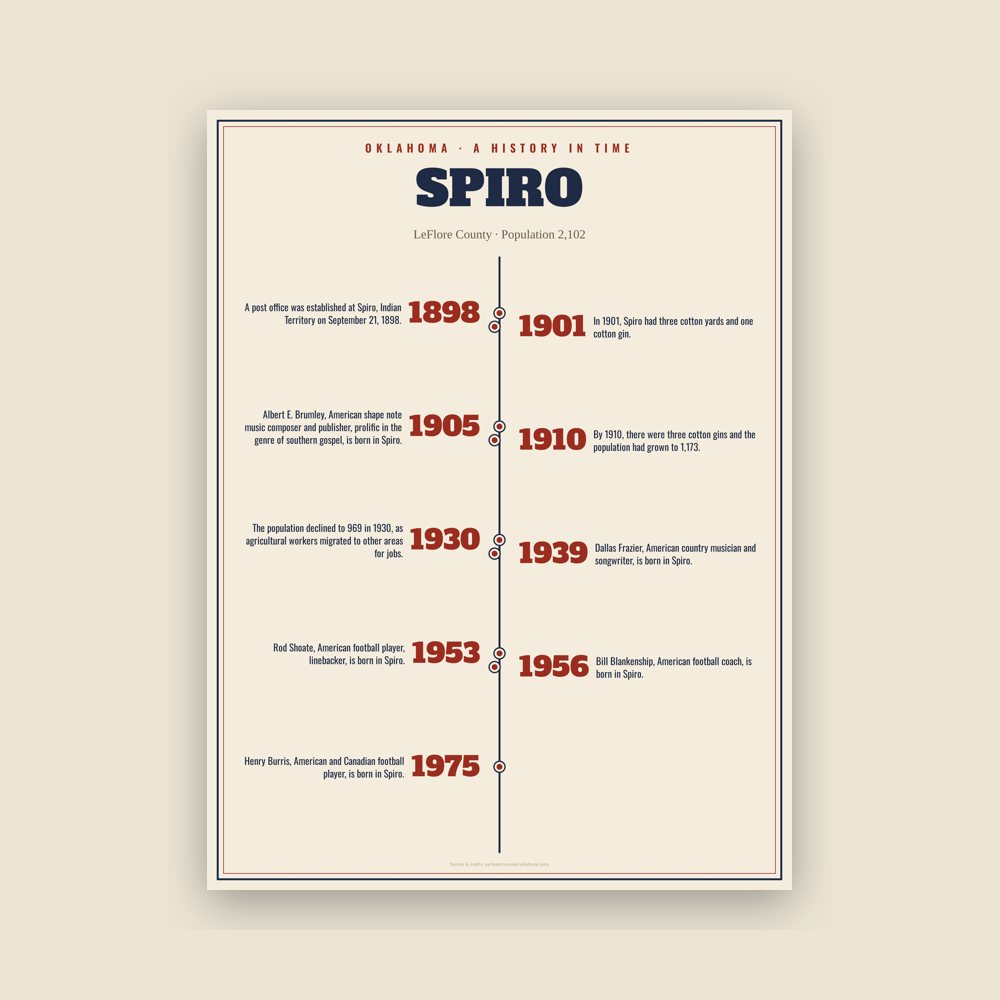
A post office was established at Spiro, Indian Territory on September 21, 1898. At the time of its founding, Spiro was located in Skullyville County, a part of the Moshulatubbee District of the Choctaw Nation.
Several accounts differ as to how the post office was named. One claims that Spiro was the maiden name of the first postmistress. Another claims it was the maiden name of the mother of a Fort Smith banker. According to the Oklahoma Historical Society, Spiro was named after Celia Spiro, wife of an Oklahoma banker, Iser H Nakdimen. He founded the City National Bank in Ft. Smith, Arkansas, and the First National Bank in Muldrow, Oklahoma.
Cotton was an important cash crop. In 1901, Spiro had three cotton yards and one cotton gin. By 1910, there were three cotton gins and the population had grown to 1,173. As cotton cultivation became more mechanized, labor needs declined. The Great Depression of the 1930s took the heart out of the market. Timber harvesting and processing and livestock became important industries in the region. The population declined to 969 in 1930, as agricultural workers migrated to other areas for jobs. It rebounded to 1,365 by 1950 as the economy grew.
Adapted (trimmed) from the Wikipedia article Spiro, Oklahoma, revision 1379245547 by its contributors, licensed CC BY-SA 4.0.