A short history of Gore
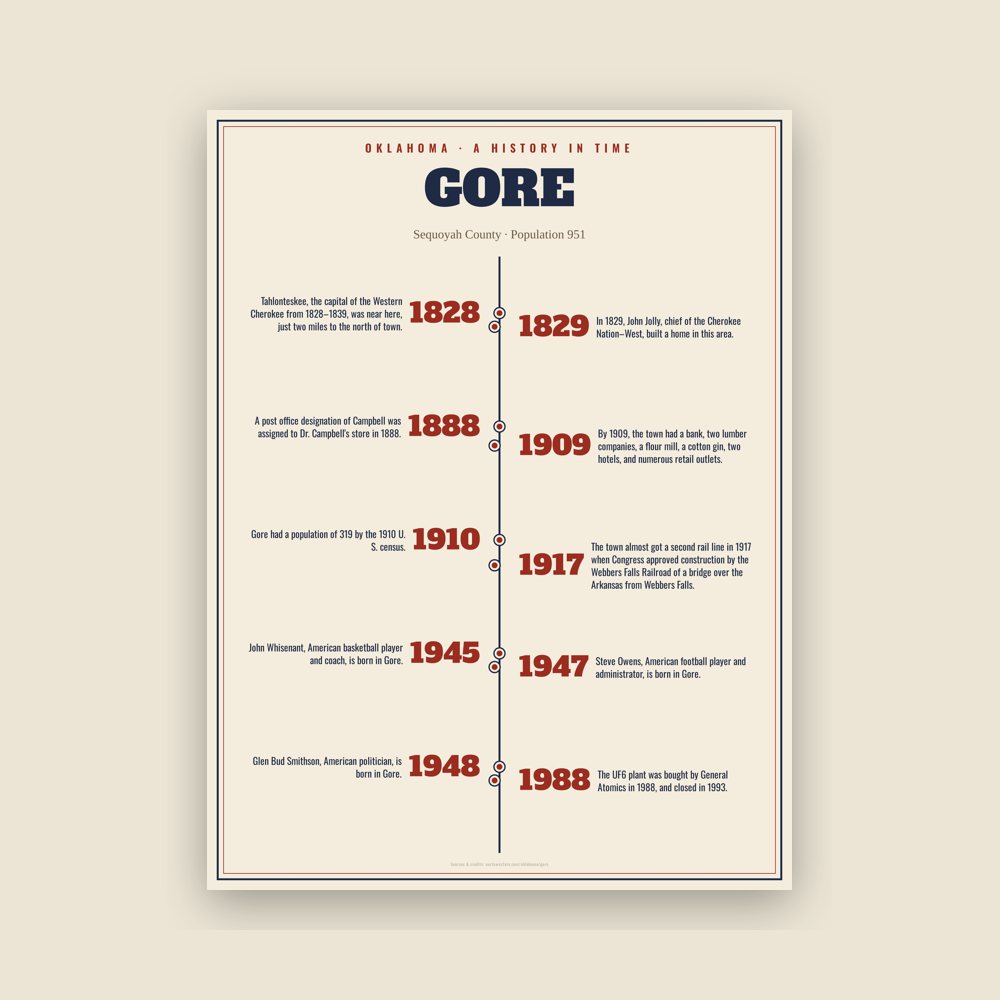
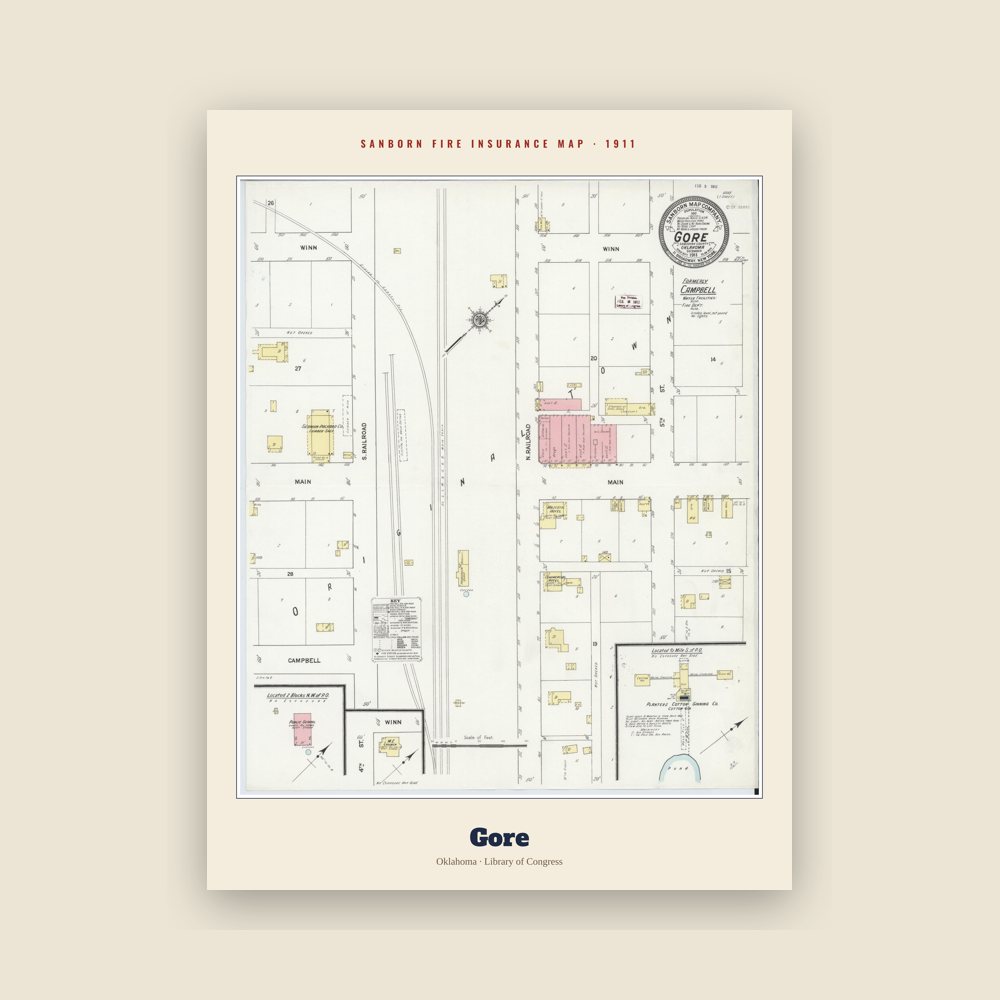
This community began as a small settlement in Indian Territory known as Campbell, named for Dr. W. W. Campbell, who, along with Joe Lynch, operated a ferry across the Arkansas River between Campbell and Webbers Falls. Tahlonteskee, the capital of the Western Cherokee from 1828–1839, was near here, just two miles to the north of town. In 1829, John Jolly, chief of the Cherokee Nation–West, built a home in this area.
The settlement was also known as Illinois Station or "Illinois Station, Campbell Post Office." It became a stage stop on the route between Fort Gibson and Fort Smith. A post office designation of Campbell was assigned to Dr. Campbell's store in 1888. Also in 1888, the St. Louis, Iron Mountain and Southern Railway (later the Missouri Pacific Railway) built a rail line through the settlement.
By 1909, the town had a bank, two lumber companies, a flour mill, a cotton gin, two hotels, and numerous retail outlets. The town changed its name on October 22, 1909, in honor of Oklahoma Senator Thomas Gore, who was serving as one of Oklahoma's U. S. senators immediately after statehood. A fire destroyed most of the business district in 1909. Gore had a population of 319 by the 1910 U. S. census.
The town almost got a second rail line in 1917 when Congress approved construction by the Webbers Falls Railroad of a bridge over the Arkansas from Webbers Falls. However, that railroad was instead scrapped in 1918.
Kerr-McGee built the Sequoyah Fuels Corporation uranium mill on a 300 acres (120 ha) tract located 3 miles (4.8 km) east of Gore to convert uranium ore into uranium hexafluoride (UF6). The UF6 plant was bought by General Atomics in 1988, and closed in 1993.
Adapted (trimmed) from the Wikipedia article Gore, Oklahoma, revision 1376080989 by its contributors, licensed CC BY-SA 4.0.