A short history of New York Mills
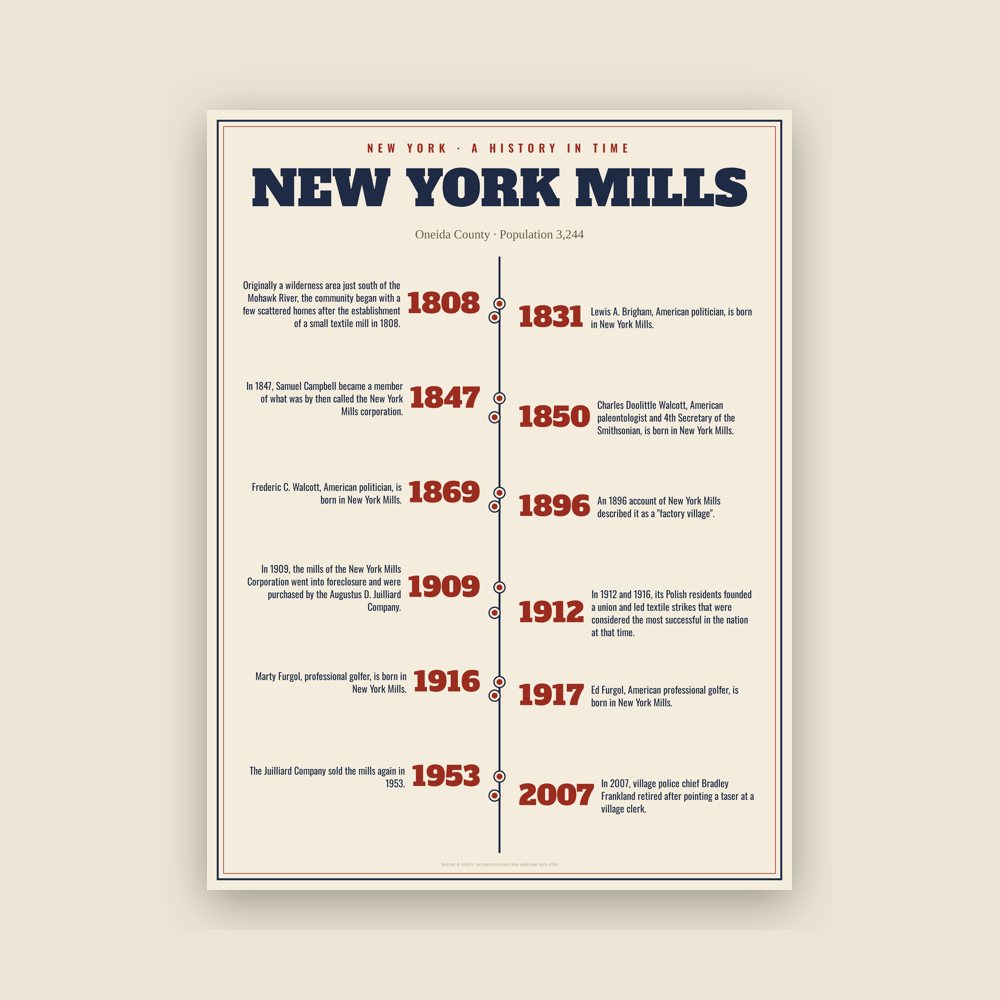
James S. Pula and Eugene E. Dziedzic provide a detailed history on the village in their book New York Mills (Images of America):New York Mills, named for the textile factories that were once the backbone of the surrounding villages economy, ranked among the foremost producers of quality fabrics in the country. Originally a wilderness area just south of the Mohawk River, the community began with a few scattered homes after the establishment of a small textile mill in 1808. Nourished by a growing economy, the village attracted a mosaic of Welsh and French-Canadian workers in the 19th century, followed by Poles, Syro-Lebanese, and Italians in the early 20th century. A hotbed of abolitionism in the antebellum years, it sent high percentages of its residents off to the Civil War, World War I, and World War II. In 1912 and 1916, its Polish residents founded a union and led textile strikes that were considered the most successful in the nation at that time. With the eventual closing of the mills in the 1950s, residents found employment in the surrounding area as the village evolved into a stable and prosperous suburban community.
The first mill was established in 1808 by Benjamin Stuart Walcott. In 1847, Samuel Campbell became a member of what was by then called the New York Mills corporation. The Campbell and Walcott families would co-own the corporation for the rest of the 19th century. An 1896 account of New York Mills described it as a "factory village".
In 1909, the mills of the New York Mills Corporation went into foreclosure and were purchased by the Augustus D. Juilliard Company. The Juilliard Company sold the mills again in 1953.
In 2007, village police chief Bradley Frankland retired after pointing a taser at a village clerk. Since 2020, the chief has been his son, Robert Frankland.
Adapted (trimmed) from the Wikipedia article New York Mills, New York, revision 1379127191 by its contributors, licensed CC BY-SA 4.0.