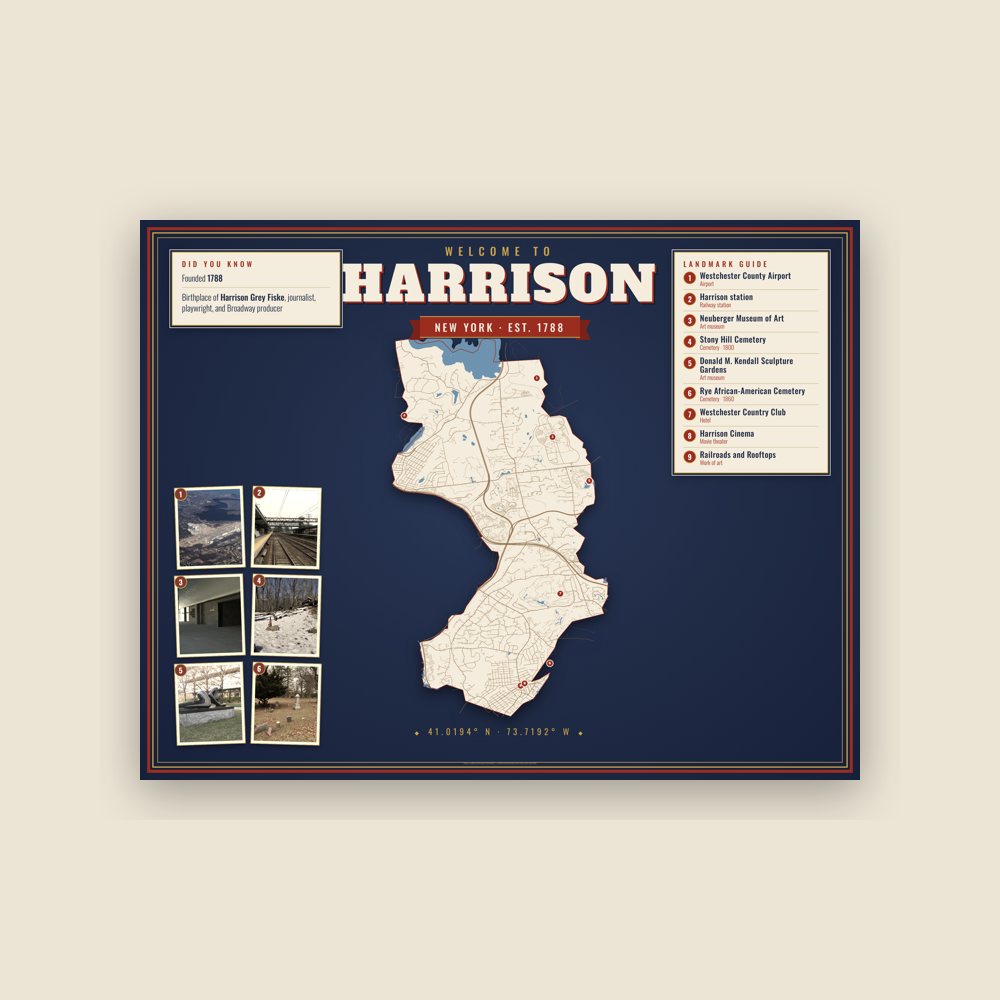
Harrison was established in 1696 by a patent granted by the British government to John Harrison and three others, who had a year earlier bargained with local Native Americans to purchase an area of land above Westchester Path, an old trail that led from Manhattan to Port Chester and below Rye Lake. Local custom holds that Harrison was given 24 hours to ride his horse around the area he could claim, and the horse could not swim or did not want to get its feet wet, but this is folklore. In fact, the land below Westchester Path and along Long Island Sound had already been purchased and partly developed by the settlers of Rye, New York.
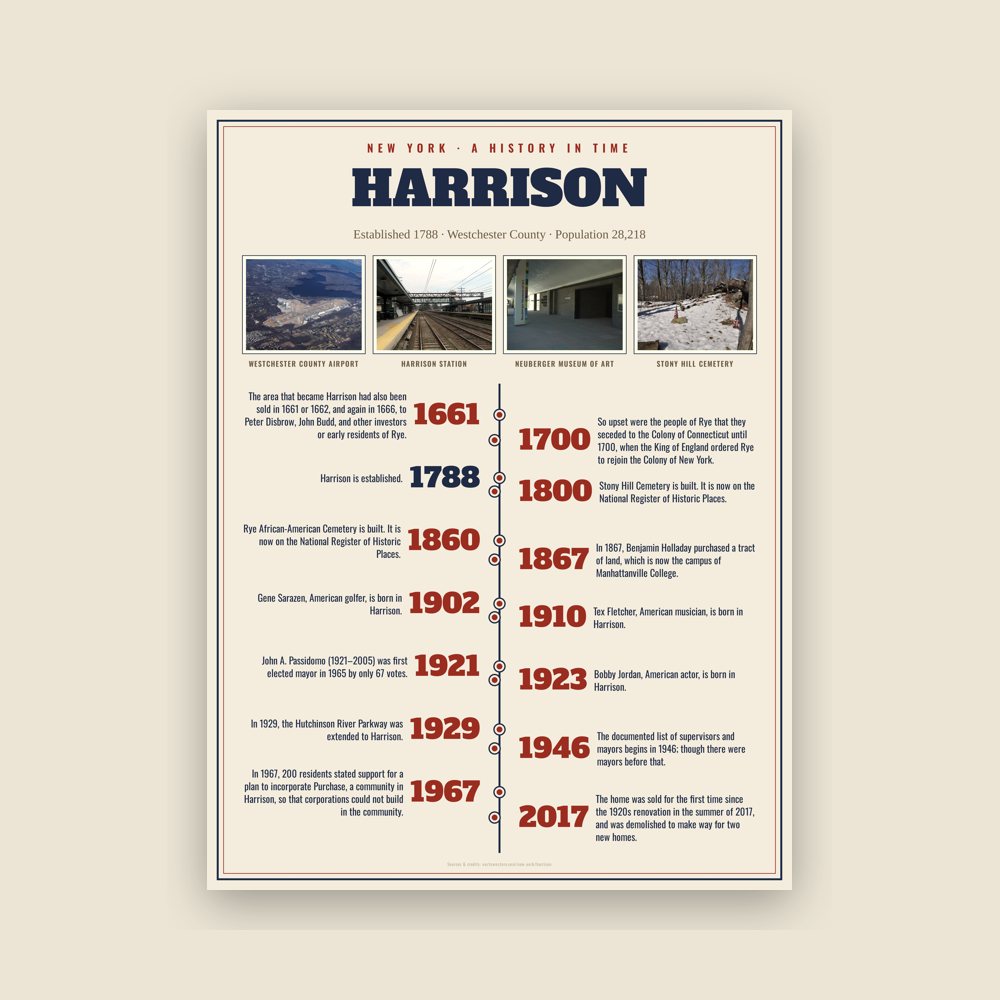
The area that became Harrison had also been sold in 1661 or 1662, and again in 1666, to Peter Disbrow, John Budd, and other investors or early residents of Rye. Disbrow and Budd evidently lost their paperwork and the land was ultimately granted to Harrison and his co-investors in 1696. So upset were the people of Rye that they seceded to the Colony of Connecticut until 1700, when the King of England ordered Rye to rejoin the Colony of New York.
Read the full history
18th century
The first permanent residents of Harrison's Purchase, as it was called, arrived in about 1725, and many early settlers were Quakers, who set up a Friend's Meeting House at a settlement located in the part of Harrison now called Purchase. Harrison's Purchase was administered jointly by the settlers of Rye until it was incorporated as a town on March 7, 1788, by an act of the New York State legislature.
Merritt's Hill in West Harrison was part of the site of the Battle of White Plains during the Revolutionary War. One company of the New York Militia that fought in the battle was composed solely of people from Harrison.
19th century
During the 1830s, David Haviland settled in Harrison where he produced Haviland China which he sold in his store in New York City before returning to his native France. Today there exists a Haviland Street in the downtown business district, as well as a Haviland Road in the Sterling Ridge neighborhood of Harrison, whose only street sign is of a historic wrought iron design in scrolled shapes, quite older than many others throughout the town.
In 1867, Benjamin Holladay purchased a tract of land, which is now the campus of Manhattanville College. He constructed an elaborate granite mansion, now known as the college's Reid Castle, and an elaborate Norman-style Roman Catholic chapel for his wife. The castle hosted the King and Queen of Siam in the early 1930s. The castle was at one time known as Ophir House, in reference to different owners.
In 1875, Sunny Ridge farm mansion was renovated to include a 14th-century woodcut from Europe, installed into the wall over the living room fireplace, among several other ancient relics, built into the home. The home was sold for the first time since the 1920s renovation in the summer of 2017, and was demolished to make way for two new homes. It was not protected by any state or local historic preservation acts.
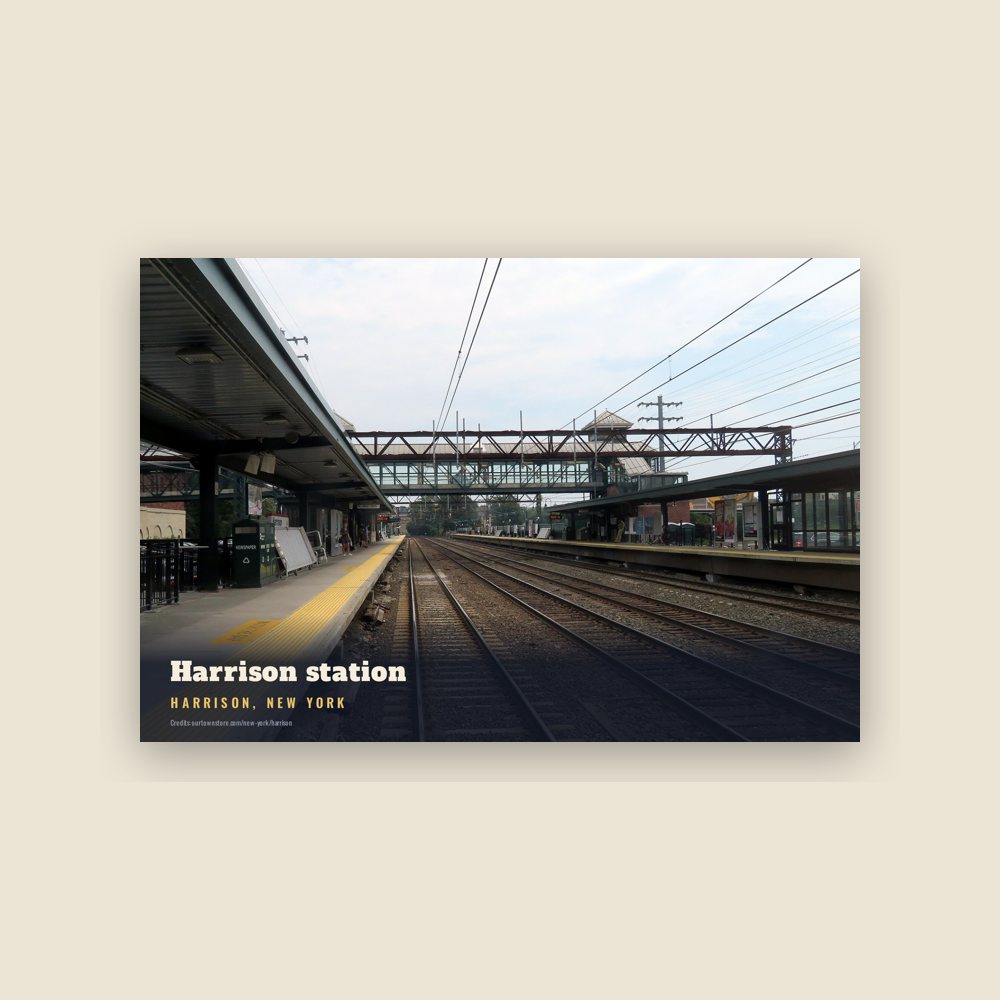
What is the present-day Metro-North Railroad's New Haven Line, running from Manhattan in New York City, to Greenwich, Connecticut, first came through Harrison in 1848, though the first station was not built until 1870. Before that time, Harrisonites had to flag down the train to get a ride. Harrison remained generally free of factories through the Industrial Revolution, while large factory districts grew in the neighboring towns of White Plains, Port Chester and Mamaroneck.
20th century
In 1929, the Hutchinson River Parkway was extended to Harrison. The same year, Harrison's former Sunnyridge Farm, located less than a half mile from the train station, was purchased by real estate developer Sidney H. Sonn, of H. & S. Sonn Co., based in New York City, and subdivided into lots for a real estate development.
H. & S. Sonn laid out new streets throughout, preserving the farm's private access road to the farm residence as today's Sunny Ridge Road. According to a 1928 article in The New York Times, "[H. & S. Sonn] virtually transformed their part of the old farm into a park, installed winding tree-lined motorways and water, gas, sewers, and electricity, and landscaped the entire 165 acres, then they erected ten English-type houses which were designed by Julius Gregory, one of them being completely furnished by Charles of London." H. & S. Sonn contracted Julius Gregory to develop house plans for single family houses in their new Sunny Ridge development, as it was termed. A new model was developed to construct homes that were of durable materials, to be resistant to exterior maintenance, using only brick, stone, and old-growth oak timber as exterior materials. The fashionable new neighborhood attracted the attention of New York banking, business, and entertainment elites, attracting Wall Street financier William Harty, then owner of Condé Nast, Joseph J. Lane; musical star Louise Groody; and Fitzhugh Green, of Putnam's Publishing House, among the first residents of the new neighborhood.
Sidney Sonn renovated the farm's original house, an immense, elaborate, 20-room, 1875 Victorian mansion, into an English Tudor, designed by renowned architect Julius Gregory, father of the American Tudor-Revival style and movement of the 1920s, as a residence for himself.
Only a small handful of homes were sold and constructed before the economic downturn of the Great Depression. The remaining vast majority of homes were constructed beginning in the middle-1940s, with the last plots filled during the 1950s. The styles of the newer, 1940s-era homes was primarily of colonial revival style, with the newest ranging into Mid-century-Modern. The older, Tudor homes as a result remain quite notable.
In 1967, 200 residents stated support for a plan to incorporate Purchase, a community in Harrison, so that corporations could not build in the community. In response, officials from the Town of Harrison put forward plans to try to become a city to try to stop Purchase from seceding from Harrison. The resolution was for the Town became a hybrid "Town / Village", which it remains today.
John A. Passidomo (1921–2005) was first elected mayor in 1965 by only 67 votes. Re-elected eight times, he served until 1983 when he resigned to become Commissioner of the New York State Department of Motor Vehicles. In his two and a half years at that job, he helped pass one of the nation's first seat-belt laws despite the law's unpopularity.
Harrison's "Platinum Mile", a string of corporate office parks along I-287 in the Purchase section of Harrison, developed under Passidomo. The mayor played an instrumental role in attracting large corporations such as PepsiCo, MasterCard and Texaco.
In the early 1970s, under Passidomo's supervision, a group in the Purchase section of town, concerned about the town's overdevelopment, attempted to incorporate as a village and thereby separate from the town of Harrison. Creatively, to avoid being served papers that would have begun the legal proceedings for Purchase to incorporate as a village, Passidomo entered his office through the fire escape. He then immediately made sure that the town Harrison became a village but remained as a town to end to the possibility of Purchase's secession, since a village cannot legally be formed in another village.