The first settlers of European descent arrived in the Beemer area by prairie schooner in 1864, seeking land under the Homestead Act.
- CountyCuming County
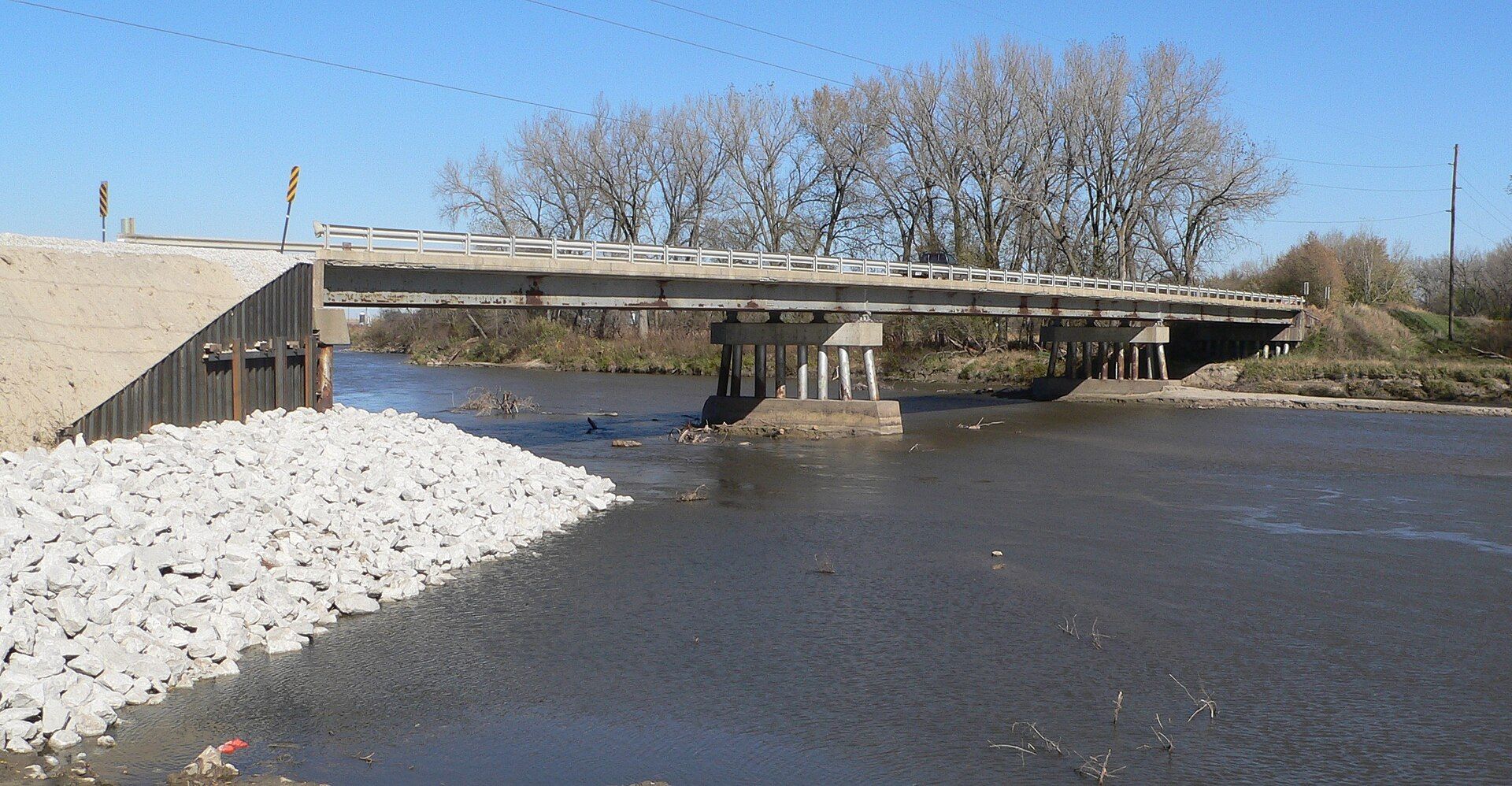
The first settlers of European descent arrived in the Beemer area by prairie schooner in 1864, seeking land under the Homestead Act.
Beemer, Nebraska gifts and souvenirs: 21 designs made from Beemer's own map, landmarks and history, from $16 to $95. Printed to order and shipped free in the USA.
| Popular | Price |
|---|---|
| Beemer Hometown Ornament | $23 |
| Beemer Vintage Travel Poster | from $40 |
| Beemer Varsity Crewneck | from $57 |
| Beemer Est. Tee | from $33 |
| Beemer Town Line Mug | from $26 |
| Beemer Market Tote | $37 |
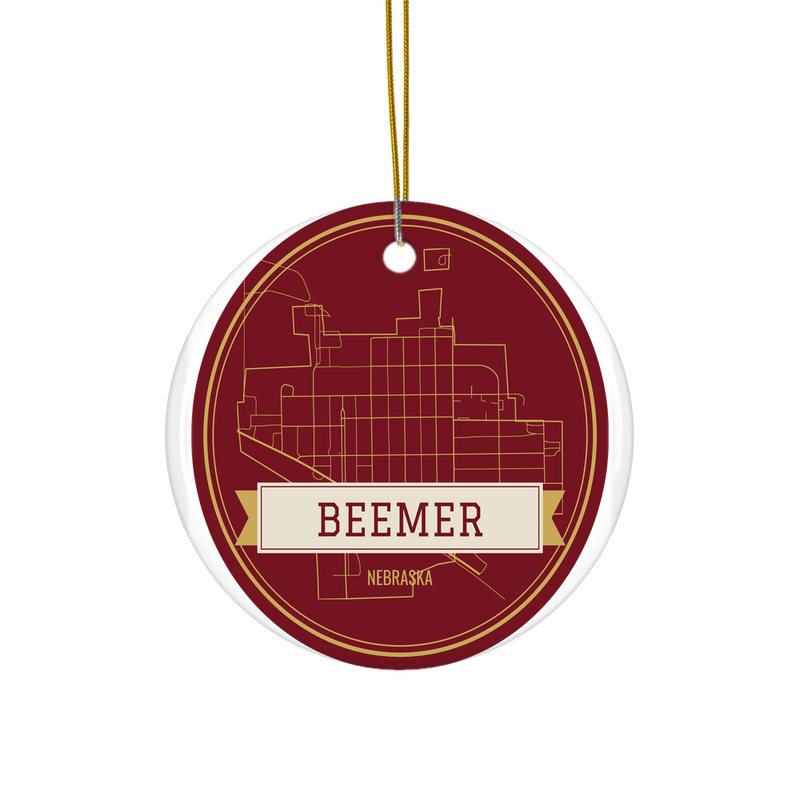
Ceramic keepsake, gold ribbon
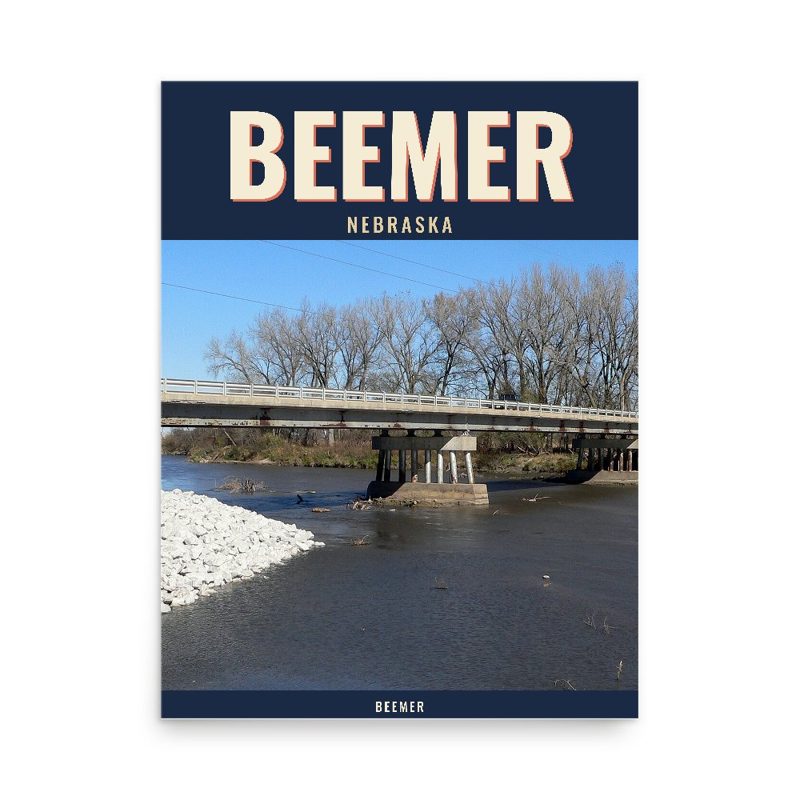
Its landmark photo in a classic travel-poster layout

A local landmark photo as a gallery print
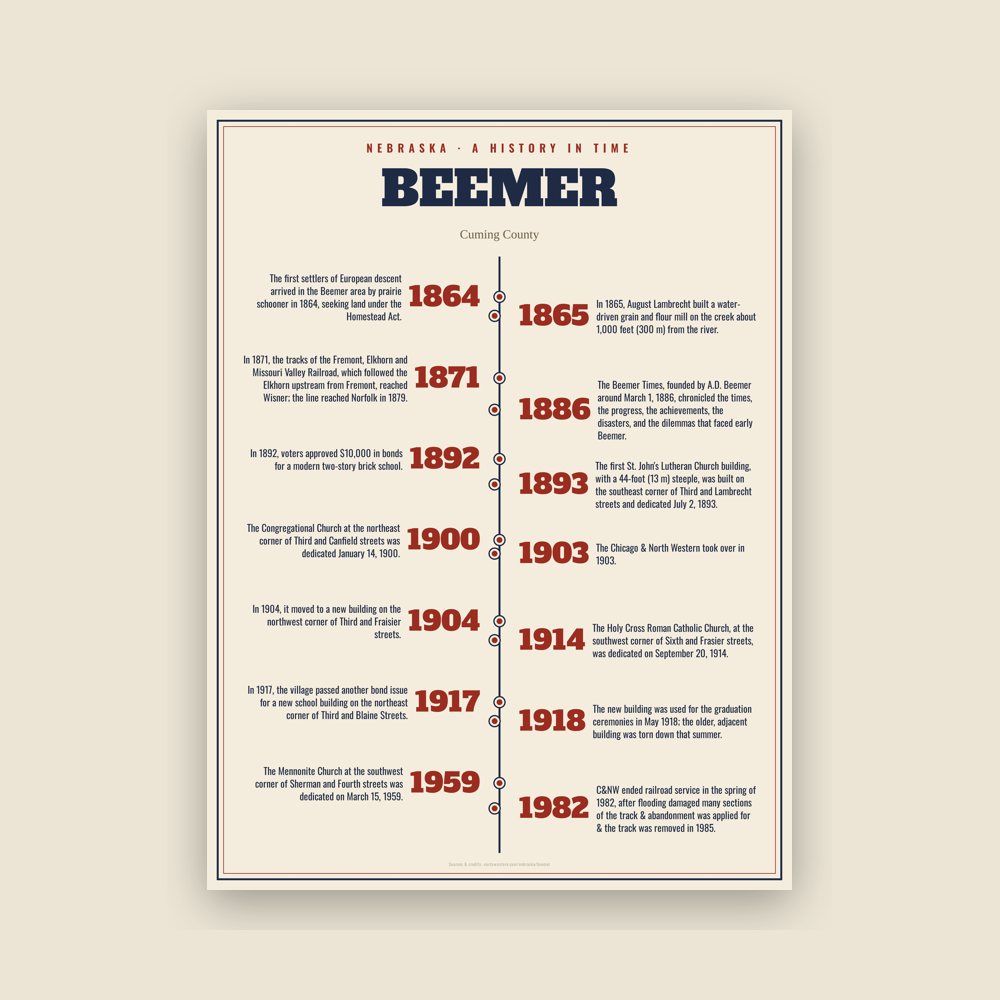
The town's story in dates, from its own records, for home or classroom
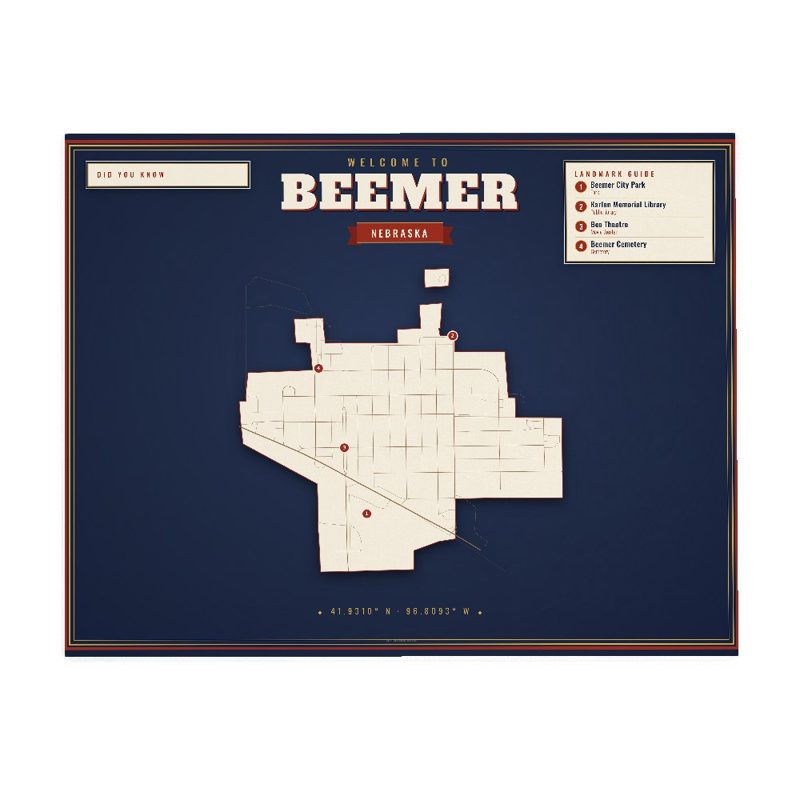
Map of local landmarks, washable fabric

Heavy-blend fleece, street map printed on the back

Red heavy-blend crewneck, knit-stitch town print
Soft Bella+Canvas jersey
Kids' Bella+Canvas jersey, youth sizes

Bella+Canvas toddler jersey

Bella+Canvas baby bodysuit

Glossy ceramic, dishwasher safe

Weatherproof, for the front walk

24″×16″, printed coir-look fibers, rubber back
12″×12″ printed wood, ready to hang
Soft-touch, zip cover

A local landmark photo with the town name, 18″×18″

Sturdy all-over-print tote

Glossy top, cork back
Soft fleece, 50″×60″

20 oz, double-wall stainless
The first settlers of European descent arrived in the Beemer area by prairie schooner in 1864, seeking land under the Homestead Act. The new inhabitants built dugouts, sod houses, and, eventually, log cabins. The earliest settlers in Beemer Township included M. Brayrerton, George Graham, Joseph S. Emley, Robert Fehlmann, Dr. H.H. Howe, Howard Howe, James and Michael McNamara, Judge Newburn, the Rabe family, W.S. Schneald, William Sharp and two sons Martin and Silas, Casper Schifferns, David Simons, Wm. A. Smith, J.E. Spencer, Benjamin Ewing, John Wagaoner, Henry White, James Wilson, and William Witte.
The first school in Beemer Township was taught by Mrs. William Sharp in 1867 in her log cabin, a short distance to the northwest of where Beemer is now located.
West of Beemer, a small stream called Rock Creek flows into the south side of the Elkhorn River. In 1865, August Lambrecht built a water-driven grain and flour mill on the creek about 1,000 feet (300 m) from the river. Lambrecht's mill, combined with the creek and with favorable agricultural conditions, attracted a small concentration of settlers; the area was known as "Rock Creek", after the stream.
In 1871, the tracks of the Fremont, Elkhorn and Missouri Valley Railroad, which followed the Elkhorn upstream from Fremont, reached Wisner; the line reached Norfolk in 1879. As the railway was extended, water stops were needed at 7-to-10-mile (11 to 16 km) intervals to support the steam locomotives. The railroad stops were also served by telegraphs for the purpose of administering and controlling the railroad as well as business development of the telegraphs. The telegraph station at the water stop located at the site of present-day Beemer was named after the nearest significant settlement, Rock Creek, and used the call letters "R C". So, for the next fifteen years, two locations, several miles apart and on opposite sides of the Elkhorn, were referred to as 'Rock Creek': one was the area around the Rock Creek stream near Lambrecht's mill and the other the area around the railway water stop and telegraph station.
In 1885, Allen D. Beemer, George Canfield, and K.C. Morehouse laid out lots to the north of the Rock Creek water stop and platted a village to be known as Rock Creek, as filed in the county seat of West Point on May 26, 1885. Mr. Beemer built the first rail depot building, and led the drive to build a wooden bridge across the Elkhorn. His efforts on behalf of the area were rewarded in 1886, when Congressman Edward K. Valentine secured a post office for the settlement, naming it the Beemer Post Office. On July 15, 1886, in response to a petition of 54 residents, a village named Beemer was incorporated with Harry Delmont, W.D. Gibbon, John M. Barber, F.J. Fitzgerald, and Niels Hansen the village trustees. In that year Mr. Beemer founded a newspaper, the Beemer Times; and the rail company changed the name of the station from Rock Creek to Beemer, although its telegraph call signs remained "R C" (for "Rock Creek") until the depot closed in 1963.
The first century was marked by growth and numerous initiatives to develop Beemer. The Beemer Times, founded by A.D. Beemer around March 1, 1886, chronicled the times, the progress, the achievements, the disasters, and the dilemmas that faced early Beemer. The paper assailed ills like the muddy streets, the lack of sidewalks, and the excessive number of taverns; and it reported on more favorable developments like improvements to the schooling, new commercial enterprises, and major modernizations such as waterworks, electrification, road improvements, and telephone systems.
Five churches were established in Beemer during this era. The Methodist Episcopal Church was built at the northeast corner of Fifth and Beemer Streets and dedicated September 5, 1886. In 1904, it moved to a new building on the northwest corner of Third and Fraisier streets. The first St. John's Lutheran Church building, with a 44-foot (13 m) steeple, was built on the southeast corner of Third and Lambrecht streets and dedicated July 2, 1893. The Congregational Church at the northeast corner of Third and Canfield streets was dedicated January 14, 1900.
The Holy Cross Roman Catholic Church, at the southwest corner of Sixth and Frasier streets, was dedicated on September 20, 1914. The Mennonite Church at the southwest corner of Sherman and Fourth streets was dedicated on March 15, 1959.
The first Beemer Public School was held in a small frame building located on the northeast corner of Third and Beemer Streets. By 1886, in order to support its 32 enrolled pupils, a two-room, frame building was built on the southwest corner of Fifth and Beemer Streets. The names of absent or tardy students were duly reported in the Beemer Times. In 1892, voters approved $10,000 in bonds for a modern two-story brick school. The school officers, F.J. Fitzgerald, A.D. Beemer, and Charles Decker reported an enrollment of 210 pupils. The building was erected on the north side of Third Street between Blaine and Harrison Streets (approximately where a 1964 addition to the school was eventually built). In 1917, the village passed another bond issue for a new school building on the northeast corner of Third and Blaine Streets. The new building was used for the graduation ceremonies in May 1918; the older, adjacent building was torn down that summer. The 1918 building would continue to be used until 2008.
The tracks of the Fremont. Elkhorn & Missouri Valley Railroad arrived in Beemer in 1871. This route was laid from Fremont to reach the Black Hills of South Dakota. The Chicago & North Western took over in 1903. By the mid-1970s, the freight traffic volumes began mildly declining. C&NW ended railroad service in the spring of 1982, after flooding damaged many sections of the track & abandonment was applied for & the track was removed in 1985.
Adapted (trimmed) from the Wikipedia article Beemer, Nebraska, revision 1381590188 by its contributors, licensed CC BY-SA 4.0.
We share a part of every Beemer sale with local partners, and we'd love to print from your collection. Old photographs, maps and postcards make the best keepsakes.
Partner with usA favorite landmark, your street, a school or team, an anniversary gift, a different product. Tell us and we'll get back to you by email.
1 free coloring page of Beemer, each traced from a photo of a local landmark. Print them at home, at school or for story hour.
 A view of Beemer