A short history of Horn Lake
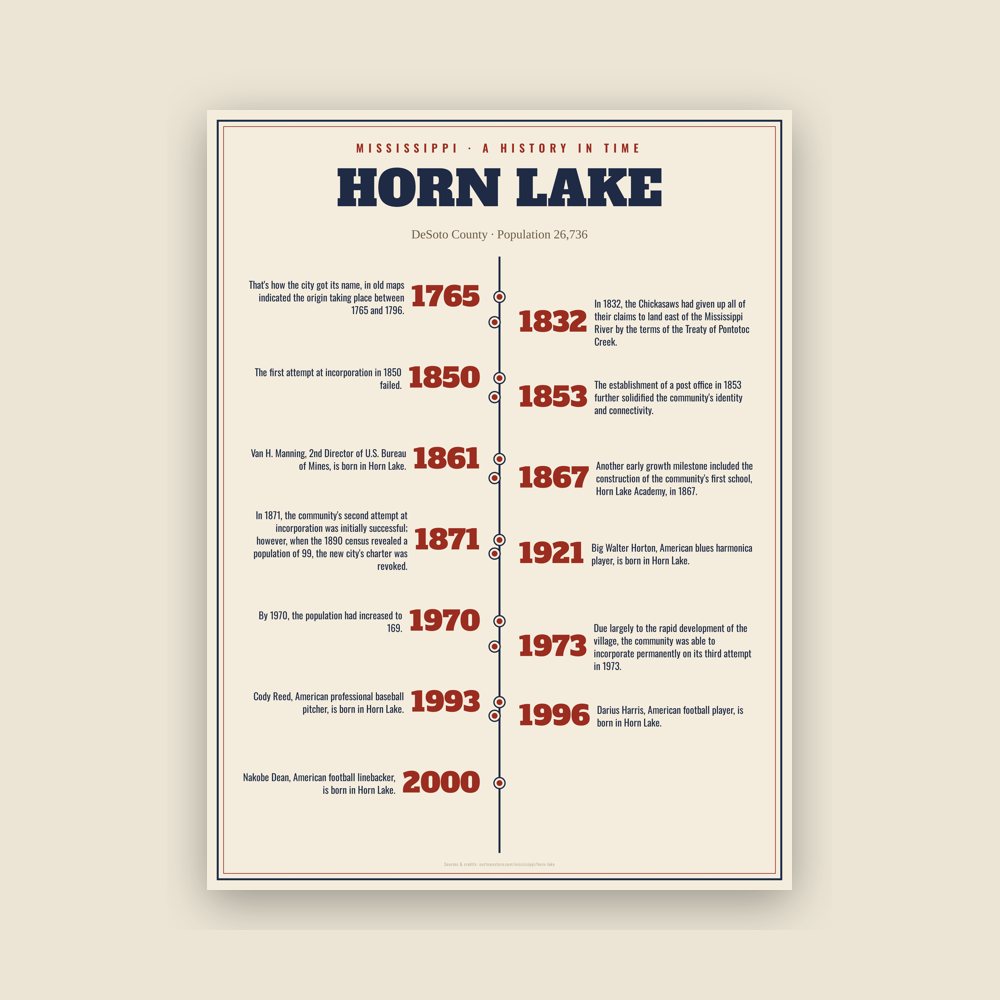
Horn Lake traces its name to an ox-bow lake, lying three miles west, which was a former riverbed of the Mississippi River. The river changed course over time in the late 18th century, leaving a stranded area that resembles a cow horn. That's how the city got its name, in old maps indicated the origin taking place between 1765 and 1796.
In historical times when the Chickasaw Indians inhabited that area as their land, Hernando de Soto and his party, the first Europeans to encounter the Chickasaws, wintered with them at the time of his discovery of the Mississippi River. The French Explorer, René-Robert Cavelier, Sieur de La Salle, solicited their help on his journey down after Mississippi to the Gulf of Mexico. The area passed through successive Spanish and English rule, finally coming under American governance after the Revolutionary War. In 1832, the Chickasaws had given up all of their claims to land east of the Mississippi River by the terms of the Treaty of Pontotoc Creek.
Settlers then moved into the area where they were clearing the wilderness and began cultivating subsistence crops. Cotton became a major cash crop, which was used in plantations in the South. The first attempt at incorporation in 1850 failed. The establishment of a post office in 1853 further solidified the community's identity and connectivity. The arrival of the Mississippi and Tennessee Railroad (later the Illinois Central) in 1856, with a depot in Horn Lake, significantly impacted the town's development, facilitating trade and travel. Another early growth milestone included the construction of the community's first school, Horn Lake Academy, in 1867. Freight marked “Horn Lake”, intended for the families who lived in the lake region, was dropped off on Goodman Road and delivered by horse and wagon. Eventually, the freight stop acquired the name “Horn Lake”, and a community grew up as residents built stores, cotton gins, a stockyard, blacksmith shops, and gristmills near the tracks. In 1871, the community's second attempt at incorporation was initially successful; however, when the 1890 census revealed a population of 99, the new city's charter was revoked.
Throughout half of the twentieth century, the community persevered as a rural community, surviving World War I, World War II and the Great Depression. By 1960, the community would begin its "rural to urban" transformation with the arrival, soon thereafter, of new industry such as Dover Elevator, Flavorite Laboratories, and J.T. Shannon Lumber Company, and the opening of Interstate 55 in 1964.
By 1970, the population had increased to 169. In that same year, First Mississippi Corporation initiated the development of some 960 acres as part of a planned neighborhood called DeSoto Village. Due largely to the rapid development of the village, the community was able to incorporate permanently on its third attempt in 1973.
Adapted (trimmed) from the Wikipedia article Horn Lake, Mississippi, revision 1380915906 by its contributors, licensed CC BY-SA 4.0.