Since 1861
A short history of Booneville
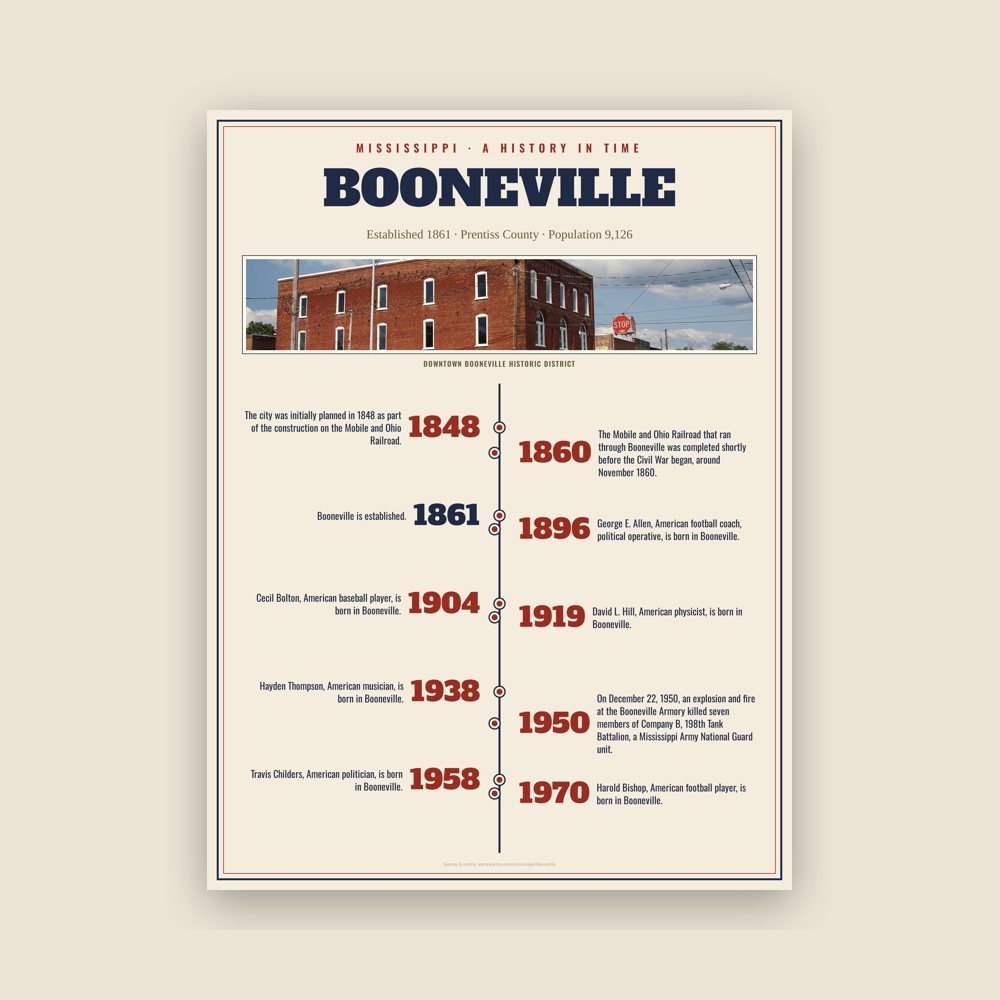
The land of Booneville was bought by B.B. Boone, G.W. Williams, and W.P. Curlee from the Chickasaw tribesman Le-Ho-Yea. The community was named for settler Colonel Reuben Holman Boone, a relative of Daniel Boone, the early American pioneer. The city was initially planned in 1848 as part of the construction on the Mobile and Ohio Railroad. While the settlement grew rapidly in its early years, the American Civil War began just as the city incorporated in 1861 and slowed the city's progress.
Read the full history
Civil War
The Mobile and Ohio Railroad that ran through Booneville was completed shortly before the Civil War began, around November 1860. It was converted to military use and became a critical military target. 184 miles of the line from Union City, Tennessee to Okolona, Mississippi would be totally destroyed by 1866, causing severe financial strain for the railroad even after it was eventually rebuilt.
On May 30, 1862, Col. Washington Lafayette Elliott of the 2nd Iowa Cavalry Regiment led a Union brigade to Booneville, where they destroyed the local depot and a large train loaded with munitions and captured 2,000 sick and wounded Confederates.
On June 28, 1862, Col. Philip Sheridan of the Union fortified a position in Booneville after hearing that the Confederates intended to move from Tupelo to Corinth in an attempt to recapture the rail junction there. Brig. Gen. James R. Chalmers of the Confederacy led 4,700 troops in an assault that pushed the Union troops to withdraw to a backup position 2 miles (3.2 km) closer to the town. The bulk of the Union force stayed on the defensive while Sheridan sent the 2nd Michigan Cavalry under Capt. Russell Alexander and the 2nd Iowa Cavalry under Lt. Col. Edward Hatch to attack the Confederate rear and left flank. It is estimated 65 of Chalmers' men were killed; Federal casualties were one dead, 24 wounded, and 16 missing.
Korean War
On December 22, 1950, an explosion and fire at the Booneville Armory killed seven members of Company B, 198th Tank Battalion, a Mississippi Army National Guard unit. Their deaths are considered the first domestic casualties of the Korean War.
Adapted (trimmed) from the Wikipedia article Booneville, Mississippi, revision 1380642209 by its contributors, licensed CC BY-SA 4.0.