Since 1949
A short history of Fridley
19th century
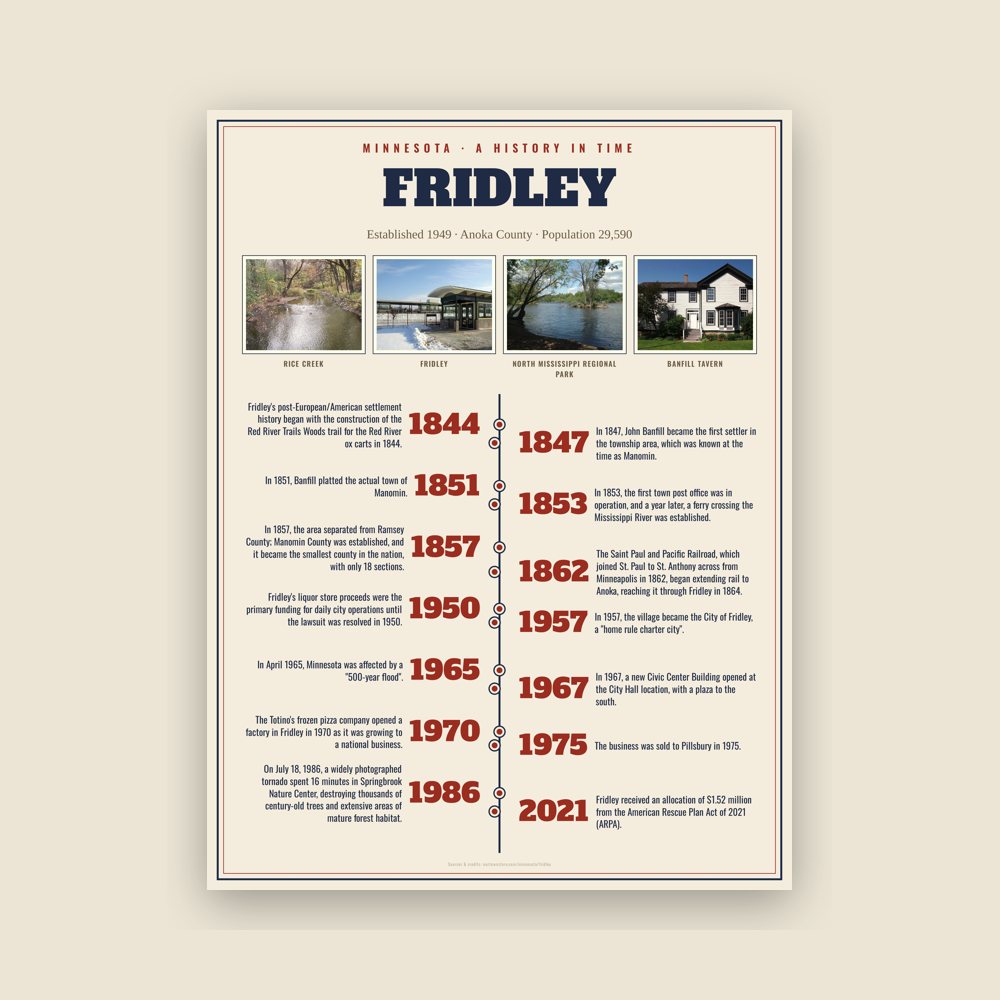
Fridley's post-European/American settlement history began with the construction of the Red River Trails Woods trail for the Red River ox carts in 1844. The trail traveled through Minnesota Territory from St. Paul to Pembina in present-day North Dakota. It was used to transport furs to the south and other supplies to Red River Valley settlers in the north. The East River Road (Anoka County Highway 1) follows this route today within Fridley, from the border with Minneapolis to the border with Coon Rapids.
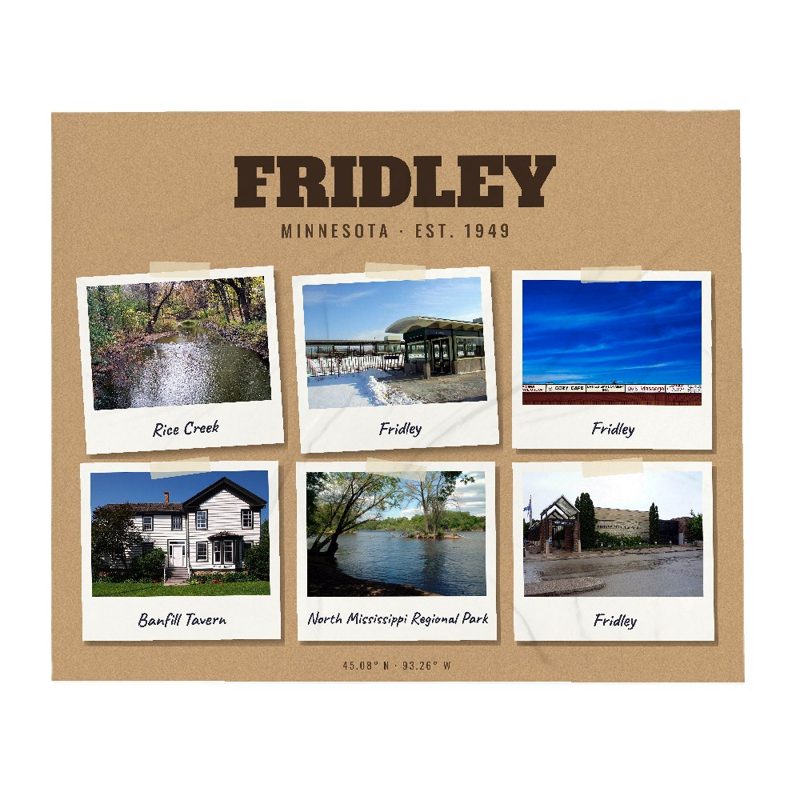
In 1847, John Banfill became the first settler in the township area, which was known at the time as Manomin. Manomin is a variant spelling of manoomin, the Ojibwe word for wild rice, a staple of their diet. It comprised the modern-day municipalities of Columbia Heights, Fridley, Hilltop, and Spring Lake Park. The Banfill Tavern was built in 1847.
The area soon grew quickly in size. In 1851, Banfill platted the actual town of Manomin. There, a general store and sawmill were built next to Rice Creek, named after Henry Mower Rice, a settler who two years earlier had acquired land in the area. In 1853, the first town post office was in operation, and a year later, a ferry crossing the Mississippi River was established.
In 1857, the area separated from Ramsey County; Manomin County was established, and it became the smallest county in the nation, with only 18 sections. This distinction was short-lived; it was annexed by Anoka County in 1870 and became a township with the same name.
The Saint Paul and Pacific Railroad, which joined St. Paul to St. Anthony across from Minneapolis in 1862, began extending rail to Anoka, reaching it through Fridley in 1864.
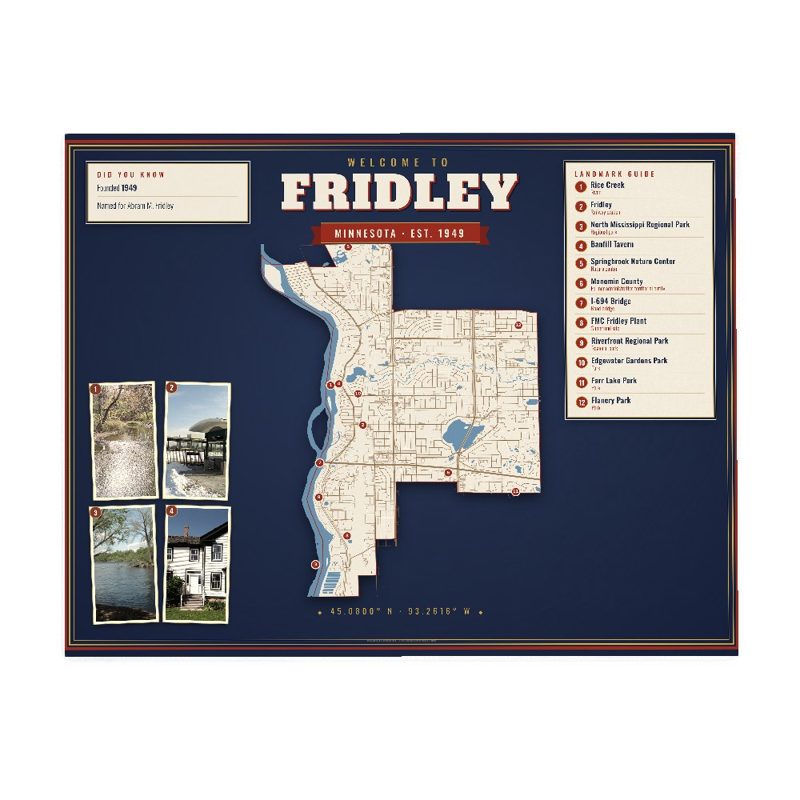
In 1879, the Minnesota Legislature, of which Abram Fridley was still a member, changed the township's name to bear his name.
Read the full history
20th century
In 1949, Fridley Township voted to be incorporated as the Village of Fridley. The Fridley Free Press was also established. Northern Pump, whose factory was within the village's boundaries, sued to challenge the village's incorporation. This caused the village funds to be frozen. Minnesota state law allowed cities to operate municipal liquor stores after Prohibition ended. Fridley's liquor store proceeds were the primary funding for daily city operations until the lawsuit was resolved in 1950. Minnesota has both private liquor stores and city-owned municipal liquor stores. Fridley is the location of the headquarters of the Minnesota Municipal Beverage Association (MMBA), a lobbying coalition for municipalities with city-owned liquor stores. In conjunction with the Minnesota Licensed Beverage Association, it lobbied against Sunday liquor store sales in Minnesota until they were finally permitted in 2017.
The Totino's frozen pizza company opened a factory in Fridley in 1970 as it was growing to a national business. The business was sold to Pillsbury in 1975.
Growth
In 1957, the village became the City of Fridley, a "home rule charter city". City Hall, at 6431 University Avenue Northeast, has a fire station, city services and council meetings. A newer fire station was built in 1964. Fridley's population grew past 15,000 in the 1950s and peaked over 30,000 by the 1970s.
21st century
In 2001, Medtronic opened its new World Headquarters on the site of the 100 Twin Drive-in at Interstate 694 and Minnesota Highway 65. As of 2019, it is still the Operational Headquarters for Medtronic, PLC, which reorganized as an Irish company in 2015.
On June 19, 2003, President George W. Bush visited the Micro Controls company in Fridley. He was promoting one of the tax relief changes made during his administration.
In the early 2000s, the Minnesota Sports Cafe was a notable venue for mixed martial arts competitions. Fighters who have claimed victories in Fridley include Sean Sherk, Nick Thompson, Brock Larson, Marcus LeVesseur, Brian Ebersole, and Harry Moskowitz.
On September 21, 2005, Fridley was struck by straight-line winds exceeding 80 mph (130 km/h), toppling many old growth trees as large as 2.5 feet (0.76 m) in diameter and destroying dozens of homes and several vehicles. Cleanup efforts took a week, leaving hundreds of residents stranded in their homes without power, unable to drive until streets were cleared of debris. The storm also affected Brooklyn Center, New Brighton, Brooklyn Park, Coon Rapids, Spring Lake Park, Blaine, and other communities in the surrounding North Metro area.
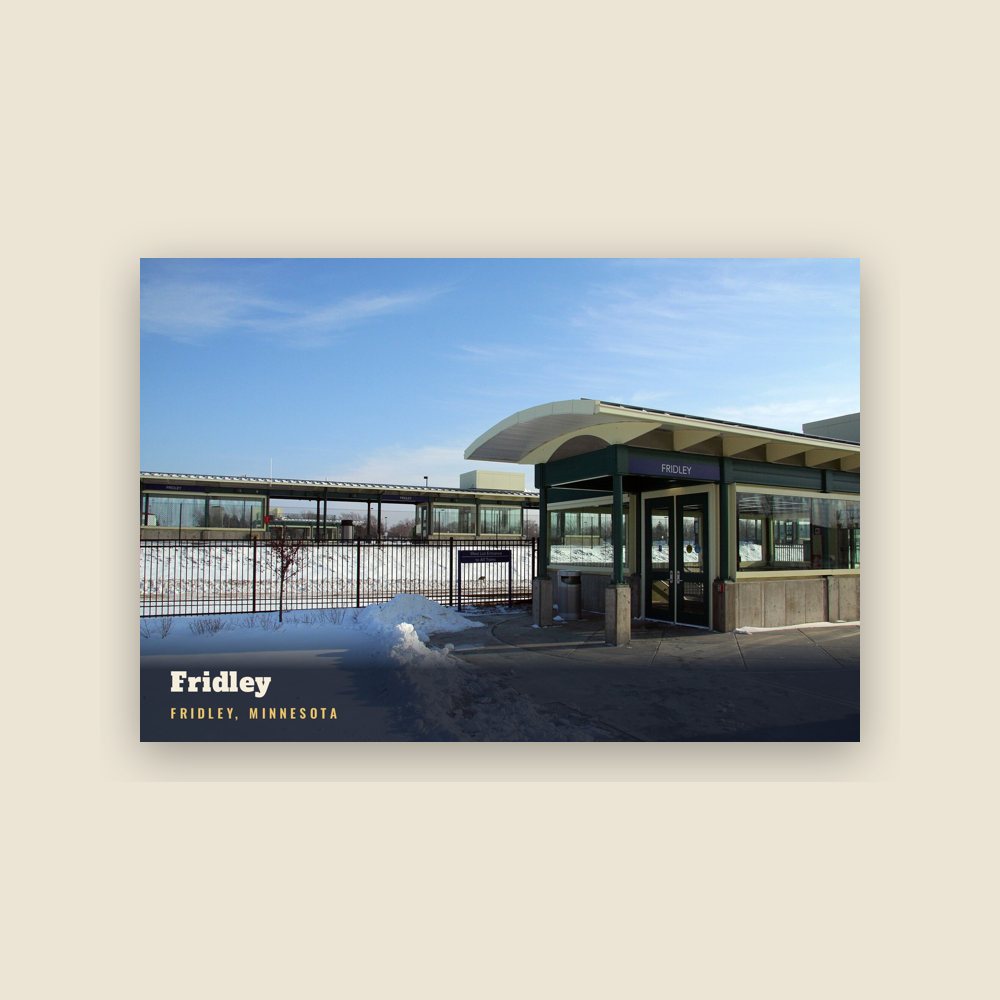
Fridley had one of the first six stations of the Northstar Commuter Rail line, which connected the northwest suburbs and downtown Minneapolis. The line opened in November 2009 and closed in January 2026. It was replaced by a bus service.
On July 17, 2011, heavy rains washed out the BNSF rail bridge over Rice Creek. A train derailed there and sent hopper cars containing corn into the creek. Traffic was rerouted for several days. In 2013, a jury awarded damages from BNSF to the train's engineer and conductor.
The Columbia Arena, filming location for the Disney Movie D3: The Mighty Ducks, was demolished in 2016 to make way for a new City Hall. This was controversial because it was expected to cost $50 million and increase homeowner taxes by 19%. The Fridley Civic Campus dedication at 7071 University Avenue NE was held on November 17, 2018. The staff had moved from the previous city hall over Veteran's Day weekend and began working there on November 12. The city council approved the project in December 2016 after nearly three years of studies, meetings and workshops. The council raised the levy to pay for the project, increasing city taxes about 16% for the average homeowner. A number of other Twin Cities suburbs updated their civic facilities during a 2018 "building boom of sorts", including Eagan, New Hope, Minnetonka, and Burnsville.
Fridley received an allocation of $1.52 million from the American Rescue Plan Act of 2021 (ARPA). The money was used to upgrade and repair its water distribution system and wastewater and storm water infrastructure. The city plans in 2022 to use the next allocation of $1.52 million to improve security at water treatment plants, rebuild its water distribution system, and on sanitary sewer and water quality projects.
President Joe Biden visited the Cummins plant in Fridley on April 3, 2022, as part of his "Investing in America" tour. Cummins had announced a $1 billion initiative to produce clean energy technology, including electrolyzers for hydrogen cells in Fridley.
Adapted (trimmed) from the Wikipedia article Fridley, Minnesota, revision 1374414536 by its contributors, licensed CC BY-SA 4.0.
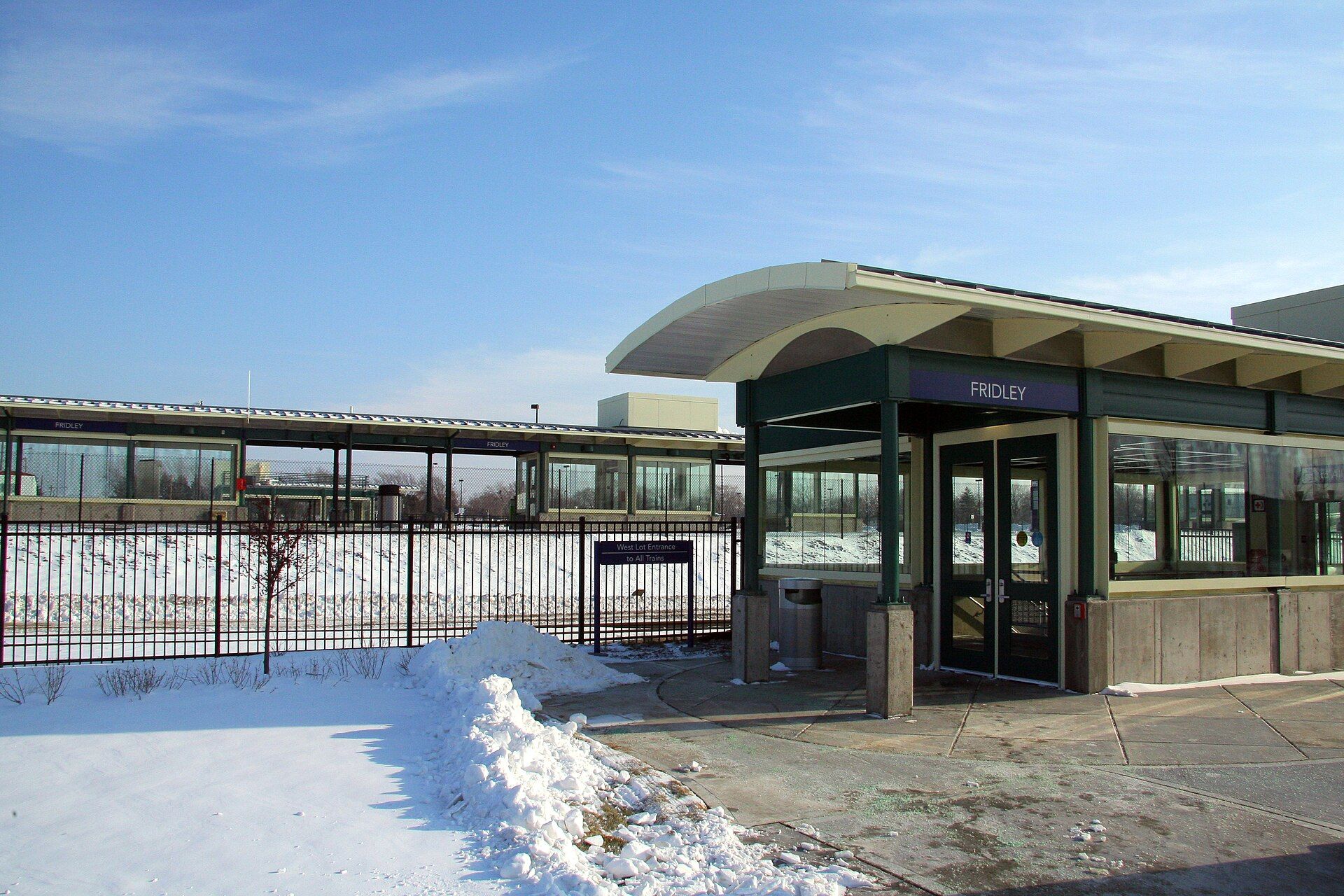





















 A view of Fridley
 Rice Creek
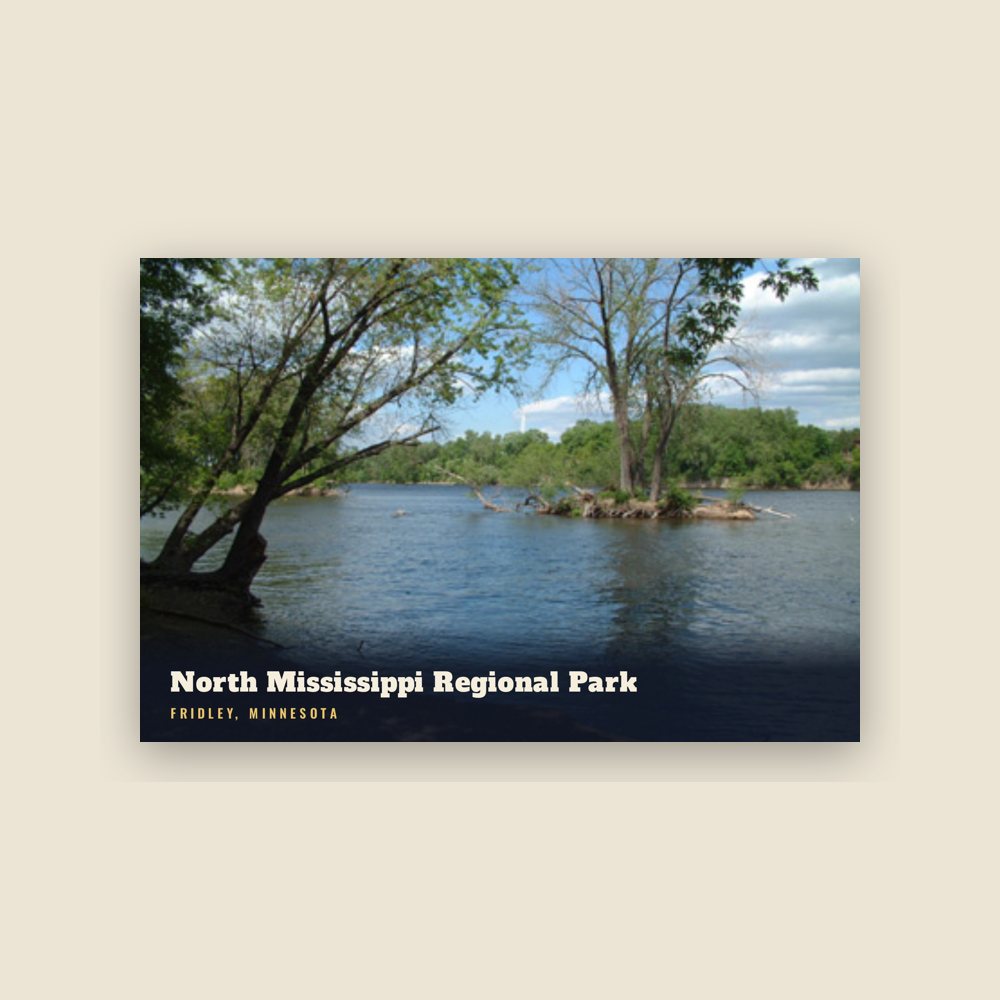
 North Mississippi Regional Park
 Banfill Tavern