A short history of St. Clair Shores
Located along the shores of Lake St. Clair and inhabited by French settlers as early as 1710, during which time the area was referred to as L'anse Creuse, the future St. Clair Shores would remain mainly a rural farming area populated by largely French and German immigrant families into the early 20th century. These local family surnames have survived into the 21st century and can be found in the surnames of current residents and among numerous residential street names.
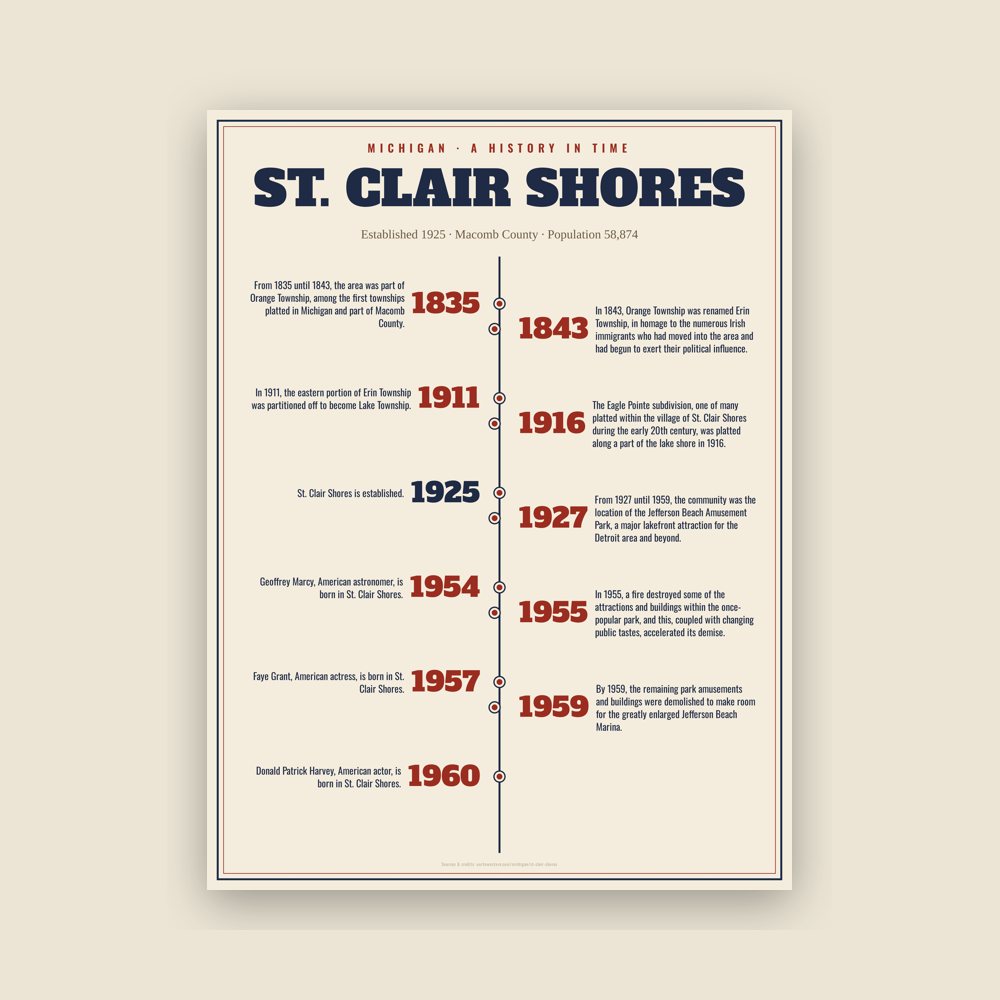
From 1835 until 1843, the area was part of Orange Township, among the first townships platted in Michigan and part of Macomb County. In 1843, Orange Township was renamed Erin Township, in homage to the numerous Irish immigrants who had moved into the area and had begun to exert their political influence. From 1843 until 1911, what is now St. Clair Shores was a part of Erin Township, parts of which make up today's municipalities of Eastpointe, Roseville, and St. Clair Shores.
In 1911, the eastern portion of Erin Township was partitioned off to become Lake Township. St. Clair Shores was incorporated as a village in 1925 and remained a part of Lake Township until, after numerous failed attempts, its residents voted to incorporate as the city of St. Clair Shores in January 1951. Lake Township continued adjacent to the city until 2009, when residents of the village of Grosse Pointe Shores (that portion of Grosse Pointe Shores in Macomb County located within Lake Township) voted to incorporate as a city.
Beginning around the time of the First World War, St. Clair Shores became a favored playground for gamblers, rum runners, and lakefront tourists alike, culminating during Prohibition, but continuing through the Second World War era. During these years, the village was the home to many popular roadhouses, blind pigs, and gambling establishments, such as the Blossom Heath Inn. St. Clair Shores' lakefront location and proximity to Canada coupled with a receptive and often participative community made it an advantageous haven for rum runners, and the area was actively involved in the rum-running era of Prohibition. Local residents, politicians, and law enforcement of the era were known to sometimes conflict with both state and federal officials over their attempts to regulate these illegal, but economically vital, activities within the community.
The Eagle Pointe subdivision, one of many platted within the village of St. Clair Shores during the early 20th century, was platted along a part of the lake shore in 1916. During the next few decades, dozens of subdivisions were platted through the local farmland, but most were not developed in earnest until after the Second World War, when St. Clair Shores became the fastest-growing suburb of Detroit during the 1950s.
From 1927 until 1959, the community was the location of the Jefferson Beach Amusement Park, a major lakefront attraction for the Detroit area and beyond. Opened in 1927, it boasted the longest roller coaster in the United States and numerous other midway attractions, a large, ornate lakefront dance pavilion, and a large, sandy beach popular with swimmers and sun bathers. In 1955, a fire destroyed some of the attractions and buildings within the once-popular park, and this, coupled with changing public tastes, accelerated its demise. While the owners of Jefferson Beach Amusement Park considered rebuilding, by this time the park was not popular with local government officials, and the city council had begun exploring forcing the closure of the facility or purchasing it for public use. Instead, the park owners, who had previously started building an onsite marina facility, began to expand that part of the facility. By 1959, the remaining park amusements and buildings were demolished to make room for the greatly enlarged Jefferson Beach Marina. All that remained of the once grand amusement park was its large, ornate lakefront dance coliseum, which for years thereafter was relegated to use as a marina storage facility and marine supply store until it, too, was destroyed by fire.
Adapted (trimmed) from the Wikipedia article St. Clair Shores, Michigan, revision 1381245865 by its contributors, licensed CC BY-SA 4.0.