Since 1869
A short history of New Haven
Origins and early history
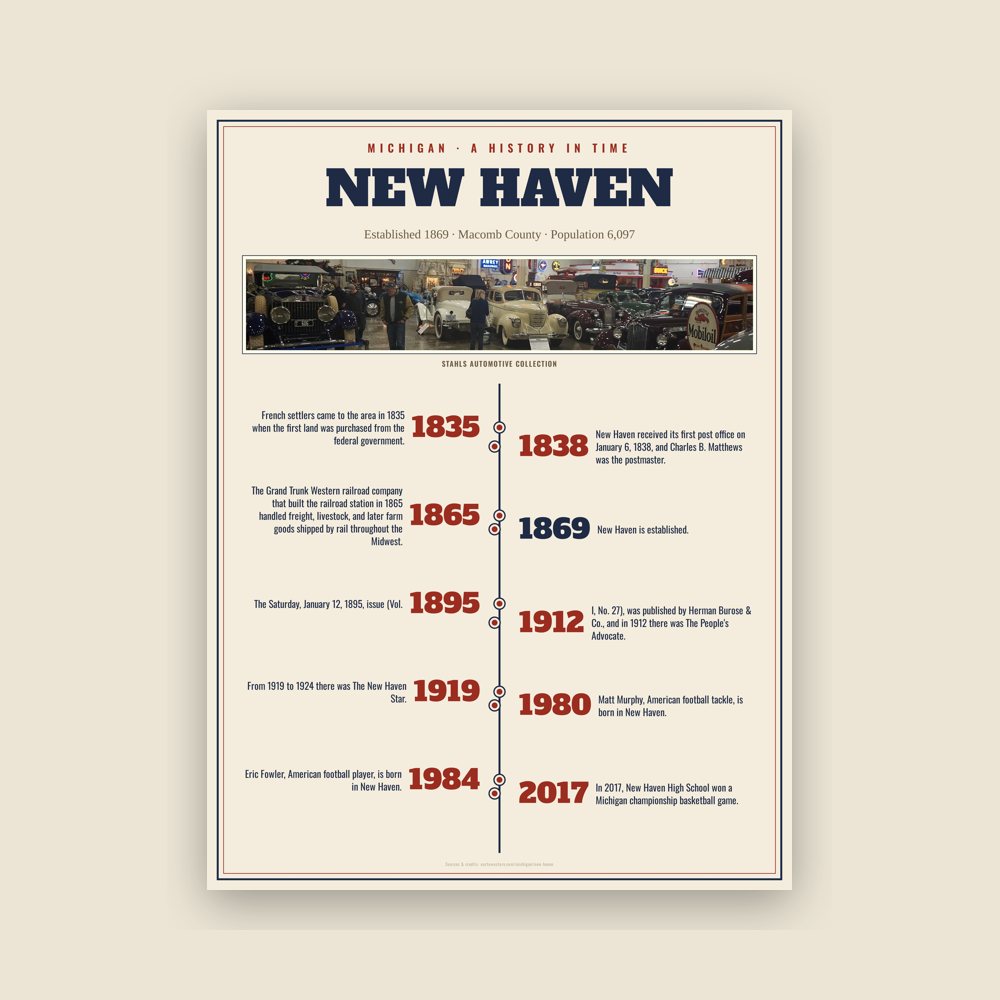
The first settlers in the New Haven area were chiefly the Native Americans of the Ojibwa tribe. The Swan Creek Chippewa is a predominant segment of the tribe. French settlers came to the area in 1835 when the first land was purchased from the federal government.
The settlement was originally called "New Baltimore Station" because of the Grand Trunk Western Railroad depot located there that did its main commerce with the village of New Baltimore, on Anchor Bay of Lake St. Clair and at the other end of the New Haven/Romeo plank road (also known as the Ashley/Romeo Plank Road) that served the area. The portion of the plank road that went through the village became the main road of New Haven. This road changes its name a few times, becoming Main Street in New Haven and Washington Street in New Baltimore.
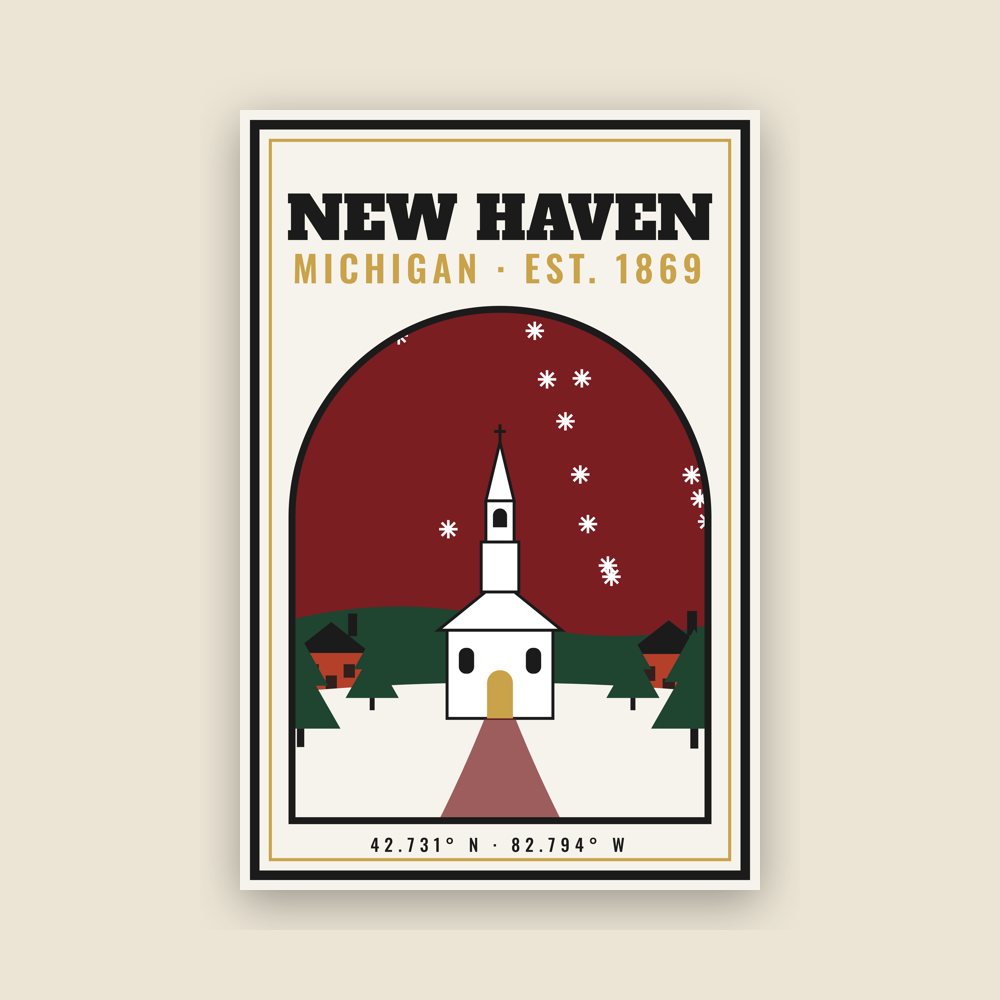
The Grand Trunk Western railroad company that built the railroad station in 1865 handled freight, livestock, and later farm goods shipped by rail throughout the Midwest. The depot had a living quarters for the station agent and his family at one end. With rounded windows in the Italianate style, it was similar to the Smiths Creek depot that is now in Greenfield Village. The depot is still located in its original location, one of the few in the Midwest that can claim that distinction. It has been restored as the village museum.
New Haven received its first post office on January 6, 1838, and Charles B. Matthews was the postmaster. Adam Bennett was the most active organizer of the village in its earliest days.
Benjamin L. Bates was elected as the first village president when the village of New Haven was incorporated on May 3, 1869. New Haven is the largest incorporated area in Lenox Township of Macomb County.
By around 1875, early industries in the village of New Haven included a general store, a sawmill, an iron foundry, a creamery, hardware store, a roller place that made flour, a farm supply business, two doctors, three flour, seed, and feed businesses, two garages to repair carriages and machinery of the day, a grocery and meat shop, a dry goods store, a drug store, a cooper (barrel) shop, two blacksmiths, two shoe and boot stores, a harness shop, a stove shop, two wagon shops, a livery stable, and a hotel chiefly known as the Graustark Hotel.
By the early 1900s, New Haven had electricity produced in a power house located on the north side of Ann Street, owned by Frank Phelps, also the owner of one of the first motorcars in the village. He had the dynamo that produced enough electricity to light the whole village located in the back of his building, originally called the Old Power House. In the front of the building he sold ice cream, candy and other items such as oyster stew. He would also project movies on weekend nights. He would use a large screen secured between two poles to project silent films (with phonograph accompaniment) to the townspeople.
New Haven had a few newspapers in its history. It appears that the village had two newspapers during 1895. The Saturday, January 12, 1895, issue (Vol. I, No. 19) of The Advance was published by T.A. Barnard. Single issues cost three cents; a yearly subscription could be had for a dollar. The Friday, November 22, 1895, issue of The Weekly Star (Vol. I, No. 27), was published by Herman Burose & Co., and in 1912 there was The People's Advocate. From 1919 to 1924 there was The New Haven Star. In the 1940s, there was the New Haven Herald, eventually purchased by the Anchor Bay Beacon of New Baltimore. In 2017, New Haven High School won a Michigan championship basketball game.
Adapted (trimmed) from the Wikipedia article New Haven, Michigan, revision 1381181309 by its contributors, licensed CC BY-SA 4.0.