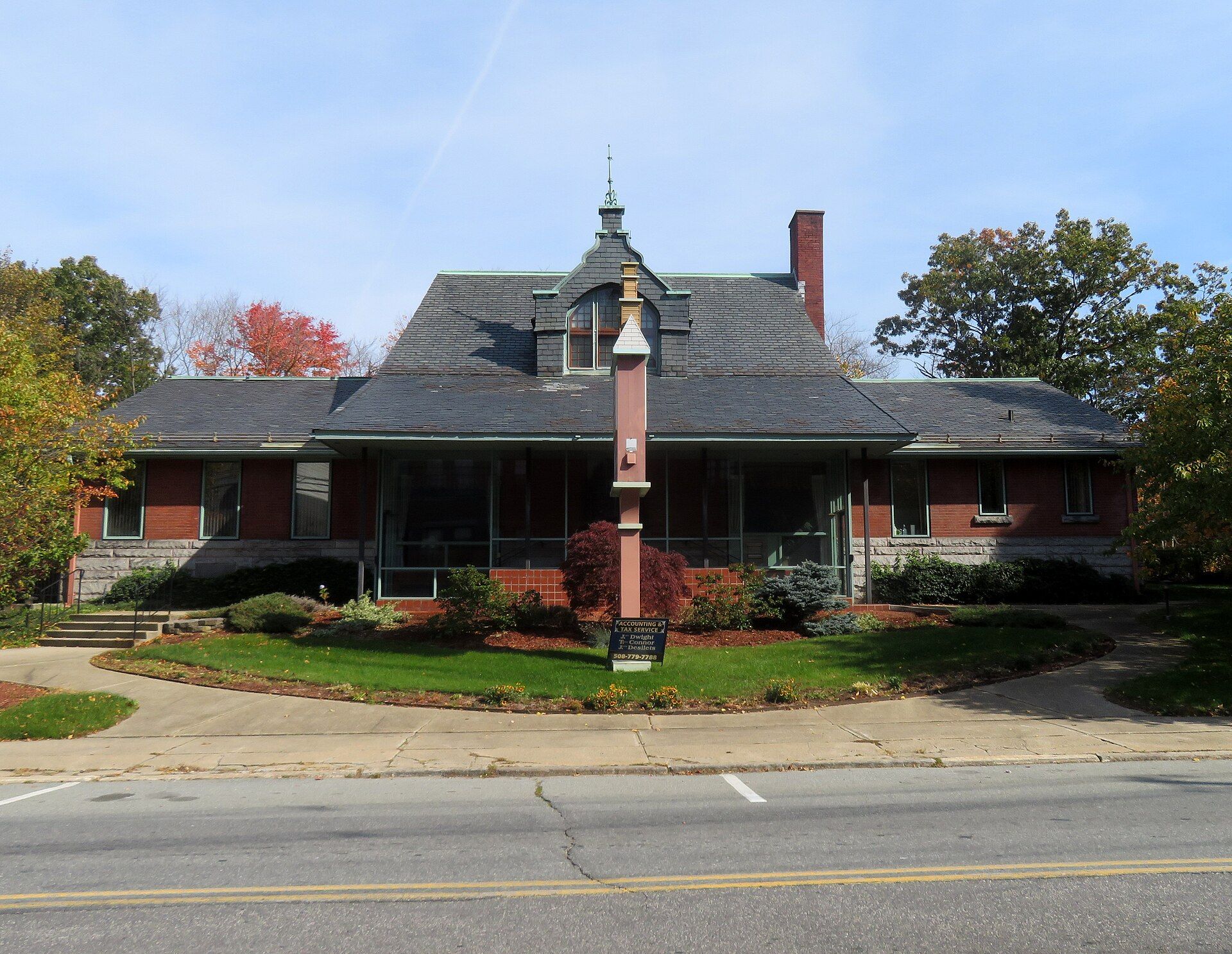
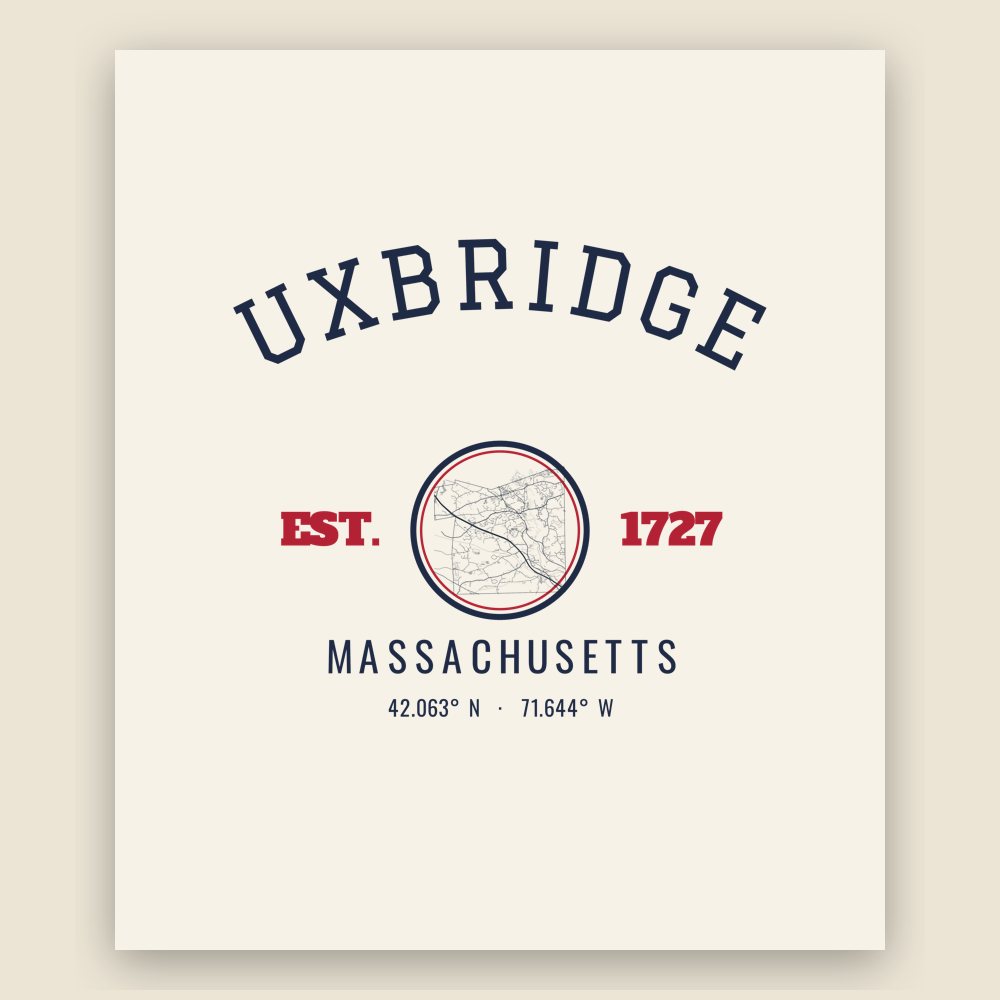
Uxbridge, a town in Worcester County, Massachusetts, was incorporated in 1727 from a part of Mendon, and named for the Earl of Uxbridge. Landmarks include Uxbridge station, Uxbridge Common District and Rogerson's Village Historic District. Uxbridge is the birthplace of Jeannine Oppewall, film art director.
Every piece is drawn from Uxbridge's own map data and historic archives, then printed and shipped from the USA when you order. No two towns look alike.
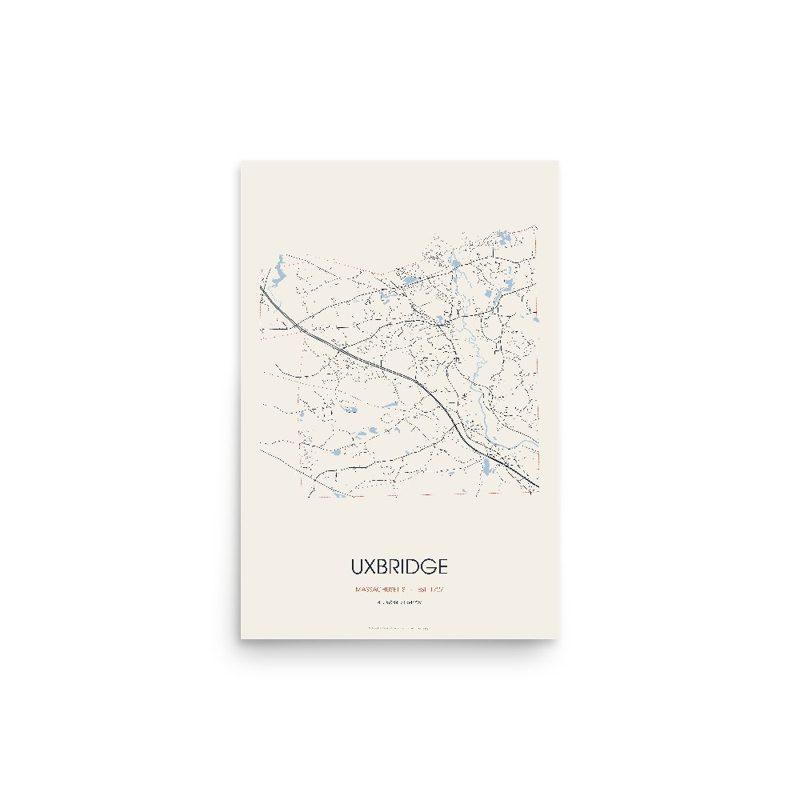
Every road in town, on archival matte paper
The same map, in navy and silver
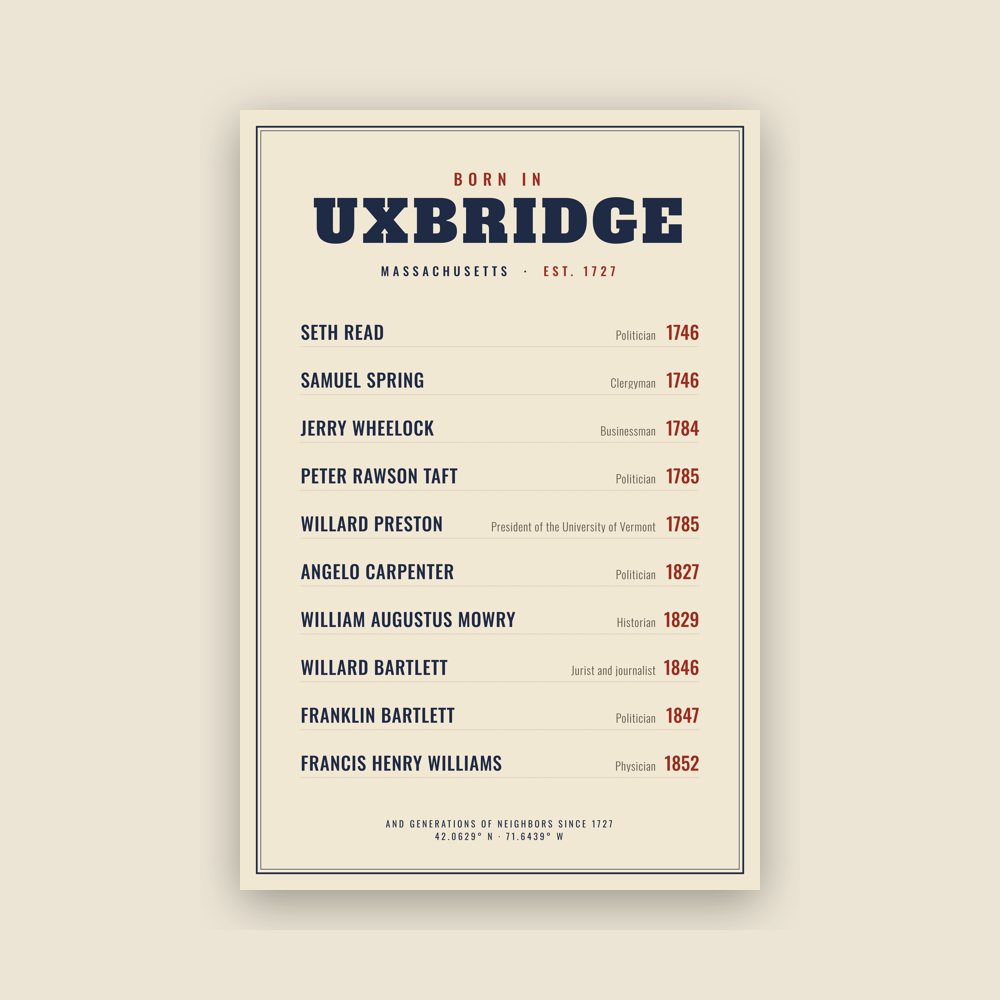
Famous natives, by birth year
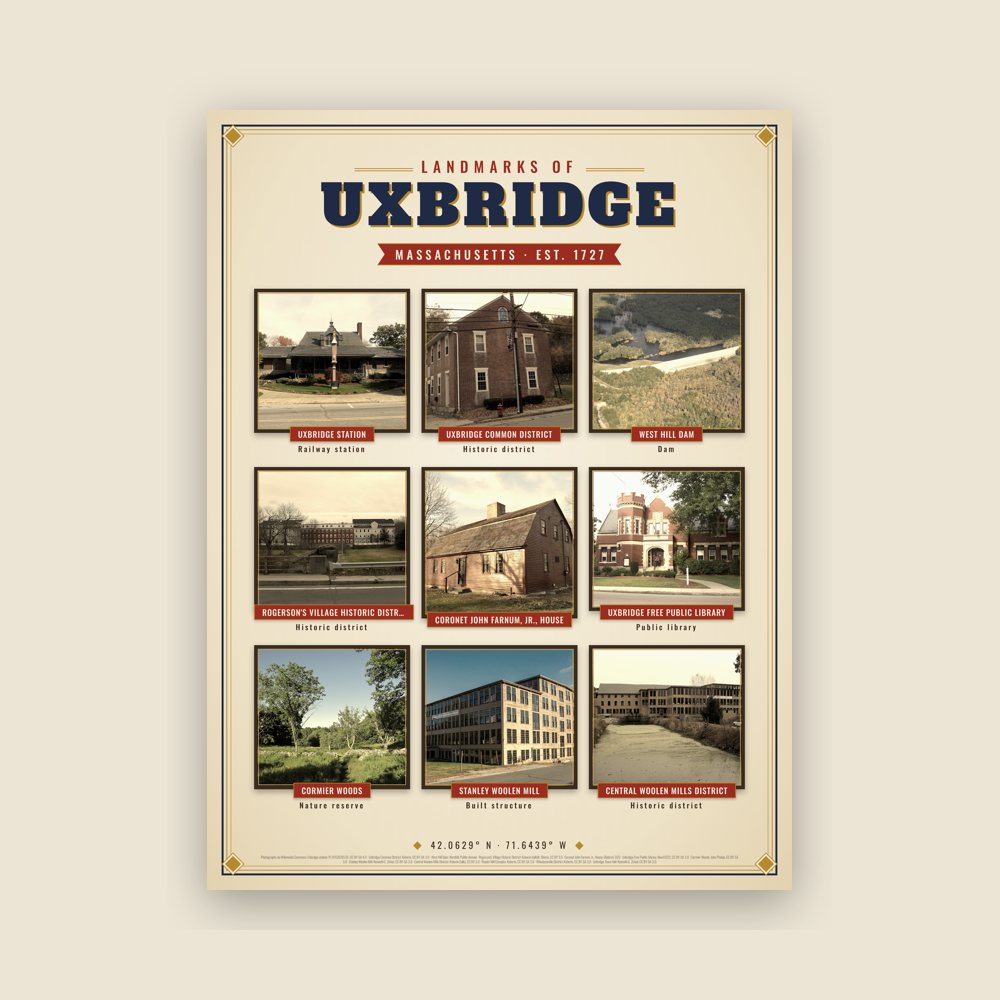
Nine local landmarks, archival matte
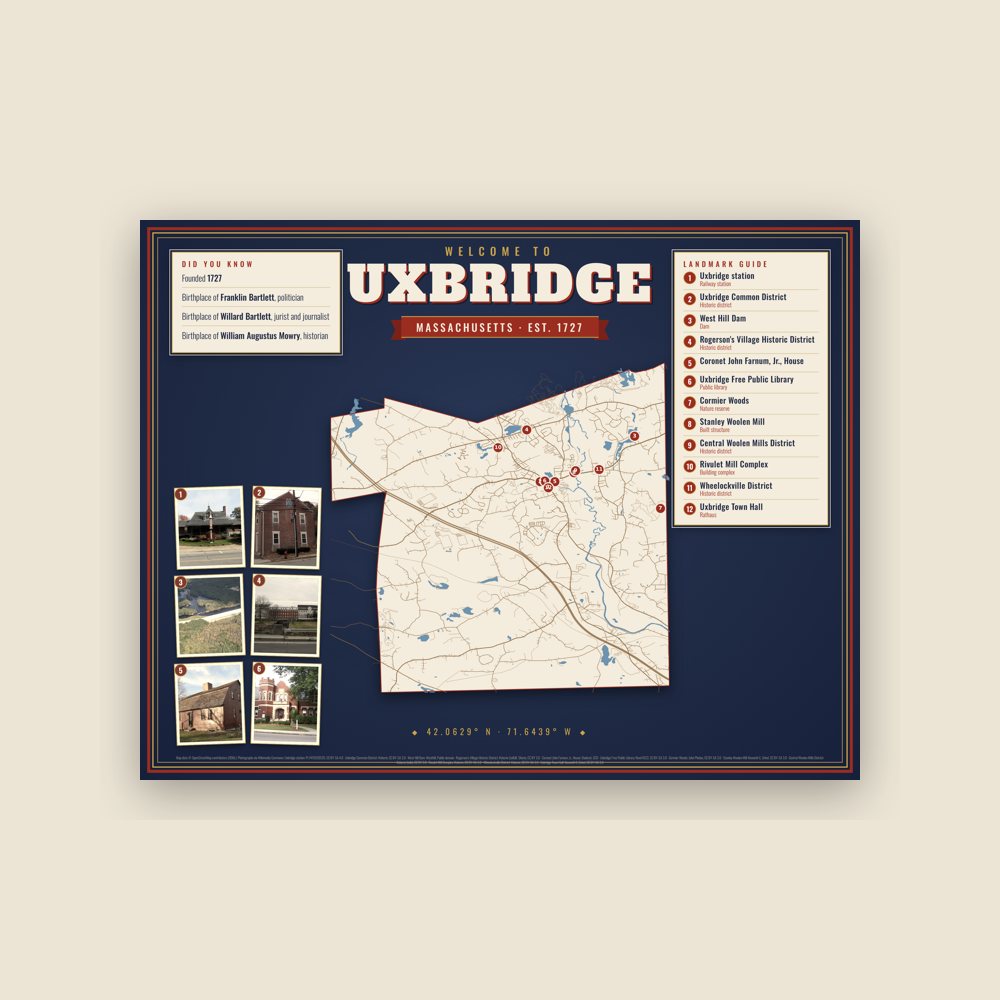
Map of local landmarks, washable fabric

Heavy-blend fleece, street map printed on the back

Soft Bella+Canvas jersey
Glossy ceramic, dishwasher safe
Ceramic keepsake, gold ribbon
Weatherproof, for the front walk
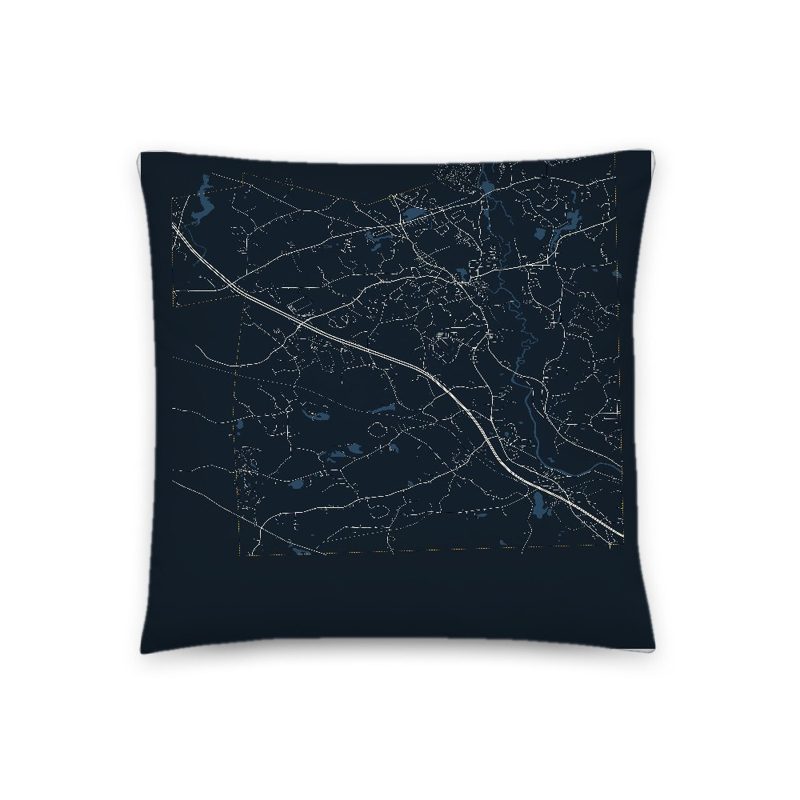
Soft-touch, zip cover

Sturdy all-over-print tote
Glossy top, cork back
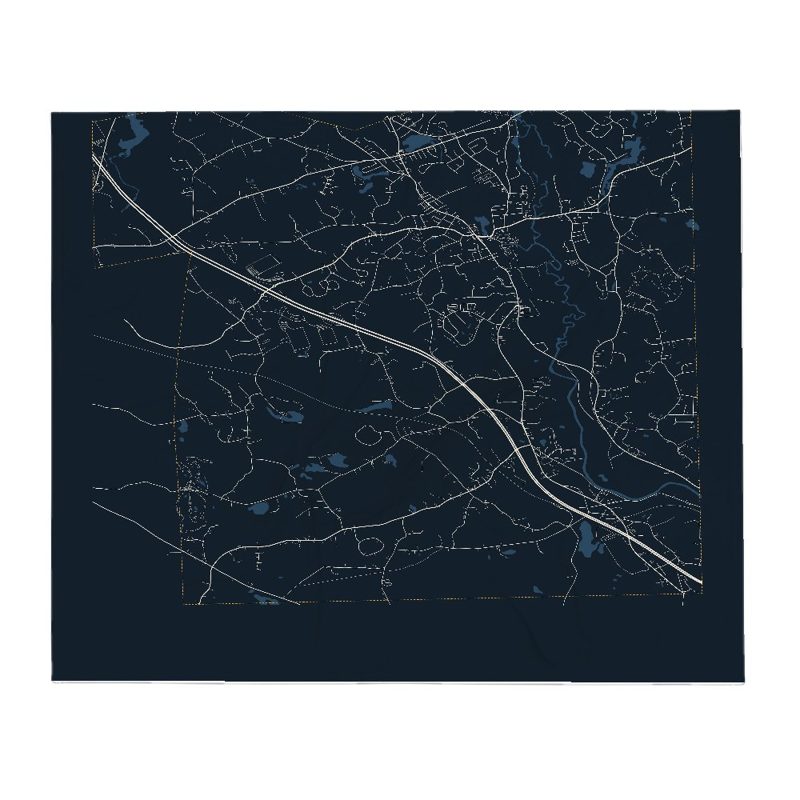
Soft fleece, 50″×60″
20 oz, double-wall stainless
Population 2010: 13,457 → 2020: 14,162
From Wikidata (CC0).
“Great John” aka Wutaushauk, Annawassanauke and Quashaamitt sold Squimshepauk plantation to settlers in September 1663, "for 24 pound Ster". Mendon began in 1667, burned in King Phillips War, and was resettled in 1680.
Western Mendon became Uxbridge in 1727, and Farnum House held the first town meeting. John Adams' uncle, Nathan Webb, was the first local minister in the Great Awakening. The American Taft family was prominent locally.
Colonial Uxbridge included Northbridge until 1772. In 1770, Colonel, James Fletcher, built his house, in Uxbridge and his forge later became Whitin Machine.
Seth and Joseph Read and Simeon Wheelock joined Committees of Correspondence. Baxter Hall was a Minuteman drummer. Seth Read fought at Bunker Hill. Washington stopped at Reed's tavern, en route to command the Continental Army. Samuel Spring was an early Revolutionary war chaplain. Deborah Sampson enlisted as "Robert Shurtlieff of Uxbridge".
Shays' Rebellion led Governor John Hancock to quell Uxbridge riots. Simeon Wheelock died protecting the Springfield Armory.
Quakers migrated from Smithfield, Rhode Island, and built mills, railroads, houses, tools and Conestoga wagon wheels. Southwick's store housed the Social and Instructive Library. Friends Meetinghouse had prominent abolitionists Abby Kelley Foster and Effingham Capron as members.
Caprons led the 450 member local anti-slavery society. Brister Pierce, a former Uxbridge slave signed an 1835 petition for abolition of slavery in the District of Columbia. The anti-slavery movement locally had leadership from the Unitarian and Quaker communities.
The Tafts built a Blackstone River bridge in 1709. "Teamsters" drove horse "team" freight wagons on the Worcester-Providence stage route. The Blackstone Canal brought horse-drawn barges to Providence through Uxbridge for overnight stops. The "crossroads village" was a junction on the Underground Railroad. The P&W Railroad ended canal traffic in 1848.
A 1732 vote "set up a school for ye town of Uxbridge". A grammar school was followed by 13 one-room district school houses, built for $2000 in 1797. The local Masonic Lodge housed the prestigious Uxbridge Academy (1818).
Uxbridge voted against the smallpox vaccine. Samuel Willard treated smallpox victims, and led the first private mental health asylum. Vital records recorded many infant deaths, the smallpox death of Selectman Joseph Richardson, "Quincy", "dysentary", and tuberculosis deaths. Leonard White recorded a malaria outbreak that led to early mosquito control efforts. Peter Emerick summarized the history of policing in Uxbridge.
Bog iron and iron forges marked the colonial era, with the inception of large-scale industries beginning around 1775. Examples of this development include the work of Richard Mowry, who built and marketed equipment to manufacture woolen, linen, or cotton cloth, and gristmills, sawmills, distilleries, and large industries. Daniel Day built the first woolen mill in 1809. By 1855, 560 local workers made 2,500,000 yards (2,300,000 m) of cloth (14,204 miles (22,859 km)). Uxbridge had twenty different industrial mills.
Innovations included power looms, vertical integration of wool to clothing, cashmere wool-synthetic blends, "wash and wear", yarn spinning techniques, and latch hook kits. Villages included mills, shops, worker housing, and farms.
Wm. Arnold's Ironstone cotton mill, later made Kentucky Blue Jeans, and Seth Read's gristmill, later housed Bay State Arms. Hecla and Wheelockville housed American Woolen, Waucantuck Mill, Hilena Lowell's shoe factory, and Draper Corporation. Daniel Day, Jerry Wheelock, and Luke Taft used water-powered mills. Moses Taft's (Central Woolen) operated continuously making Civil War cloth.
North Uxbridge housed Clapp's 1810 cotton mill, Chandler Taft's and Richard Sayles' Rivulet Mill, the granite quarry, and Rogerson's village.
Crown and Eagle Mill was "a masterpiece of early industrial architecture". Blanchard's granite quarry provided curb stones to New York City, the Statue of Liberty and regional public works projects. William Howard Taft, visited Samuel Taft House.
John Caprons mill pioneered US satinets and woolen power looms. Charles A. Root, Edward Bachman, and Harold Walter expanded Bachman-Uxbridge Worsted nationally, to lead the industry in woolens, synthetic blends and women's fashion. The local plant manufactured US Army uniforms for the Civil War, World War I, World War II, the nurse corps, and the first Air Force dress uniforms, dubbed "Uxbridge Blue". Uxbridge Worsted peaked in 1954 and closed a decade later.
The Uxbridge Worsted factory became Bernat Yarn’s largest plant until that also closed. Textile mills waned and were repurposed in later years.
The Blackstone river was restored after mills closed and the National Park service reproduced Project Zap curriculum for student engagement. The Blackstone River Valley National Heritage Corridor contains the 1,000-acre (4.0 km2)Blackstone Canal Heritage State Park, 9 miles (14 km) of the Blackstone River Greenway, the Southern New England Trunkline Trail (which has the interesting SNETT stone chamber south of Lee pond), West Hill Dam, a 567-acre wildlife refuge, parcels of the Metacomet Land Trust, and Cormier Woods. 60 Federalist homes were added to 54 national and 375 state-listed historic sites. Elmshade typified Georgian architecture. Capron's wooden mill survived a 2007 fire at the Bernat Mill. The Great Gatsby (1974) and Oliver's Story (1978) were filmed locally.
Adapted (trimmed) from the Wikipedia article Uxbridge, Massachusetts, revision 1379296796 by its contributors, licensed CC BY-SA 4.0.
We share a part of every Uxbridge sale with local partners, and we'd love to print from your collection. Old photographs, maps and postcards make the best keepsakes.
Partner with us