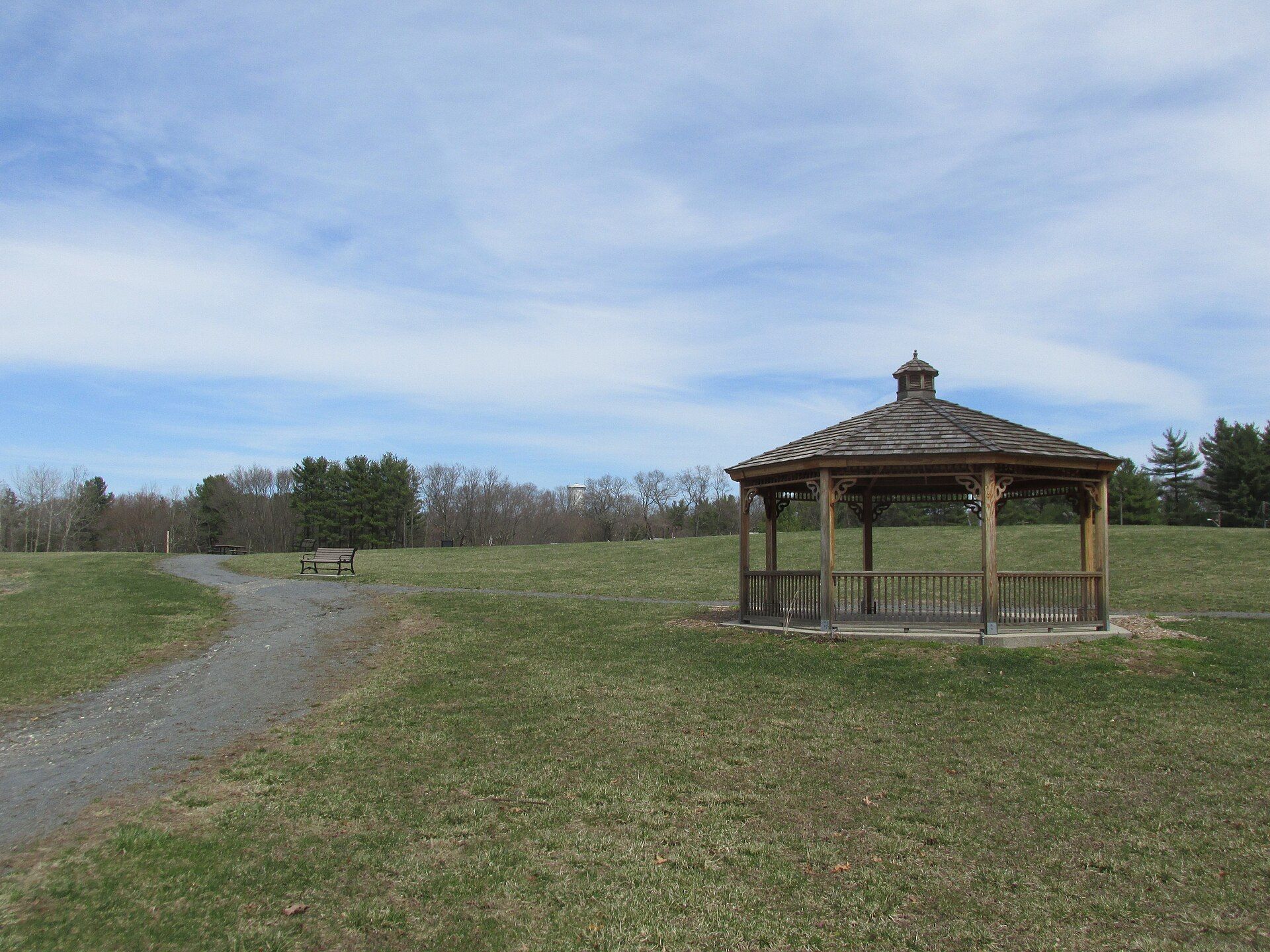
Supreme Court decision resolving a longstanding border dispute between Massachusetts and Rhode Island, a portion of Tiverton, Rhode Island was awarded to Massachusetts to become part of Fall River, while two-thirds of Seekonk was awarded to Rhode Island. Landmarks include Seekonk Meadows Park. Seekonk is the birthplace of Troy Pina, cape Verdean swimmer.
Every piece is drawn from Seekonk's own map data and historic archives, then printed and shipped from the USA when you order. No two towns look alike.
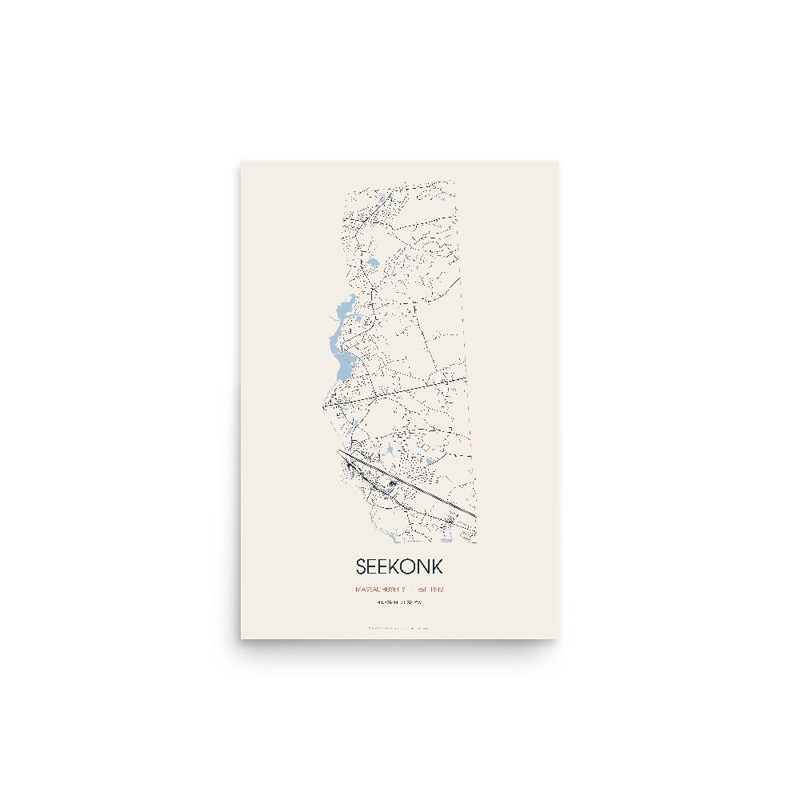
Every road in town, on archival matte paper
The same map, in navy and silver
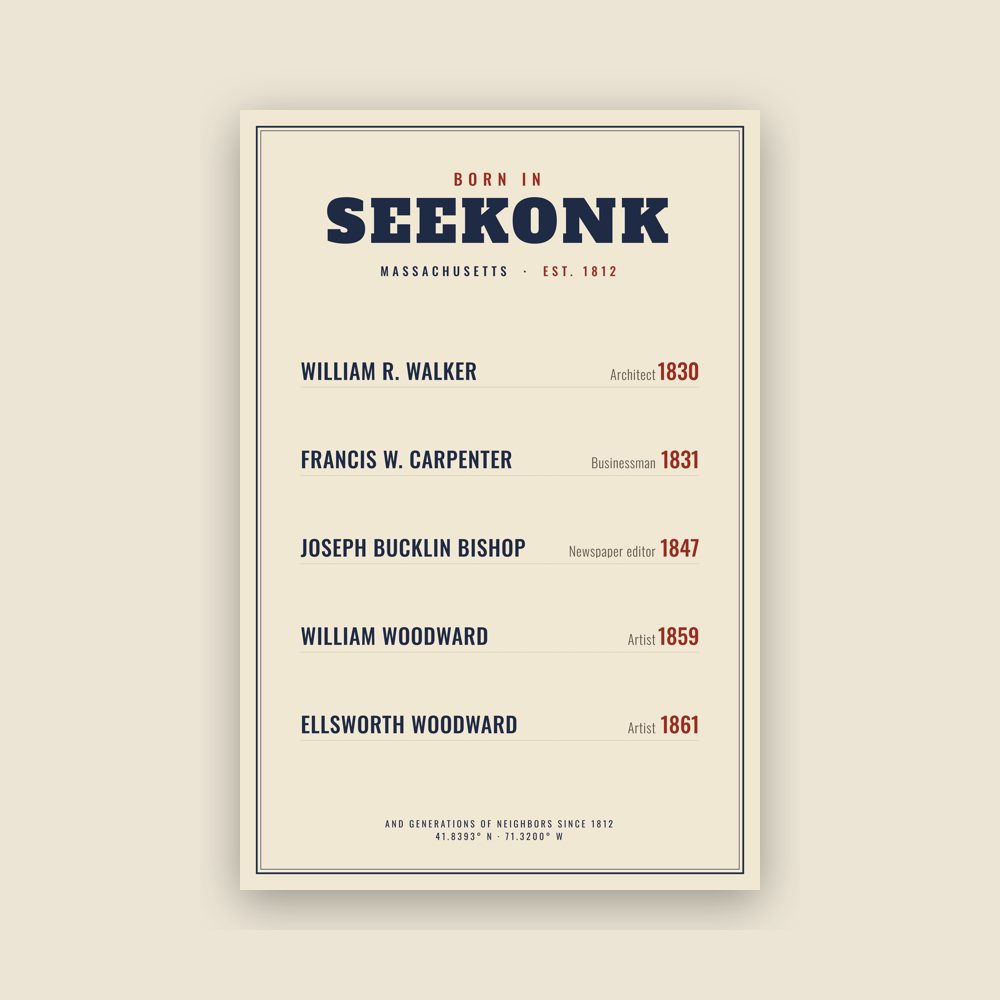
Famous natives, by birth year
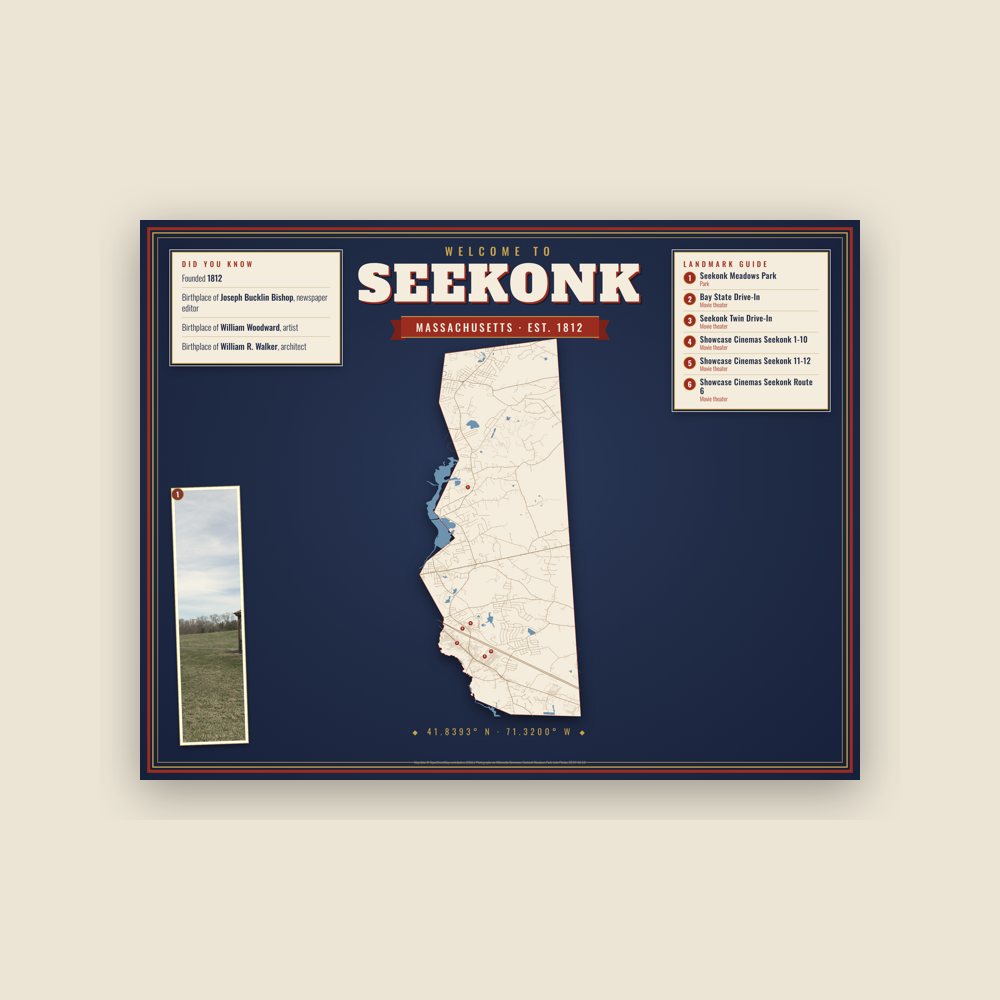
Map of local landmarks, washable fabric
Heavy-blend fleece, street map printed on the back
Soft Bella+Canvas jersey
Glossy ceramic, dishwasher safe
Ceramic keepsake, gold ribbon
Weatherproof, for the front walk
Soft-touch, zip cover
Sturdy all-over-print tote
Glossy top, cork back
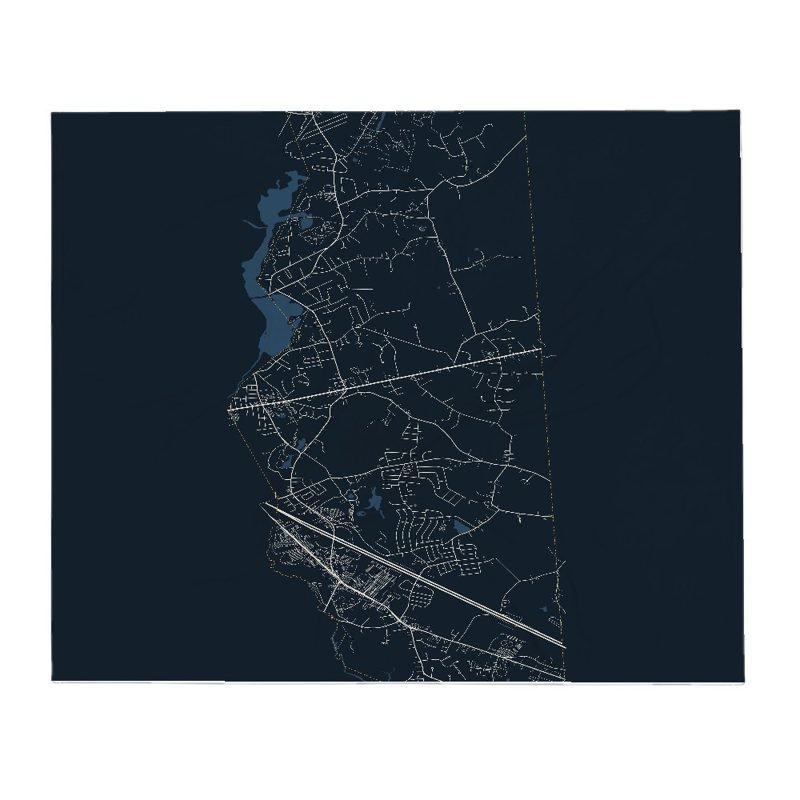
Soft fleece, 50″×60″
20 oz, double-wall stainless
Population 2010: 13,722 → 2020: 15,531
From Wikidata (CC0).
The earliest known inhabitants of Seekonk were Native Americans from the Wampanoag Tribe. The name Wampanoag means People of the Morning Light. This name refers to the geographical area of the tribe. Living in the East they would be the first people to greet the sun each morning. The area now known as Seekonk and Rehoboth provided agricultural and water resources with abundant food supplies. During the warm summer months the Natives spent time near the rivers and oceans in what is now Southeastern Massachusetts. In the winter months the Natives lived inland, including several locations in Seekonk. At one time there were three Native American villages in the area we now call Seekonk.
There have been many spellings of the name Seekonk. Some of the various spellings include Seconch, Sink Hunk, Secquncke, Seaconke, and Squannakonk. The symbol of the goose in flight is used on the Town Seal.
The chief of the Wampanoags at the time the colonists settled in Southeastern Massachusetts was known as Massasoit Ossamequin and had been seriously affected by a plague just prior to the arrival of the Pilgrims at Plymouth. A large number of Wampanoag Indians had been killed by this illness. Most historians believe this plague to have been yellow fever.
Massasoit decided to make a peace treaty with the new immigrants for a number of reasons. Perhaps the most important factor was that the Wampanoags were fearful of being overtaken by the Narragansett Indians who lived nearby. Ossamequin believed an alliance with the English would help to secure the safety of his people.
In 1641, the local Native Americans had granted a large part of modern-day Seekonk to purchasers from Hingham, including Edward Gilman Sr., Joseph Peck, John Leavitt and others. In 1653 Ossamequin and his son Wamsetto, also known as Alexander to the English, signed a deed granting the land that is now Seekonk and the surrounding communities to Thomas Willitt, Myles Standish and Josiah Winslow.
The Wampanoags were paid 35 pounds sterling by the English settlers, for instance, for the sale to Willitt, Standish and Winslow.
Three of the earliest English men to settle in the area now known as Seekonk and Providence were William Blackstone, Roger Williams and Samuel Newman. These men and their followers proved it was possible to provide a living away from the coastal areas. This allowed groups of individuals to separate themselves from Puritan control. In turn this led to a greater diversity of culture and religious and philosophical freedom. It was only by forming alliances with the Native Americans in both the Wampanoag and Narragansett tribes that these early settlements were able to flourish.
Massasoit lived until he was 80 years old. While he lived, his people and the settlers lived in relative peace. He was followed in power by his son Wamsetto, also known as Alexander. This chief died shortly after his father and was replaced by his brother Metacomet, also known as King Philip.
In 1675, King Philip's War began and both sides saw this as an opportunity to claim the land for their people and their way of life. Metacomet and his people ultimately lost the war, and the chief was killed by a mixed group of English and Indian fighters led by Benjamin Church. He was beheaded and his head stayed on public display on a pole in Plymouth for 25 years.
For the next 200 years, the area now known as Seekonk was primarily a farming community. Accounts of Town Meetings during these years communicate just how contentious deciding what was best for this area could be. Boundary disputes were common and the land that is now Rehoboth, East Providence, Pawtucket and Seekonk was claimed by both Rhode Island and Massachusetts. In 1812, the border disputes were settled by the Massachusetts courts and the present town of Seekonk was incorporated. Two industrial villages developed to supplement the agricultural economy, with such businesses as the Rumford Chemical Works. But what had become the industrial area of Seekonk in the late-18th and early-19th century was lost when East Providence was incorporated in 1862, taking half of the town's territory, two-thirds of its valuation and more than two-thirds of its population. The town remained basically agricultural into the 20th century, although the Kent Manufacturing Company did make tennis racquets and croquet sets on the upper reaches of the Tenmile River. With the opening of the Providence and Taunton street railway in 1891, Seekonk became an increasingly residential suburb of Providence.
Very few farms still exist in Seekonk. Developers have turned the farms into housing divisions and Seekonk is used largely as a suburban home community for people who work in the Rhode Island and Boston areas. It is now well known for its retail area along Route 6, which includes several different chain stores and restaurants, Seekonk Speedway, a 1/3 mile oval track located along Route 6, as well as Seekonk Grand Prix, with multiple amusement rides and miniature golf. A longtime cinema on Route 6 closed in 2025. Although there has been a great deal of building in Seekonk since the Wampanoags first lived here, one can still see many of the "black" Canada geese which give the town its name.
Adapted (trimmed) from the Wikipedia article Seekonk, Massachusetts, revision 1374931336 by its contributors, licensed CC BY-SA 4.0.
We share a part of every Seekonk sale with local partners, and we'd love to print from your collection. Old photographs, maps and postcards make the best keepsakes.
Partner with us