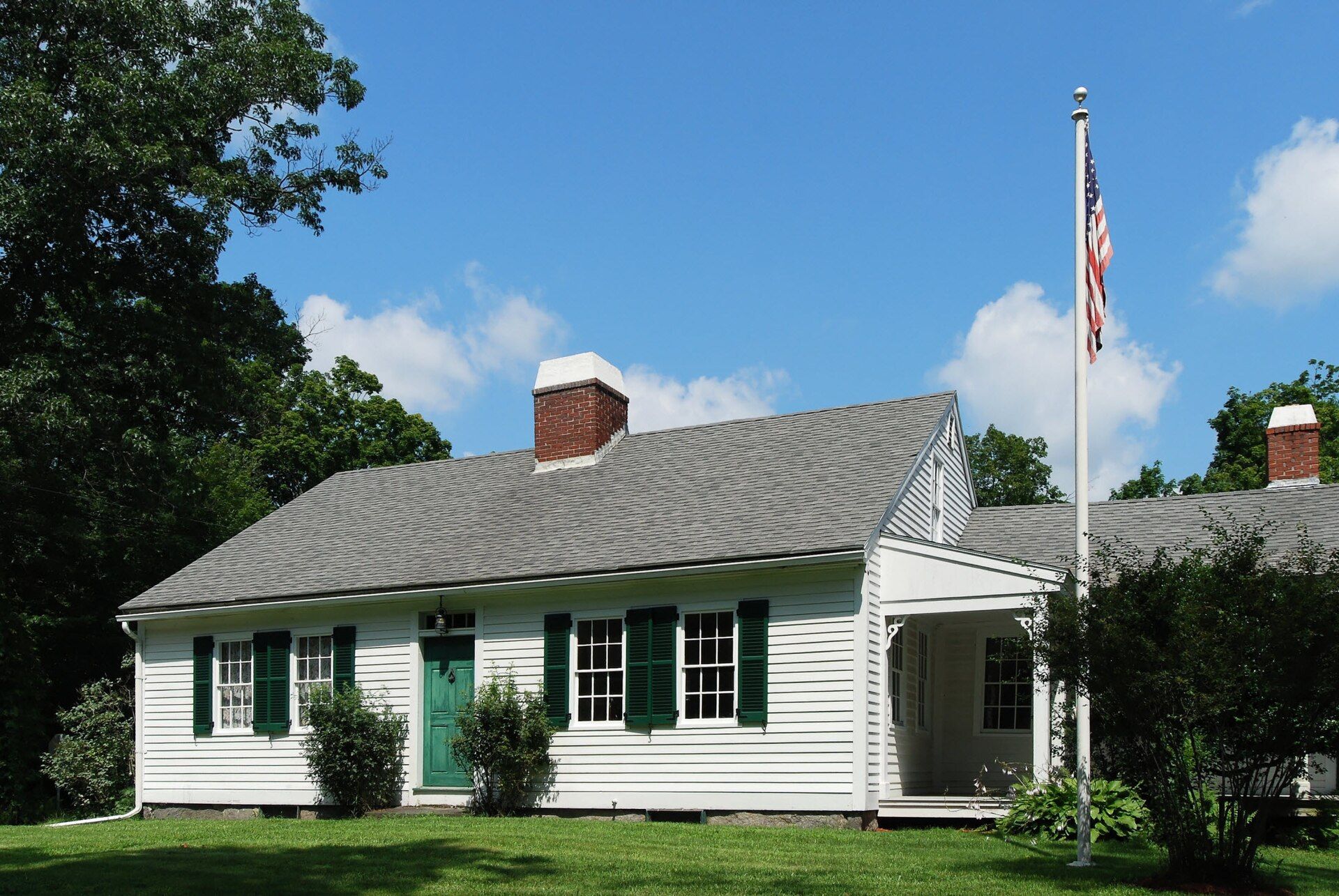
Present day Oxford and the areas surrounding it were inhabited for thousands of years before European colonization. Landmarks include Huguenot Fort, Clara Barton Homestead and Hudson House. Oxford is the birthplace of Clara Barton, civil War nurse.
Every piece is drawn from Oxford's own map data and historic archives, then printed and shipped from the USA when you order. No two towns look alike.
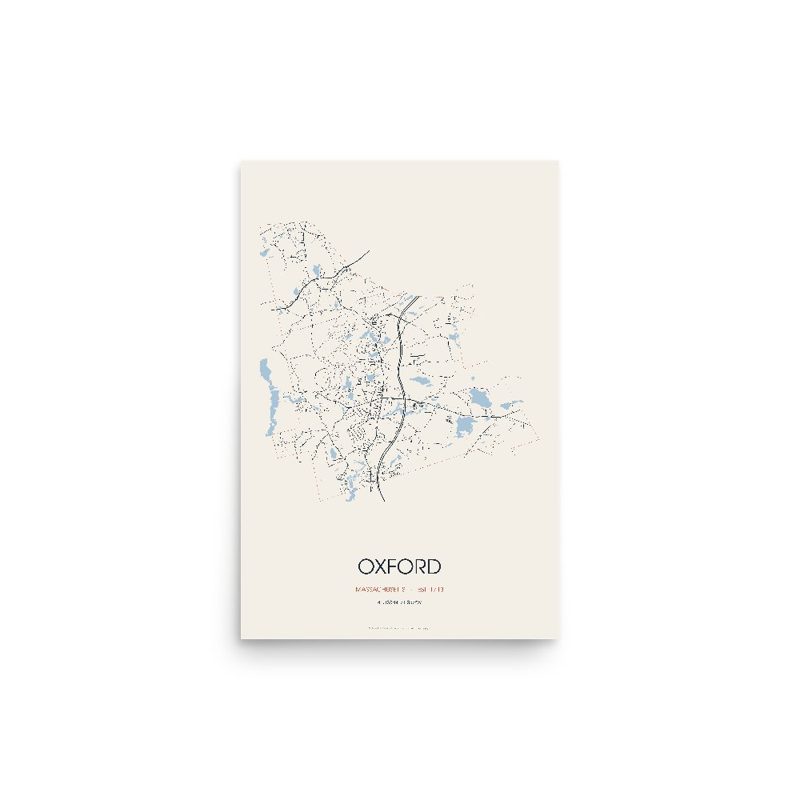
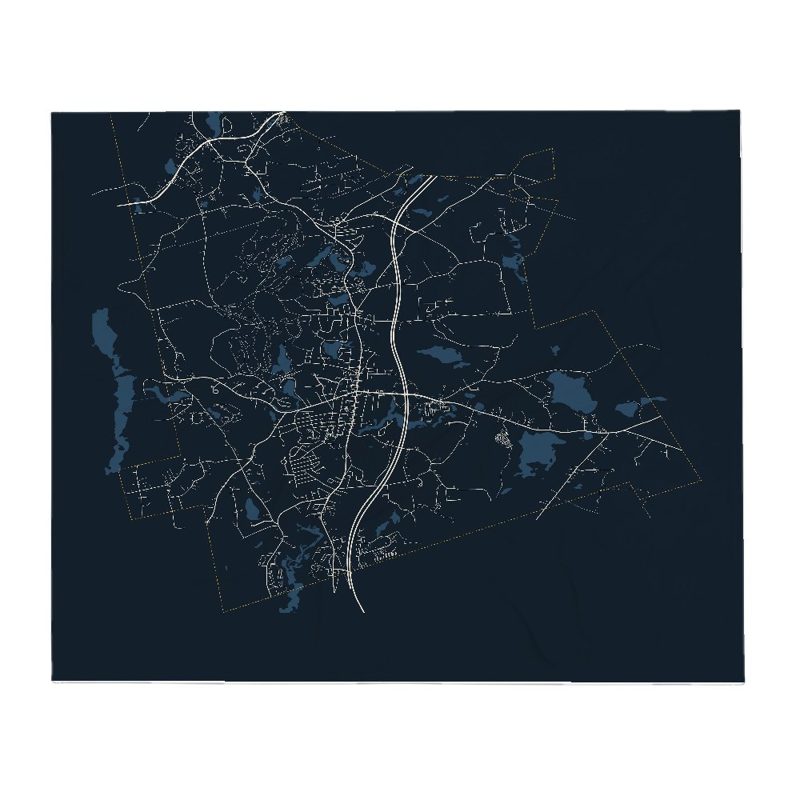
Every road in town, on archival matte paper
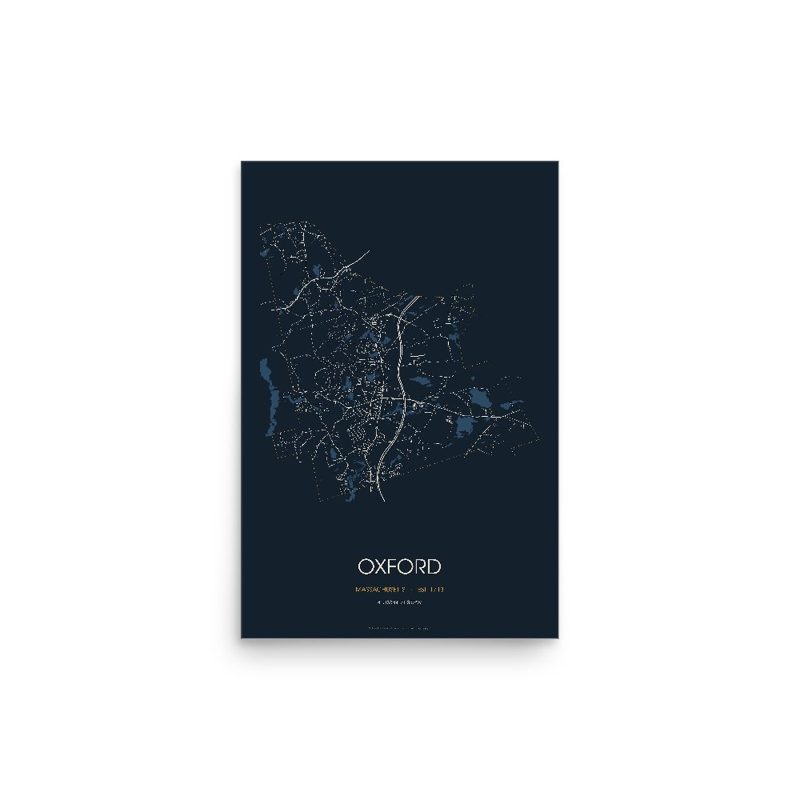
The same map, in navy and silver
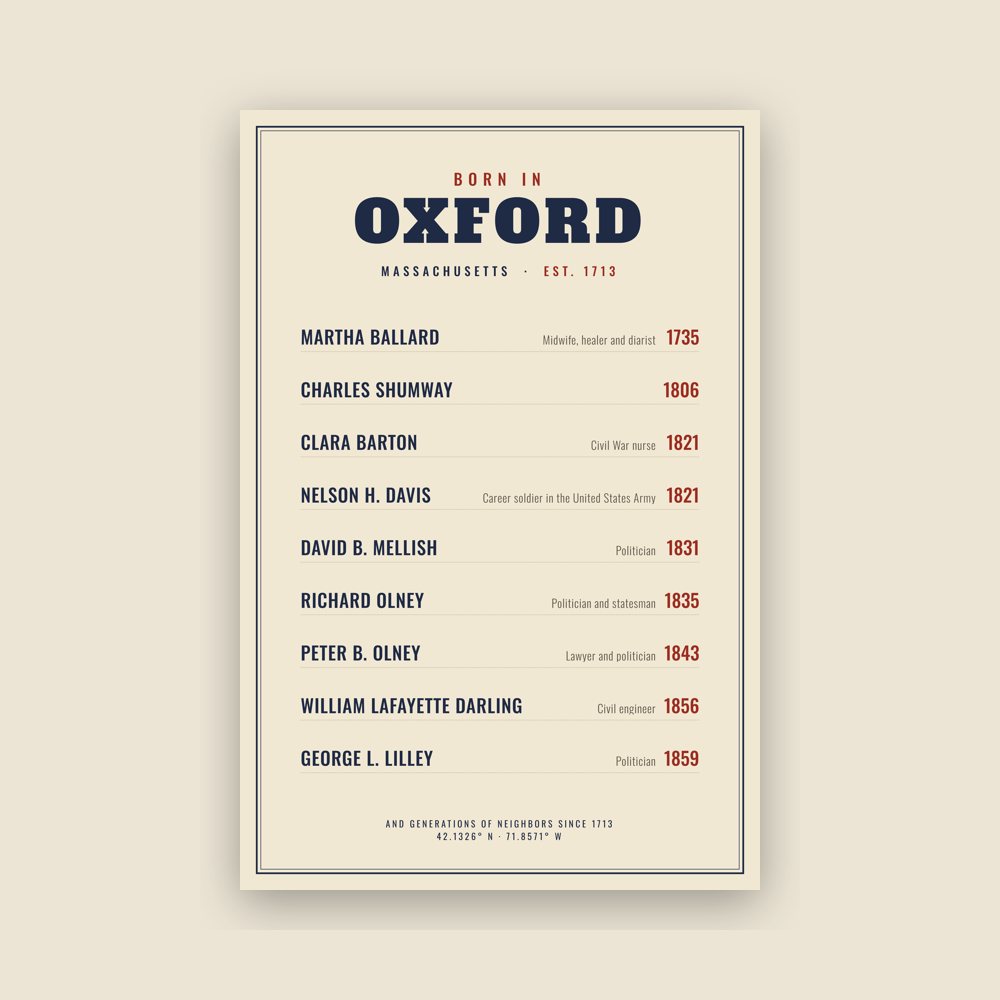
Famous natives, by birth year
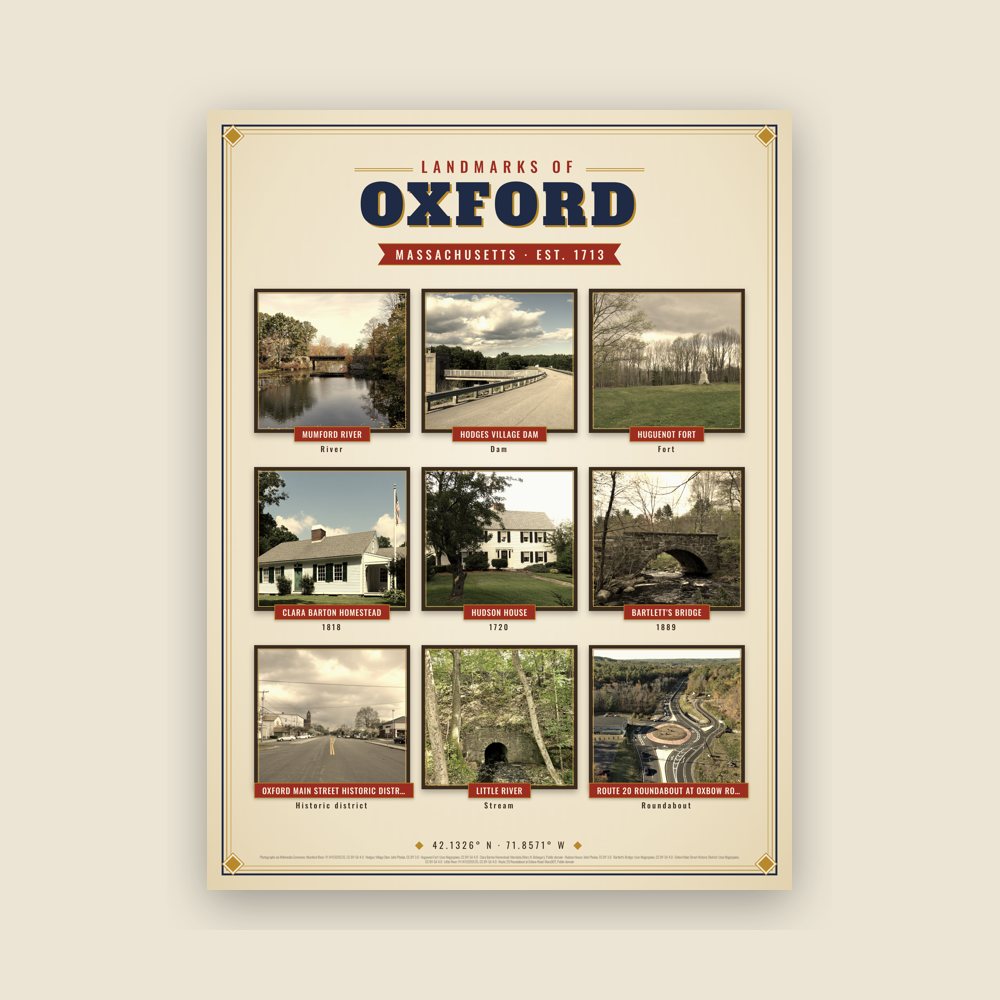
Nine local landmarks, archival matte
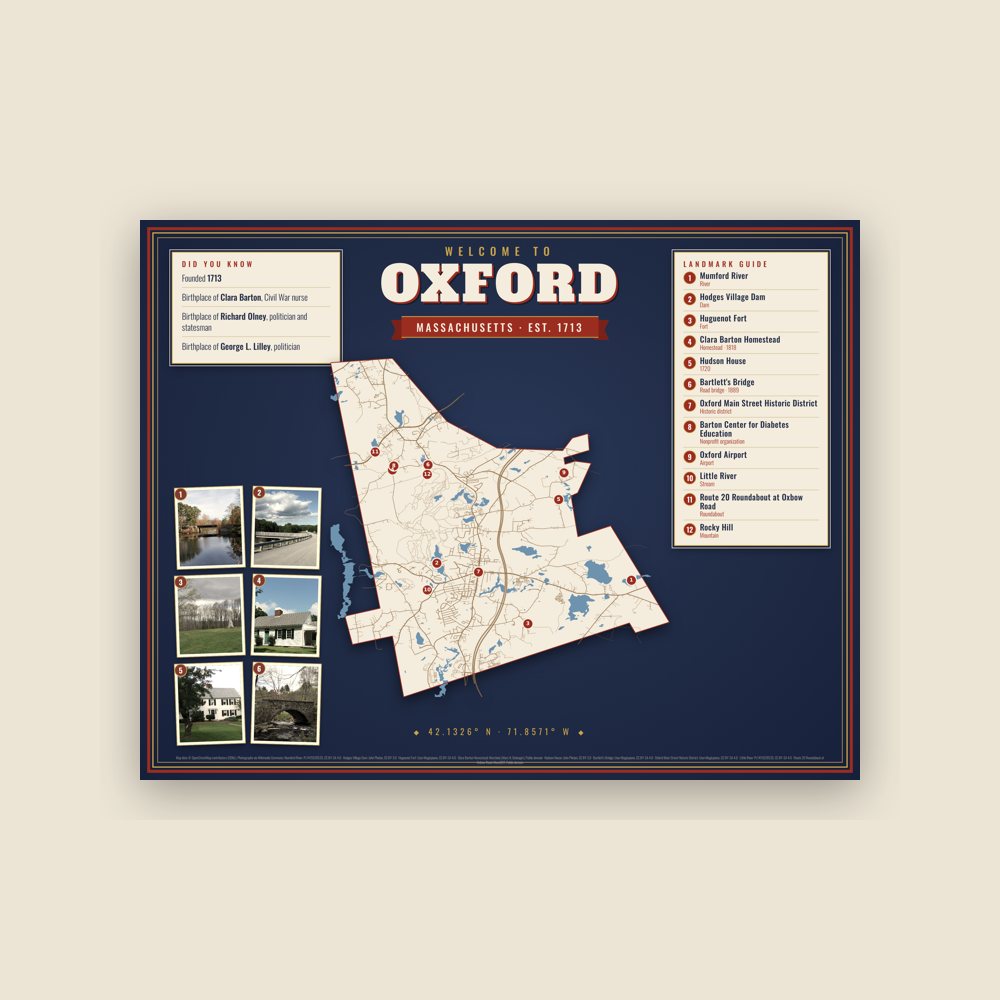
Map of local landmarks, washable fabric
Heavy-blend fleece, street map printed on the back
Soft Bella+Canvas jersey
Glossy ceramic, dishwasher safe
Ceramic keepsake, gold ribbon
Weatherproof, for the front walk
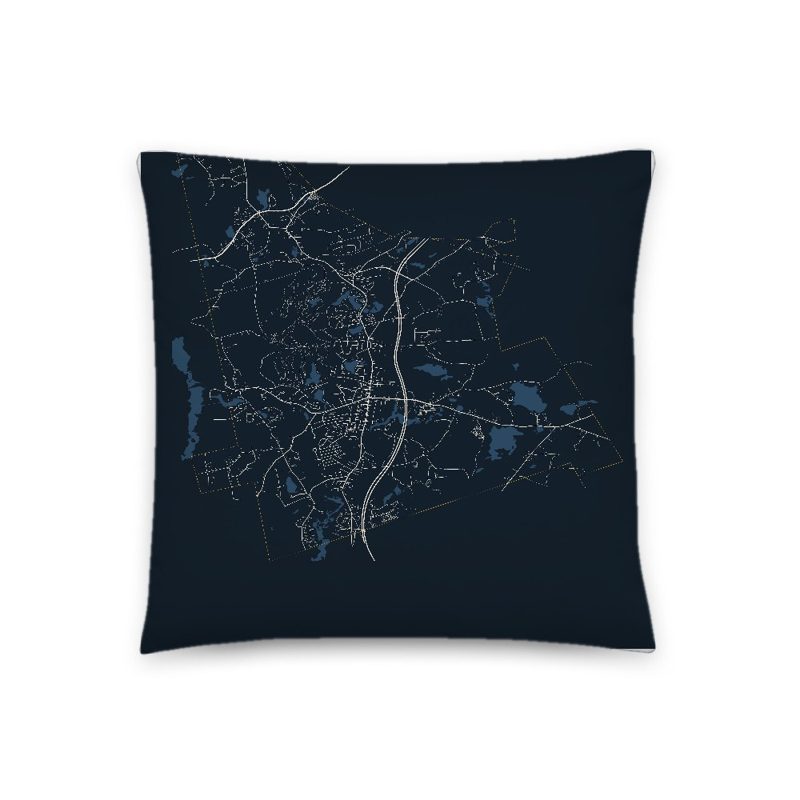
Soft-touch, zip cover
Sturdy all-over-print tote
Glossy top, cork back
Soft fleece, 50″×60″
20 oz, double-wall stainless
Population 2000: 13,352 → 2010: 13,709 → 2020: 13,347
From Wikidata (CC0).
Present day Oxford and the areas surrounding it were inhabited for thousands of years before European colonization. Although archaeological sites exist in Central Massachusetts dating back to the Paleoindian period (12,000–9000 years before present) there are much more abundant archaeological remains starting in the period from 6500 to 3000 years before present, including an arrowhead identified in Oxford Massachusetts. An arrowhead collected at an archaeological site in Oxford has been radiocarbon dated to 2990 ± 155 years before present.
At the time of English colonization in the early and mid-1600s, the area was inhabited by the Pegan subgroup of the Nipmuc people, whom the English attempted to convert to Christianity. To this end, out of unceded Nipmuc lands, the Society for the Propagation of the Gospel in New England created the praying town of Manchaug in the early 1670s, which included present day Oxford in its bounds. In 1674 around 60 native people lived in Manchaug, however residents fled the town during King Phillip's War when praying towns were targeted by both colonial and Wampanoag war parties: for example, despite their neutrality in the conflict, in 1676 the neighboring Nipmuc praying town of Chaubunagungamaug was attacked by the colonial militia and 52 people were killed or captured.
After King Philip's War, neighboring Chaubunagungamaug was the only inhabited Nipmuc praying town, and in 1681-1682 the constable of Chaubunagungamaug, known as Black James, acting on behalf of the Nipmuc Praying Indians (though not their non-Christianized counterparts), signed a deed selling large tracts of land in the Chaubunagungamaug and Manchaug to investors including Joseph Dudley in Roxbury and Robert Thompson in London. This sale included the present day town of Oxford.
Oxford was first colonized intermittently by Europeans in 1687, with several breaks during the French and Indian Wars, and was officially incorporated in 1713. In 1687, Robert Thompson arranged for a group of 52 French Huguenots he had connected with in London to colonize the land recently purchased from Black James. During this early period the Huguenot settlement grew to about 70 individuals, while Native settlements remained in the area numbering around 40 families.
In 1694, the Huguenot colonists built the Huguenot Fort out of concern for conflict with local Native Americans after the outbreak of hostilities between the Massachusetts colony and the Wabanaki Confederacy in King William's War. The original settlement was abandoned after four residents (John Johnson and his three children, Peter, Andrew and Mary) were killed in a violent confrontation with local Native Americans. This event, the "Johnson Massacre," is commemorated near the south end of town on Main Street. The remains of the Huguenot Fort still exist near Huguenot Road.
The English investors who received the deed from Black James in 1682 continued to try to recruit settlers to the Oxford area, and by 1720, a group of around 30 English families had founded a new church there with a new minister. From 1699 to 1704, Huguenot settlers attempted to return to the settlement but it was abandoned again during Queen Anne's War. The first town clerk of Oxford was John Town, who also served as selectman and as a church deacon.
Adapted (trimmed) from the Wikipedia article Oxford, Massachusetts, revision 1378783017 by its contributors, licensed CC BY-SA 4.0.
We share a part of every Oxford sale with local partners, and we'd love to print from your collection. Old photographs, maps and postcards make the best keepsakes.
Partner with us