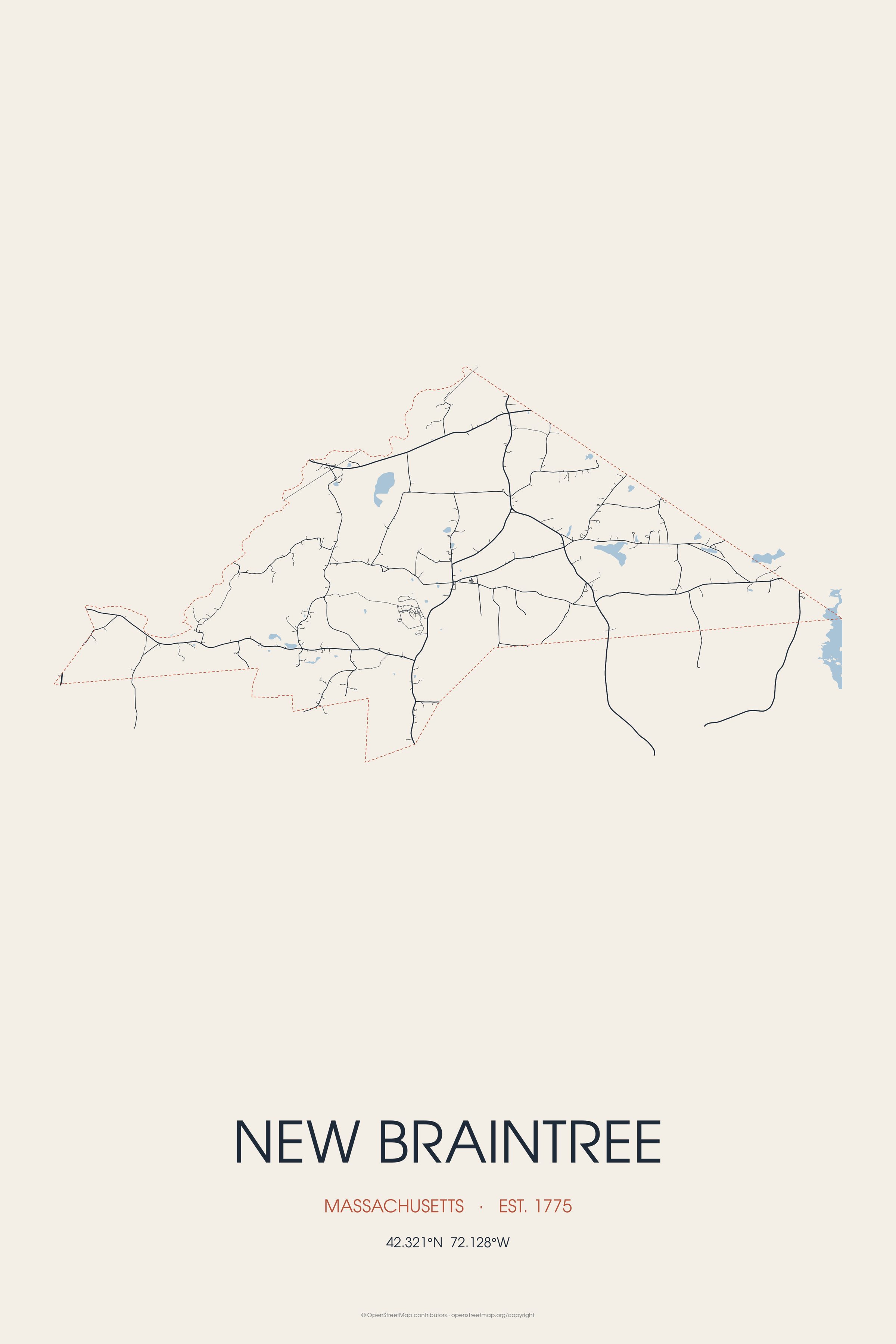
Before being settled by re-located residents of Braintree, Massachusetts, New Braintree was occupied by various Native American groups for at least 9,000 years. New Braintree is the birthplace of Charles Delano, politician.
Every piece is drawn from New Braintree's own map data and historic archives, then printed and shipped from the USA when you order. No two towns look alike.
Every road in town, on archival matte paper
The same map, in navy and silver
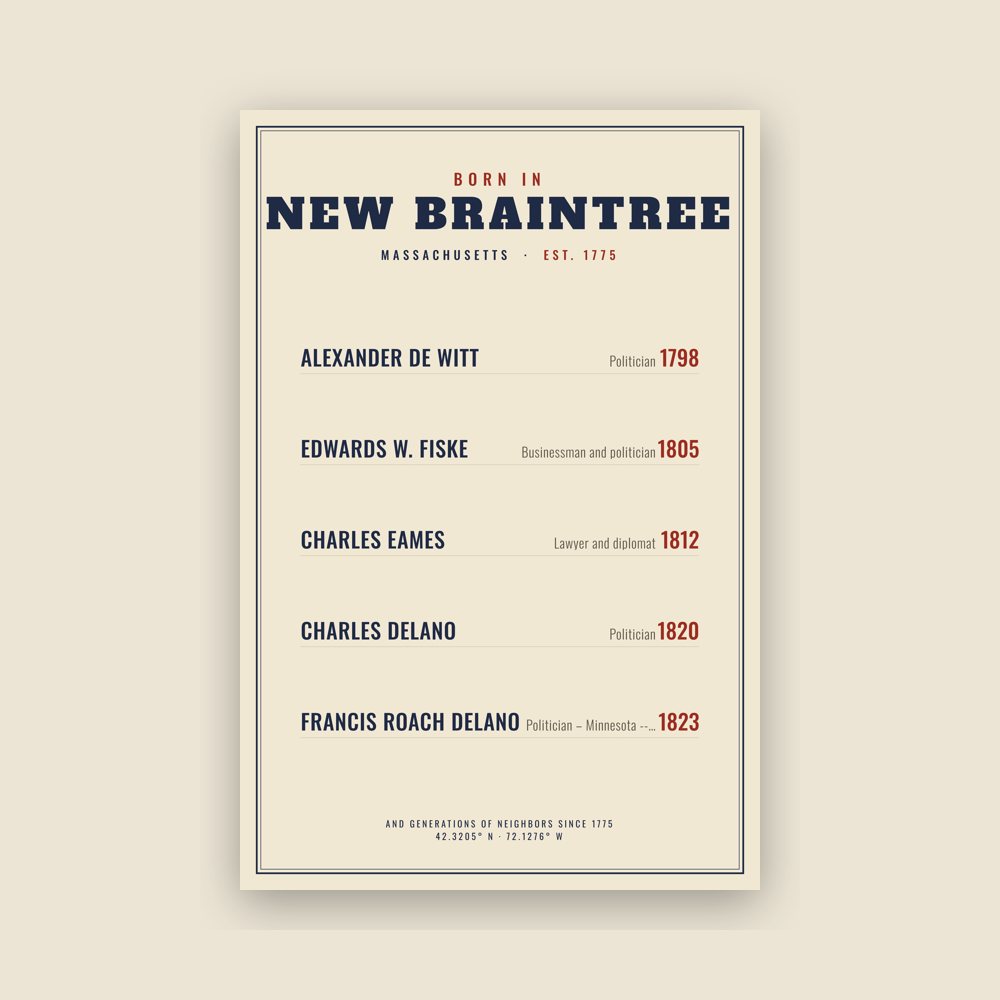
Famous natives, by birth year
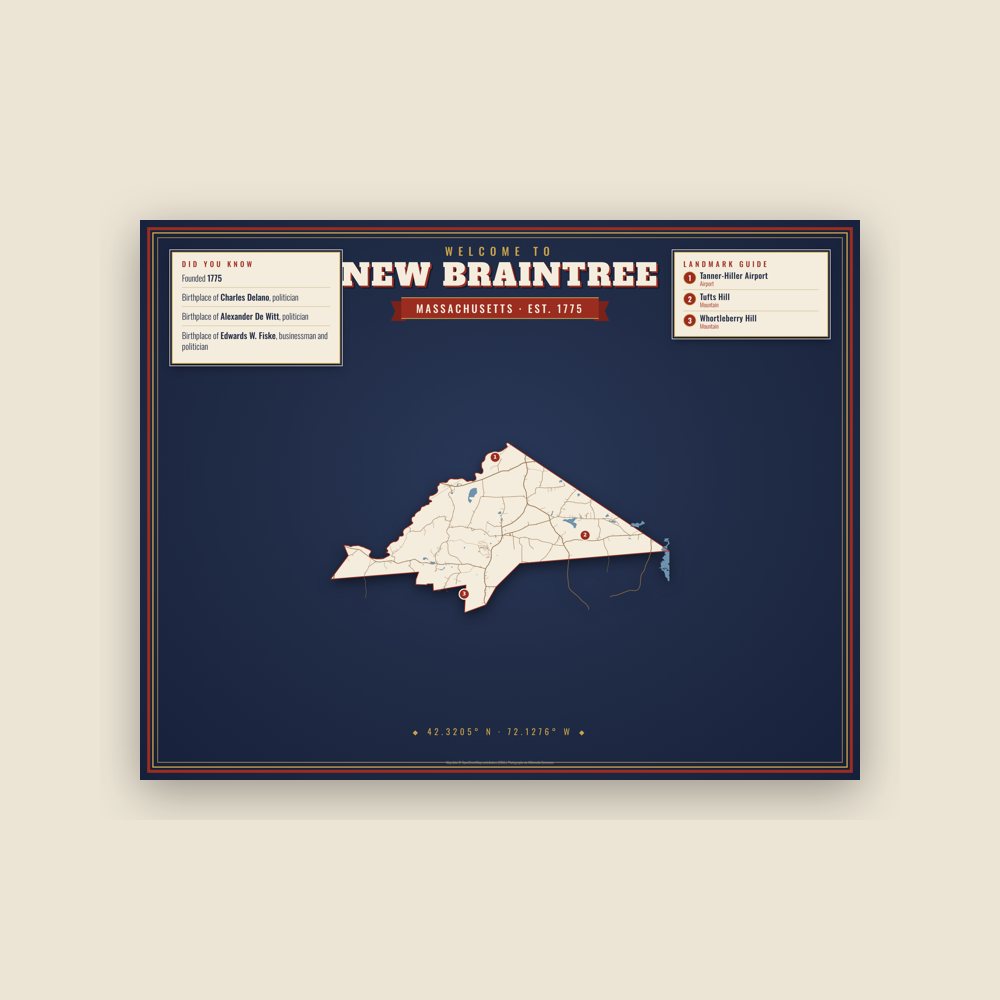
Map of local landmarks, washable fabric
Heavy-blend fleece, street map printed on the back
Soft Bella+Canvas jersey
Glossy ceramic, dishwasher safe
Ceramic keepsake, gold ribbon
Weatherproof, for the front walk
Soft-touch, zip cover
Sturdy all-over-print tote
Glossy top, cork back
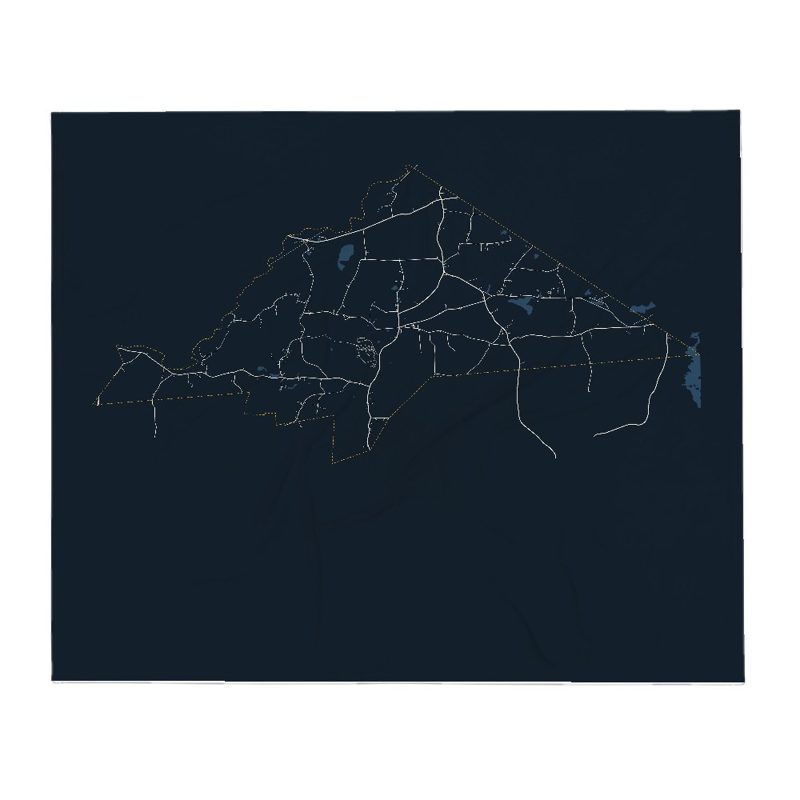
Soft fleece, 50″×60″
20 oz, double-wall stainless
Population 2010: 999 → 2020: 996
From Wikidata (CC0).
Before being settled by re-located residents of Braintree, Massachusetts, New Braintree was occupied by various Native American groups for at least 9,000 years. At the time of English colonization in the 17th century, the area was inhabited by Quaboag and Nipmuc people.
In 1660 the Massachusetts Bay Colony made a land grant establishing Quaboag Plantation, but it was not until 1665 that a deed was obtained by the English settlers from a native person named Shattoocquis for the land. In 1669, the town of Braintree, located southeast of Boston, voted that each household would be granted an equal interest in the 6000 acres purchased out of Quaboag Plantation to the west, to be known as "Braintree Farms".
In 1675 King Philip's War broke out between the English United Colonies and the Wampanoag, interrupting the plans of the Braintree settlers. As Native people retreated from praying towns and border regions with the English, present-day New Braintree became the site of a Nipmuc stronghold known as Menimesit or Wenimessit. That same year, a group of Nipmuc destroyed Quaboag plantation and routed a company of colonial soldiers in a battle in present-day New Braintree known as "Wheeler's Surprise." Menimesit was visited by major native leaders in the conflict, including King Philip himself, and it features in the captive narrative of Mary Rowlandson.
In the years following the war, additional tracts of land which were formerly part of Brookfield and Hardwick were acquired by the Braintree settlers. The land was recolonized by Europeans in 1709 and was officially incorporated in 1751 as New Braintree.
New Braintree has been the home of the Massachusetts State Police Academy since 1992. Governor Michael Dukakis had proposed and began construction of a controversial state prison in the late 1980s on this site, but was met with heavy opposition by the town, Boston-area radio talk show host Jerry Williams and a group called C.O.S.T. (Conserve Our Small Town). Governor William Weld was elected and ceased the construction of the prison. The state police training academy now occupies the grounds and buildings of the former Seventh-day Adventist Pioneer Valley Academy. In the photo shown, one can see the school's former boys' and girls' dormitories with the cafeteria in between and the water tower to the right of the boys' dormitory. The school opened its doors in September 1965 and closed in June 1983.
Adapted (trimmed) from the Wikipedia article New Braintree, Massachusetts, revision 1377786979 by its contributors, licensed CC BY-SA 4.0.
We share a part of every New Braintree sale with local partners, and we'd love to print from your collection. Old photographs, maps and postcards make the best keepsakes.
Partner with us