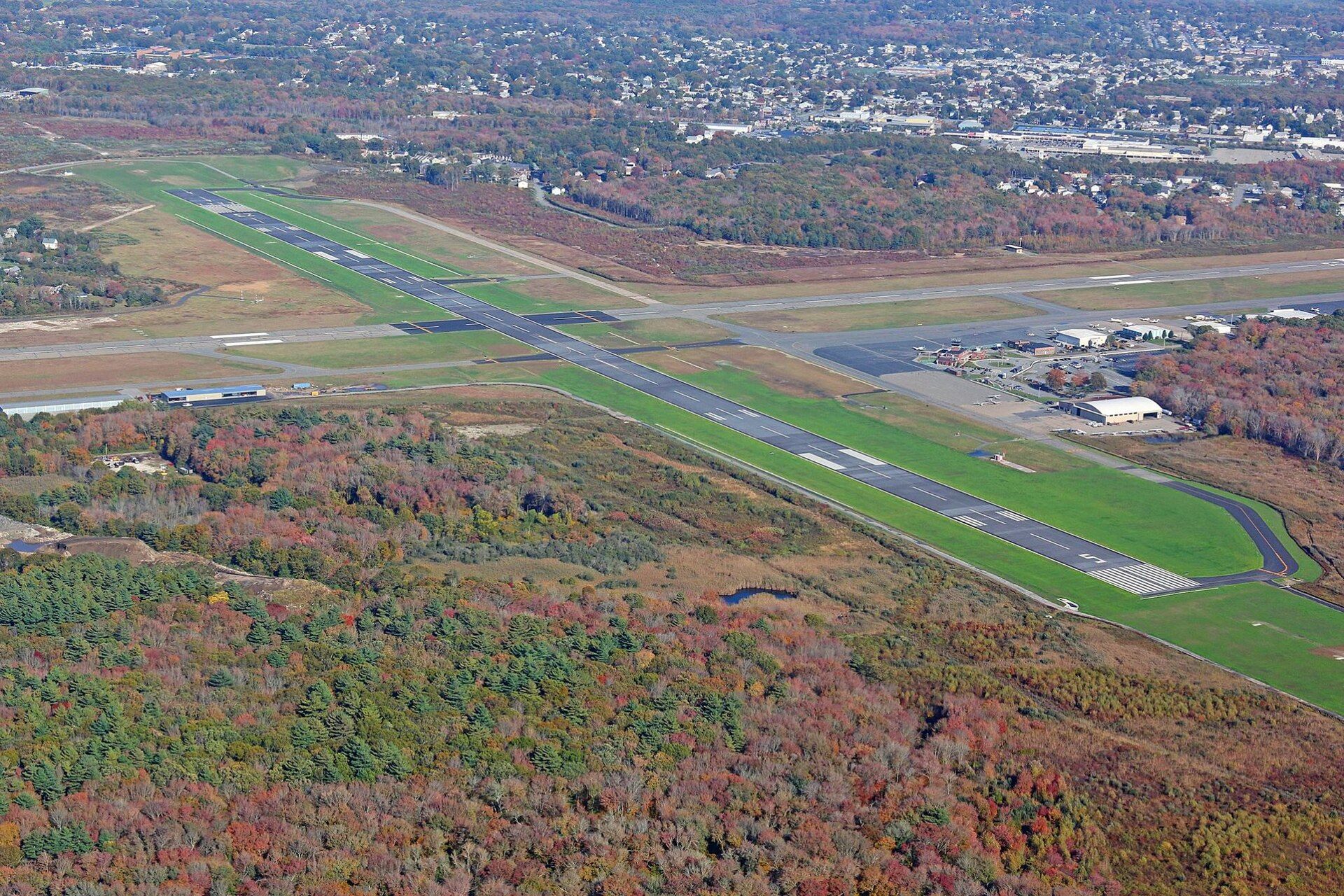
From there, he explored Cape Cod and the neighboring areas, including the site of present-day New Bedford. Landmarks include New Bedford Regional Airport, New Bedford Whaling Museum and New Bedford Whaling National Historical Park. New Bedford is the birthplace of John Tukey, mathematician.
Every piece is drawn from New Bedford's own map data and historic archives, then printed and shipped from the USA when you order. No two towns look alike.
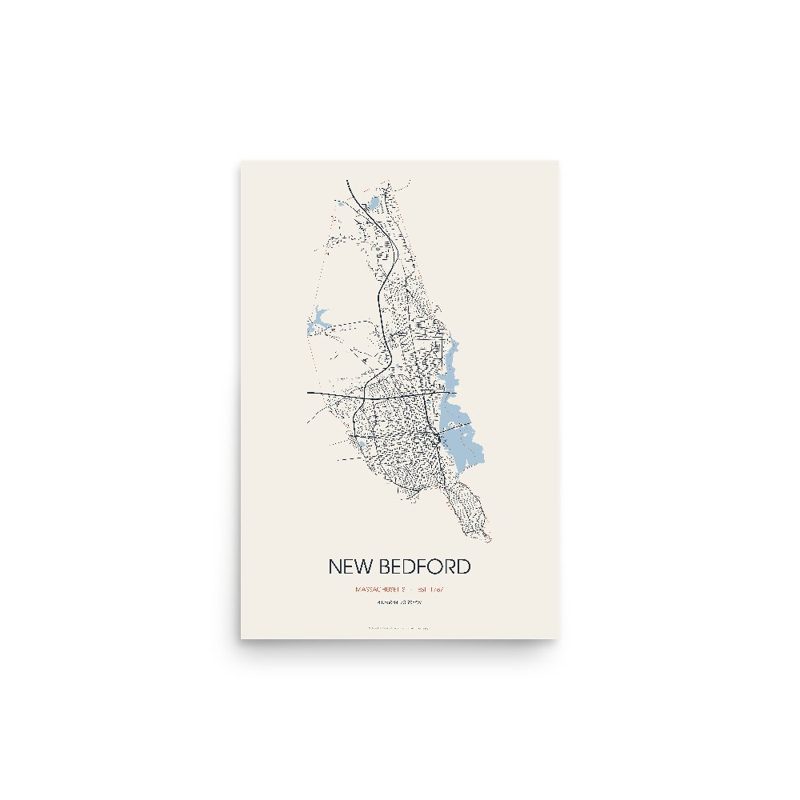
Every road in town, on archival matte paper
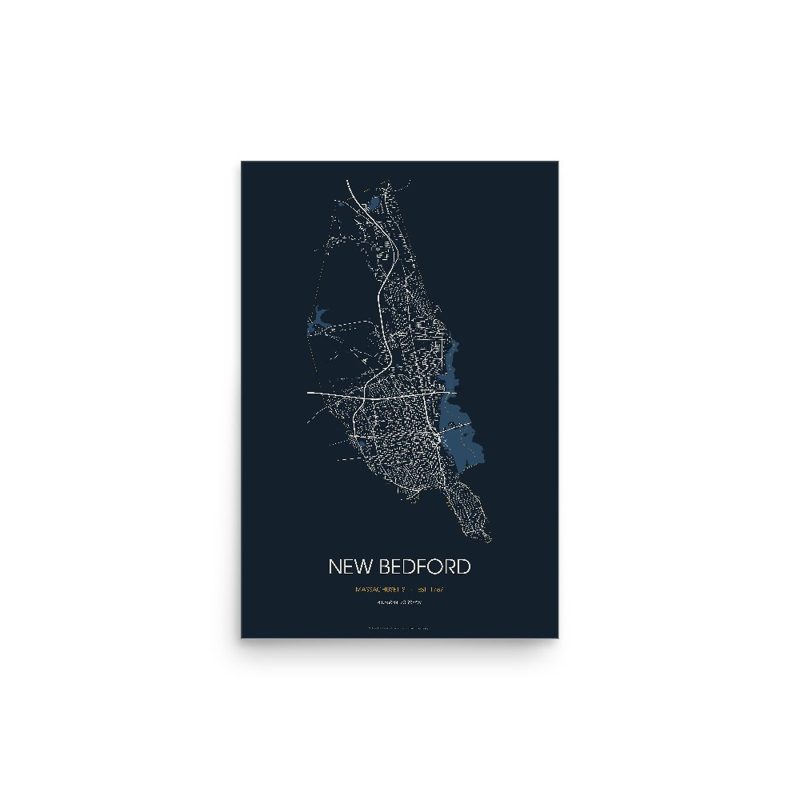
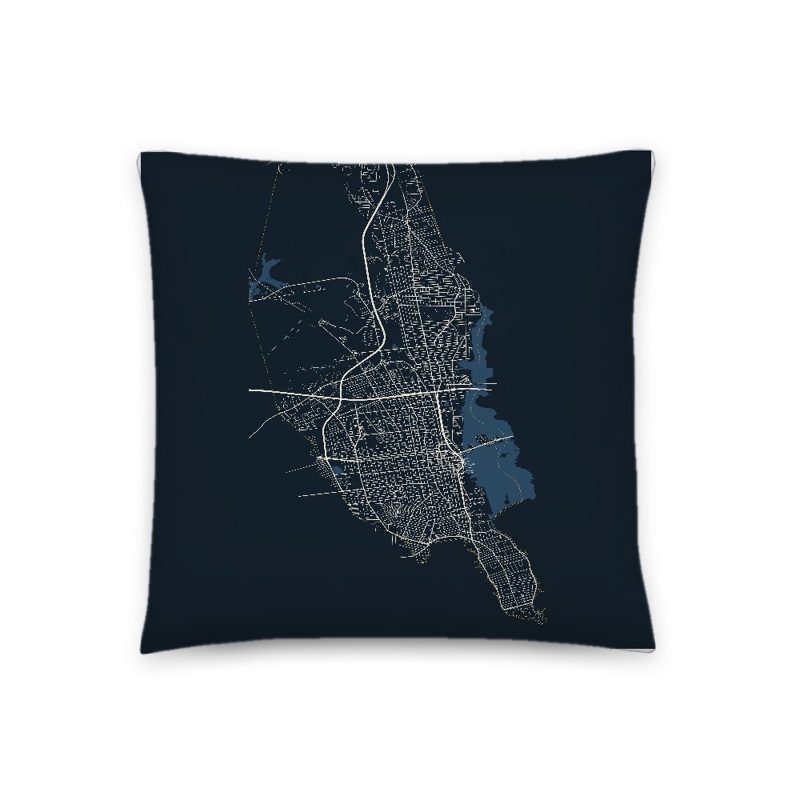
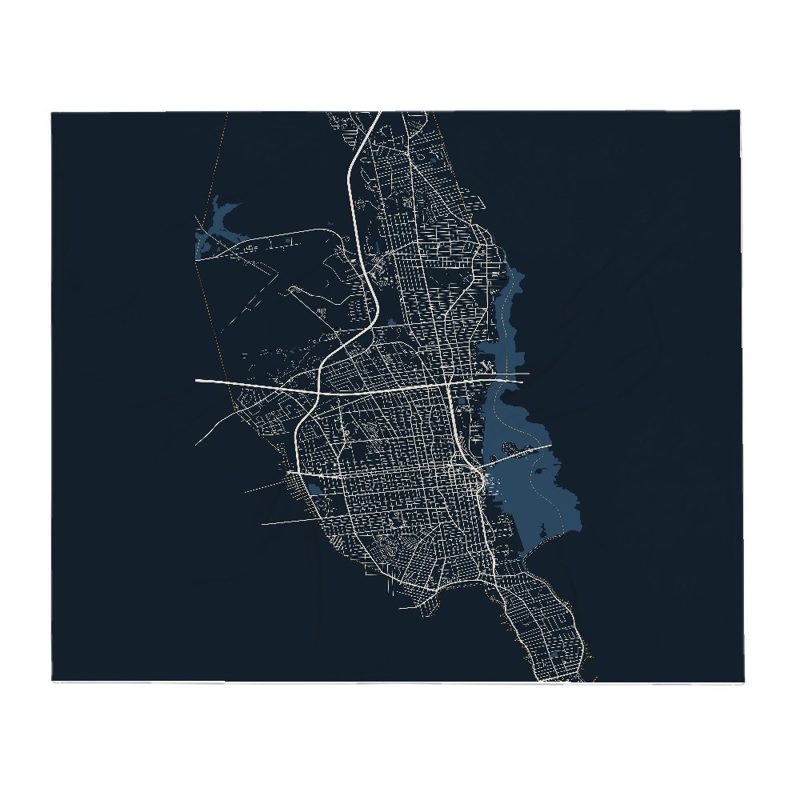
The same map, in navy and silver
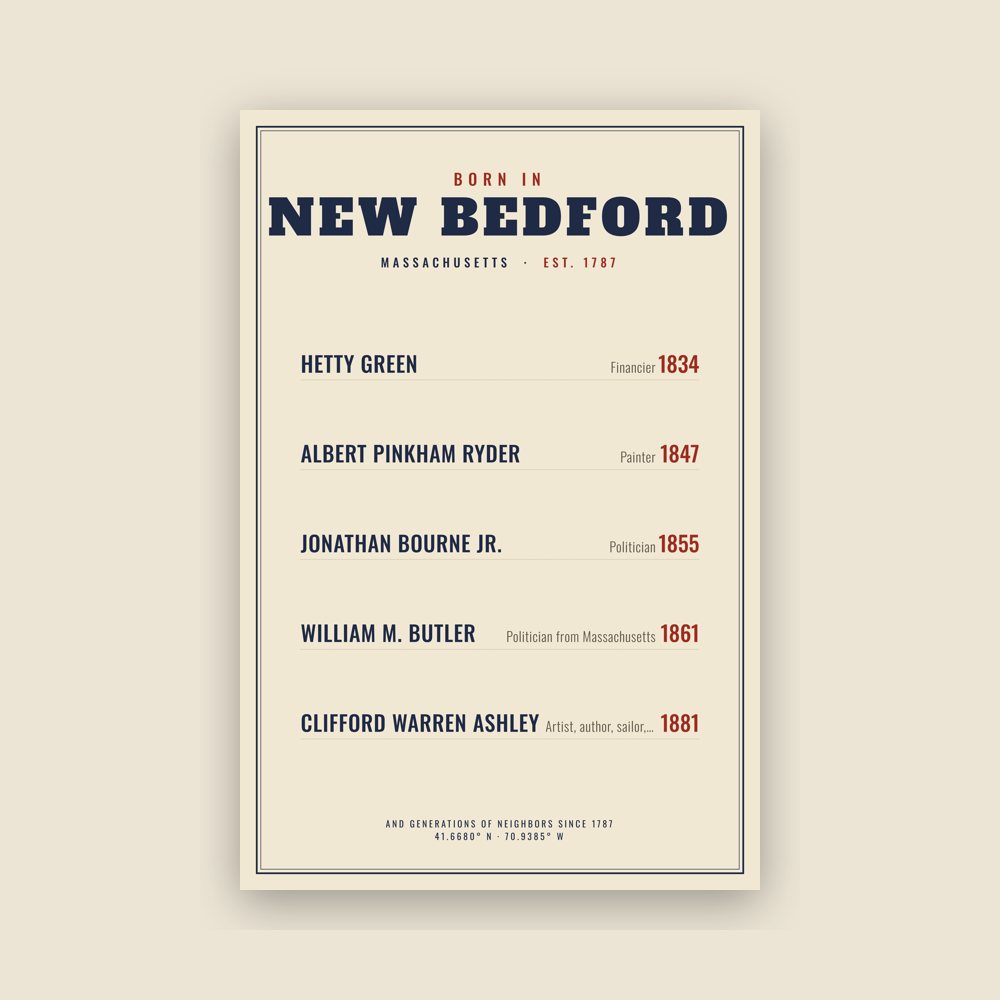
Famous natives, by birth year
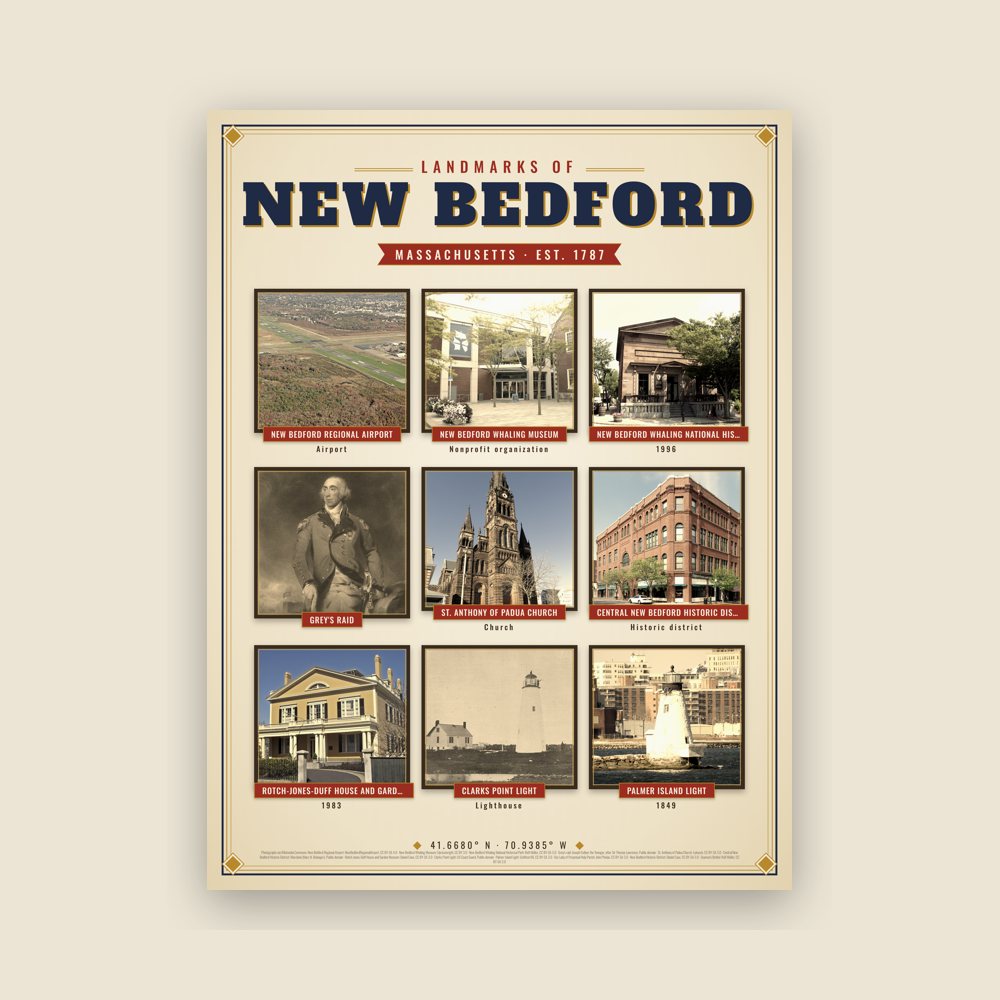
Nine local landmarks, archival matte
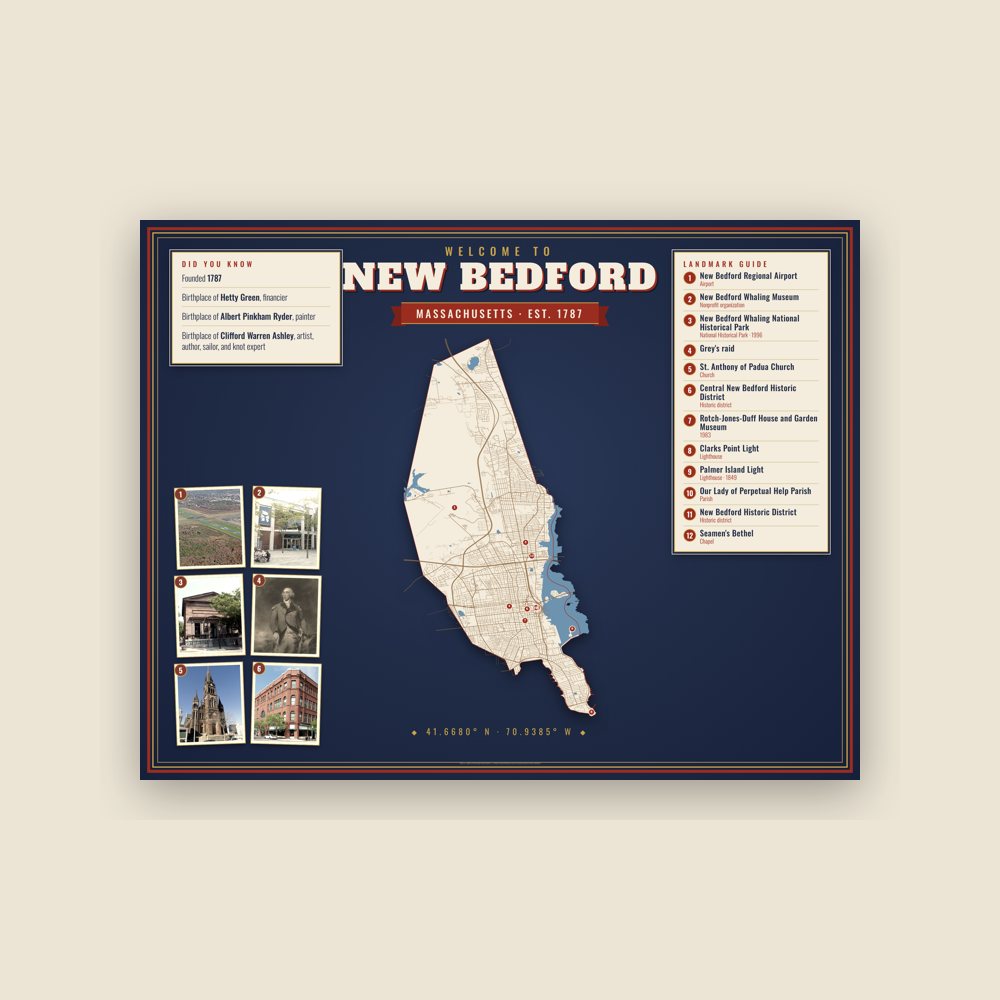
Map of local landmarks, washable fabric
Heavy-blend fleece, street map printed on the back
Soft Bella+Canvas jersey
Glossy ceramic, dishwasher safe
Ceramic keepsake, gold ribbon
Weatherproof, for the front walk
Soft-touch, zip cover
Sturdy all-over-print tote
Glossy top, cork back
Soft fleece, 50″×60″
20 oz, double-wall stainless
Population 2010: 95,072 → 2011: 95,115 → 2020: 101,079
From Wikidata (CC0).
Before the 17th century, the lands along the Acushnet River were inhabited by the Wampanoag Native Americans, who had settlements throughout southeastern Massachusetts and Rhode Island, including Martha's Vineyard and Nantucket. Their population is believed to have been about 12,000.
On May 15, 1602, English explorer Bartholomew Gosnold in the ship Concord landed on Cuttyhunk Island while exploring New England. From there, he explored Cape Cod and the neighboring areas, including the site of present-day New Bedford. Gosnold left and settled in the Jamestown Colony of Virginia.
In 1652, English colonists purchased Old Dartmouth—a region of 115,000 acres (470 km2) that is now Dartmouth, Acushnet, New Bedford, Fairhaven, and Westport—in a treaty between the Wampanoag, represented by Chief Ousamequin (Massasoit) and his son Wamsutta, and John Winslow, William Bradford, Myles Standish, Thomas Southworth, and John Cooke. While the Europeans considered themselves full owners of the land through the transaction, the Wampanoag have disputed this claim because the concept of land ownership—in contrast with hunting, fishing, and farming rights—was a foreign concept to them.
Members of the Religious Society of Friends, also known as Quakers, were among the early European settlers on the South Coast. They had faced persecution in the Puritan communities of Plymouth Colony and Massachusetts Bay Colony; the latter banned the Quakers in 1656–1657. When the Massachusetts Bay Colony annexed the Plymouth Colony in 1691, Quakers already represented a majority of the population of Old Dartmouth. In 1699, with the support of Peleg Slocum, the Quakers built their first meeting house in Old Dartmouth, where the Apponegansett Meeting House is now located.
At first, the Old Dartmouth territory had no major town centers, and instead had isolated farms and small, decentralized villages, such as Russells' Mills. One reason for this is that the inhabitants enjoyed their independence from the Plymouth Colony and they did not want the Plymouth court to appoint them a minister.
At this time, the economy primarily ran on agriculture and fishing. The availability of land attracted many Quakers and Baptists from Newport and Portsmouth in Rhode Island, as well as more waves of Puritan migration.
The rising European population and increasing demand for land led the colonists' relationship with the indigenous inhabitants of New England to deteriorate. European encroachment and disregard for the terms of the Old Dartmouth Purchase led to King Philip's War in 1675. In this conflict, Wampanoag tribesmen, allied with the Narragansett and the Nipmuc, raided Old Dartmouth and other European settlements in the area. Europeans in Old Dartmouth garrisoned in sturdier homes—John Russell's home at Russells Mills, John Cooke's home in Fairhaven, and a third garrison on Palmer Island.
A section of Old Dartmouth near the west bank of the Acushnet River, originally called Bedford Village, was officially incorporated as the town of New Bedford on February 23, 1787, after the American Revolutionary War. The name was suggested by the Russell family, who were prominent citizens of the community. The Dukes of Bedford, a leading English aristocratic house, also bore the surname Russell. (Bedford, Massachusetts, had been incorporated in 1729; hence "New" Bedford.)
The late 18th century was a time of growth for the town. A small whale fishery developed, as well as modest international trade. In the 1760s, between the Seven Years' War and the American Revolution, shipwrights, carpenters, mechanics, and blacksmiths, settled around New Bedford harbor, creating a skilled and comprehensive maritime community.
New Bedford's first newspaper, The Medley (also known as the New Bedford Marine Journal), was founded in 1792. On June 12, 1792, the town set up its first post office. William Tobey was its first postmaster. The construction of a bridge (originally a toll bridge) between New Bedford and present-day Fairhaven in 1796 also spurred growth. (Fairhaven separated from New Bedford in 1812, forming an independent town that included both present-day Fairhaven and present-day Acushnet.)
Nantucket had been the dominant whaling port, though the industry was controlled by a cartel of merchants in Boston, Newport, and Providence. In the 1760s, Nantucket's most prominent whaling families moved to New Bedford, refining their own oil and making their own premium candles.
The American Revolutionary War completely paralyzed the whaling industry. The Battle of Fairhaven, the first naval battle of the war occurred on 13 and 14 May 1775, in Buzzard's Bay. While an American victory, it neither broke the Royal Navy blockade nor prevented Grey's raid in September 1778, when British troops raided New Bedford and burnt ships, warehouses, and wharves; the ensuing conflagration unintentionally spread to nearby homes and churches. 38 American troops manning a small fort on the other side of the Acushnet River briefly fired at the ships the raiders arrived on before spiking their guns and abandoning the fort. The British returned fire and destroyed the fort’s guns.
Nantucket was even more exposed, and the physical destruction, frozen economy, and import taxes imposed after the war obliterated previous fortunes. New Bedford also had a deeper harbor and was located on the mainland. As a result, New Bedford supplanted Nantucket as the nation's preeminent whaling port, and so began the Golden Age of Whaling. William Rotch (owner of the Dartmouth of the Boston Tea Party) and Samuel Rodman were important Quaker businessmen in the whaling industry.
After the War of 1812's embargo was lifted, New Bedford started amassing a number of colossal, sturdy, square-rigged whaling ships, many of them built at the shipyard of Mattapoisett. The invention of on-board tryworks, a system of massive iron pots over a brick furnace, allowed the whalers to render high quality oil from the blubber. This allowed the whaling ships to go out to sea for as long as four years, processing their catch while at sea. Ships from New Bedford came back to port with barrels of oil, spermaceti, and occasionally ambergris.
Whaling dominated New Bedford's economy for much of the century, and many families of the city were involved with it as crew and officers of ships. The Quakers remained prominent and influential in New Bedford throughout the whaling era. They brought religious values into their business models, promoting stability as well as prosperity, investing in infrastructure projects such as rail, and employing without discrimination. They established solid social and economic relationships with Boston, New York, and Philadelphia, integrating New Bedford into the urban northeastern economy.
Ten thousand men worked in the whaling industry. During this period, New Bedford's population increased from approximately 4,000 in 1820 to about 24,000 in 1860. At the height of the whaling industry in 1857, the harbor hosted 329 vessels worth over $12 million, and New Bedford became the richest city per capita in North America.
On March 18, 1847, the town of New Bedford officially became a city; Abraham Hathaway Howland was elected its first mayor.
The Quakers of New Bedford applied their principles of egalitarianism and community-building in their businesses. On the boats, at the docks, at the factories, or in the shops—British, Wampanoag, Cape Verdean, Azorean, Irish, and West African hands found work in New Bedford.
New Bedford also became one of the first centers of abolitionism in North America, and an important stop on the Underground Railroad. Many people were attracted by New Bedford's relatively open-minded atmosphere. For example, Paul Cuffe—an Ashanti-Wampanoag Quaker and self-made tycoon—among several other remarkable achievements earned black property owners in New Bedford the right to vote decades before Abraham Lincoln even signed the Emancipation Proclamation. Lewis Temple, an African-American blacksmith, invented the Temple toggle iron, which was the most successful harpoon design. Frederick Douglass, the famous social reformer and orator, also found amnesty in New Bedford and worked at the wharf for three years.
The whaling industry went into decline after the 1859 discovery of petroleum in Pennsylvania. Each decade thenceforth saw a gradual decrease in whaling work, activity, and revenue. During the Civil War, the Confederacy engaged in commerce raiding with ships such as the Alabama, the Florida, and the Shenandoah, trying to attack the Yankee whaling industry and sabotage the US economy. Additionally, the US federal government bought several inactive whalers, filled them with stones, sand, and dirt, and towed them to Charleston, South Carolina, where the Union Navy sank what became known as the Stone Fleet in an unsuccessful attempt to blockade the Confederate bay. Along with the poor business and low whale populations, this dealt a potent blow to a failing industry.
In the midst of this decline, greater New Bedford's economy became more dependent on the textile industry, which began to eclipse the whaling industry in the late 19th century. The mills grew and expanded constantly, eventually comprising multiple sites along the Acushnet River. In 1875 alone, the Wamsutta Mills processed 19,000 bales of cotton into 20 million yards of cloth, which had a wholesale value comparable to that of the entire whaling catch, and continued to produce over 20 million yards of cloth yearly after 1883. The Wamsutta Mills remained the world's largest weaving plant until 1892.
The textile mills redefined wealth in New Bedford, and gave birth to a prosperity greater than that of the whaling industry. New Bedford, funded by industrial fortunes, developed a thriving art scene. The Mount Washington Glass Company (which later became Pairpoint) crafted works of glass and silver for the newly affluent class, and examples of these works can be seen today on the second floor of the New Bedford Whaling Museum.
In the 1920s, local employers came under competitive pressure from new textile factories in the low-wage South. In April 1928 their demand for a 10 percent across the board cut in wages was met with strike action. After considerable controversy control of the large-scale work stoppage passed from the Communist-led Textile Mill Committee (TMC) to sundry craft unions affiliated with the American Federation of Labor who, agreeing to a five percent wage cut, ended the strike in October. Wage reductions were not enough to arrest the long-term competitive decline of the local textile industry.
Until 1800, New Bedford and its surrounding communities were, by and large, populated by Protestants of English, Scottish, Welsh, and Dutch origin. During the first half of the 19th century many Irish people came to Massachusetts. In 1818, Irish immigrants established the Catholic mission that built St. Mary's Church. During the Great Irish Famine of the 1840s, which was to drive many more across the Atlantic, with the town's whaling "aristocracy" (many of them Quaker) they were active in providing their compatriots with relief. New Bedford's once significant Irish population declined in the 20th century; as with many immigrant groups, as they had become established they moved out to the suburbs.
Later in the 19th century, immigrants from Portugal and its colonial possessions in the Atlantic—Cape Verde, the Azores, and Madeira—began arriving in New Bedford and the surrounding area, attracted by jobs in the whaling industry; many had family members who had worked on whaling ships. The presence of Cape Verdeans in the New Bedford whaling fleet inspired the fictional character Daggoo in Herman Melville's 1851 novel Moby-Dick. As the Portuguese community began to increase in population, it established the first Portuguese parish in the city, St. John the Baptist (1871). However, many Cape Verdean Catholics encountered racial prejudice amongst the Portuguese parishioners and established the Our Lady of Assumption, the first Cape Verdean American church, in 1905.
The city's annual Feast of the Blessed Sacrament, initiated in 1915 by four immigrants from Madeira, is the world's largest celebration of Luso-American heritage, regularly drawing crowds of tens of thousands to the city's Madeira Field.
French Canadians also secured a foothold in New Bedford at about the same time, building the Church of the Sacred Heart in 1877, as did Polish immigrants who in 1903 established the parish of Our Lady of Perpetual Help (the church closed in 2022).
A number of Jewish families, arriving in the mid 19th century from, were active in candle-making and in selling provisions and outfitting ships for the whaling fleet. During the years leading up to the First World War, a sizable eastern-European Jewish community joined them in New Bedford. Some became prominent merchants and businessmen, mainly in textiles and manufacturing.
Fishing and manufacturing continue to be two of the largest businesses in the area, and healthcare has become a major employer. The three largest single employers based in New Bedford are Southcoast Hospitals Group, one of the top ten employers in Massachusetts (healthcare), Titleist (golf clubs, balls, apparel, manufacturing), and Riverside Manufacturing (apparel manufacturing).
According to a 2001 study by the University of Massachusetts Dartmouth Center for Policy Analysis, the three largest employment sectors in the Greater New Bedford area (the area includes New Bedford and Acushnet, Dartmouth, Fairhaven, Freetown, Lakeville, Marion, Mattapoisett, Rochester, and Wareham) were as follows: services (26% of total employment); wholesale trade (22%); manufacturing (19%). The largest industries by employment in the area were as follows: health services, eating and drinking places, wholesale trade, food stores, and social services.
In 2002, the city received $61,194,358 in taxation revenue, $44,536,201 in local receipts, and $12,044,152 classified as other available.
In 2005 the unemployment rate was 7.3%, having dropped throughout the 1990s from 12.5% to 5.3% in 2000, and then having risen to 10.4% in 2003. By 2009, in the midst of the economic crisis of the era, the unemployment rate got as high as 12.4%.
In 2005, the city received $104,925,772 for education, and $22,755,439 for general government from the State of Massachusetts.
In 2016, the city hopes its proximity to Massachusetts' southern coastline will allow it to become a center for the growing wind energy market. Three companies, OffshoreMW, Deepwater Wind, and DONG Energy, have leased portions of New Bedford's Marine Commerce Terminal for the staging of turbines and platforms.
The Ash Street Jail, which houses inmates from Bristol County, is located in New Bedford. It opened in 1829 and is the oldest continuously operating jail in the United States.
Fort Taber and Fort Rodman (also called the "Fort at Clark's Point") were built during the American Civil War and are now in Fort Taber Park. Both forts are often called Fort Taber, including in some references.
Adapted (trimmed) from the Wikipedia article New Bedford, Massachusetts, revision 1378591843 by its contributors, licensed CC BY-SA 4.0.
We share a part of every New Bedford sale with local partners, and we'd love to print from your collection. Old photographs, maps and postcards make the best keepsakes.
Partner with us