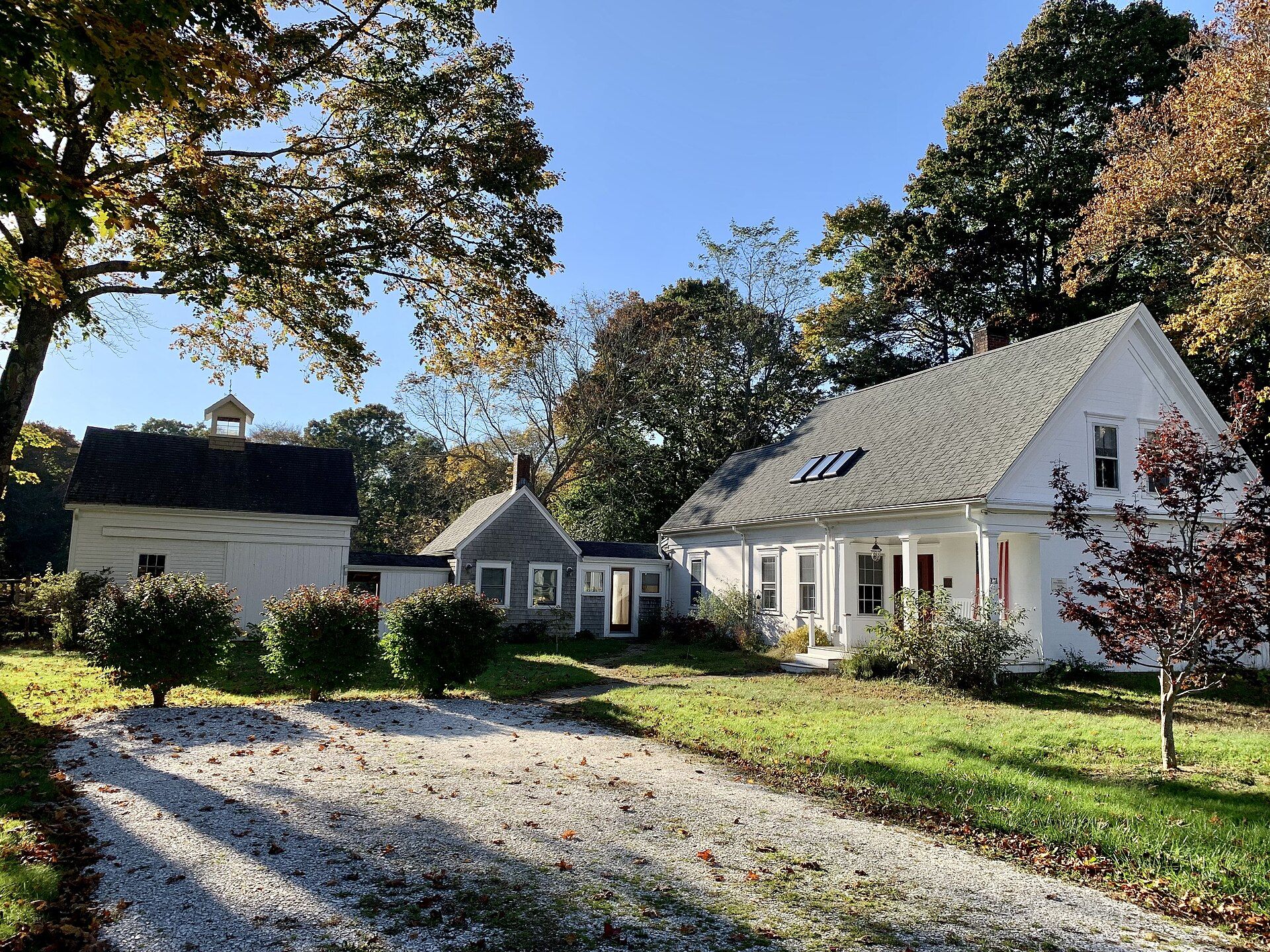
The town is the historic and contemporary home of the Mashpee Wampanoag Tribe—federally recognized in 2007—which maintains its headquarters in Mashpee. Landmarks include Otis Air National Guard Base, Old Indian Meeting House and Mashpee Wampanoag Indian Museum. Mashpee is the birthplace of Jessie Little Doe Baird, linguist.
Every piece is drawn from Mashpee's own map data and historic archives, then printed and shipped from the USA when you order. No two towns look alike.
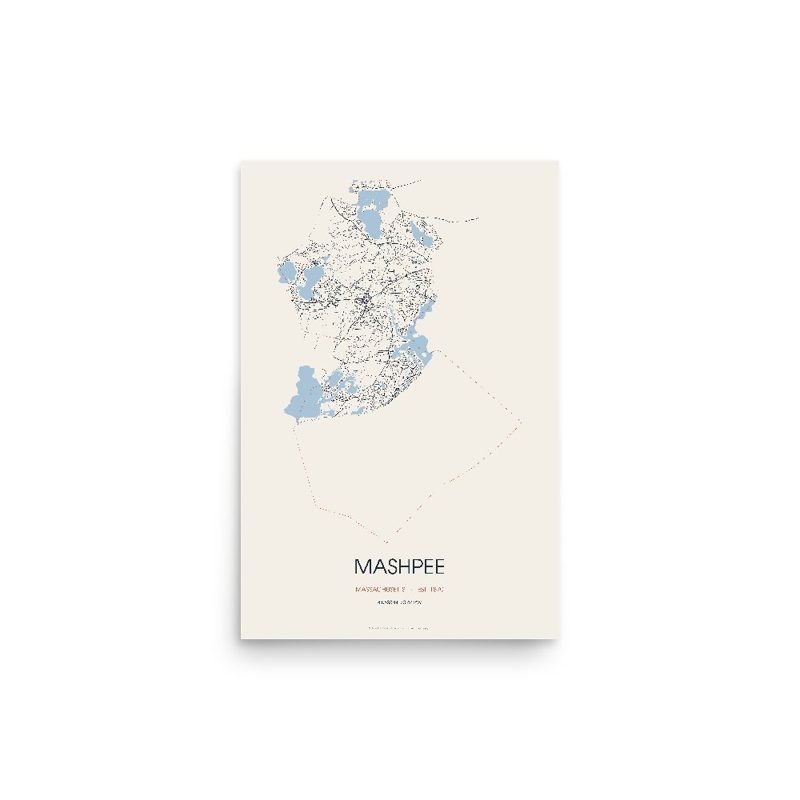
Every road in town, on archival matte paper
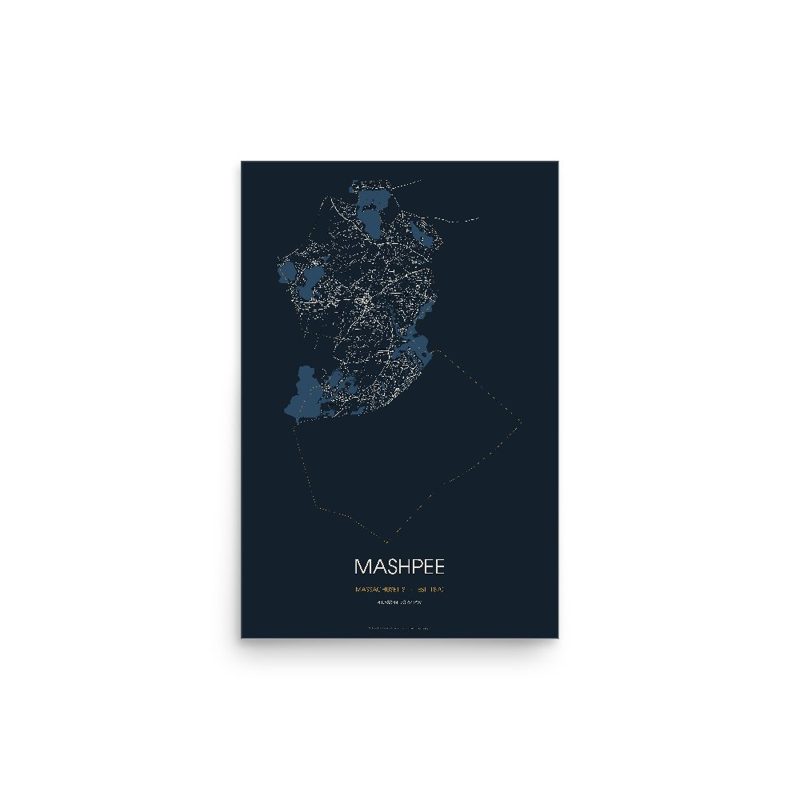
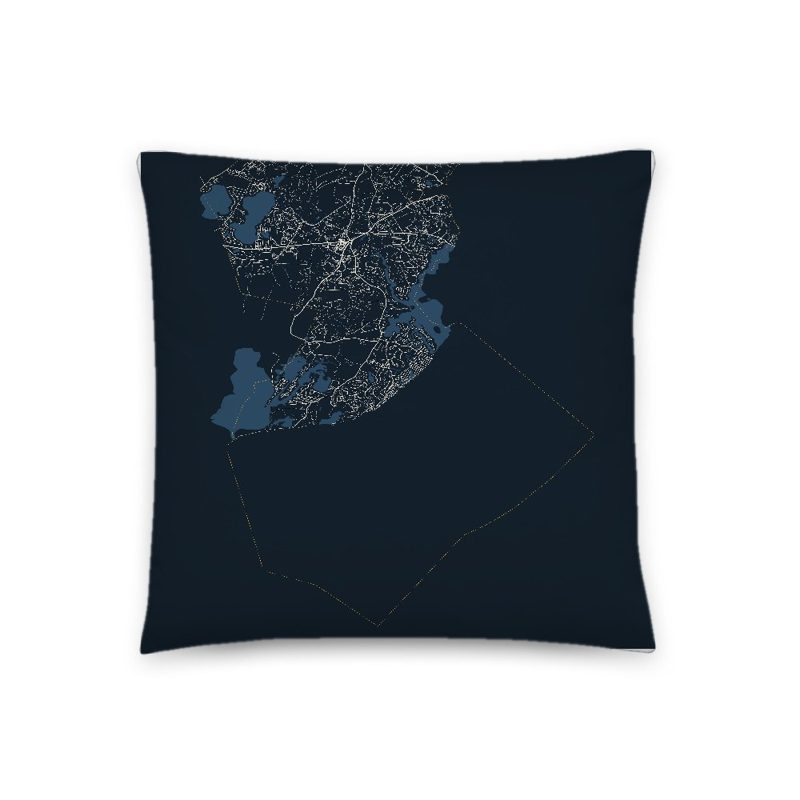
The same map, in navy and silver
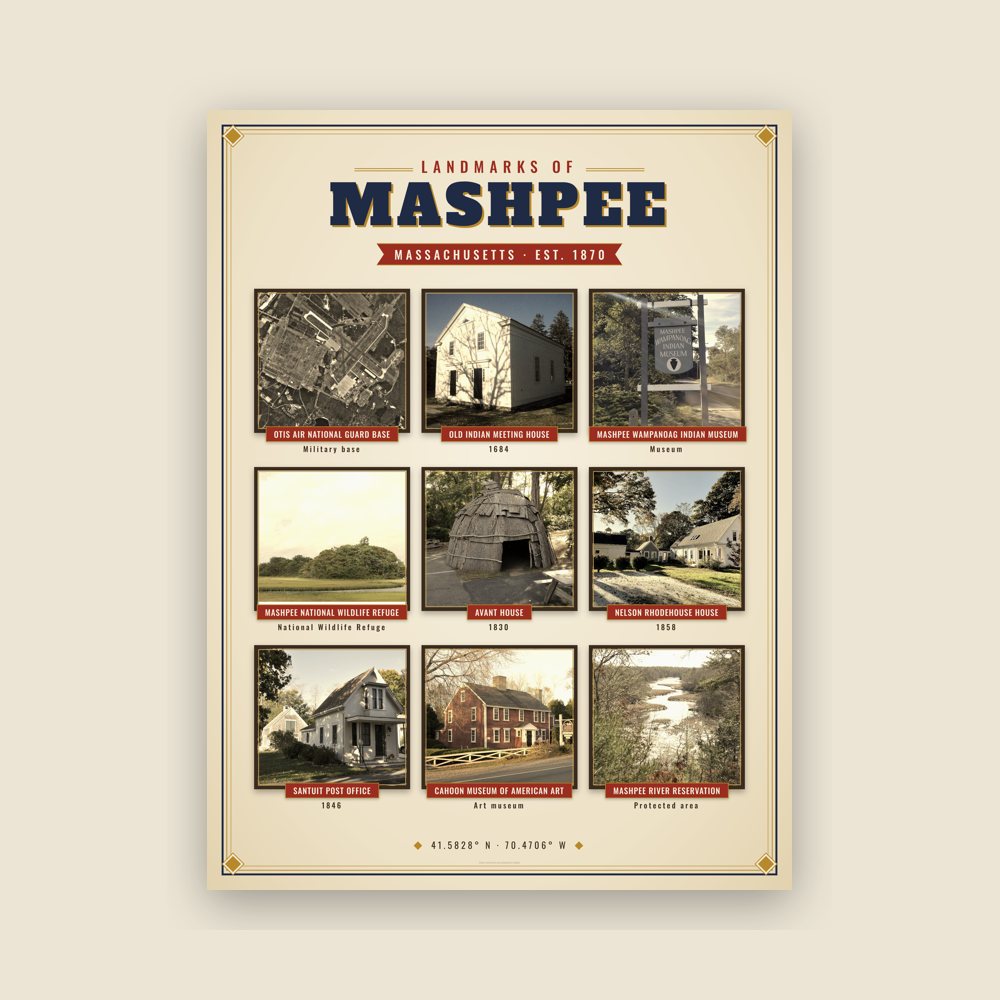
Nine local landmarks, archival matte
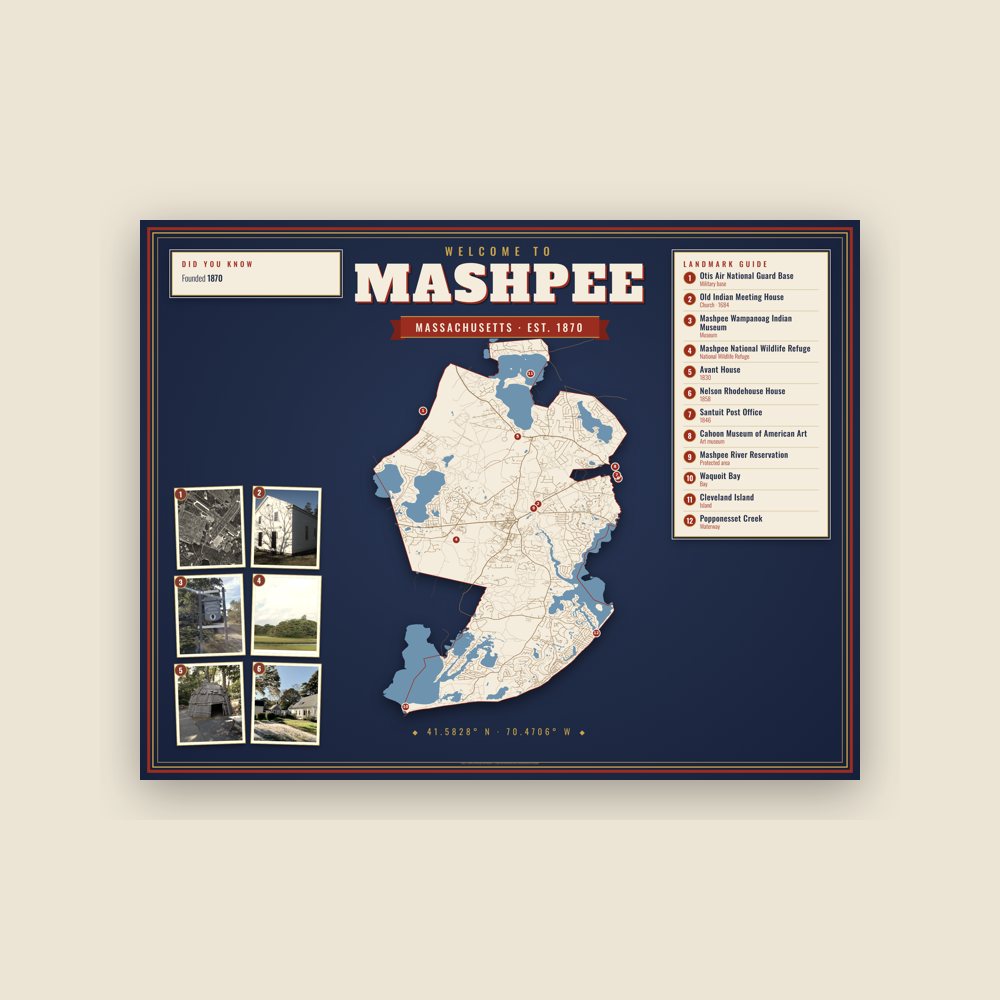
Map of local landmarks, washable fabric
Heavy-blend fleece, street map printed on the back
Soft Bella+Canvas jersey
Glossy ceramic, dishwasher safe
Ceramic keepsake, gold ribbon
Weatherproof, for the front walk
Soft-touch, zip cover
Sturdy all-over-print tote
Glossy top, cork back
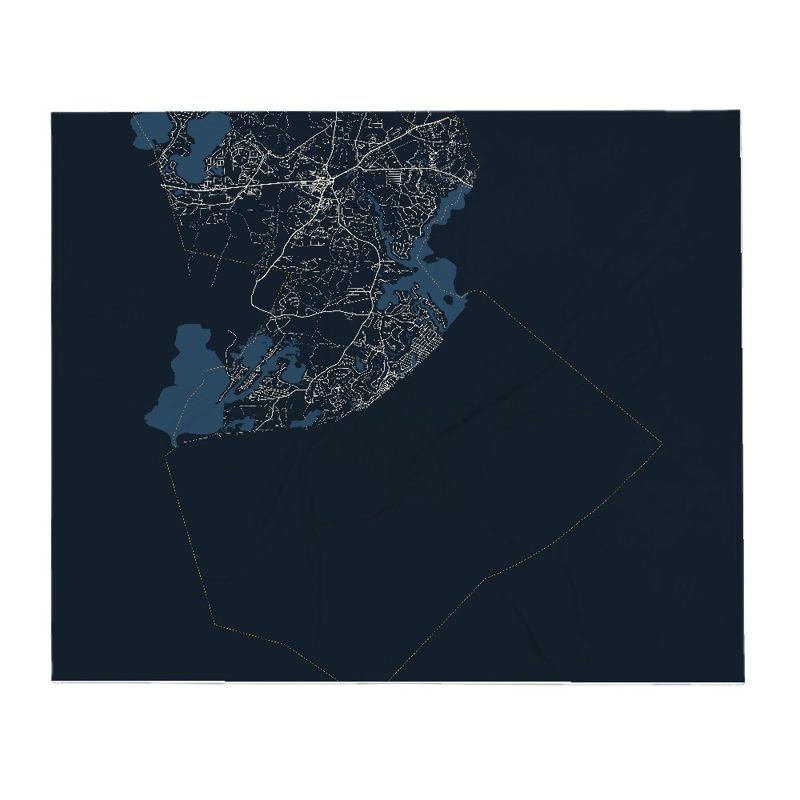
Soft fleece, 50″×60″
20 oz, double-wall stainless
Population 2010: 14,006 → 2020: 15,060
From Wikidata (CC0).
Cape Cod was occupied for more than ten thousand years by indigenous peoples. The historic Algonquian-speaking Wampanoag were the native people encountered by the English colonists here and in the area of the Massachusetts Bay Colony in the seventeenth century. The Wampanoag also controlled considerable coastal area. These two cultures would interact, shaping each other for decades.
After English colonists arrived, they began to settle the area of present-day Mashpee with the assistance of the missionary Richard Bourne, who established a church there in 1658. The town was officially settled in 1660. In 1660 the colonists allowed those Christian Wampanoag who had been converted about 50 square miles (130 km2) in the English settlement. Beginning in 1665, the Wampanoag governed themselves with a court of law and trials according to English custom (they had long governed themselves according to their own customs).
Following their defeat in King Philip's War (1675–1676), the Wampanoag of the mainland were resettled with the Sakonnet in present-day Rhode Island. Others of the people were brought, together with the Nauset, into the praying towns, such as Mashpee, in Barnstable County. There were also Wampanoag on Martha's Vineyard and other areas.
The colonists designated Mashpee on Cape Cod as the largest Indian reservation in Massachusetts. The town's name is an Anglicization of a native name, mass-nippe: mass is "great", or "greater" (see Massachusetts), and nippe is "water". The name has been translated as "the greater cove" or "great pond," or "land near great cove", where the water being referenced is Wakeby Pond, which is greater at one end.
In the year 1763, the British Crown designated Mashpee as a plantation, against the will of the Wampanoag. Designation as a plantation meant that the area governed by the Mashpee Wampanoag was integrated into the colonial district of Mashpee. The colony gave the natives the "right" to elect their own officials to maintain order in their area, but otherwise subjected them to colonial government. The population of the plantation declined steadily due to the conditions placed upon the Wampanoag. They also suffered from encroachment on their lands by the English.
Following the American Revolutionary War, the town in 1788 revoked Mashpee self-government, which European-American officials considered a failure. They appointed a committee, consisting of five European-American members, to supervise the Mashpee.
In 1833-34, William Apess, a Pequot Methodist preacher, helped the Mashpee Wampanoag lead a peaceful protest, known as the Mashpee Woodland Revolt, and the governor threatened a military response. The state returned a certain level of self-government to the Wampanoag, although they were not completely autonomous. With the idea that emulating European-American farming would encourage assimilation, in 1842 the state broke up some of the Wampanoag communal land. It distributed 2,000 acres (8.1 km2) of their 13,000-acre (53 km2) property in allotments of 60-acre (240,000 m2) parcels to heads of households, so that each family could have individual ownership for subsistence farming.
The legislature passed laws against the encroachments on Wampanoag land by European Americans, but did not enforce them. The competing settlers also stole wood from the reservation. It was a large region, once rich in wood, fish and game, and desired by white settlers, who envied the growing community of Mashpee. This resulted in ongoing land loss. The Mashpee Indians suffered more conflicts with their white neighbors than did other more isolated or less desirable Indian settlements in the state.
On May 28, 1870, the Commonwealth of Massachusetts approved the incorporation of Mashpee as a town. Ultimately the Wampanoag lost control of their land and self-government. Many of their descendants remain in the area and identify as Mashpee by their communal culture.
In the early 1970s, the Mashpee reorganized and filed a land claim against the state for the loss of lands. While they ultimately did not win their case, the Mashpee continued to develop as an organized community and gained federal recognition as a tribe in 2007.
Today the town of Mashpee is known both for tourist recreation and for its distinctive minority Wampanoag culture. The population is predominately European American in ancestry. As the town attracts numerous summer visitors, there are many seasonal businesses and service jobs to support this tourism.
The Mashpee Wampanoag Tribe maintains its headquarters in Mashpee and was federally recognized in 2007. In 2015 the Department of Interior evaluated taking into trust 170 acres (0.69 km2) in Mashpee as a reservation for the Wampanoag, who already controlled the land, however in 2018 the request was ultimately rejected. This decision also applied to the 150 acres (0.61 km2) in Taunton, Massachusetts, which the Wampanoag tribe had acquired.
That action was challenged in October 2016 by a United States District Court decision, reached after a suit was filed earlier that year by opponents to Mashpee Wampanoag's plans to build a gaming casino on their Taunton land.
Adapted (trimmed) from the Wikipedia article Mashpee, Massachusetts, revision 1377746223 by its contributors, licensed CC BY-SA 4.0.
We share a part of every Mashpee sale with local partners, and we'd love to print from your collection. Old photographs, maps and postcards make the best keepsakes.
Partner with us