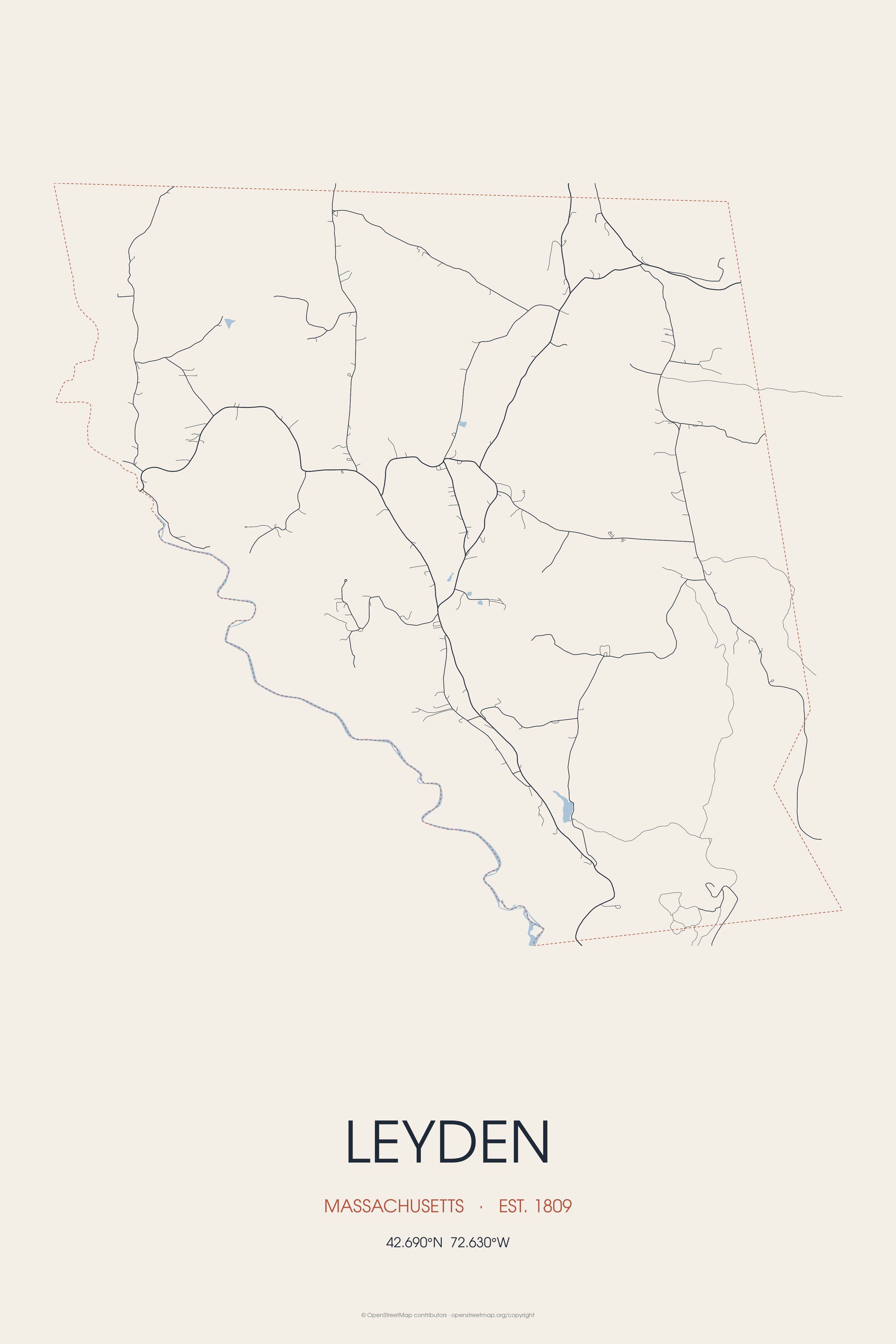
English colonists first settled in Leyden in 1737 as part of "Fall Town", which also included Bernardston and Colrain. Landmarks include WPVQ-FM. Leyden is the birthplace of Henry Kirke Brown, artist.
Every piece is drawn from Leyden's own map data and historic archives, then printed and shipped from the USA when you order. No two towns look alike.
Every road in town, on archival matte paper
The same map, in navy and silver
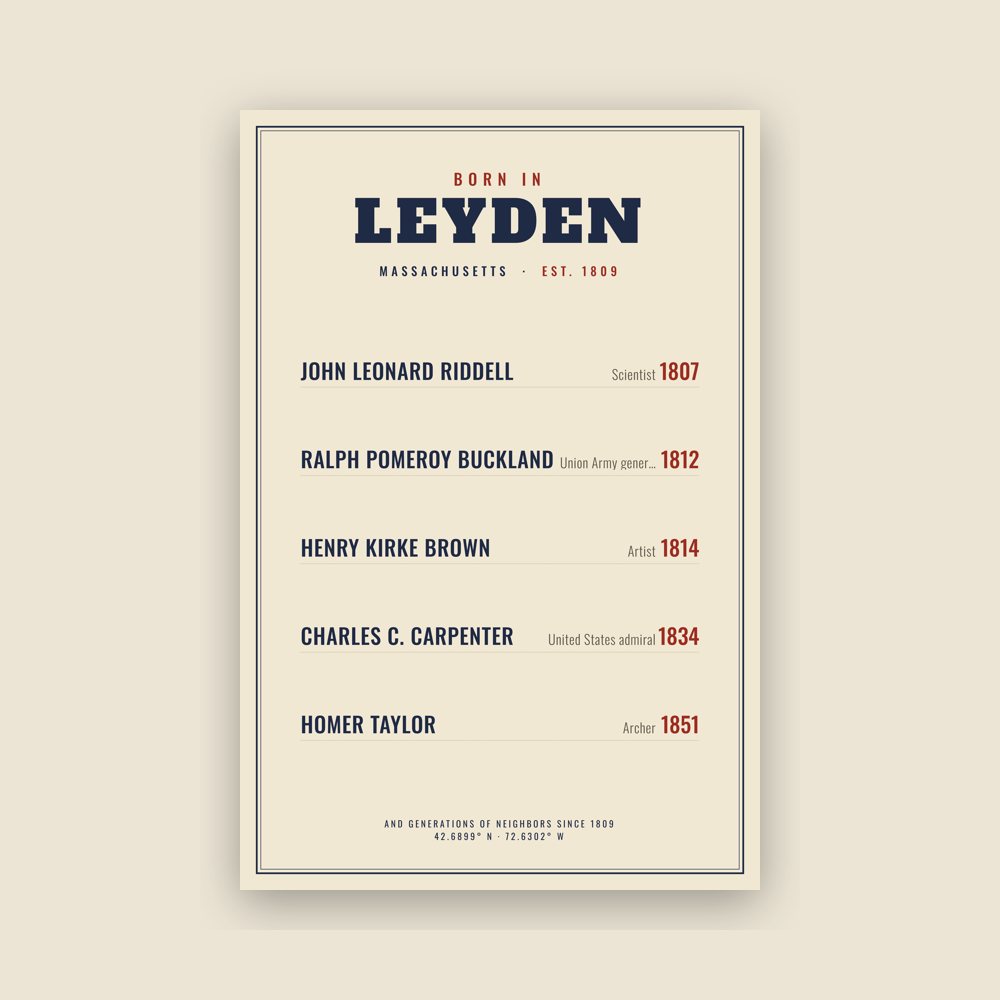
Famous natives, by birth year
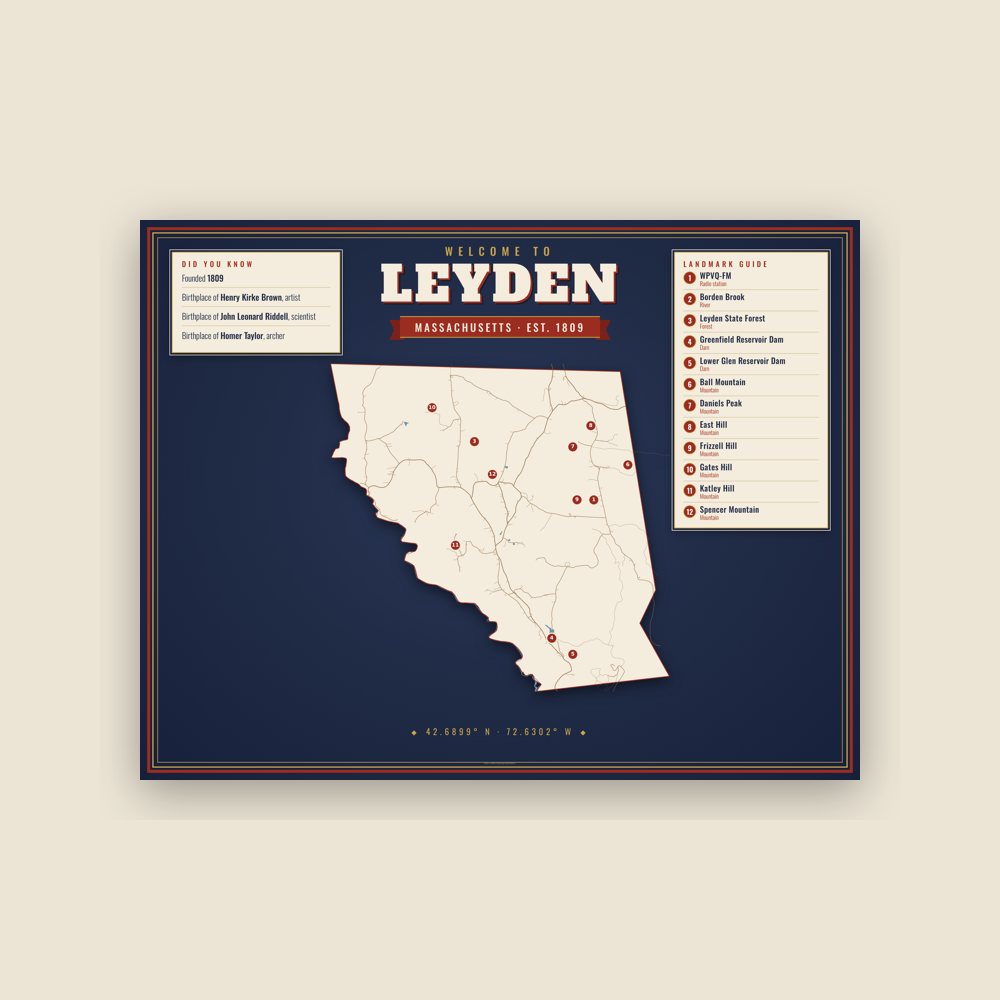
Map of local landmarks, washable fabric
Heavy-blend fleece, street map printed on the back
Soft Bella+Canvas jersey
Glossy ceramic, dishwasher safe
Ceramic keepsake, gold ribbon
Weatherproof, for the front walk
Soft-touch, zip cover
Sturdy all-over-print tote
Glossy top, cork back
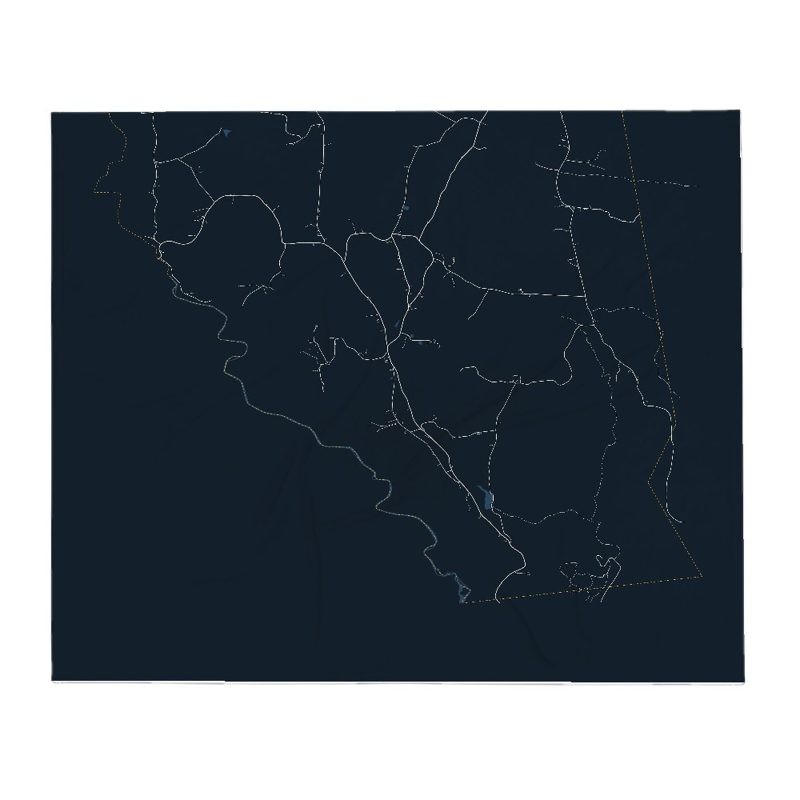
Soft fleece, 50″×60″
20 oz, double-wall stainless
Population 2010: 711 → 2020: 734
From Wikidata (CC0).
Immediately prior to English settlement, the area was occupied by the Wabanaki people. English colonists first settled in Leyden in 1737 as part of "Fall Town", which also included Bernardston and Colrain. The town was set off from Bernardston in 1784, but it was not incorporated as a town until February 22, 1809. The town was named for the city of Leiden, Netherlands, refuge of the Pilgrims before colonizing the Americas. Leyden had several small industries in the eighteenth century, including grist mills, wood product mills, and dairying, but today the largest industry is maple sugar production. The town also has a reservoir which supplies the town of Greenfield. The Dorrellites, a utopian sect founded and led by William Dorrell, was active in Leyden in the 1790s. The Brotherhood of the Spirit commune was founded in Leyden in 1968.
Adapted (trimmed) from the Wikipedia article Leyden, Massachusetts, revision 1379473517 by its contributors, licensed CC BY-SA 4.0.
We share a part of every Leyden sale with local partners, and we'd love to print from your collection. Old photographs, maps and postcards make the best keepsakes.
Partner with us