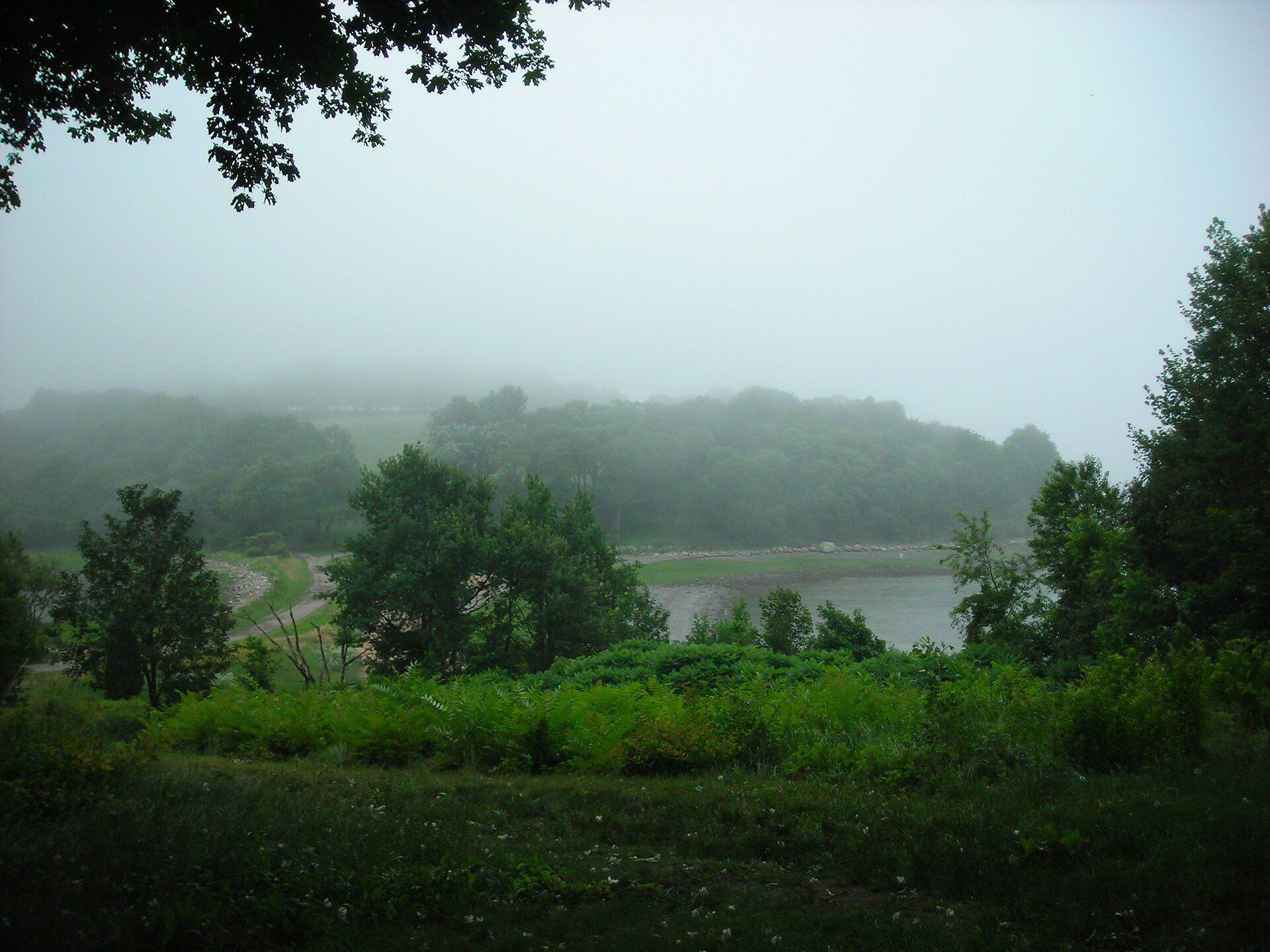
Hingham is known for its colonial history and location on Boston Harbor. Landmarks include World's End, General Benjamin Lincoln House and Nantasket Junction station. Hingham is the birthplace of James Hall, paleontologist.
Every piece is drawn from Hingham's own map data and historic archives, then printed and shipped from the USA when you order. No two towns look alike.
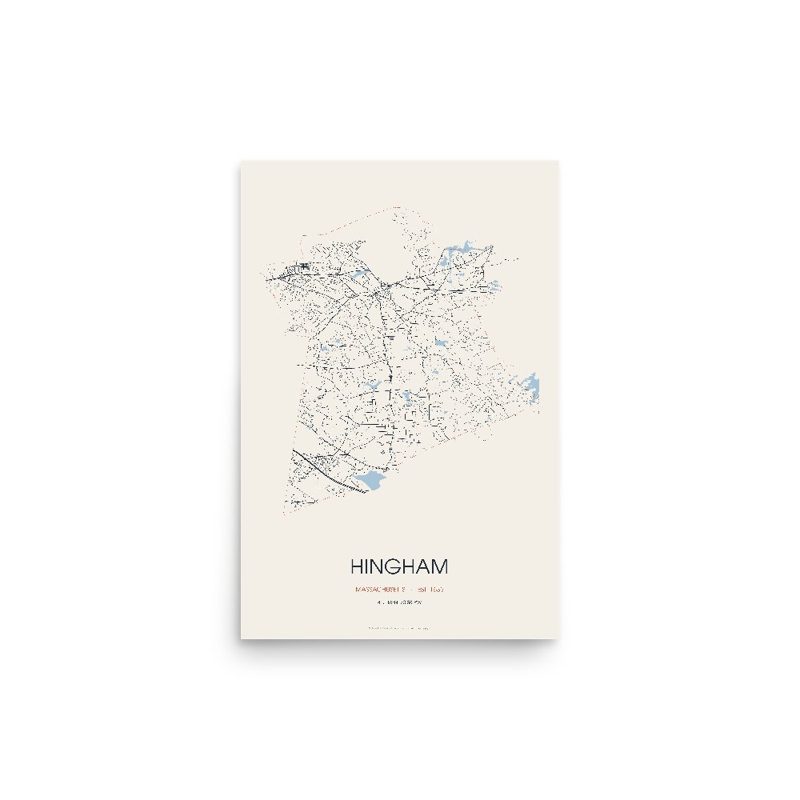
Every road in town, on archival matte paper
The same map, in navy and silver
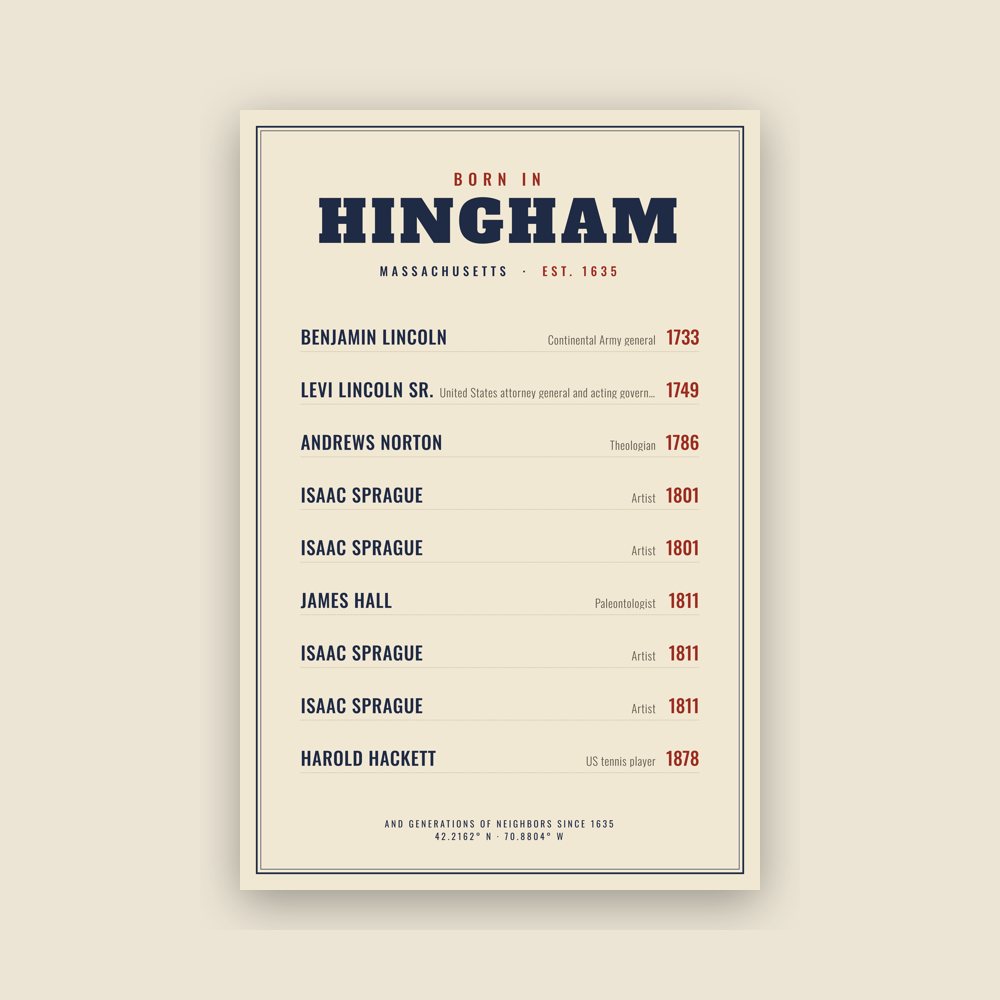
Famous natives, by birth year
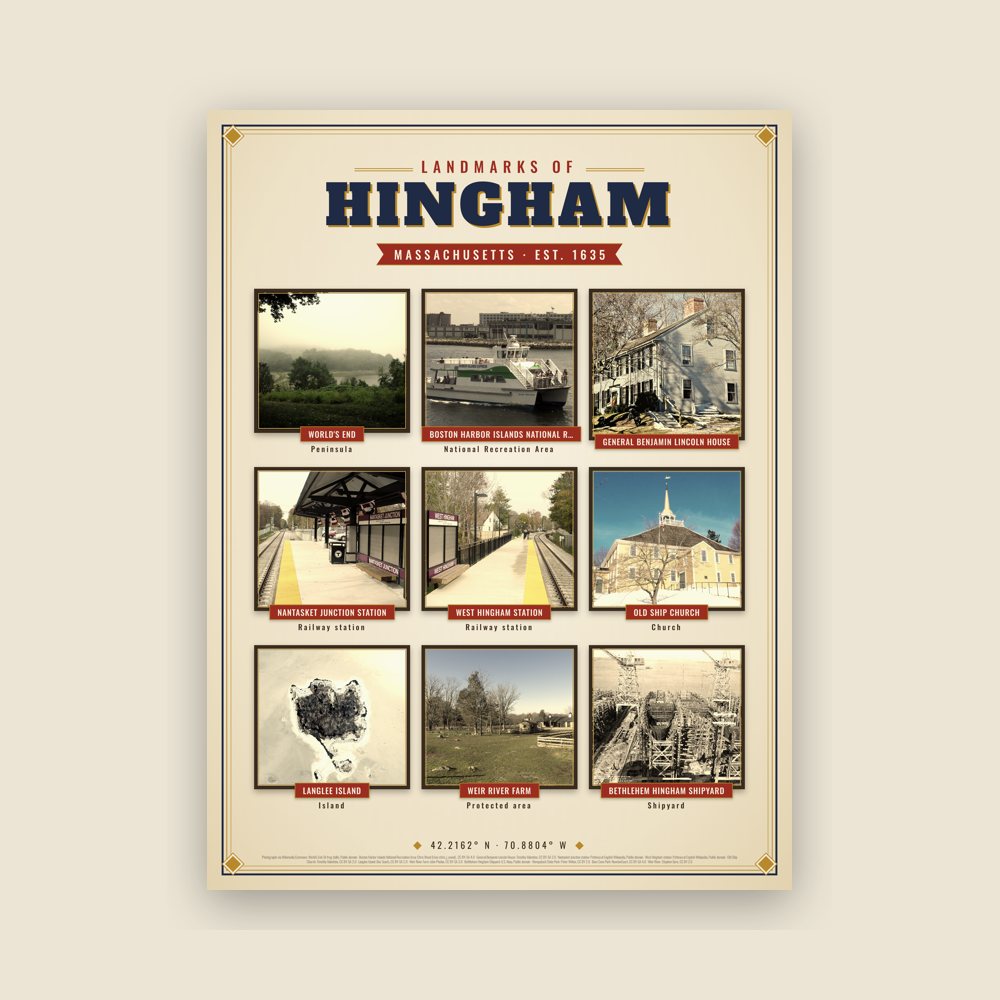
Nine local landmarks, archival matte
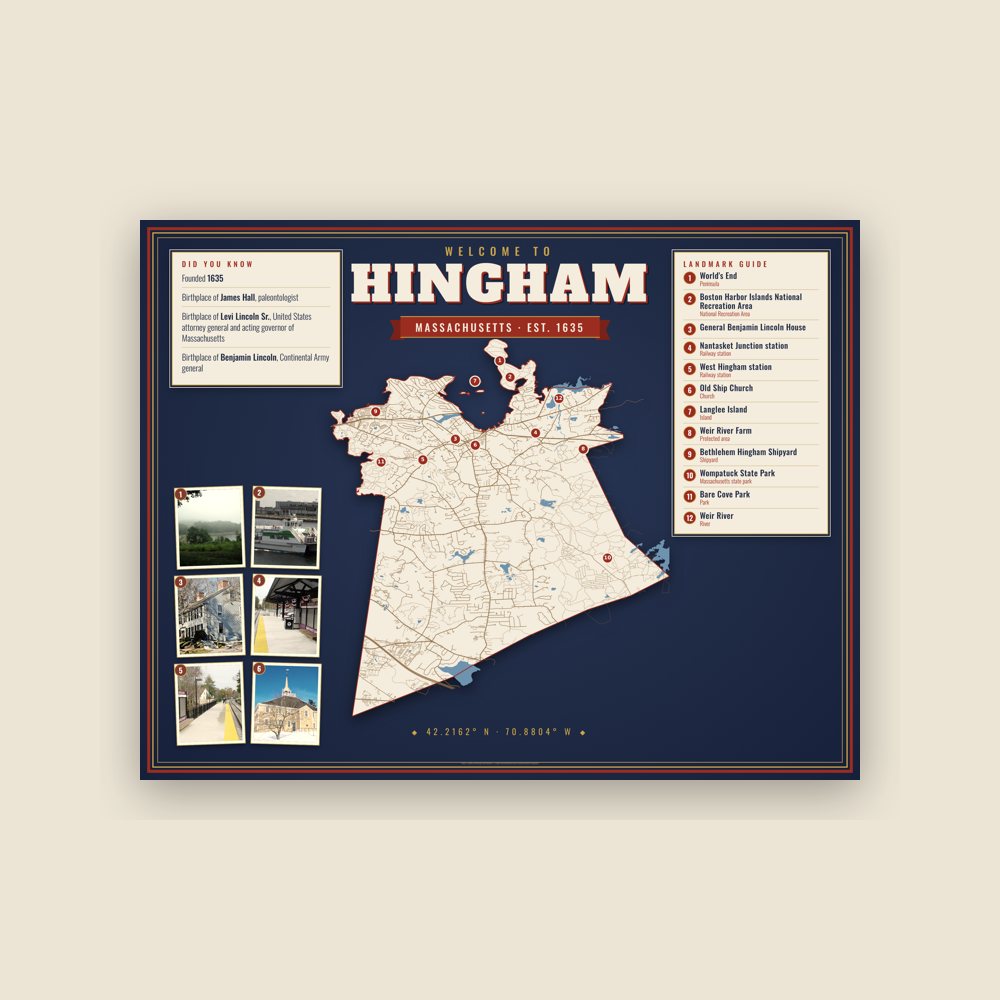
Map of local landmarks, washable fabric
Heavy-blend fleece, street map printed on the back
Soft Bella+Canvas jersey
Glossy ceramic, dishwasher safe
Ceramic keepsake, gold ribbon
Weatherproof, for the front walk
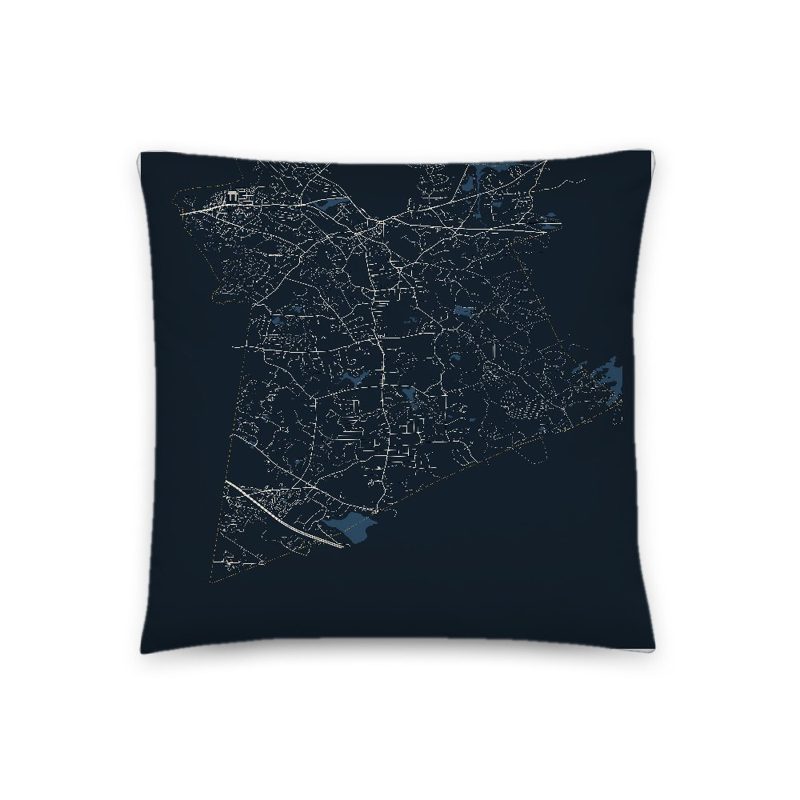
Soft-touch, zip cover
Sturdy all-over-print tote
Glossy top, cork back
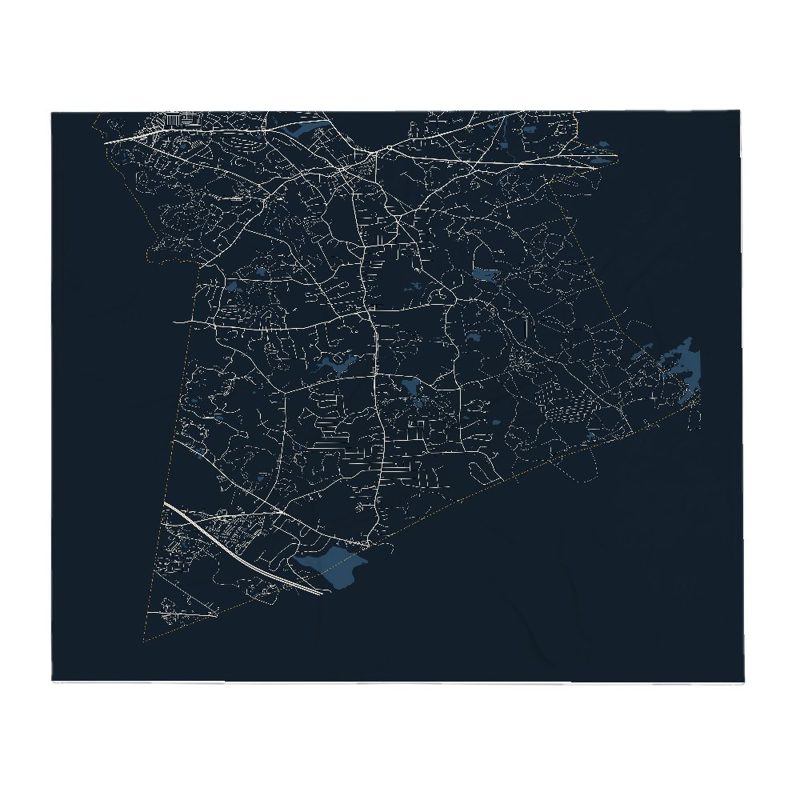
Soft fleece, 50″×60″
20 oz, double-wall stainless
Population 2010: 22,157 → 2020: 24,284
From Wikidata (CC0).
The town of Hingham was dubbed "Bare Cove" by the first colonizing English in 1633, but two years later was incorporated as a town under the name "Hingham." The land on which Hingham was settled was deeded to the English by the Wampanoag sachem Wompatuck in 1655. The town was within Suffolk County from its founding in 1643 until 1803, and Plymouth County from 1803 to the present. The eastern part of the town split off to become Cohasset in 1770. The town was named for Hingham, a market town in the English county of Norfolk, whence most of the first colonists came, including Abraham Lincoln's ancestor Samuel Lincoln (1622–1690), his first American ancestor, who came to Massachusetts in 1637. A statue of President Lincoln adorns the area adjacent to downtown Hingham Square.
Hingham was born of religious dissent. Many of the original founders were forced to flee their native town in Norfolk with both their vicars, Rev. Peter Hobart and Rev. Robert Peck, when they fell afoul of the strict doctrines of the Church of England. Peck was known for what the eminent Norfolk historian Rev. Francis Blomefield called his "violent schismatical spirit". Peck lowered the chancel railing of the church, in accord with Puritan sentiment that the Anglican church of the day was too removed from its parishioners. He also antagonized ecclesiastical authorities with other forbidden practices.
Hobart, born in Hingham, Norfolk, in 1604 and, like Peck, a graduate of Magdalene College, Cambridge, sought shelter from the prevailing discipline of the high church among his fellow Puritans. The cost to those who emigrated was steep. They "sold their possessions for half their value," noted a contemporary account, "and named the place of their settlement after their natal town." (The cost to the place they left behind was also high: Hingham was forced to petition Parliament for aid, claiming that the departure of its most well-to-do citizens had left it hamstrung.)
While most of the early Hingham settlers came from Hingham and other nearby villages in East Anglia, a few Hingham settlers like Anthony Eames came from the West Country of England. The early settlers of Dorchester, Massachusetts, for instance, had come under the guidance of Rev. John White of Dorchester in Dorset, and some of them (like Eames) later moved to Hingham. Accounts from Hingham's earliest years indicate some friction between the disparate groups, culminating in a 1645 episode involving the town's "trainband", when some Hingham settlers supported Eames, and others supported Bozoan Allen, a prominent early Hingham settler and Hobart ally who came from King's Lynn in Norfolk. Prominent East Anglian Puritans like the Hobarts and the Cushings, for instance, were used to holding sway in matters of governance. Eventually the controversy became so heated that John Winthrop and Thomas Dudley were drawn into the fray; minister Hobart threatened to excommunicate Eames.
The bitter trainband controversy dragged on for several years, culminating in stiff fines. Eventually a weary Eames, who was in his mid-fifties when the controversy began and who had served Hingham as first militia captain, a selectman, and Deputy in the General Court, threw in the towel and moved to nearby Marshfield where he again served as Deputy and emerged as a leading citizen, despite his brush with the Hingham powers-that-be.
Although the town was incorporated in 1635, the colonists did not get around to negotiating purchase from the Wampanoag, the Native American tribe in the region, until three decades later. On July 4, 1665, the tribe's chief sachem, Josiah Wompatuck, sold the township to Capt. Joshua Hobart (brother of Rev. Peter Hobart) and Ensign John Thaxter (father of Col. Samuel Thaxter), representatives of Hingham's colonial residents. Having occupied the land for 30 years, the Englishmen presumably felt entitled to a steep discount.
The sum promised Josiah Wompatuck for the land encompassing Hingham was to be paid by two Hingham landowners: Lieut. John Smith and Deacon John Leavitt, who had been granted 12 acres (49,000 m2) on Hingham's Turkey Hill earlier that year. Now the two men were instructed to deliver payment for their 12-acre (49,000 m2) grant to Josiah the chief Sachem. The grant to Smith and Leavitt—who together bought other large tracts from the Native Americans for themselves and their partners—was "on condition that they satisfy all the charge about the purchase of the town's land of Josiah—Indian sagamore, both the principal purchase and all the other charge that hath been about it". With that payment the matter was considered settled.
The third town clerk of Hingham was Daniel Cushing, who emigrated to Hingham from Hingham, Norfolk, with his father Matthew in 1638. Cushing's meticulous records of early Hingham enabled subsequent town historians to reconstruct much of early Hingham history as well as that of the early families. Cushing was rather unusual in that he included the town's gossip along with the more conventional formal record-keeping.
Adapted (trimmed) from the Wikipedia article Hingham, Massachusetts, revision 1374429673 by its contributors, licensed CC BY-SA 4.0.
We share a part of every Hingham sale with local partners, and we'd love to print from your collection. Old photographs, maps and postcards make the best keepsakes.
Partner with us