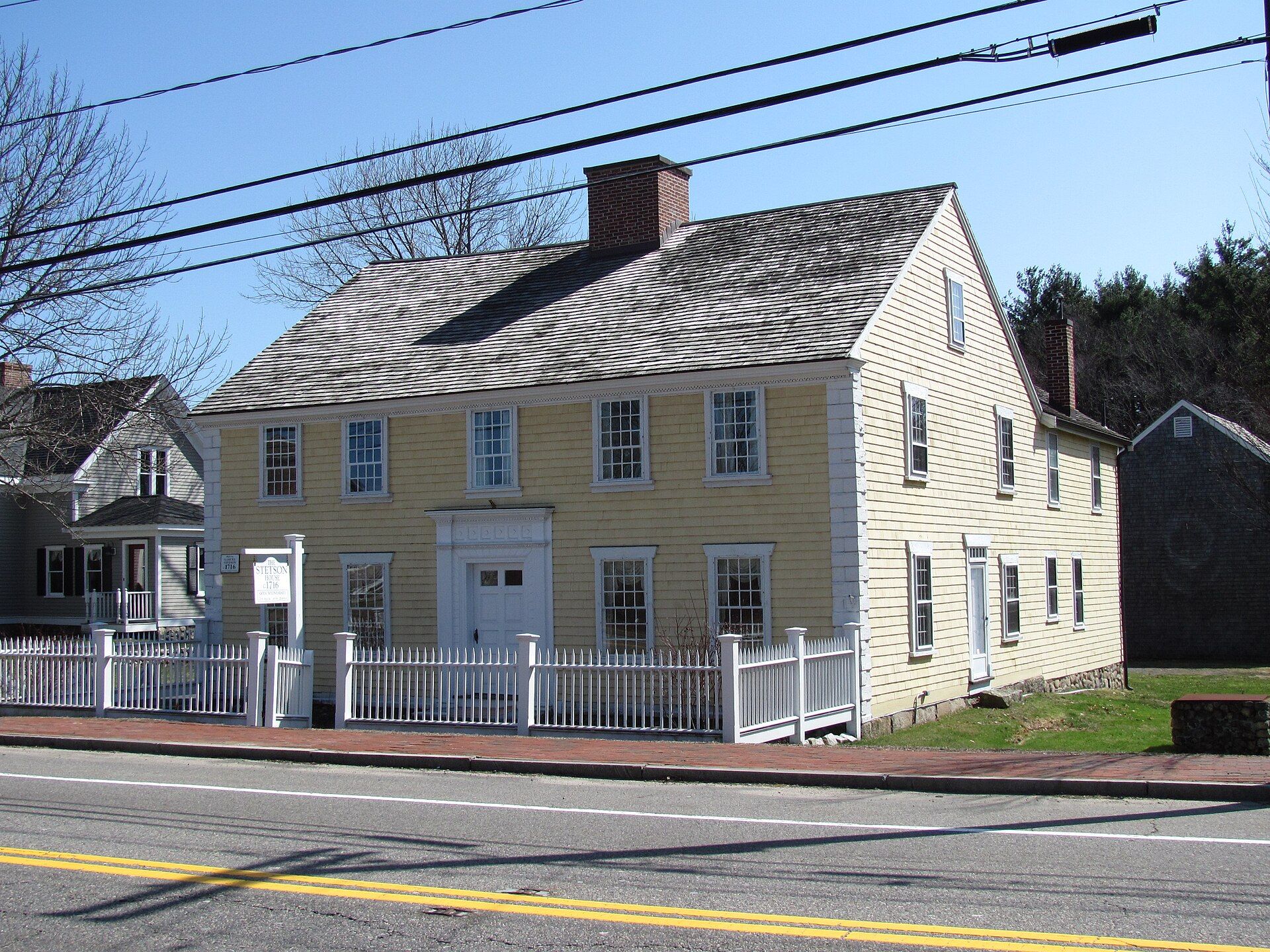
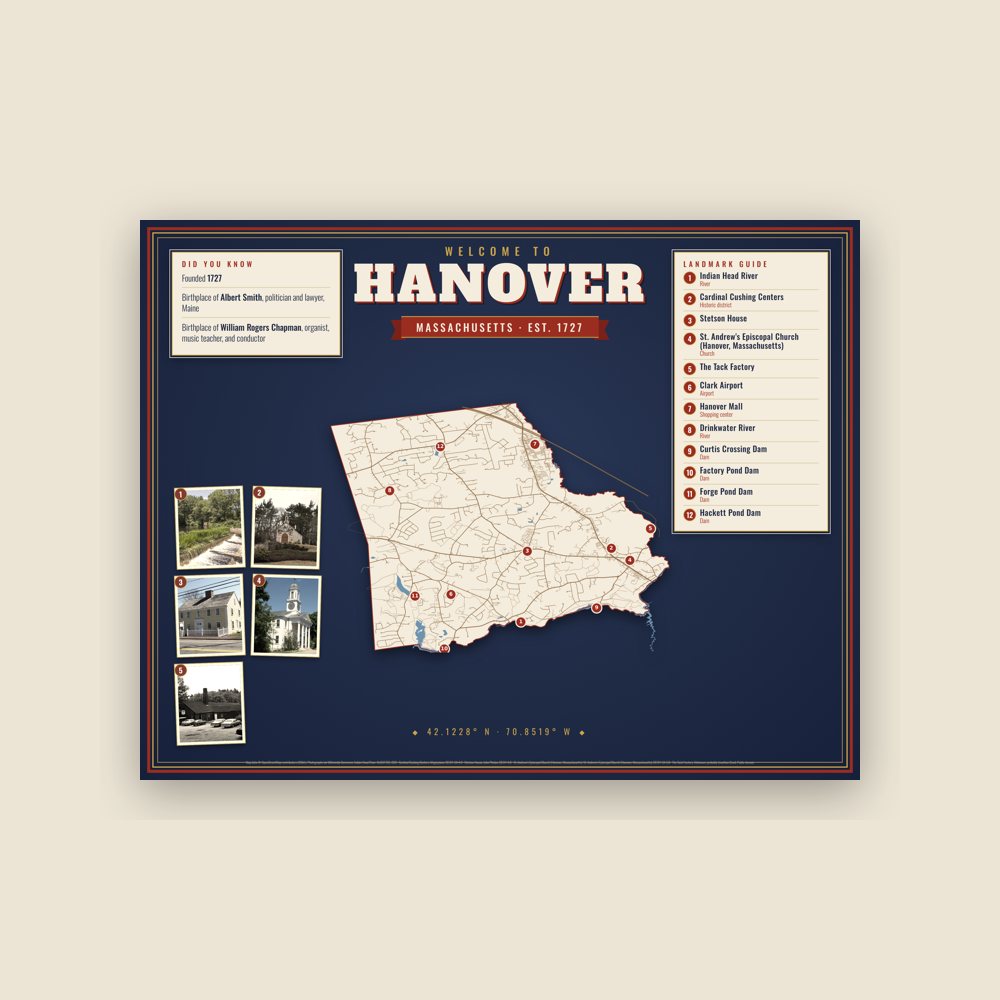
The area of Hanover was first inhabited by the local Wampanoag and Massachusett people before Europeans had settled. Landmarks include Cardinal Cushing Centers, Stetson House and St. Andrew's Episcopal Church (Hanover, Massachusetts). Hanover is the birthplace of Colin White, ice hockey player.
Every piece is drawn from Hanover's own map data and historic archives, then printed and shipped from the USA when you order. No two towns look alike.
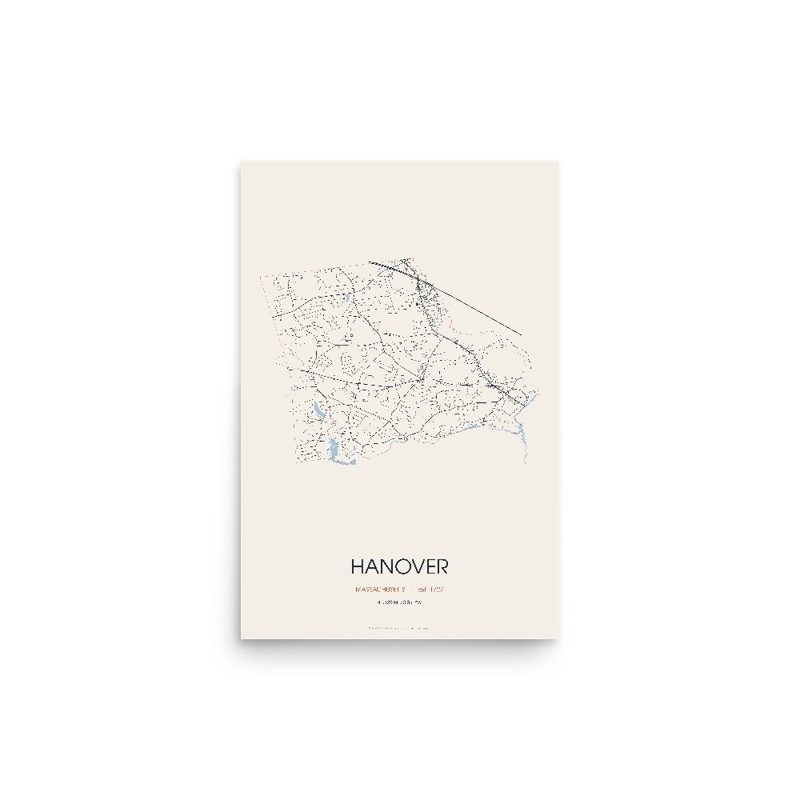
Every road in town, on archival matte paper
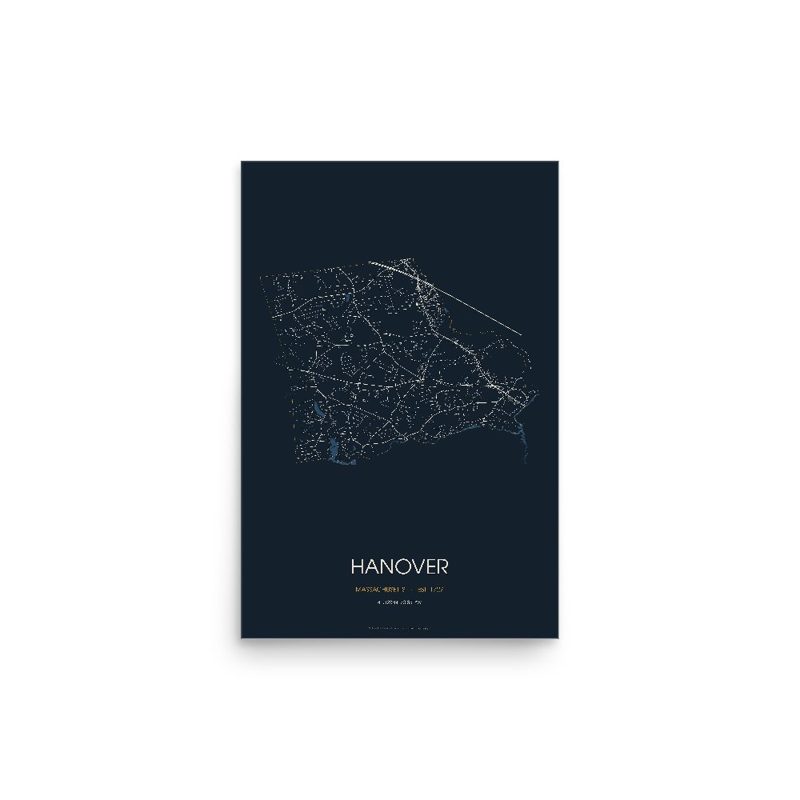
The same map, in navy and silver
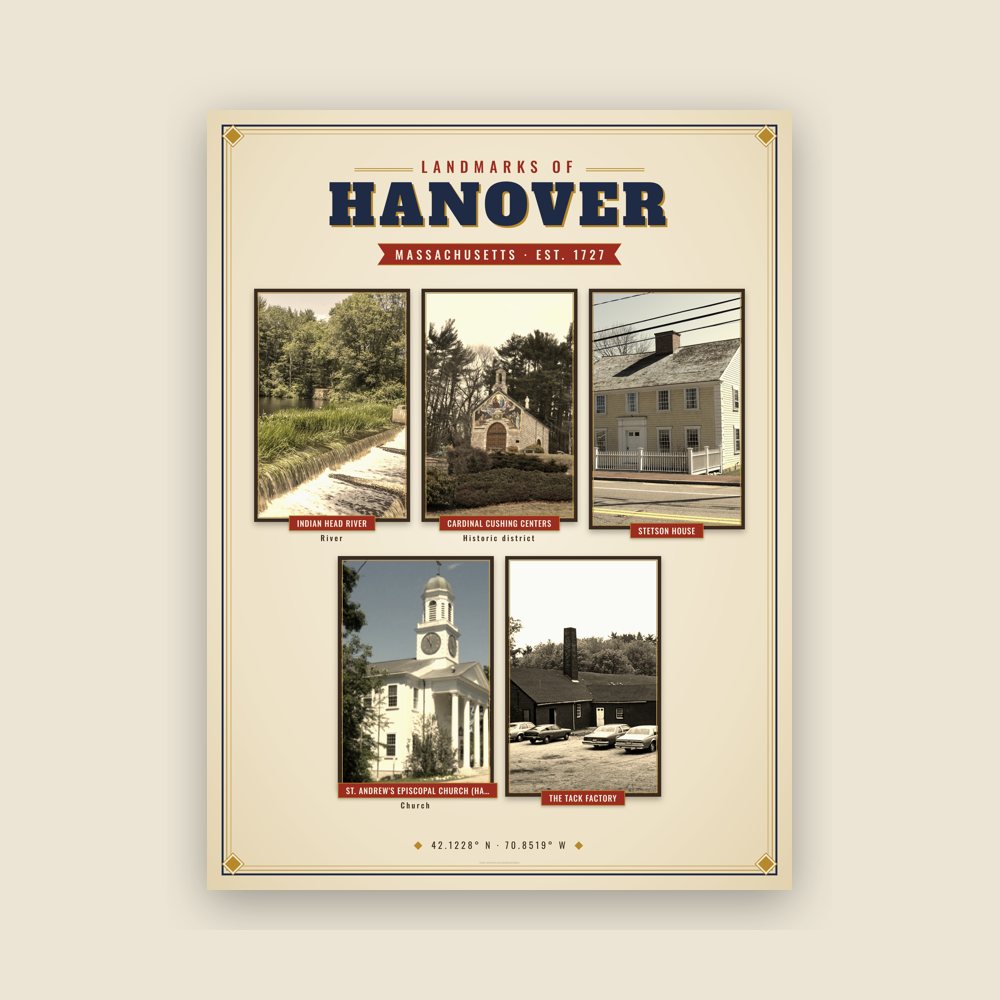
Nine local landmarks, archival matte
Map of local landmarks, washable fabric
Heavy-blend fleece, street map printed on the back
Soft Bella+Canvas jersey
Glossy ceramic, dishwasher safe
Ceramic keepsake, gold ribbon
Weatherproof, for the front walk
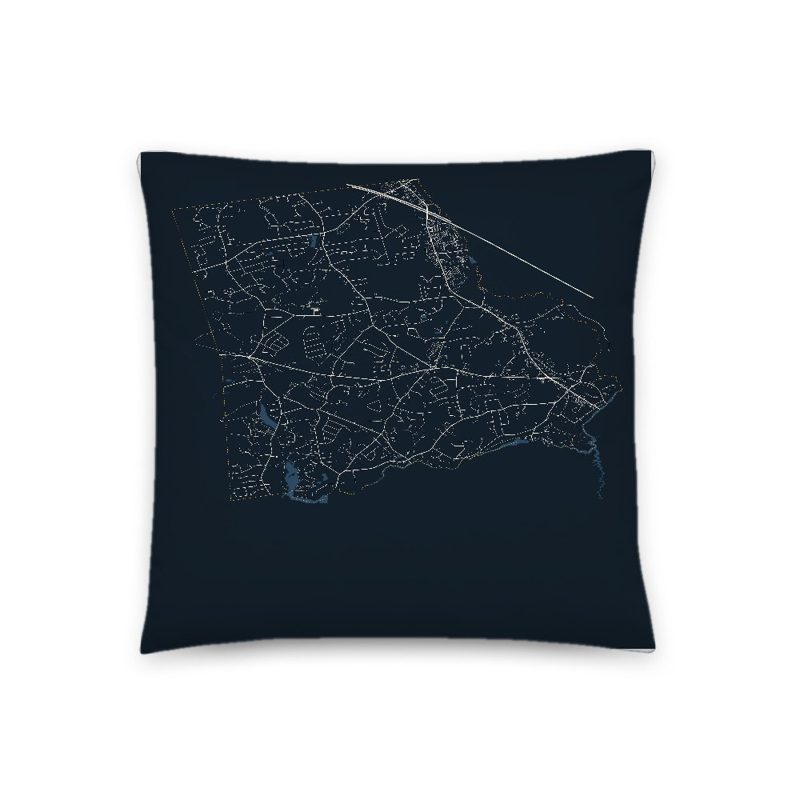
Soft-touch, zip cover
Sturdy all-over-print tote
Glossy top, cork back
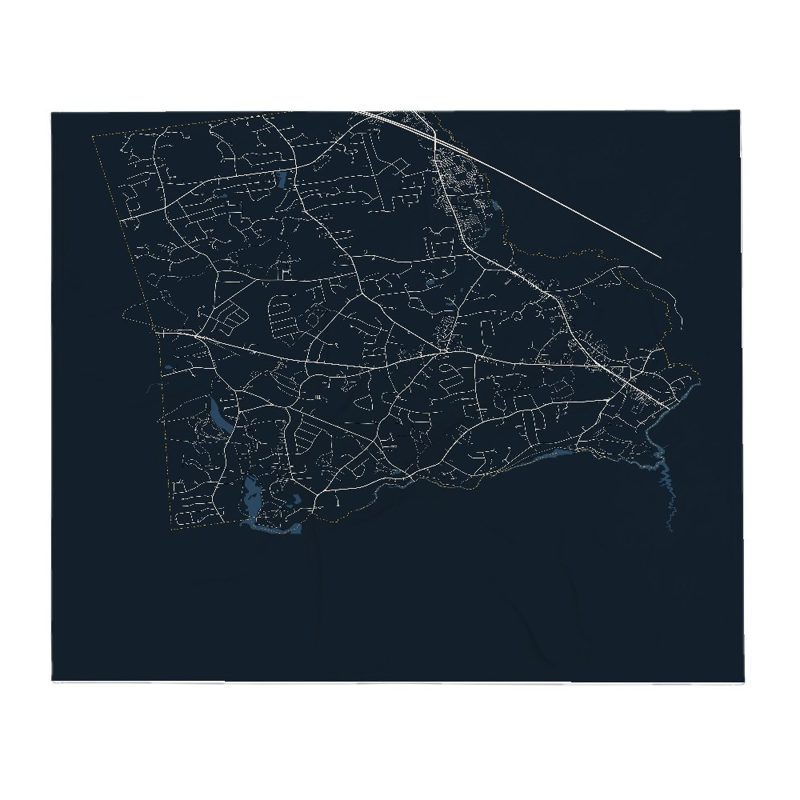
Soft fleece, 50″×60″
20 oz, double-wall stainless
Population 2010: 13,879 → 2020: 14,833
From Wikidata (CC0).
The area of Hanover was first inhabited by the local Wampanoag and Massachusett people before Europeans had settled. According to local history, there were a few documented sites being within the modern day border of Hanover, with one being in Assinippi, one in Pine Island Swamp, and the last being at Factory Pond, also known as Drinkwater Swamp. In the middle of the 17th century, the indigenous people were removed by force as waves of settlers from the British Isles started to migrate towards North America. The last of these natives in Hanover were removed in a small skirmish that occurred at the Factory Pond area in the 1630s.
European settlement began when the land was settled by English settlers from Scituate in 1649 when William Barstow, a farmer, built a bridge along the North River at what is now Washington Street. When Barstow settled the town, he constructed a cabin that was located off what is known today as Oakland Avenue (formerly Back Street). According to Dwelley's History of Hanover (1849), Phineas Pratt of the Wessagusset Colony apparently spent a night crossing the Indian Head or North River in the Hanover/Pembroke area during his difficult journey from what is today Weymouth to Plymouth in 1623.
During its first decades of settlement, the land was the westernmost portion of the town of Scituate, and it would officially separate and be incorporated as a town on June 14, 1727. The name "Hanover" is probably a tribute to King George I, the first Hanoverian King of Great Britain. (While George I died on June 11, 1727, the reports would not have reached the colonies until after the town's incorporation.) The origin of the name "Hanover/Hannover" however, comes from the Middle Low German ho or hoch meaning high, and over meaning bank or shore.
There are six separate villages settled within the town; North Hanover, Four Corners, West Hanover, Hanover Center, South Hanover, and Assinippi. Each village originally had its own school district, general store, and post offices. Hanover's early industry revolved around farming, small mills, anchor forging, and several shipbuilding yards along the North River. The oldest building in Hanover with the best documentation to support it is the Daniel Turner house, built in the year 1693.
Hanover was also the home of eleven smaller shipyards, with larger ones being Smiths shipyard and Barstow's Lower Yard. Another well known ship that was built in Hanover was the Oeno, in 1821 at Barstow's Lower Yard. The ship was wrecked off the coast of Fiji in 1825. Later industries would include tack factories and shoe factories along the smaller waterways in the town. The town was the site of the invention of the first tack-making machine, and making tacks and fireworks were among the industries of the later 19th century for Hanover.
It is said that the old Cornet Stetson Mill that was built on the Hanover side of the Third Herring Brook, and burnt down during King Philip's War, was the oldest mill in America. On the Indian Head River, the E.H. Clapp Rubber Works was an industrial stronghold for the town during the nineteenth century, the original building is preserved at Luddam's Ford Park now. Immigrants from Ireland and the British Isles settled the lands of Hanover and the North River region, also many immigrants from Northern and Eastern Europe, specifically from Germany, Poland, Lithuania, and Scandinavia, immigrated into Hanover during the nineteenth century.
At one point, from the late 1920s to the early 1940s, locals of Hanover and other parts of the North River area referred to West Hanover as "Little Poland". Today, Hanover is mostly residential. The Hanover Crossing, along with Merchants Row and other shops, are located near the intersection of Routes 3 and 53. Hanover Center has many war memorials dedicated to veterans who fought and died in wars throughout United States history.
During the American Revolution, Hanover sent Colonel John Bailey and his men to help defend Boston Harbor and Castle Island for the patriots. Later in the war, they were sent on expeditions to Rhode Island and Manchester, New Hampshire. The Four Corners area of the town was the site of Wales Tavern, which also hosted Paul Revere and Daniel Webster. An Iron Forge in West Hanover had also gone from producing anchors, to producing cannons and cannonballs. The westernmost shipping point on the North River was located at Chapman's Landing near Luddam's Ford. Iron would come from Humarock on ships traveling up the river to Chapman's Landing in Hanover, where the iron would be forged.
The Stetson family, in which created the famous hat company, originated in the North River area of Massachusetts. The Stetson family made some of their very first American homesteads in Hanover. Slavery was also present in the town prior to the 1783 abolishment of slavery in Massachusetts, as one of the most prominent slave owners in the town was Job Tilden. The Tilden family of Hanover came to Scituate from England in 1634, the same Tilden family that of Samuel J. Tilden.
During the mid to late 19th century, there was the Hanover Branch Railroad, which had stations from Hanover Four Corners to North Abington. It was deeded to the Old Colony Railroad system in 1887. In 1813, anchors for the ship the USS Constitution were made in Hanover at the Robert Salmond anchor forge, that was located at Luddam's Ford during the 1700 and 1800s. Hanover also had an airport called Clark Airport, that was operational from 1927 to 1958. It was located in West Hanover. During WWI and WWII the Pilgrim Ordnance Works in West Hanover made munitions for the war effort.
The Stetson House is also located in Hanover Center. Hanover Center is listed in the National Register of Historic Places as Hanover Center Historic District. The Four Corners area is where William Barstow's Two Oaks shipyard was. In the Southwest corner of the town, there was an anchor forge on Forge Pond, the rest of the area evolved into an industrial park that produced fireworks and ammunition that was controlled by the Pilgrim Ordnance Works. The Northeast served as a business sector for the town with much of Route 53 being enclosed with many shops, stores, restaurants, grocery stores, and outlets. The Cardinal Cushing Centers is also in the National Register of Historic Places, which is located at Hanover Four Corners. Richard Cushing is buried at the Portiuncula Chapel there, as Cardinal Cushing was the presiding minister during the funeral and burial of President John F. Kennedy. One of the oldest Boy Scouts troops in the United States was founded and is still active today in Hanover, Troop 1.
Hanover had several smaller shipyards during its development, however, the more prominent ones such as Barstow's Two Oaks shipyard and Lower Yards were better documented. Others such as Clarks Yard, Kingman Yard, and Wing Yard, and a shipyard that was owned by the family of Thatcher Magoun, also helped Hanover during its early development. The ships would sail down the North River and would bring pork, fish, beef, and oil, and would return with spices, rum, and sugar. At the height of the shipbuilding boom of 1812, it has been said that every Saturday night one would see at most 400 workers at the shipyards. Today, Hanover's shipyards are marked in the Four Corners area of the town, making it a point of interest.
Adapted (trimmed) from the Wikipedia article Hanover, Massachusetts, revision 1377374092 by its contributors, licensed CC BY-SA 4.0.
We share a part of every Hanover sale with local partners, and we'd love to print from your collection. Old photographs, maps and postcards make the best keepsakes.
Partner with us