A short history of Atchison
Founding
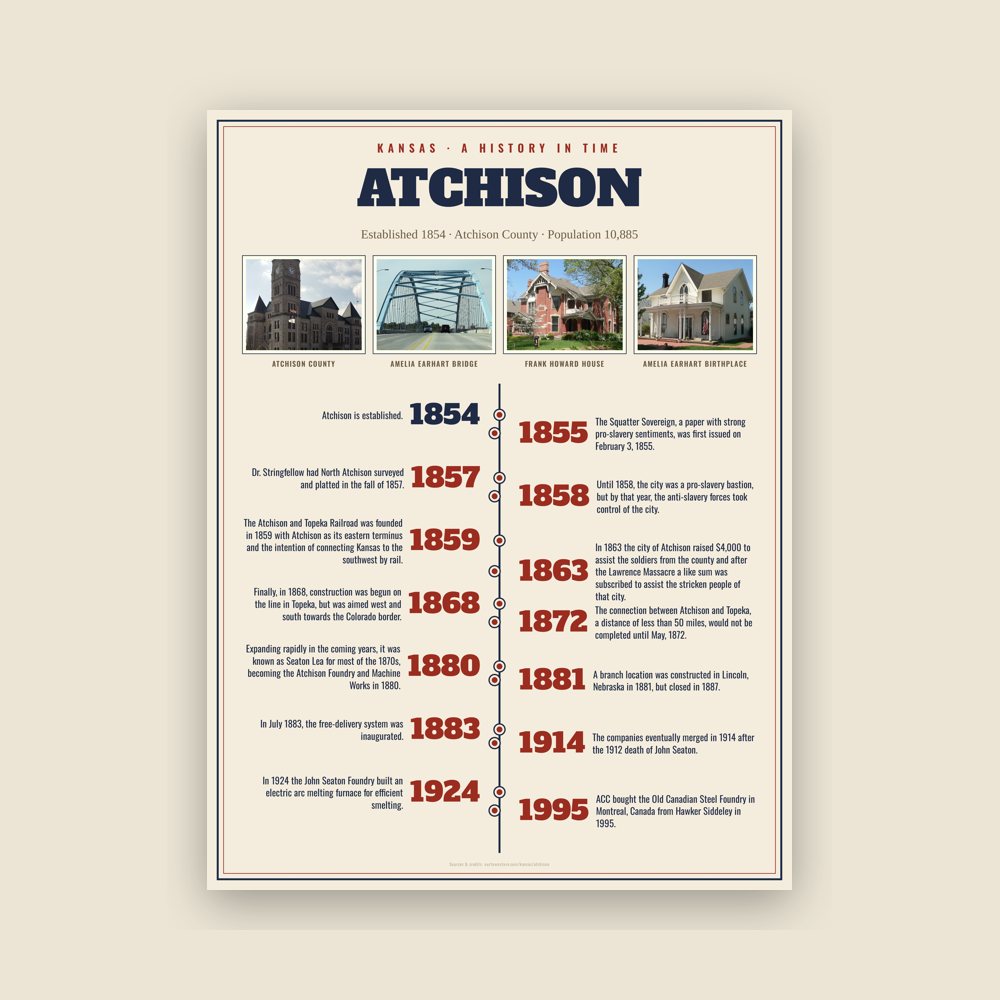
Atchison was founded in 1854 and named in honor of Missouri senator David Rice Atchison, who, when Kansas was opened for settlement, interested some of his friends in the scheme of forming a city in the new territory. Senator Atchison was interested in ensuring that the population of the new Kansas Territory would be majority pro-slavery, as he had been a prominent promoter of both slavery and the idea of popular sovereignty over the issue in the new lands. However, not everyone agreed upon the location he had selected, and on July 20, 1854, Dr. John H. Stringfellow, Ira Norris, Leonidas Oldham, James B. Martin, and Neal Owens left Platte City, Missouri, to decide definitely upon a site. They found a site that was the natural outlet of a remarkably rich agricultural region just open to settlement. George M. Million and Samuel Dickson had staked claims near the river; Dr. Stringfellow staked a tract north of Million's. Million sold his claim for $1,000—an exorbitant price. Eighteen persons were present when the town company was formally organized by electing Peter T. Abell, president; James Burns, treasurer; and Dr. Stringfellow, secretary. The site was divided into 100 shares by the company, of which each member retained five shares, the remainder being reserved for common benefit of all. By September 20, 1854, Henry Kuhn had surveyed the 480 acres (1.9 km2) and made a plat, and the next day was fixed for the sale of lots, an event of great importance as it had become understood that Senator Atchison would make a speech upon the political question of the day, hence the sale would be of political as well as business significance. At his meeting on the 21st, two public institutions of vital interest to a new community were planned for—a hotel and a newspaper. Each share of stock in the town company was assessed $25, the proceeds to be used to build the National Hotel, which was completed in the spring of 1855, and $400 was donated to Dr. Stringfellow and Robert S. Kelley to erect a printing office.
The Squatter Sovereign, a paper with strong pro-slavery sentiments, was first issued on February 3, 1855. It had formerly been published at Liberty, Missouri, under the name of the Democratic Platform. In the spring of 1857 it was purchased by Samuel C. Pomeroy, Robert McBratney and F.G. Adams, who changed its policy and published it as a free-state paper until the fall of the same year, when Pomeroy became the sole owner.
The first post office in Atchison was established April 10, 1855, with Kelley as postmaster. It was opened in a small building in the block later occupied by the Otis house. In July 1883, the free-delivery system was inaugurated.
For years there had been considerable trade up and down the Missouri River, which had naturally centered at Leavenworth, but in June 1855, several overland freighters, such as Livingston, Kinkead & Co., and Hooper & Williams were induced to select Atchison as their outfitting point and formed the basis that established Atchison as a commercial center. Early merchants to establish businesses in the new town were George Challis, Burns Bros., Stephen Johnston and Samuel Dickson.
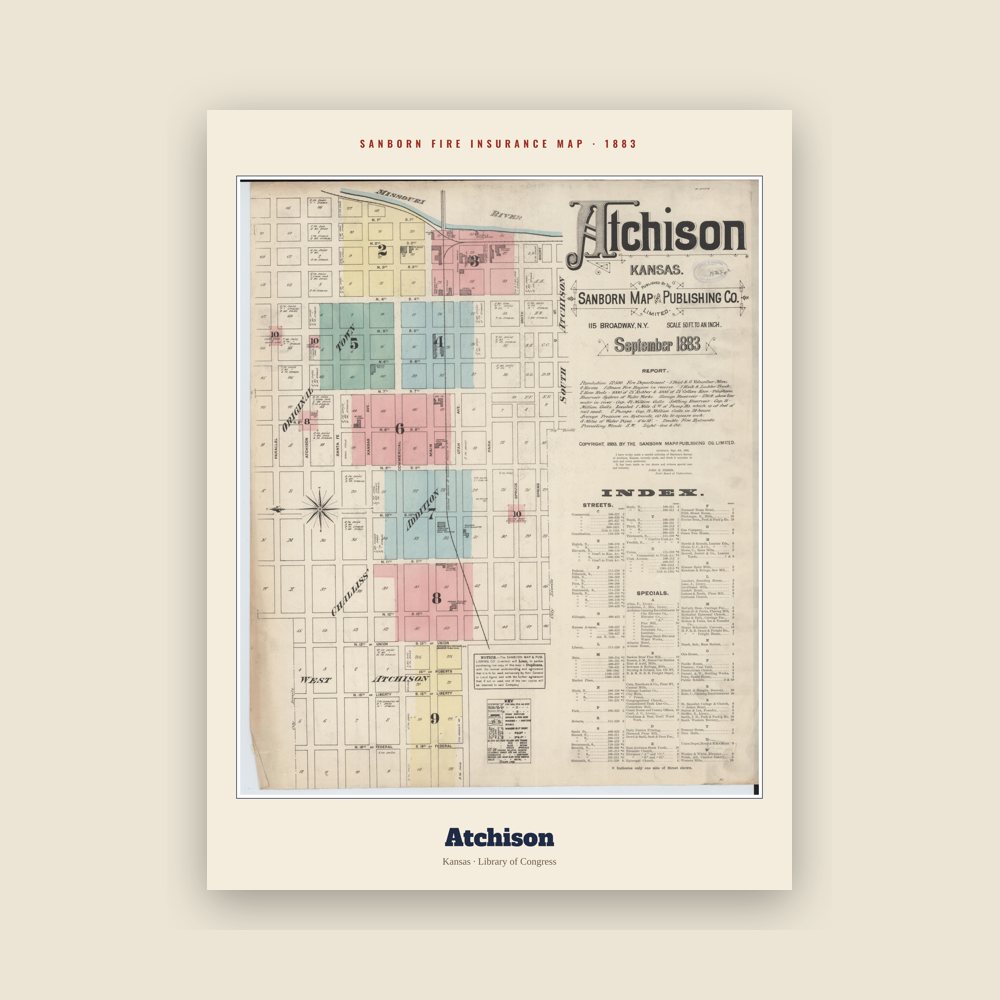
On August 30, 1855, Atchison was incorporated. Dr. Stringfellow had North Atchison surveyed and platted in the fall of 1857. This started a fever of additions. In February 1858, West Atchison was laid out by John Roberts, and in May Samuel Dickson had his property surveyed as South Atchison. Still another addition was made by John Challis.
Until 1858, the city was a pro-slavery bastion, but by that year, the anti-slavery forces took control of the city. On February 12, 1858, the legislature issued a charter to the city of Atchison, which was approved by the people on March 2 at a special election. The first city officers were elected at a second special election on March 13, 1858, and Republican Samuel C. Pomeroy was elected mayor. The German element, largely Catholic, opposed the Sunday closing laws of the new city government, but a satisfactory compromise was reached that allowed the sale of beer on Sundays after church services.
Read the full history
Early development
The first schools in the town were private, including parochial schools operated by the Germans. One of the first English schools was opened in 1857 by Lizzie Bay. The first school district was established in October 1858, and a month later the Atchison free high school was opened at the corner of Atchison and Commercial streets.
Civil War
At the outbreak of the American Civil War there were three militia companies organized in Atchison, whose members enlisted in the Kansas regiments. They were known as Companies A, C and “At All Hazards”. Early in September 1861, a home guard was organized in the town to protect it in case of invasion from Missouri, and on the 15th of the month another company was raised, which was subsequently mustered into a state regiment. In 1863 the city of Atchison raised $4,000 to assist the soldiers from the county and after the Lawrence Massacre a like sum was subscribed to assist the stricken people of that city. Citizens of the town also joined the vigilance committees that so materially aided the civil authorities in suppressing raiding and the lawless bands of thieves that infested the border counties.
During the war, Atchison was also the headquarters of numerous bands of jayhawkers including the notorious Charles Metz, who was known as Cleveland. Metz, a former prisoner at the Missouri State Penitentiary, selected Atchison as his headquarters for raids into Missouri and was accepted with open arms by the people of the town. During his period of operations, he stole hundreds of horses from Missouri farmers and sold them in Kansas. He robbed any suspected southern sympathizer and threatened several leading citizens with murder and robbery if they remained in town. He even had the audacity to run off the first president of Atchison, P.T. Abell, who was forced into exile until after the Civil War concluded. He defied all authorities who attempted to rein in his excesses, but was finally shot and killed at some point in 1862. He is buried in St. Joseph, Missouri.
Industrialization
In the late 1850s, plans were underway to connect California to the rest of the country by rail. The logical location for a western terminus was in or around San Francisco, California, but an eastern terminus had yet to be chosen. Atchison was in fierce competition to be selected as the terminus, and in order to bolster its position, a rail line was constructed from St. Joseph, Missouri to Atchison between 1857 and 1859, funded in large part by $150,000 raised by the citizens of Atchison and connected to the Hannibal & St. Joseph R.R. at its eastern end. The Atchison and Topeka Railroad was founded in 1859 with Atchison as its eastern terminus and the intention of connecting Kansas to the southwest by rail. Although construction was delayed by the Civil War, a land grant similar to the one given the Union Pacific to construct the first transcontinental railroad was made by the federal government to Kansas in 1863, which was transferred to the newly reformed Atchison, Topeka, and Santa Fe Railroad (AT&SF). Finally, in 1868, construction was begun on the line in Topeka, but was aimed west and south towards the Colorado border. The connection between Atchison and Topeka, a distance of less than 50 miles, would not be completed until May, 1872.
The city tried to become a major railroad center, but was surpassed by Kansas City and Omaha, due to the former's greater industrial capability and connections to Texas and the latter's connection to Chicago, rather than St. Louis. Furthermore, Atchison boosters were unable to unite on a single project, instead scattering their efforts to the southwest, west and northwest, none of which proved successful. A proposed "Atchison and Pike's Peak" line was eventually taken over by the Union Pacific, while a speculative Atchison-Nebraska connector was eventually finished and taken over by other investors. Bickering delayed the building of bridges, stockyards, elevators, warehouses and railroad yards, revealing the disharmony that plagued Atchison's entrepreneurs.
However, with the completion of the connector to St. Joseph, which later became part of the Missouri Pacific, and the final connection to the growing AT&SF system, industrialization reached Atchison. Grain elevators, flour mills, and a flax mill were all erected in Atchison in the late 1860s and early 1870s. Several prominent businessmen in town lured Captain John Seaton, who operated a foundry in Alton, Illinois, to town to improve the Atchison Foundry and Machine Works in 1872. It soon began turning out decorative wrought iron fences, spiral staircases, and hitching posts for horses. The foundry expanded quickly, as Seaton transported his entire Alton operation to Atchison to establish the Seaton Foundry. It employed over 200 men and had a payroll of more than $14,000 per month in 1872. Expanding rapidly in the coming years, it was known as Seaton Lea for most of the 1870s, becoming the Atchison Foundry and Machine Works in 1880. A branch location was constructed in Lincoln, Nebraska in 1881, but closed in 1887. In 1905, the Locomotive Finished Materials Company was established by Harry E. Muchnic, formerly of the AT&SF railroad, which produced finished materials for the construction of railroad locomotives in close conjunction with Seaton's foundry. The companies eventually merged in 1914 after the 1912 death of John Seaton.
After his arrival in 1872, John Seaton became one of the leading citizens of Atchison. Besides establishing the foundry which became the center of the town's industry, he also owned the local theater, served on the school board, was elected to the Kansas Legislature in 1889, served on the Kansas Penitentiary Board, and was nominated for Governor of Kansas. He died on January 12, 1912.
In 1914, Harry Muchnic invented a revolutionary diesel locomotive piston ring. In 1924 the John Seaton Foundry built an electric arc melting furnace for efficient smelting. In 1924 Atchison began the transition from iron to steel which paved the transition from steam locomotives to diesel locomotives. The first steel locomotive truck assembly was designed, cast, and assembled in 1934. In 1938 LFM was making 18 locomotive assemblies every day for General Motors-Electric Motive Division (EMD) and continued to be a key supplier of components to EMD.
In 1958 Rockwell purchased the LFM Steel Foundry to make locomotive trucks for EMD and GM (Progress Rail). Rockwell's Transit Truck Design Group was established in 1960. Rockwell Manufacturing and Rockwell International were the owners from 1956 to 1993 and they renamed the LFM to Atchison Casting Corporation (ACC) in 1991. Atchison Casting became a publicly held corporation in 1994. ACC bought the Old Canadian Steel Foundry in Montreal, Canada from Hawker Siddeley in 1995. The foundry has primarily become a producer of rail transport components, including commuter rail truck frames for commuter rail systems in San Francisco, Chicago, Atlanta, and Washington, D.C. It has also undergone various mergers, reorganizations, and renamings, most recently after it was purchased by Bradken, a global manufacturing company headquartered in Australia.
Adapted (trimmed) from the Wikipedia article Atchison, Kansas, revision 1374755702 by its contributors, licensed CC BY-SA 4.0.
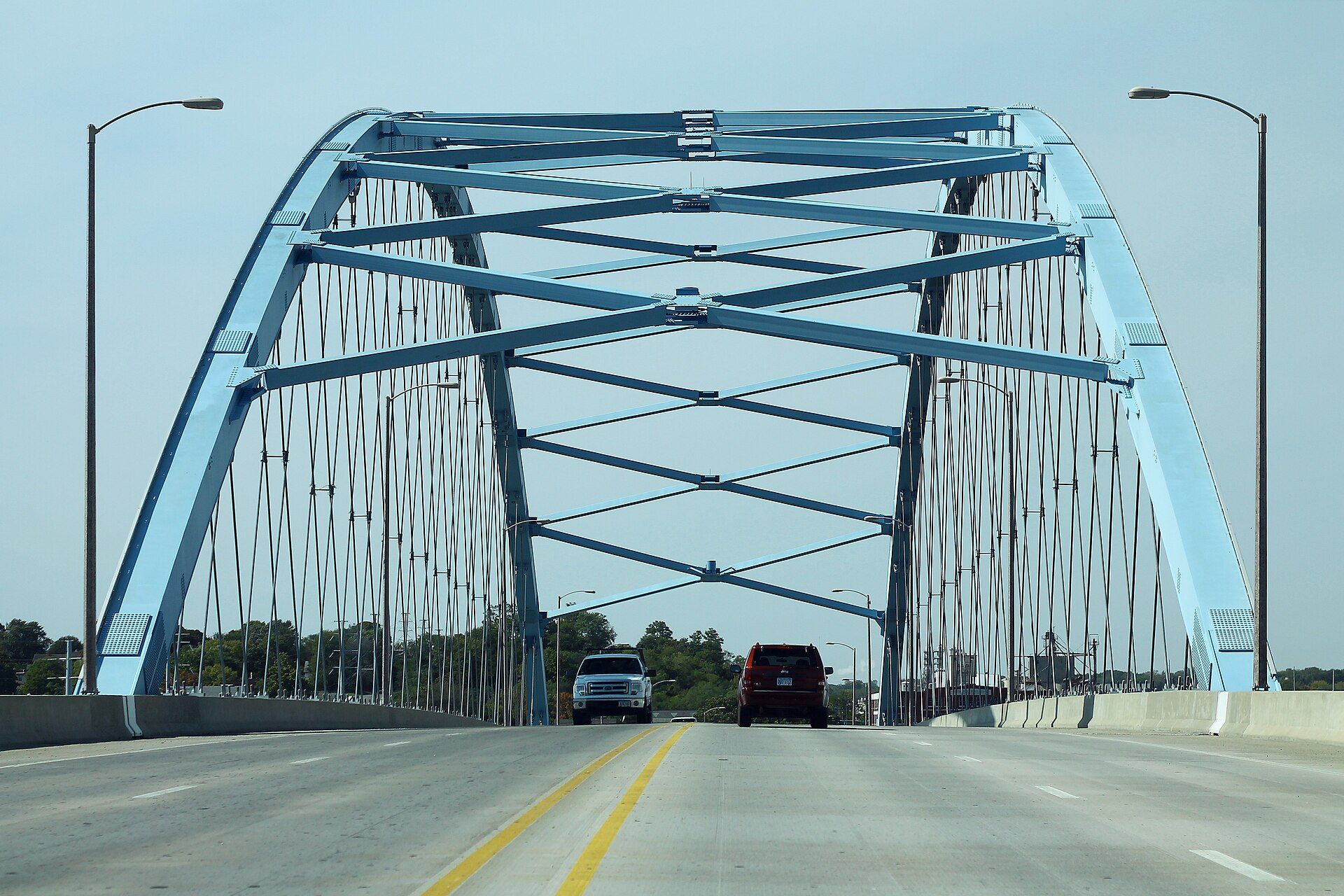
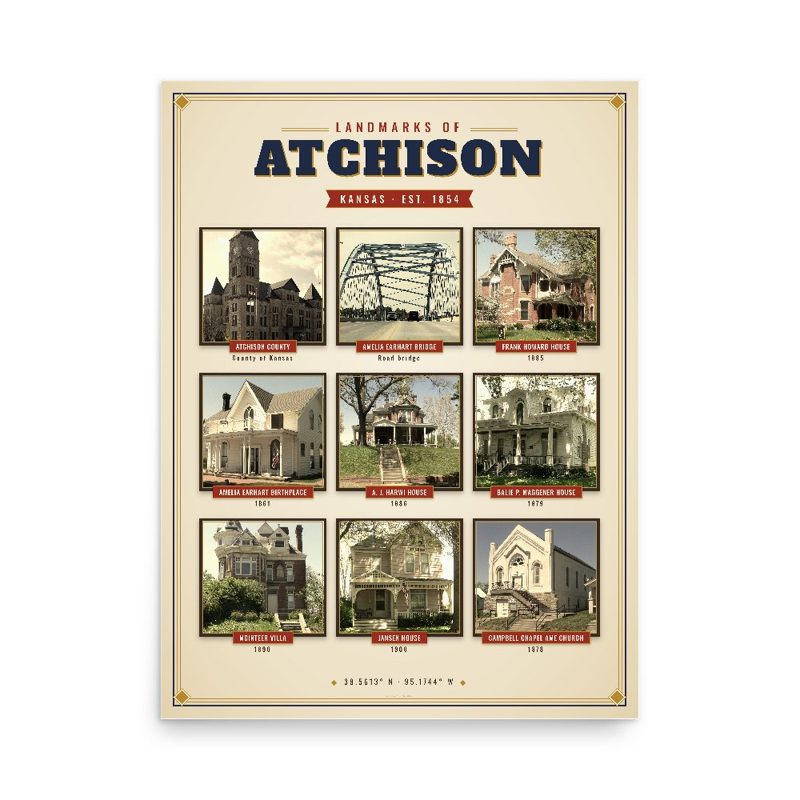
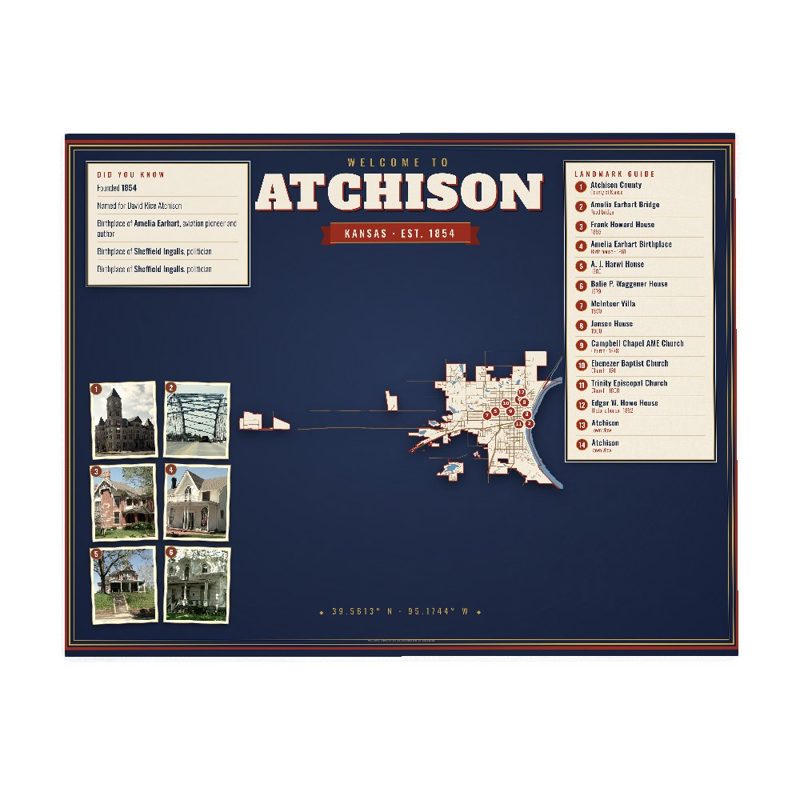





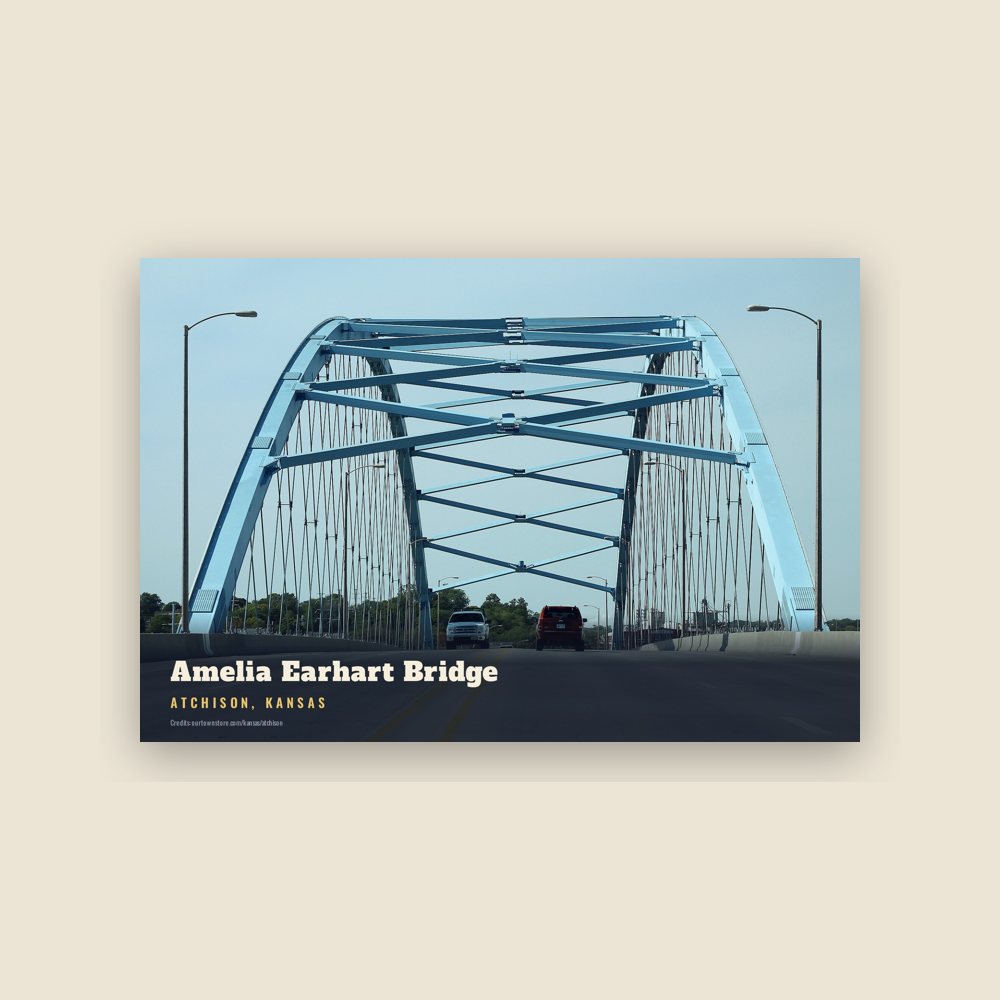
 Amelia Earhart Bridge
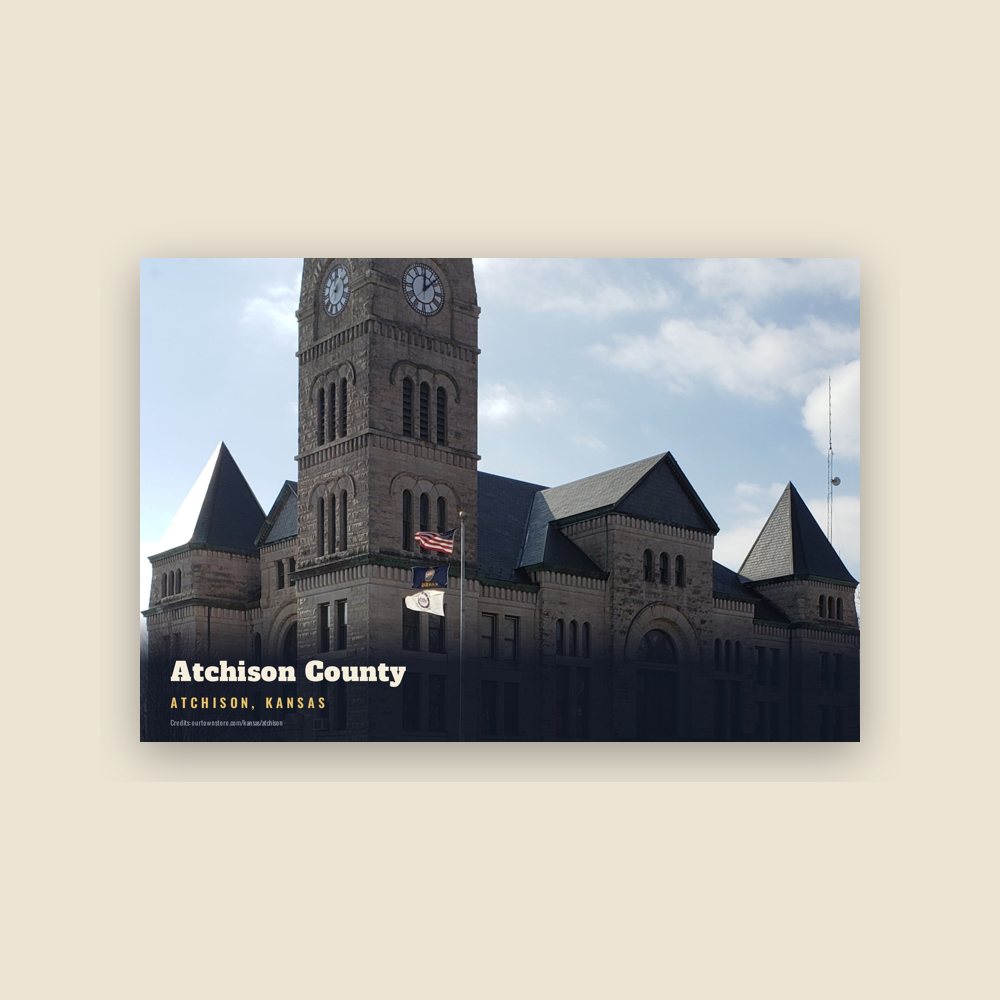
 Atchison County
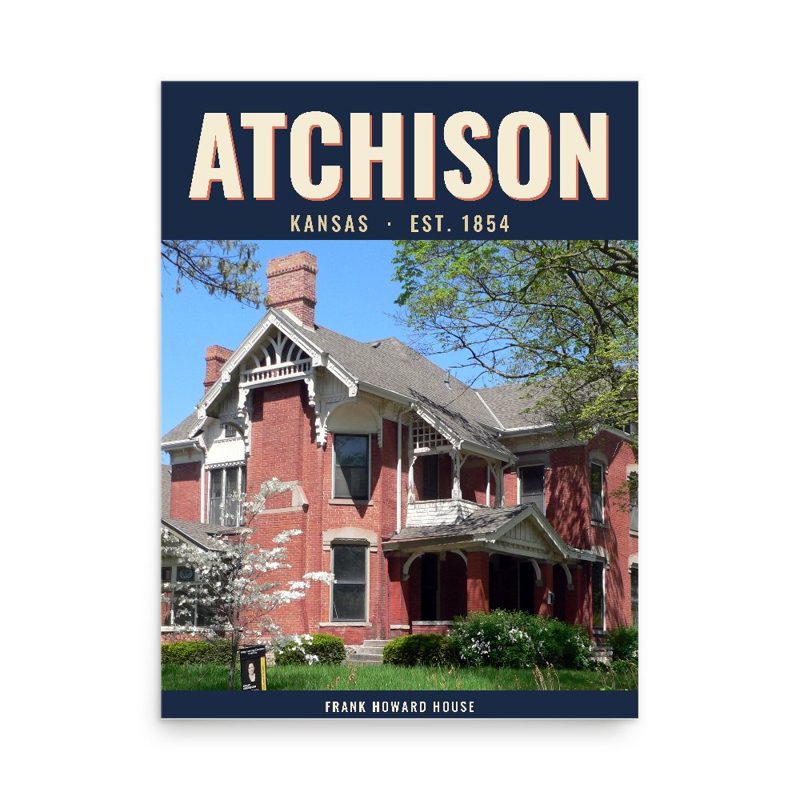
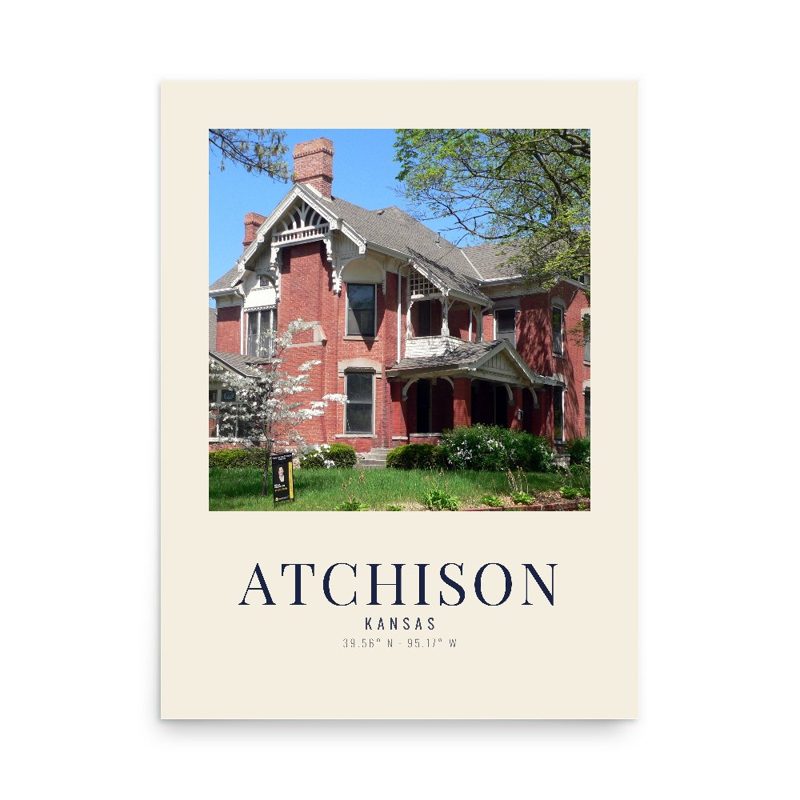
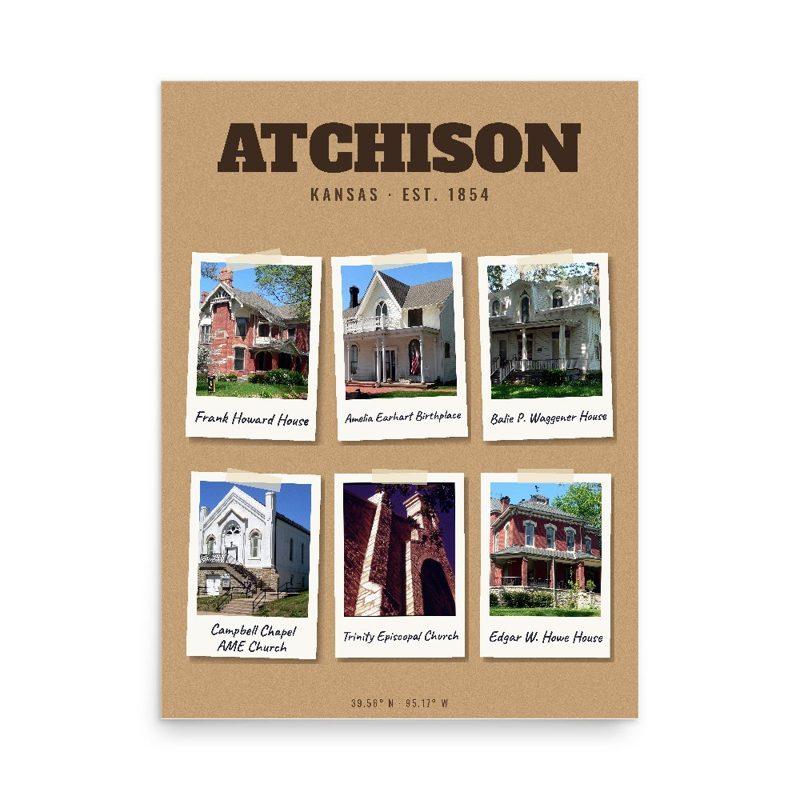
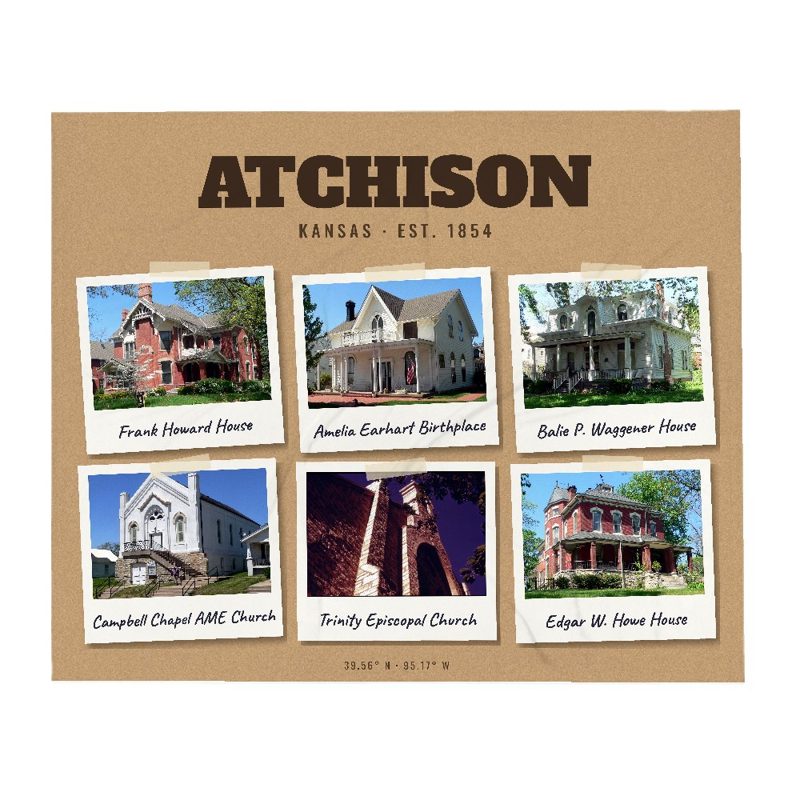
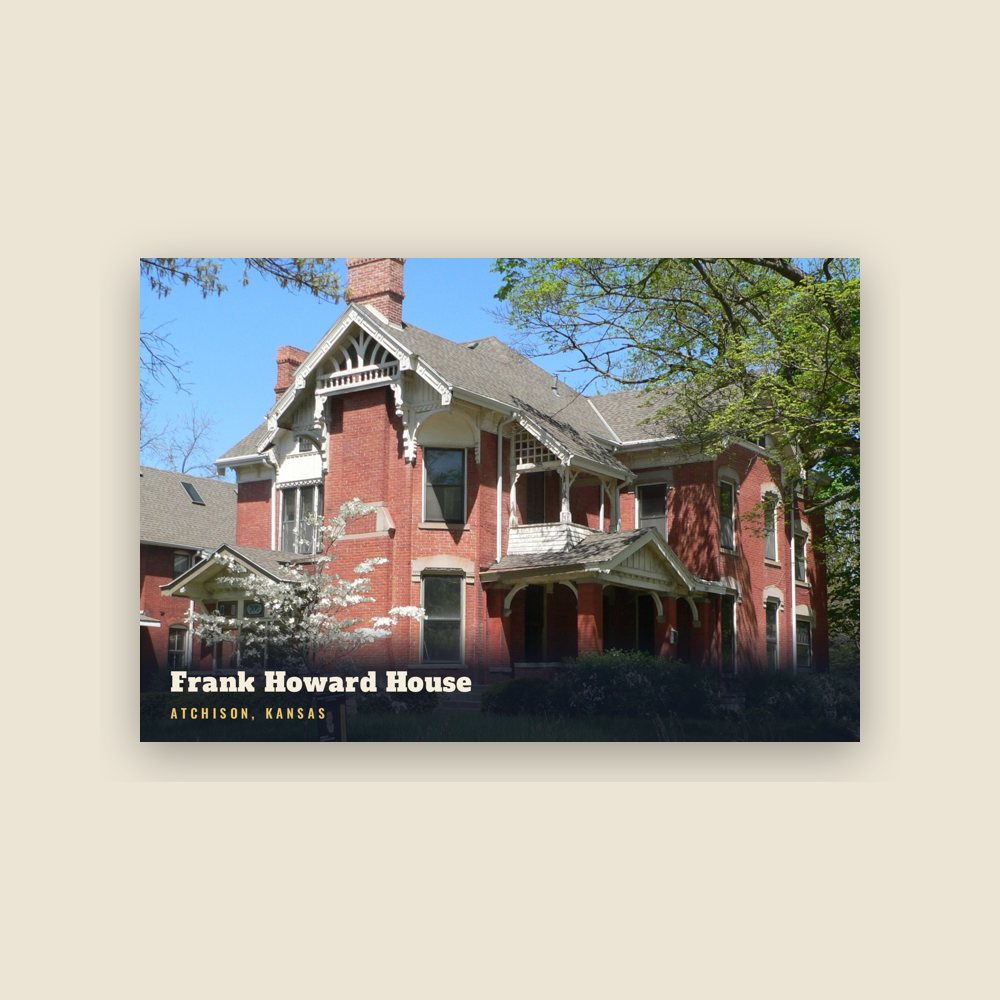
 Frank Howard House
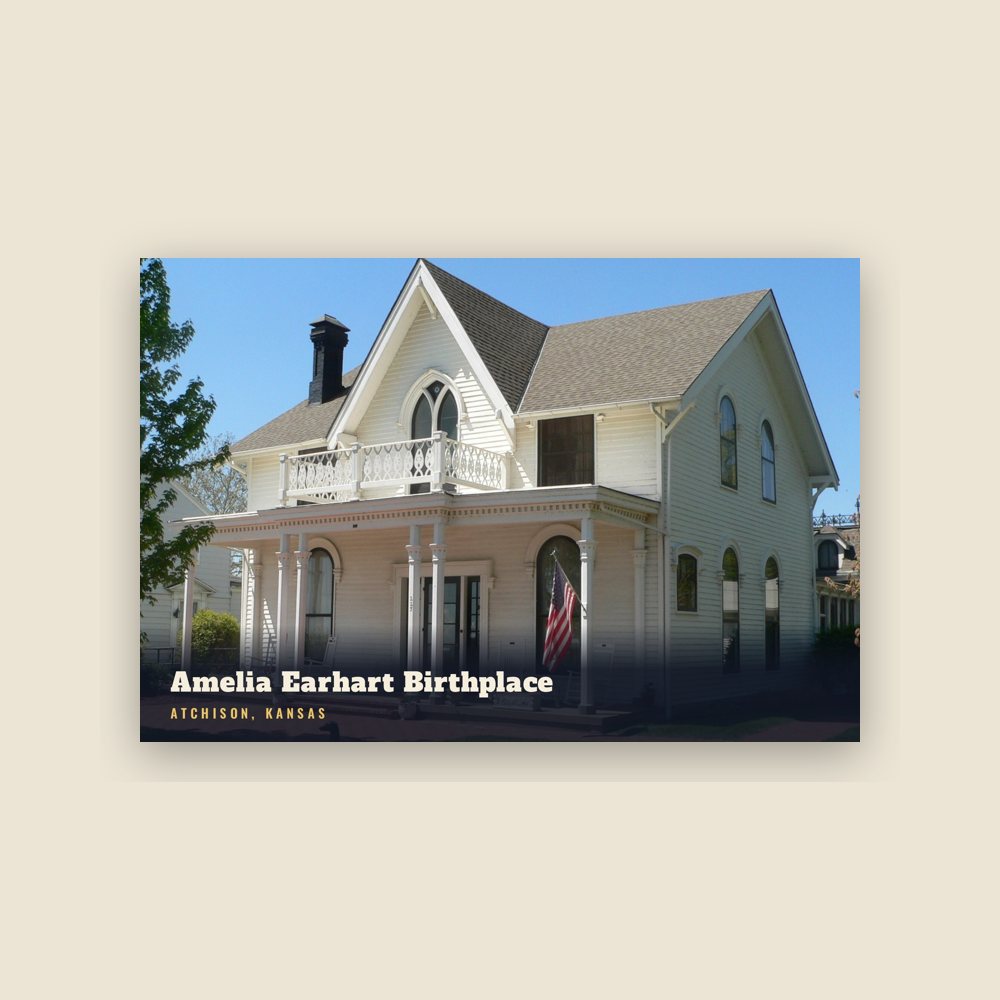
 Amelia Earhart Birthplace