Glenwood is the largest city in and the county seat of Mills County, Iowa, United States. Landmarks include Glenwood Resource Center. Glenwood is the birthplace of Don Hall, film director.
- CountyMills County
- Population5,073 (2020 U.S. Census)

Glenwood is the largest city in and the county seat of Mills County, Iowa, United States. Landmarks include Glenwood Resource Center. Glenwood is the birthplace of Don Hall, film director.
Glenwood, Iowa gifts and souvenirs: 25 designs made from Glenwood's own map, landmarks and history, from $16 to $95. Printed to order and shipped free in the USA.
| Popular | Price |
|---|---|
| Glenwood Hometown Ornament | $23 |
| Glenwood Vintage Travel Poster | from $40 |
| Glenwood Varsity Crewneck | from $57 |
| Glenwood Est. Tee | from $33 |
| Glenwood Town Line Mug | from $26 |
| Glenwood Market Tote | $37 |
Ceramic keepsake, gold ribbon, in 3 styles
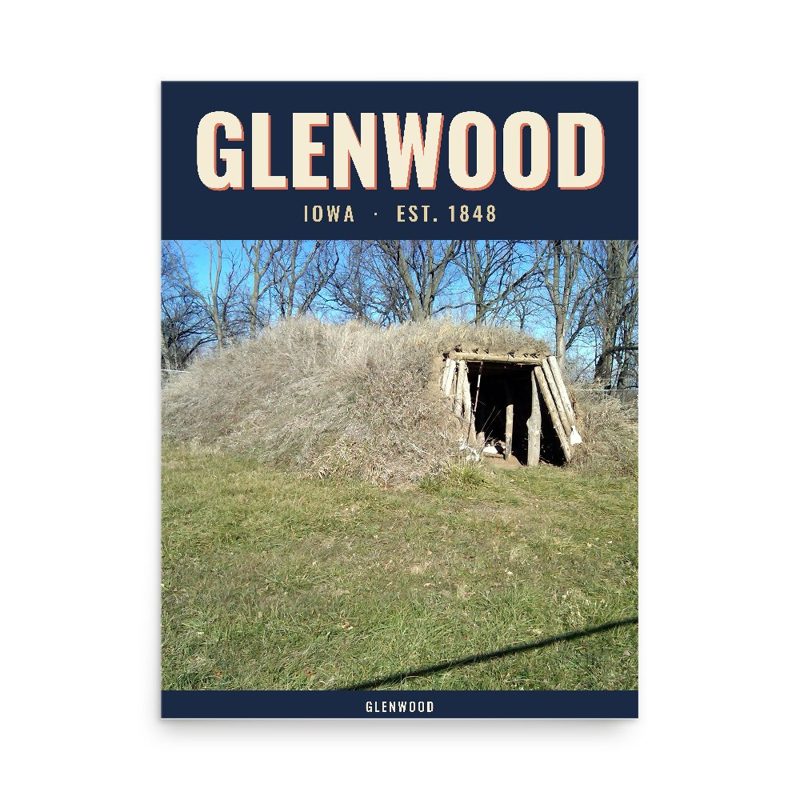
Its landmark photo in a classic travel-poster layout
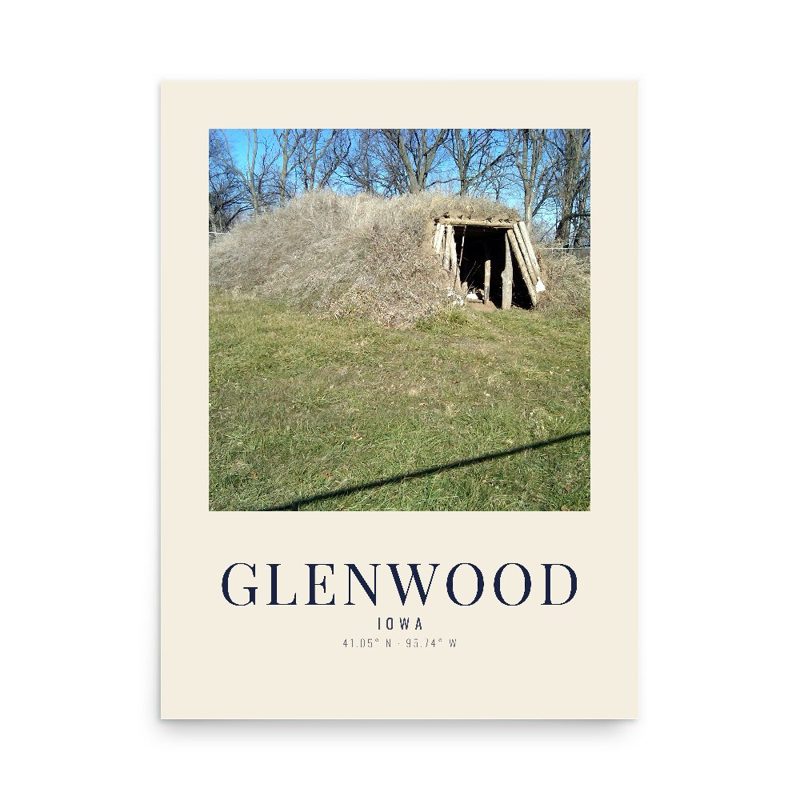
A local landmark photo as a gallery print
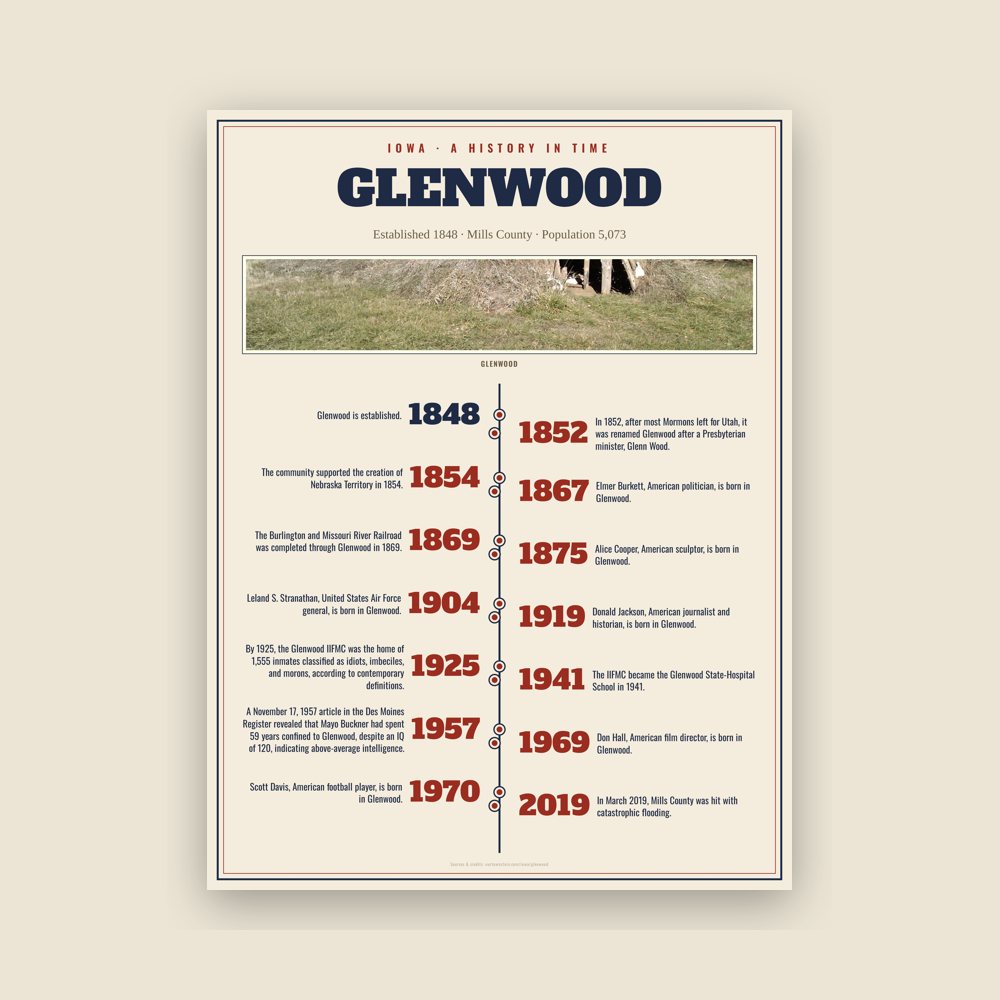
The town's story in dates, from its own records, for home or classroom
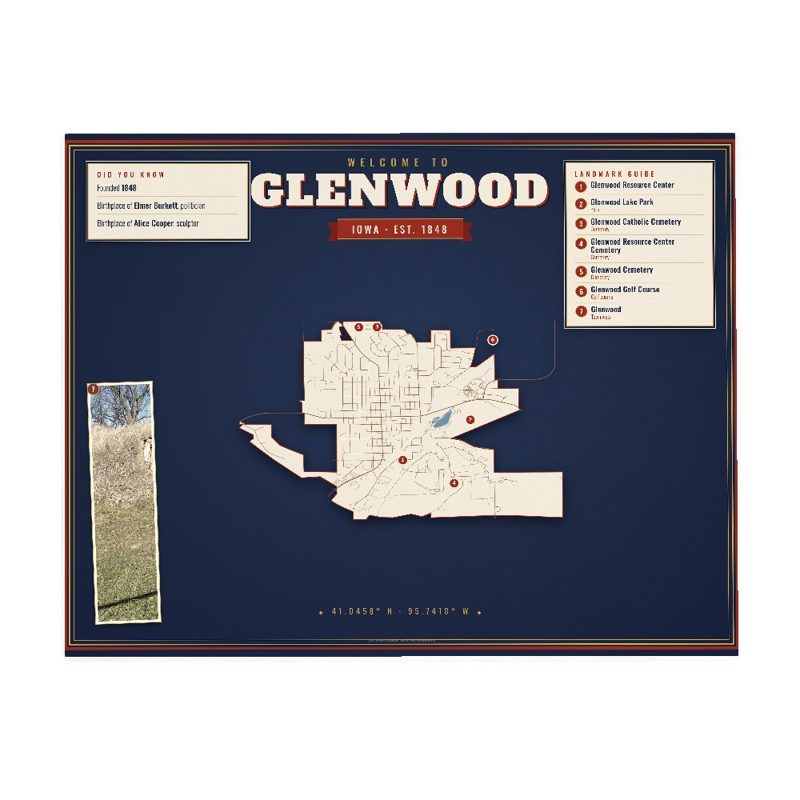
Map of local landmarks, washable fabric
Heavy-blend fleece, street map printed on the back
Red heavy-blend crewneck, knit-stitch town print

Soft Bella+Canvas jersey

Kids' Bella+Canvas jersey, youth sizes

Bella+Canvas toddler jersey
Bella+Canvas baby bodysuit

Glossy ceramic, dishwasher safe
Weatherproof, for the front walk
24″×16″, printed coir-look fibers, rubber back
12″×12″ printed wood, ready to hang
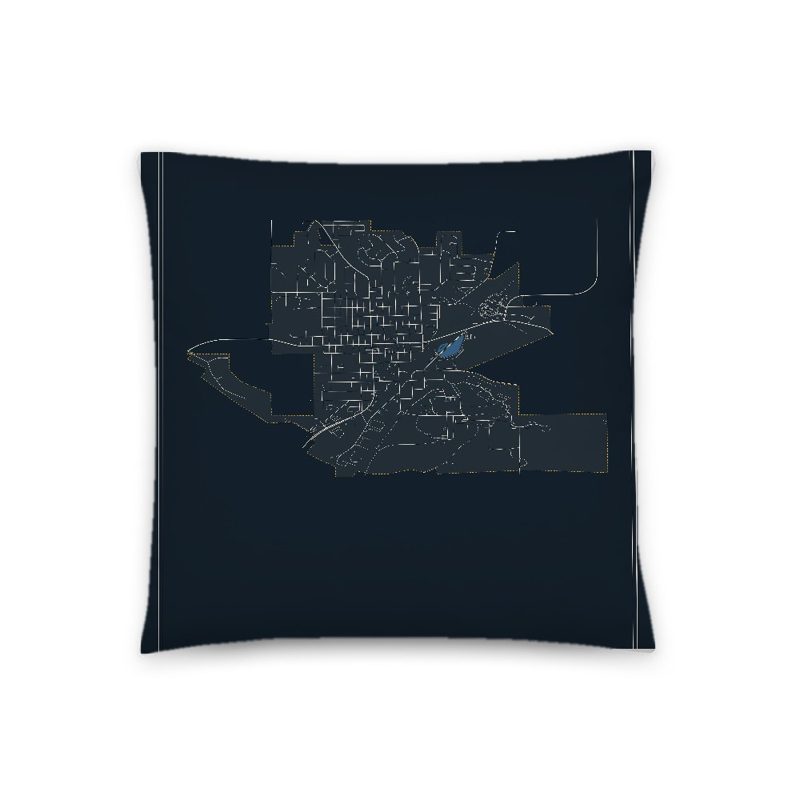
Soft-touch, zip cover
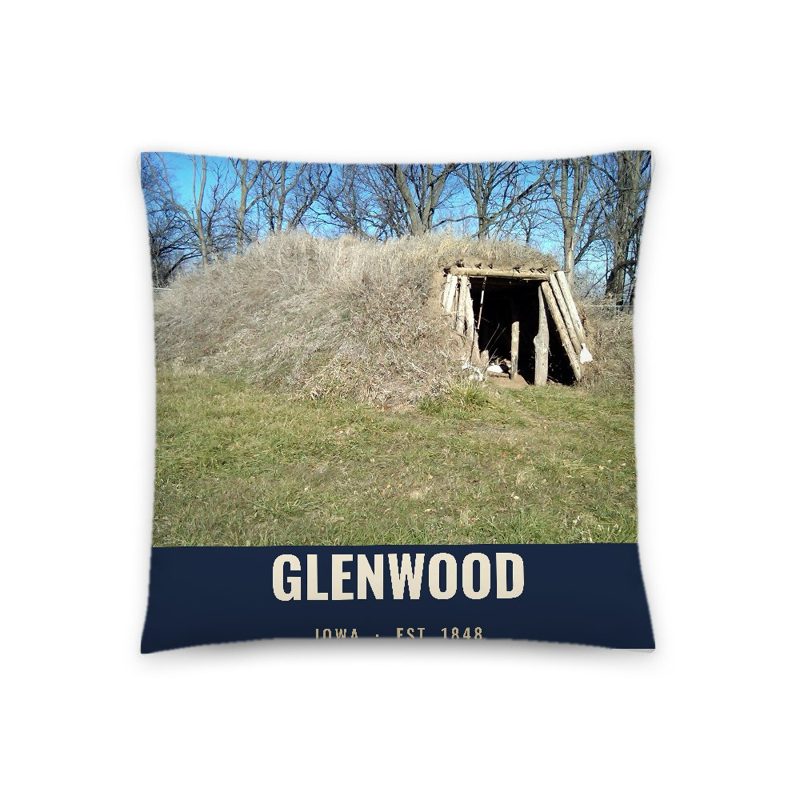
A local landmark photo with the town name, 18″×18″

Sturdy all-over-print tote

Glossy top, cork back
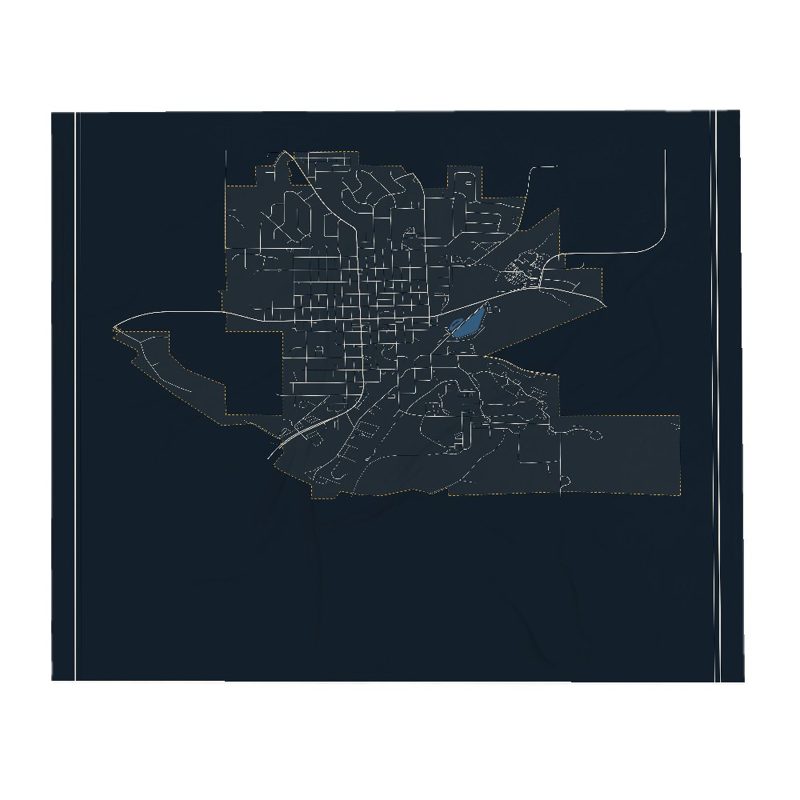
Soft fleece, 50″×60″
20 oz, double-wall stainless
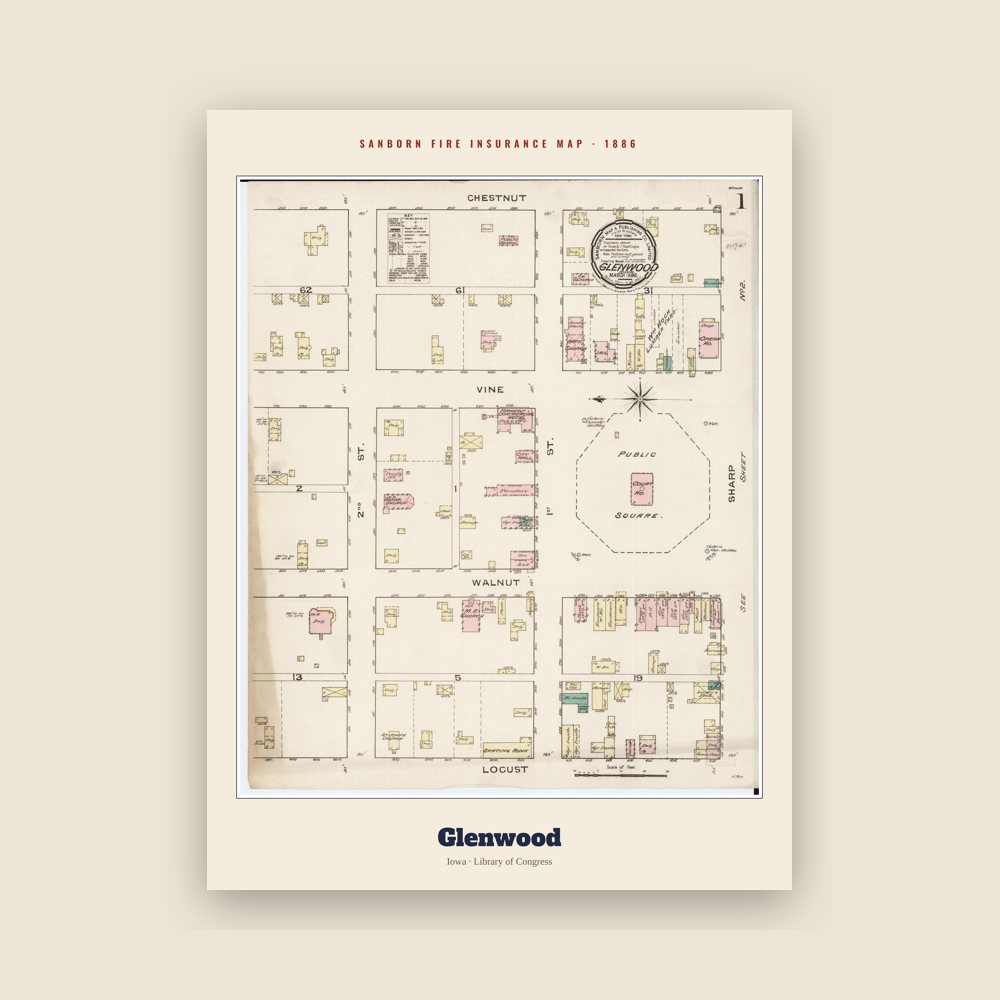
The town's earliest Sanborn fire-insurance map, drawn building by building and hand-coloured, from the Library of Congress
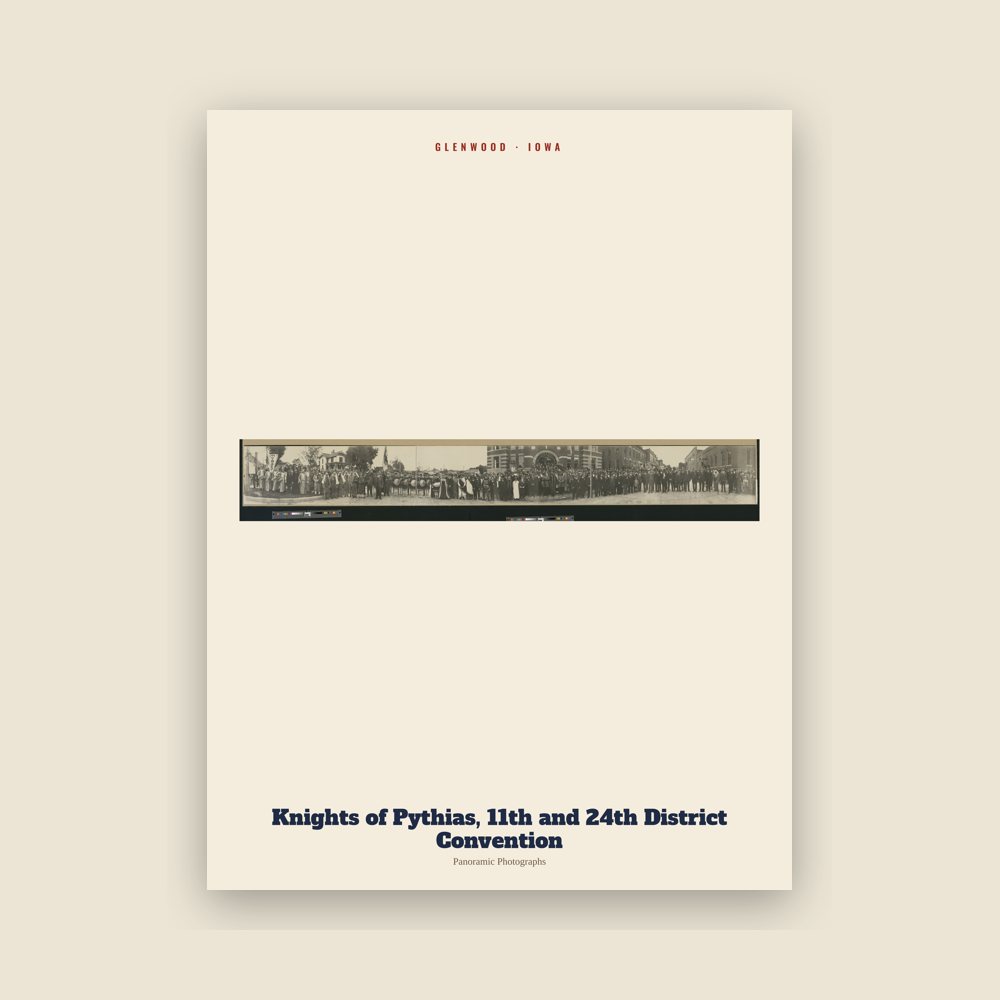
From the Library of Congress collections: a historic survey drawing or photograph of the town
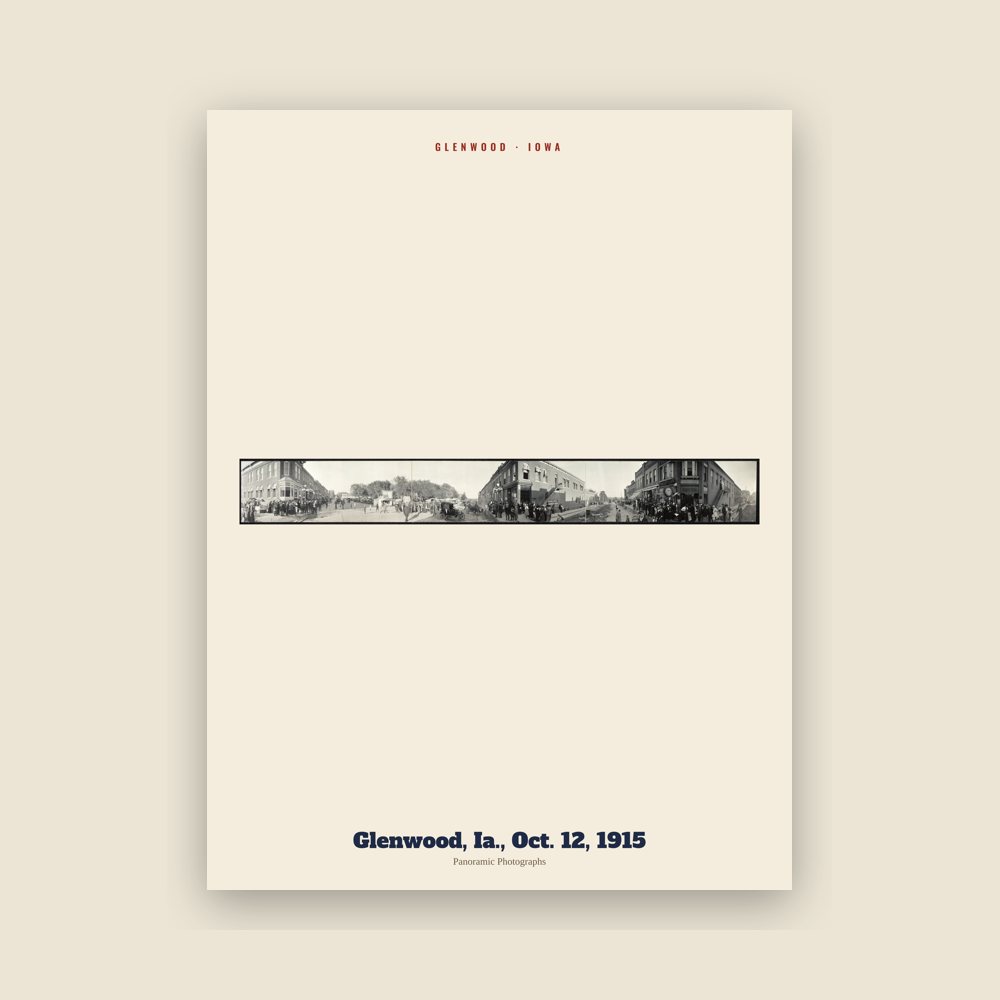
From the Library of Congress collections: a historic survey drawing or photograph of the town
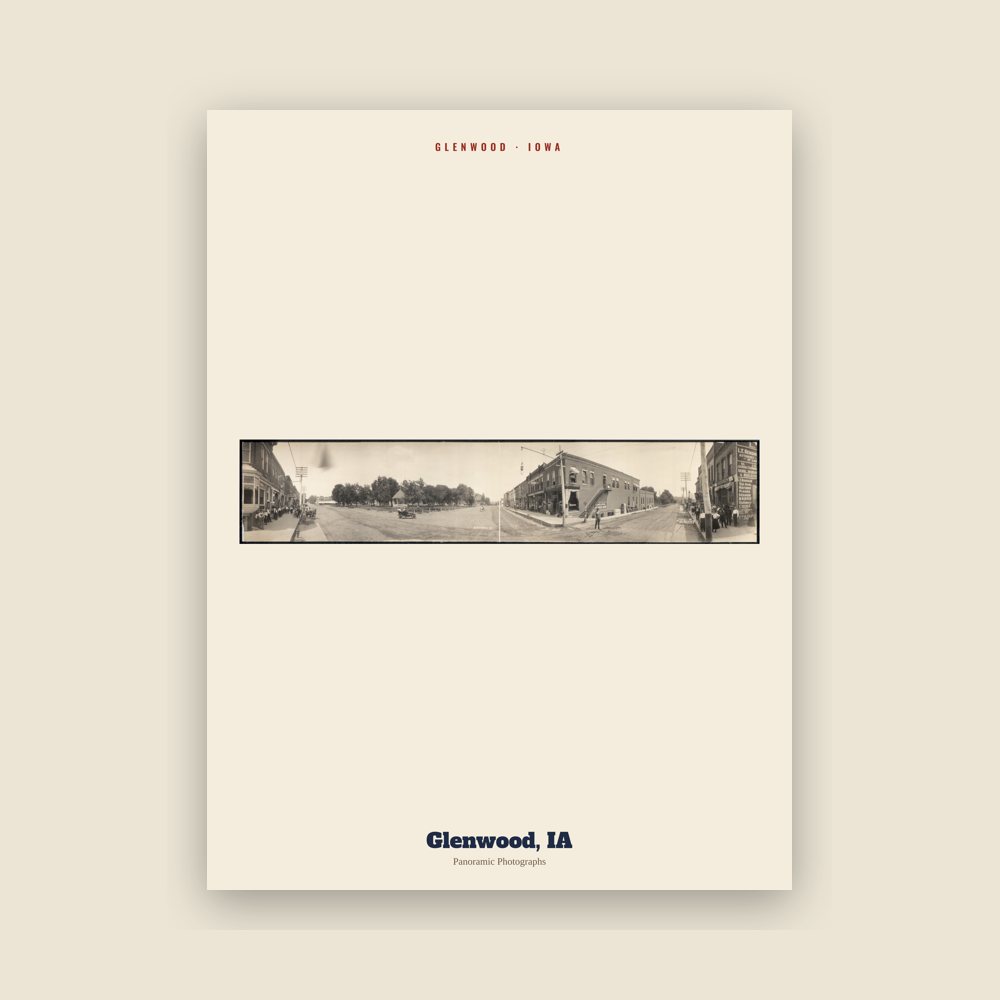
From the Library of Congress collections: a historic survey drawing or photograph of the town
Population 1860: 614 → 2000: 5,358 → 2010: 5,269 → 2020: 5,073
From Wikidata (CC0).
Located in a hollow of the Loess Hills on the east side of the Missouri River, Glenwood was established by Mormons in 1848 as Coonsville. It prospered during the California Gold Rush largely due to the grain mill on Keg Creek. Coonsville was the scene of anti-Mormon mob violence. It became the county seat of Mills County in 1851. In 1852, after most Mormons left for Utah, it was renamed Glenwood after a Presbyterian minister, Glenn Wood.
The community supported the creation of Nebraska Territory in 1854. Two Glenwood attorneys were elected to the Nebraska territorial legislature, and they were run out of town for accepting shares in Scriptown. At the end of the Civil War, an Iowa Veteran's Orphans Home was founded here. The evangelist (and professional baseball athlete) Billy Sunday lived at the orphanage as a child.
The Burlington and Missouri River Railroad was completed through Glenwood in 1869. During the late 19th century, the community was widely known as Iowa's center of fruit production, particularly of apples, and it hosted an annual Apple Carnival. Early industries included an iron foundry, an expansive marble and stone works, the Glenwood Creamery, and a large cannery that covered a city block on the east side of Locust Street. It distributed its products under the brand-name "The Glenwood". Darting & McGavern's "Sanitary" cannery on South Vine and Railroad Avenue canned tomatoes, pumpkin, apples, and beets into the 1920s.
In 1876 the State Veterans' Orphan's Home at Glenwood was adapted for use as the Iowa Asylum for Feeble-Minded Children, the seventh such facility in the country and the first located west of the Mississippi River. The Glenwood facility expanded with increased acceptance of treatment and institutionalization for intellectual disability; it became the Iowa Institution for Feeble-Minded Children. The grounds and Administration Building were largely patterned on the Kirkbride Plan, as state funding permitted. (The Administration Building has since been demolished.)
The institution has long dominated Glenwood both economically and culturally, although the IIFMC was self-sufficient and intentionally isolated the residents from the rest of the town. By 1925, the Glenwood IIFMC was the home of 1,555 inmates classified as idiots, imbeciles, and morons, according to contemporary definitions. The IIFMC became the Glenwood State-Hospital School in 1941. By the early 1950s, the facility covered 1,185 acres (5 km2); it had 310 staff members for the 1,968 patients. Under the influence of eugenics theory, the state had ordered sterilization of those defined as feeble-minded or worse, and experimental treatments such as cold baths and electroshock were used to reduce symptoms of psychosis and depression. The de-institutionalization of Glenwood began in the late 1950s. A November 17, 1957 article in the Des Moines Register revealed that Mayo Buckner had spent 59 years confined to Glenwood, despite an IQ of 120, indicating above-average intelligence. National attention followed for Buckner and the Glenwood State-Hospital School, which were featured in the December 9, 1957 issue of Time and the March 25, 1958 issue of Life Magazine. During the 1970s, the facility completed a transformation from traditional ward buildings into group home-styled cottages. It is now known as the Glenwood Resource Center and provides services and skills training to support people living in communities.
After World War II, the town of Glenwood became a center of meat-packing. During the early 1950s, it had one of America's largest kosher packinghouses, with most of its product shipped to New York and the East Coast. The packinghouse was later modified to process both cattle and pork; it was bought by Swift & Company and then closed in the 1980s. Meatpacking has moved to sites further west, closer to ranching areas.
Trajet, a hot tub manufacturer, now occupies the former slaughterhouse. A large industrial laundry operated for most of the 20th century in the town until it was purchased and closed by Cintas.
Transportation links include the BNSF; U.S. Route 34, and U.S. Route 275 pass through Glenwood, and Interstate 29 is located a few miles west on the floodplain of the Missouri River. Tourist destinations are the Loess Hills and the National Scenic Byway.
In March 2019, Mills County was hit with catastrophic flooding. While Glenwood itself was not directly affected, residents were without clean water for weeks on a boil order. Glenwood officials worked with Mills County to help flood efforts in nearby towns like Pacific Junction, which was nearly completely submerged with hundreds displaced.
Adapted (trimmed) from the Wikipedia article Glenwood, Iowa, revision 1378791220 by its contributors, licensed CC BY-SA 4.0.
We share a part of every Glenwood sale with local partners, and we'd love to print from your collection. Old photographs, maps and postcards make the best keepsakes.
Partner with usA favorite landmark, your street, a school or team, an anniversary gift, a different product. Tell us and we'll get back to you by email.
1 free coloring page of Glenwood, each traced from a photo of a local landmark. Print them at home, at school or for story hour.
Glenwood's population was 5,073 in the 2020 U.S. Census, up from 614 in 1860.
 A view of Glenwood