A short history of Columbus Junction
Columbus Junction began as a settlement located at the intersection of two railroad lines. The Chicago, Rock Island and Pacific Railroad (also known as the Rock Island [Line]) built an east–west line through the area in 1858, and the perpendicular north–south Burlington, Cedar Rapids and Minnesota Railroad (BCR&M) line was built in 1870.
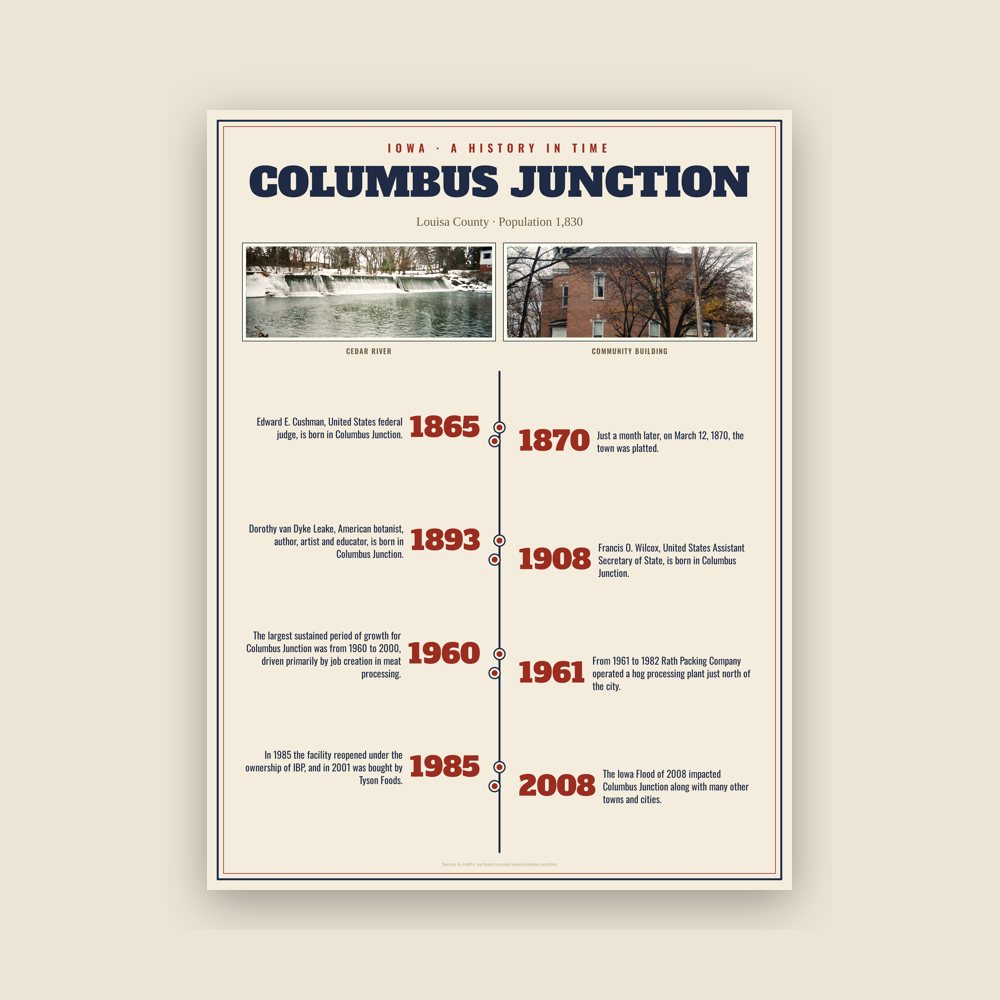
The first local business, a restaurant and boarding house imported via the Rock Island from Muscatine, Iowa, opened the day after a BCR&M train made the inaugural stop and crossing of the newly completed intersection. Just a month later, on March 12, 1870, the town was platted.
Neighboring Columbus City had been established before the railroads arrived and both the Rock Island and BCR&M had built their lines over a mile's distance away. Because they had invested in the latter line, they were permitted to name the new town, and so it became Columbus Junction.
The largest sustained period of growth for Columbus Junction was from 1960 to 2000, driven primarily by job creation in meat processing. From 1961 to 1982 Rath Packing Company operated a hog processing plant just north of the city. In 1985 the facility reopened under the ownership of IBP, and in 2001 was bought by Tyson Foods.
Immigration has played a strong role in the history of Columbus Junction. The most recent wave of immigrants includes refugees from the Chin State of Myanmar (Burma). Many of them work in the meat processing plants.
The Iowa Flood of 2008 impacted Columbus Junction along with many other towns and cities. The damage dealt by the inundation affected 29 businesses and non-profits, but the community has since been able to recover.
Adapted (trimmed) from the Wikipedia article Columbus Junction, Iowa, revision 1378543278 by its contributors, licensed CC BY-SA 4.0.