A short history of Cedar Falls
Early settlement and development
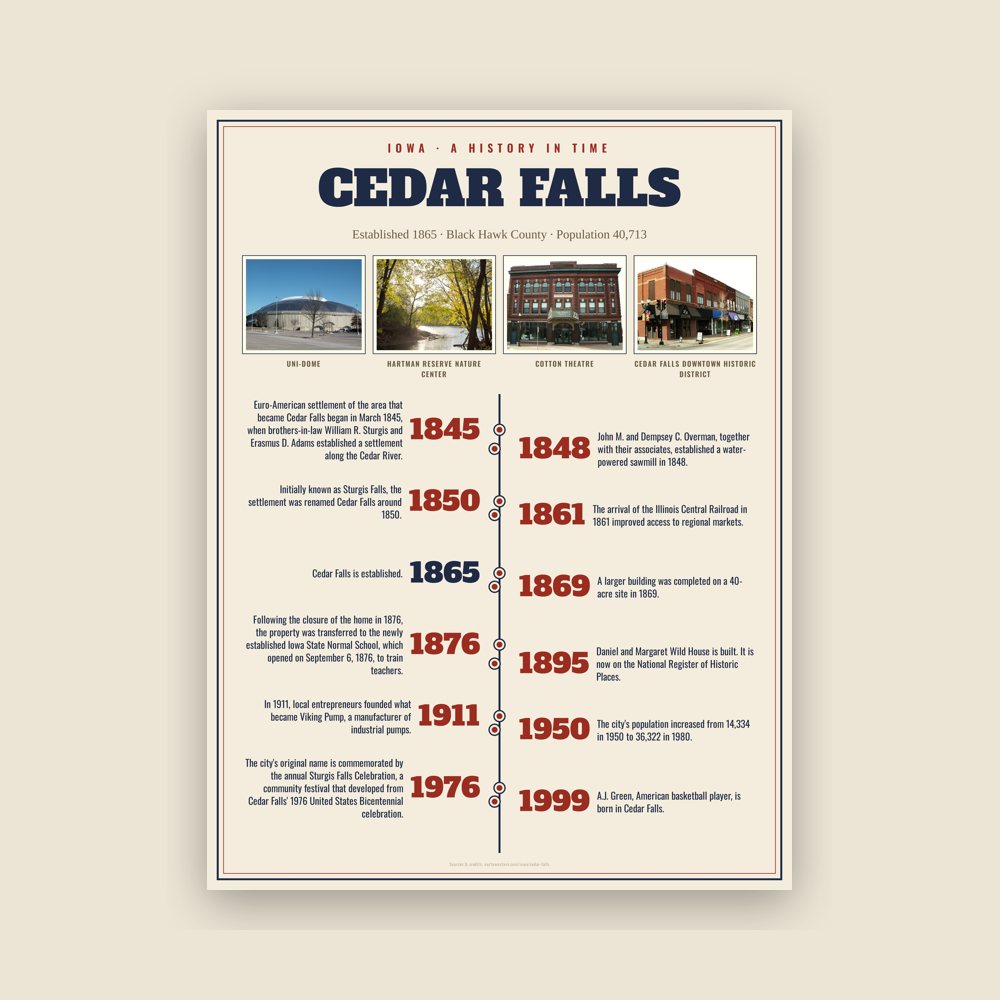
The Cedar Valley was historically inhabited by Indigenous peoples, including the Sauk and Meskwaki (Fox). Euro-American settlement of the area that became Cedar Falls began in March 1845, when brothers-in-law William R. Sturgis and Erasmus D. Adams established a settlement along the Cedar River. Initially known as Sturgis Falls, the settlement was renamed Cedar Falls around 1850.
The settlement developed rapidly following the arrival of the Overman family. John M. and Dempsey C. Overman, together with their associates, established a water-powered sawmill in 1848. A gristmill was added in 1850, providing milling services to settlers from surrounding areas. Andrew Mullarky established an early general store near Main and First streets in 1850.
In 1853, Cedar Falls was selected as the first county seat of Black Hawk County. The Overman family donated land to support the construction of county government facilities. However, a contested referendum in April 1855 resulted in the relocation of the county seat to nearby Waterloo. Cedar Falls was incorporated as a city in 1865.
Read the full history
Industrial and railroad development
The availability of water power from the Cedar River contributed to Cedar Falls' development as a milling and manufacturing center during the nineteenth century. Flour mills and other industries were established along the river, while surrounding agricultural communities provided raw materials and markets for manufactured goods.
The arrival of the Illinois Central Railroad in 1861 improved access to regional markets. Additional railroad connections followed, and by 1893 Cedar Falls was served by four railroad lines, including the Burlington, Cedar Rapids and Northern Railway and the Chicago Great Western Railway.
By the late nineteenth century, Cedar Falls supported a diversified industrial economy. In his 1893 Historical Record of Cedar Falls, local historian Peter Melendy documented more than 60 manufacturing and industrial establishments, including flour mills, foundries, woodworking operations, agricultural processing facilities, and machinery manufacturers. His account described the importance of both railroad transportation and the Cedar River's water power to the city's economic growth.
Education and twentieth-century growth
In 1865, a Soldiers' Orphans' Home opened in Cedar Falls to care for children of Civil War soldiers. A larger building was completed on a 40-acre site in 1869. Following the closure of the home in 1876, the property was transferred to the newly established Iowa State Normal School, which opened on September 6, 1876, to train teachers. The institution subsequently developed into the University of Northern Iowa.
Industrial growth continued into the twentieth century. In 1911, local entrepreneurs founded what became Viking Pump, a manufacturer of industrial pumps. Sartori Hospital was established in 1915, and additional civic institutions and public parks were developed during the early twentieth century.
Between 1950 and 1980, Cedar Falls experienced substantial population growth, influenced by the expansion of the University of Northern Iowa and industrial employment in the neighboring Waterloo metropolitan area. The city's population increased from 14,334 in 1950 to 36,322 in 1980.
The city's original name is commemorated by the annual Sturgis Falls Celebration, a community festival that developed from Cedar Falls' 1976 United States Bicentennial celebration.
Adapted (trimmed) from the Wikipedia article Cedar Falls, Iowa, revision 1385457293 by its contributors, licensed CC BY-SA 4.0.