A short history of Bettendorf
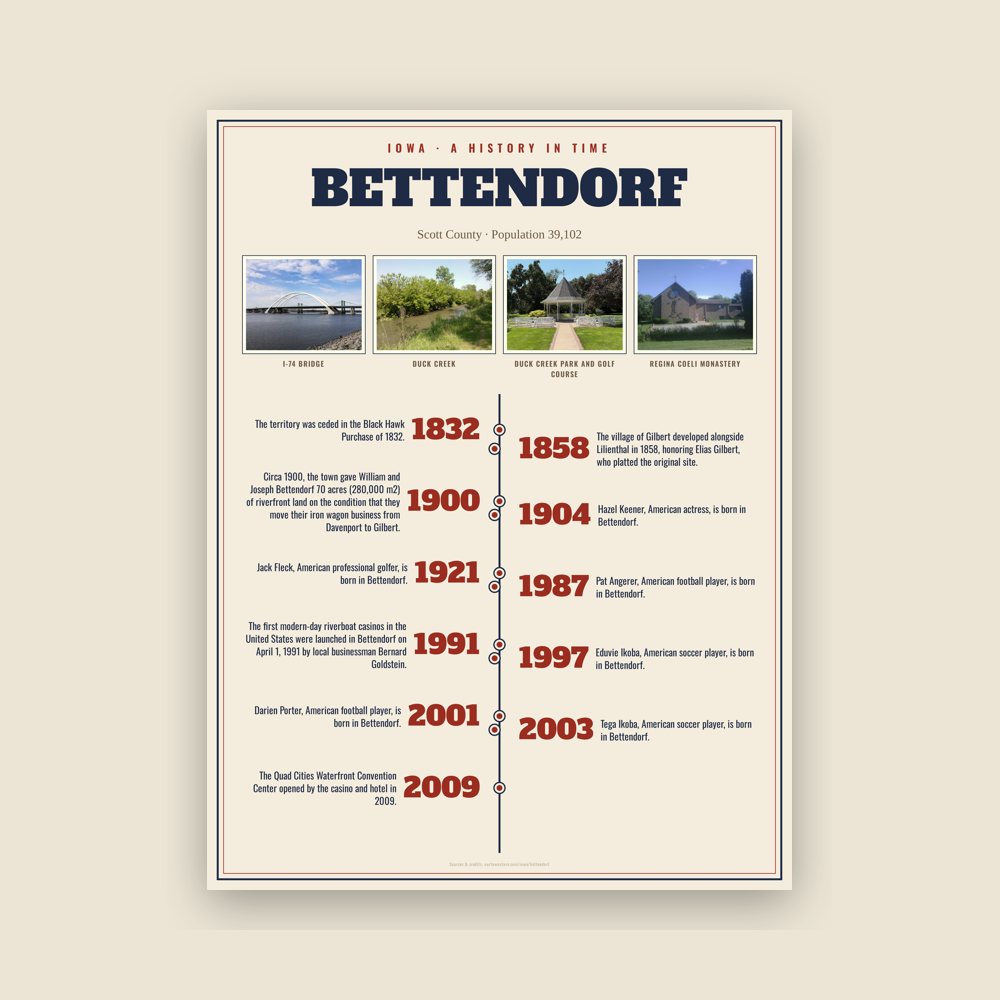
Bettendorf lies in the original Wisconsin Territory, which the United States bought from the Sac and Fox Indians after defeating them in the Black Hawk War. The territory was ceded in the Black Hawk Purchase of 1832. The first European-American settlers established a village they called Lilienthal, after an early tavern and dance hall. The village of Gilbert developed alongside Lilienthal in 1858, honoring Elias Gilbert, who platted the original site. At that time, the residents were predominantly German immigrants and worked as farmers, skilled laborers, and small business owners. The two villages eventually combined to become the town of Gilbert.
Circa 1900, the town gave William and Joseph Bettendorf 70 acres (280,000 m2) of riverfront land on the condition that they move their iron wagon business from Davenport to Gilbert. In 1903, the town of 440 citizens petitioned for incorporation, requesting to change the town's name in honor of the brothers whose factory was a major economic influence in the early development of the city.
In the late 1940s, Aluminum Company of America (A.L.C.O.A.) chose Riverdale, an enclave of Bettendorf, for construction of the world's largest aluminum mill. The huge mill, and the attendant developments from it, created thousands of jobs and greatly increased growth in Bettendorf's population, which has continued to the present day.
The first modern-day riverboat casinos in the United States were launched in Bettendorf on April 1, 1991 by local businessman Bernard Goldstein. He went on to found the Isle of Capri Casinos. Goldstein and his family members also operate Alter Companies, which is a scrap metal, barge and towboat company operating on the river waterfront. The Quad Cities Waterfront Convention Center opened by the casino and hotel in 2009. It is owned by the city and operated by the Isle of Capri.
Adapted (trimmed) from the Wikipedia article Bettendorf, Iowa, revision 1378494946 by its contributors, licensed CC BY-SA 4.0.