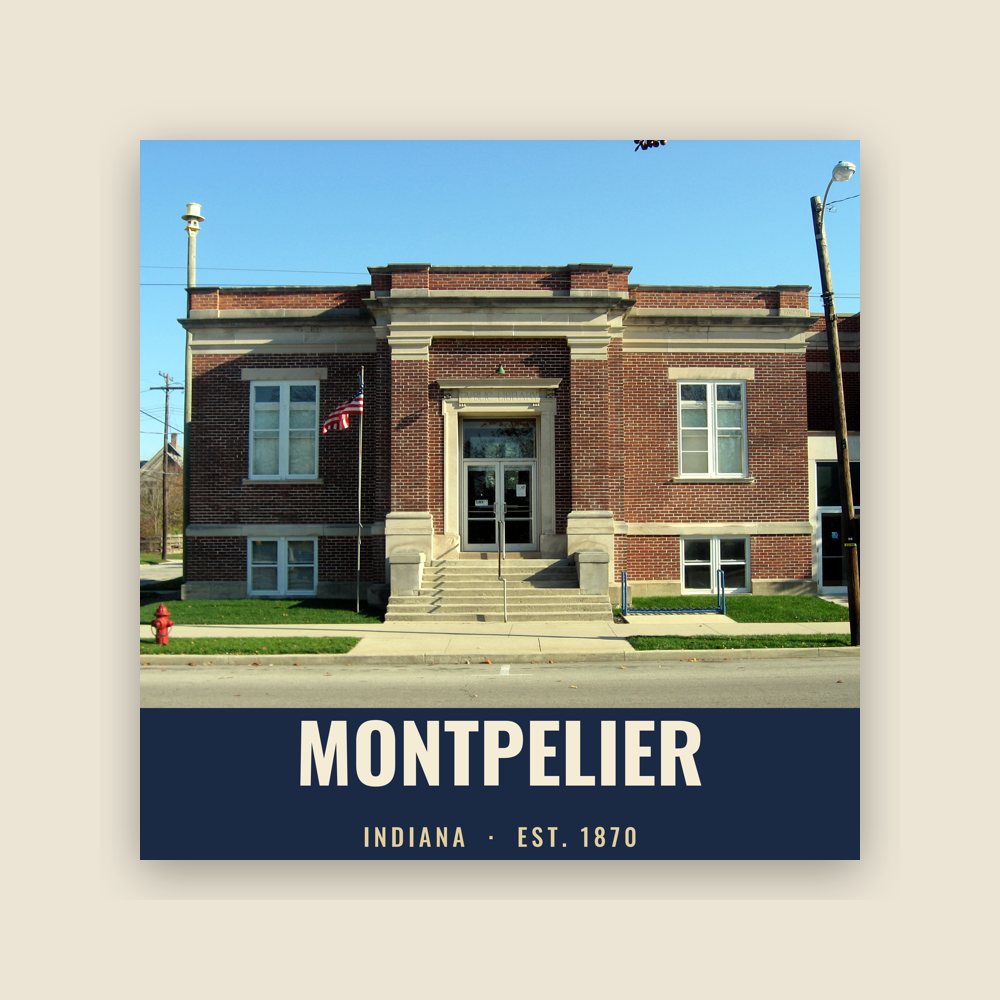
Since 1870
A short history of Montpelier
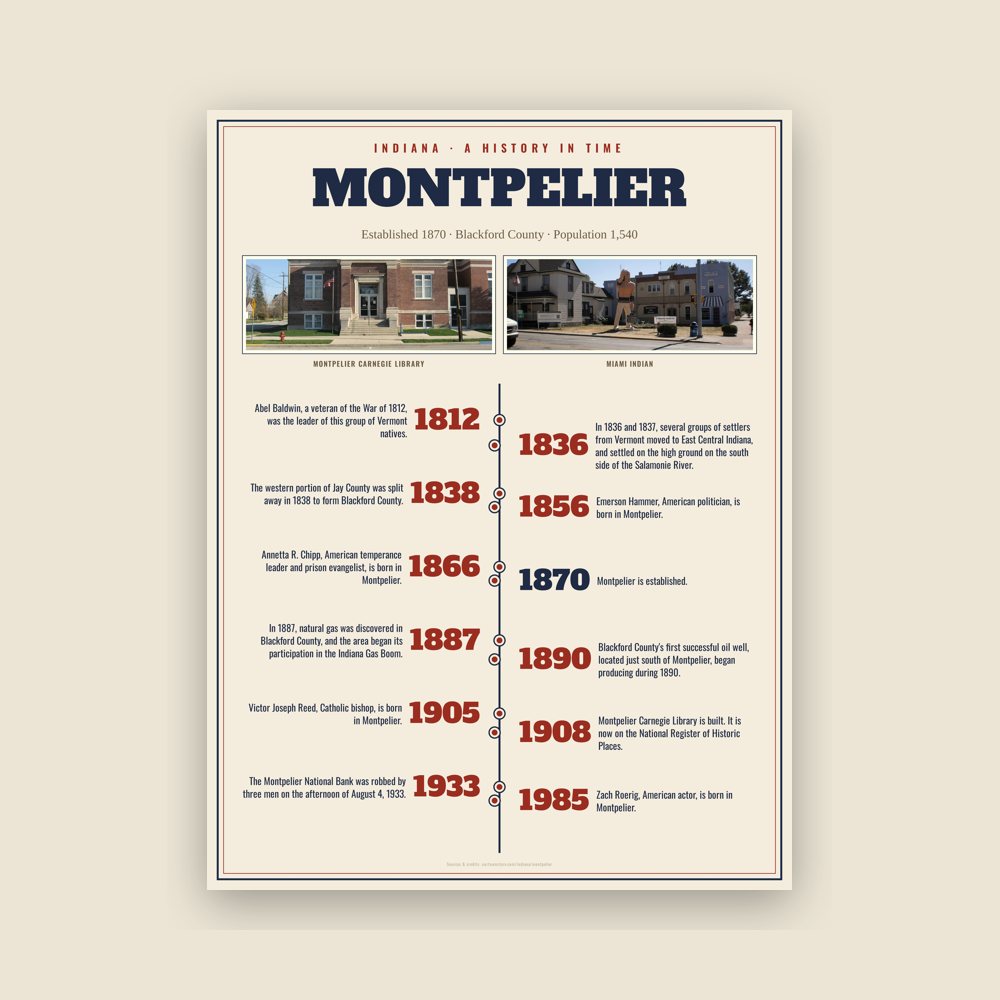
In 1836 and 1837, several groups of settlers from Vermont moved to East Central Indiana, and settled on the high ground on the south side of the Salamonie River. Abel Baldwin, a veteran of the War of 1812, was the leader of this group of Vermont natives. They named their community Montpelier, after the capital of their original home state. Baldwin and his son-in-law, civil engineer John Cook, surveyed the area in 1836, and it was platted on September 5, 1837. The original plat had 16 blocks with a total of 154 lots.
At the time Montpelier was settled, it was part of Jay County. The western portion of Jay County was split away in 1838 to form Blackford County. Montpelier was not the first community in what would become Blackford County – a village named Matamoras existed earlier. However, Montpelier was platted first, and Matamoras was essentially a ghost town after the 1880s.
Beginning in September 1870, the Fort Wayne, Cincinnati & Louisville Railroad connected Fort Wayne with Muncie, Indiana, and Montpelier was (and still is) on this line. With dramatically improved transportation for the community, Montpelier became incorporated as a town at the end of 1870. By that time, the town had grown to a population of 231.
Read the full history
Gas Boom
In 1887, natural gas was discovered in Blackford County, and the area began its participation in the Indiana Gas Boom. While natural gas was found throughout Blackford County, crude oil was found mostly in the county's Harrison Township, which includes Montpelier. Blackford County's first successful oil well, located just south of Montpelier, began producing during 1890. Montpelier was thought to be "the very heart of the greatest natural gas and oil field in the world". By the mid-1890s, about two-thirds of Harrison Township (25 square miles) was considered part of an oil-producing region. Montpelier became a city where “money and whiskey flowed frequently”, and numerous other “recreational activities” were available. Oil production from the Trenton Gas and Oil Field surrounding Montpelier began decreasing during the first decade of the 20th century, and the Gas Boom (or Montpelier's oil boom) gradually came to an end. Montpelier began a return to normalcy and its population (like many boom towns) has never exceeded its Gas Boom peak.
Dillinger
The Montpelier National Bank was robbed by three men on the afternoon of August 4, 1933. The robbery lasted about ten minutes, and no shooting was involved. The robbers quietly left town, driving east on Indiana State Road 18, without being followed. It was later determined, by the Federal Bureau of Investigation, that the robbers were John Dillinger and the Dillinger Gang.
Adapted (trimmed) from the Wikipedia article Montpelier, Indiana, revision 1382319288 by its contributors, licensed CC BY-SA 4.0.