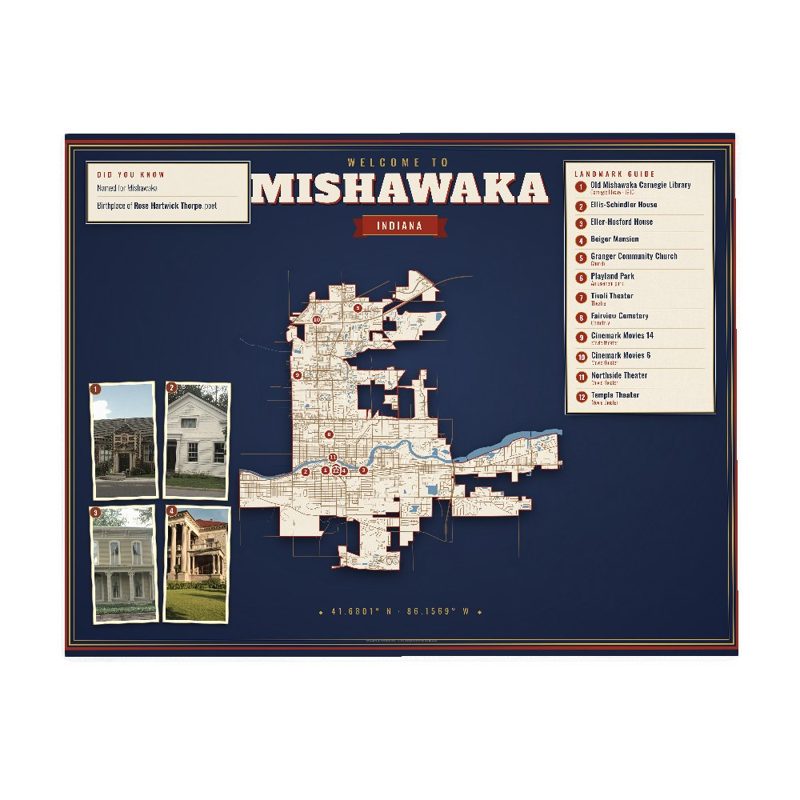
A short history of Mishawaka
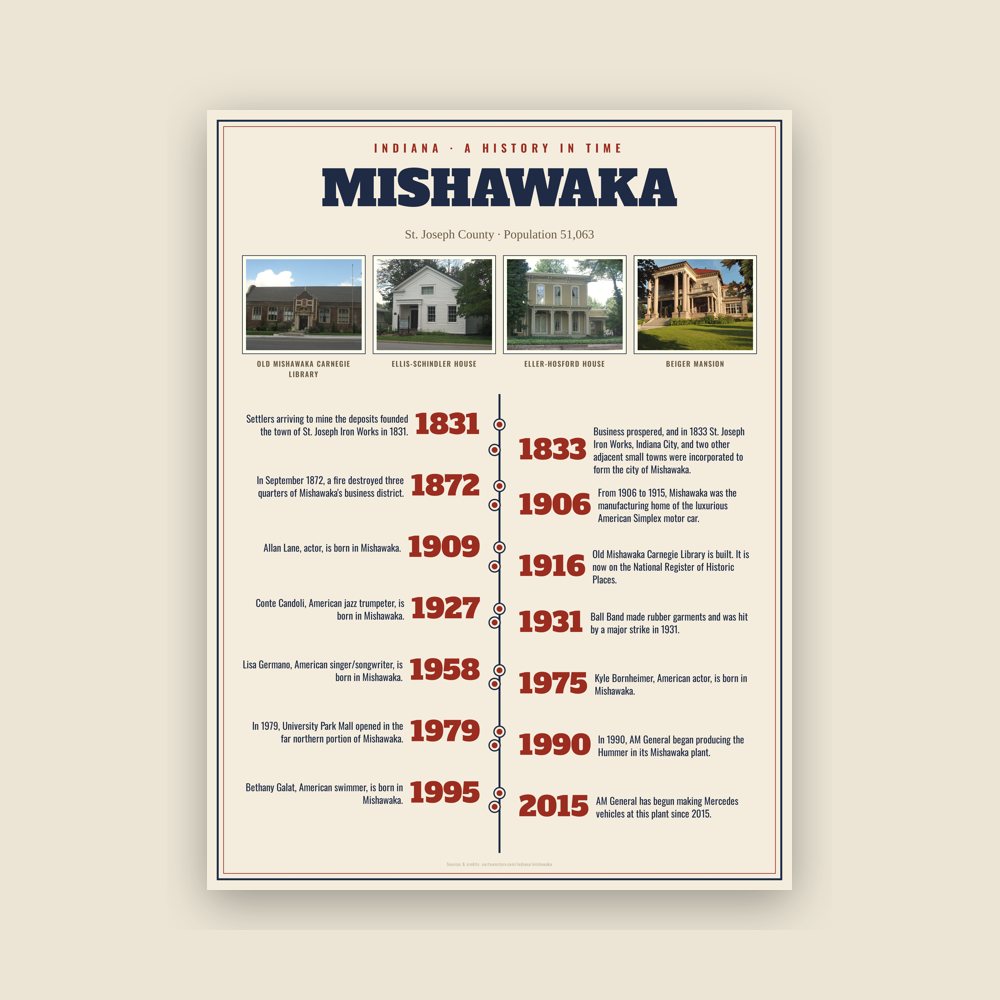
Mishawaka's recorded history began with the discovery of bog iron deposits at the beginning of the 1830s. Settlers arriving to mine the deposits founded the town of St. Joseph Iron Works in 1831. Within a few years, the town had a blast furnace, a general store, a tavern, and about 200 residents. Business prospered, and in 1833 St. Joseph Iron Works, Indiana City, and two other adjacent small towns were incorporated to form the city of Mishawaka.
In September 1872, a fire destroyed three quarters of Mishawaka's business district. However, the citizens rebuilt and attracted new industry. The Dodge Manufacturing Company, Perkins Windmills and the Mishawaka Woolen and Rubber Company (later Ball Band, then Uniroyal) all helped the town to prosper. Mishawaka grew through both industry and agriculture. In the late 19th century, Mishawaka became known as the "Peppermint Capital of the World", as its rich black loam produced great quantities of mint.
From 1906 to 1915, Mishawaka was the manufacturing home of the luxurious American Simplex motor car. Ball Band made rubber garments and was hit by a major strike in 1931. It flourished in the 1940s, finally closing in 1997 in the face of cheaper imports. Manufacturing in Mishawaka peaked in the 1940s and began a slow decline due to industrial restructuring. The economic base shifted to retail services and small industry.
In 1979, University Park Mall opened in the far northern portion of Mishawaka. In 1990, AM General began producing the Hummer in its Mishawaka plant. The MV-1 is a purpose-built taxicab and replaces the planned Standard Taxi; it was developed in collaboration with AM General. The car is built in Mishawaka at an AM General plant. AM General has begun making Mercedes vehicles at this plant since 2015.
Read the full history
Names
One theory for the word Mishawaka proposes that it derives from the name of a Potawatomi village at the junction of the Elkhart and St. Joseph rivers, where there were many dead trees. The village's exact name in the Potawatomi language may have been *mšwakig ("at the firewood-tree land"). In the Miami-Illinois language, which historically was also spoken in the area, the corresponding placename is mihswaahkwahkiki ("it is firewood-tree land").
The most probable origin of the word comes from the city's government website, where in a history of Mishawaka paper written by local historian Peter DeKever states, "The Potawatomi had numerous villages in the region, including one on the south bank of the St. Joseph River located in the area bounded today by Lincolnway West and North Main and West Streets. The Potawatomi were drawn to this location by the ease of transport the river provided, a ford near a natural rapids, abundant fish and game, and access to timber. Their term for the area, M’Shehwahkeek, translates as swift flowing water or heavy timbered rapids." This theory is also mentioned by The History Museum of South Bend, and other sources.
The nickname "Princess City", however, derives from a different account of the name's origin. According to this story, "Mishawaka" or something similar was the name of the daughter of a Shawnee chief named "Elkhart". A love triangle between Mishawaka, a white trader named "Dead Shot", and a Shawnee warrior named "Grey Wolf" led to various adventures. This story originated with Flavius J. Littlejohn, a Michigan author, politician and judge, who published a collection of stories in 1875; in Littlejohn's account, the woman's name was "Mishawaha". Despite the story being completely fictional, it became popular and helped foster the legend that is known to this day. Even though the story is from a work of fiction, many residents believe Princess Mishawaka was real because of a "symbolic grave marker" of her erected by the Daughters of the American Revolution to promote the centennial of the city of Mishawaka in 1932. Lack of context has led to many believing that the site is the actual grave of the princess, and that the legend was true. In many ways, Princess Mishawaka represents a mascot for the city.
Adapted (trimmed) from the Wikipedia article Mishawaka, Indiana, revision 1374758830 by its contributors, licensed CC BY-SA 4.0.