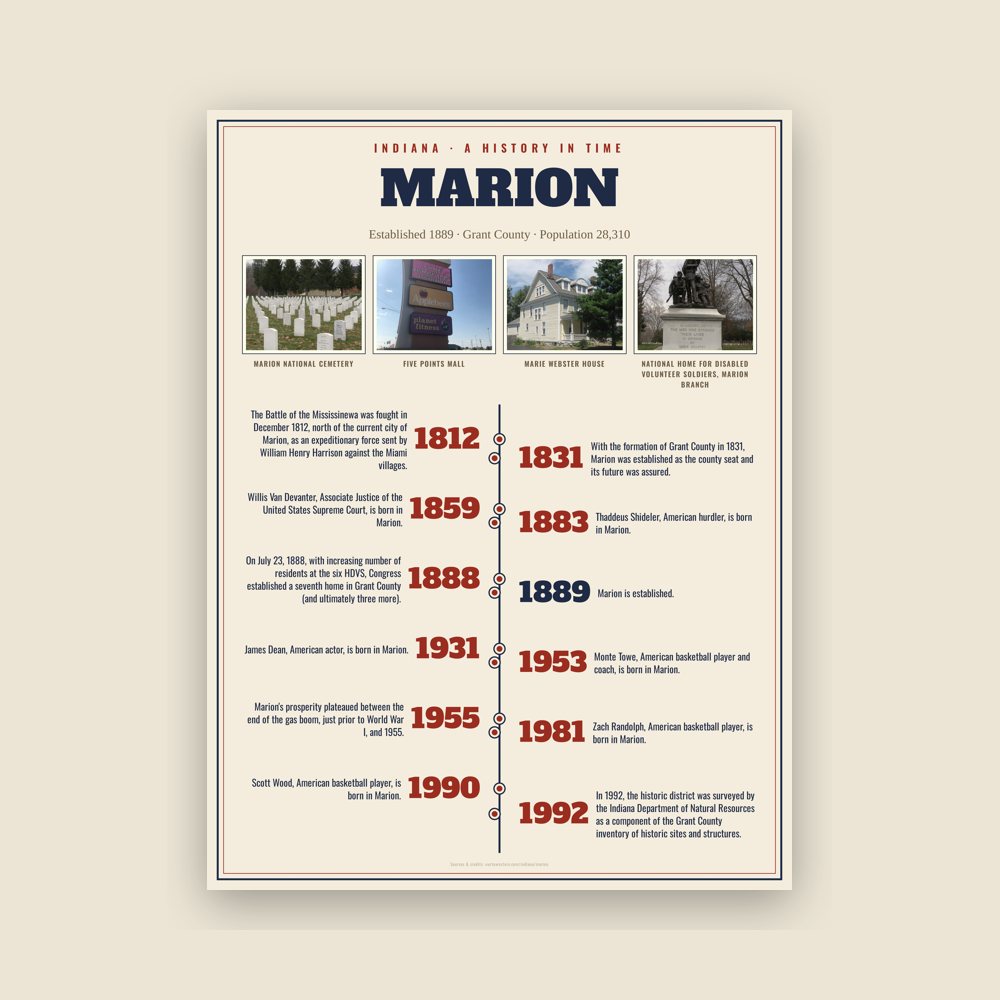
The Battle of the Mississinewa was fought in December 1812, north of the current city of Marion, as an expeditionary force sent by William Henry Harrison against the Miami villages. Today, the battle is reenacted every fall by residents of Grant County and many reenactors and enthusiasts from throughout the United States and Canada during the annual Mississinewa 1812 festival, the largest War of 1812 reenactment in the United States. When Martin Boots and David Branson each donated 30 acres (120,000 m2) of land in 1831 for the site of Marion, they chose a location on the left bank of the swift, scenic river which the Miami Indians had named "Mississinewa," meaning "Falling water." So rapid had been the tide of settlement that it followed by only 19 years the Battle of Mississinewa, 7 miles (11 km) downstream, where federal troops and Indians had fought a bloody, pre-dawn encounter in 1812.
With the formation of Grant County in 1831, Marion was established as the county seat and its future was assured. The river provided water supply, power, and drainage as it flowed at the base of the nearby hills. Along with at least 36 other communities in the nation, Marion was named for the Revolutionary War General Francis Marion, the "Swamp Fox" of South Carolina.
Read the full history
Industrial growth
Marion grew slowly for more than 50 years as an agricultural trading center supported by a sprinkling of small farm- and forest-related industries. Native Americans were a common sight as they traveled there from Indiana's last reservation, with its Indian school, Baptist Church, and cemetery, 8 miles (13 km) away. In the 1880s, fields of natural gas were discovered across much of east-central Indiana, and Grant County began to grow at a dizzying pace during the Indiana gas boom. Gas City and Matthews were carved out of raw farmland and launched as speculative boom towns, each absorbing existing tiny villages. They attracted several thousand residents before the gas reserves were tapped and most industries left. As late as the 1940s, Matthews resembled a Western ghost town, before it attracted eleven glass factories and drew the professional baseball team away from Indianapolis. Grant County's only covered bridge remains there as a link to the past. However, the gas boom left its legacy. A few industries remained, particularly glass manufacturers.
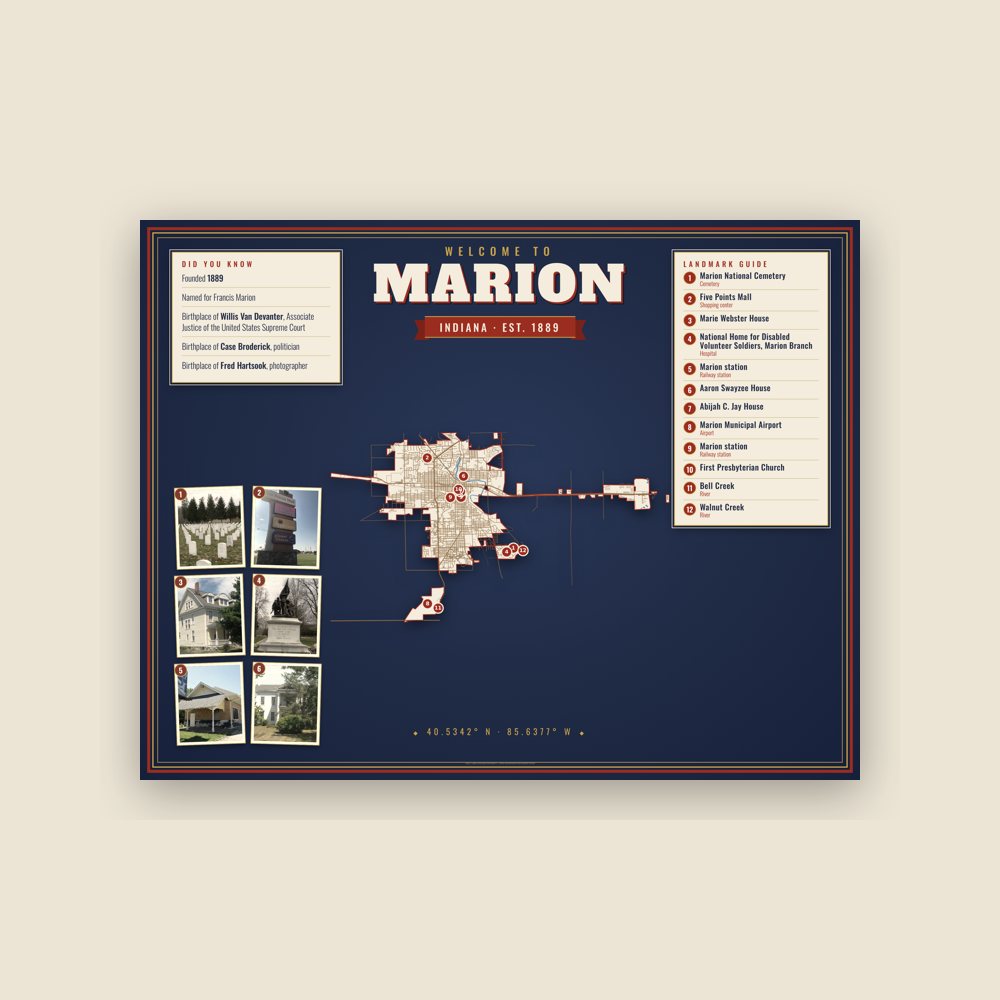
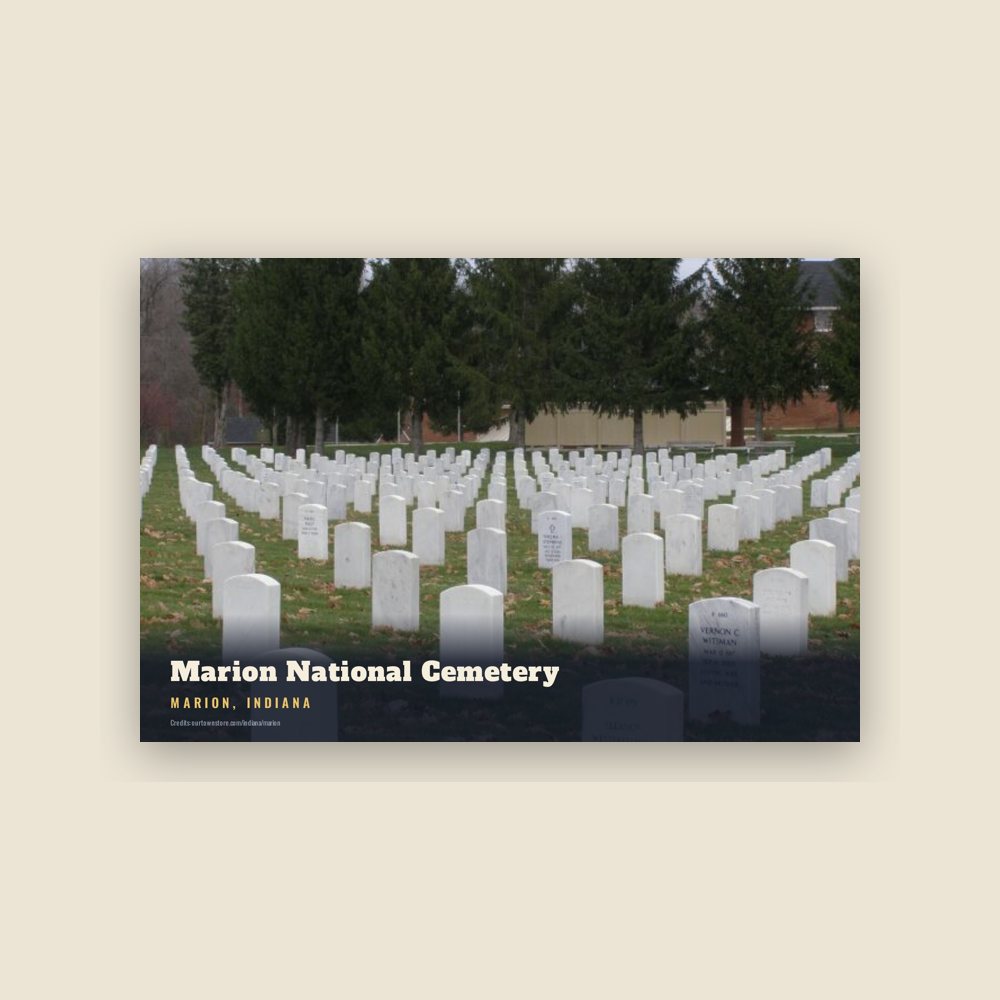
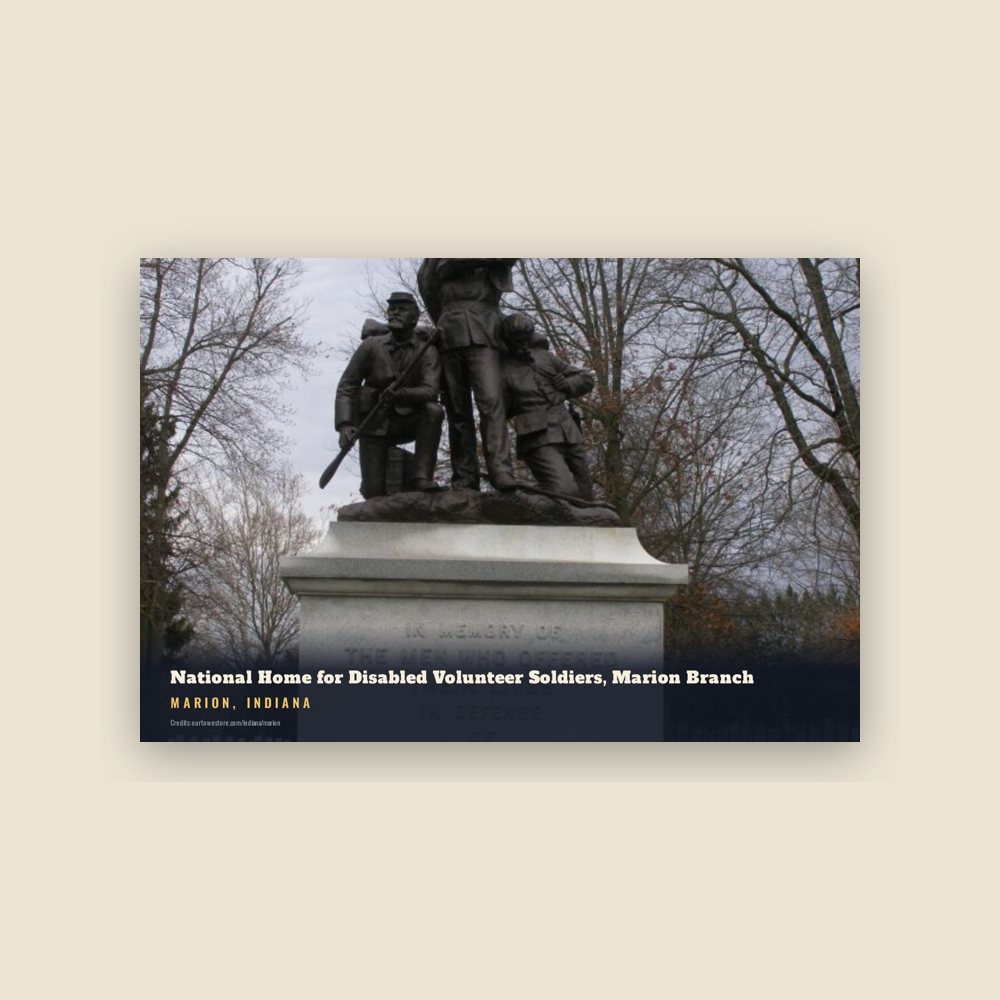
On July 23, 1888, with increasing number of residents at the six HDVS, Congress established a seventh home in Grant County (and ultimately three more). It is known as the Marion Branch. Congress allotted an appropriation of $200,000 for construction, while Grant County residents provided a natural gas supply for heating and lighting. Marion was selected as a site for the new branch due to the availability of natural gas and the political support of Colonel George Washington Steele, US Congressman serving from 1880 to 1890. This facility is now a part of the Veterans Administration (VA) Northern Indiana Health Care System, a dual-campus facility associated with the former VA Medical Center Fort Wayne. In the early 21st century, the original treatment hospital, built in 1889, the greenhouse, and cadet quarters are scheduled for demolition. There has been a lack of public support for funding restoration of these buildings. As they do not meet current standards, the Veterans Administration plans to demolish the buildings and replace them.
In 1930, two African-American men, Thomas Shipp and Abram Smith, were lynched in Marion for allegedly killing a white man and raping his girlfriend. A white mob estimated at 5,000 gathered at the county jail where Shipp, Smith, and activist James Cameron, were dragged from the jail and severely beaten.
Modern history
Marion's prosperity plateaued between the end of the gas boom, just prior to World War I, and 1955. But construction of a General Motors stamping and tool plant created many new jobs. The city grew rapidly. Except for bedroom communities near metropolitan centers, Marion's growth during the 1950s exceeded all but one Indiana city with populations of 10,000-100,000.
In the late 20th century, Marion surveyed its significant properties and defined the main buildings and grounds of the hospital as the Marion Branch Historic District. It is located at the intersection of 38th Street and Lincoln Boulevard, approximately 2+1⁄2 miles southeast of the center of Marion. The boundaries are 38th Street on the north, the railroad right-of-way on the east, the Mississinewa River on the southeast, Chambers Park on the south and southeast, and Lincoln Boulevard to the west. The 212-acre (0.86 km2) site is roughly square in form with diagonal boundary lines on the southeast and the southwest eliminating those corners of the square. Originally, farming operations on the home grounds included the area that is now Chambers Park. In 1981, a Determination of Eligibility for the National Register of Historic Places for Federal Properties was made under Criteria A and C. As a result, since 1981, various projects have been reviewed by the Indiana State Preservation Office for compliance under Section 106 of the National Historic Preservation Act of 1966, as amended. In 1992, the historic district was surveyed by the Indiana Department of Natural Resources as a component of the Grant County inventory of historic sites and structures.
One of Marion's more notable architectural landmarks is the extensive Marion High School campus, which includes a 1,468-seat community auditorium, home of the Marion Philharmonic Orchestra, the Community School for the Arts, and the Mississinewa Valley Community Band. The city has a lending library, the Marion Public Library.
The eight-time state basketball champions, Marion Giants, play in the 7,500 seat Bill Green Athletic Arena. The city operates a 2.75-mile (4.43 km) Riverwalk from downtown to Matter Park, and there is a newly renovated $9,000,000 YMCA Memorial Coliseum to honor war veterans. This was the previous home of the Giants, which was built after their first State Basketball Title in 1926.