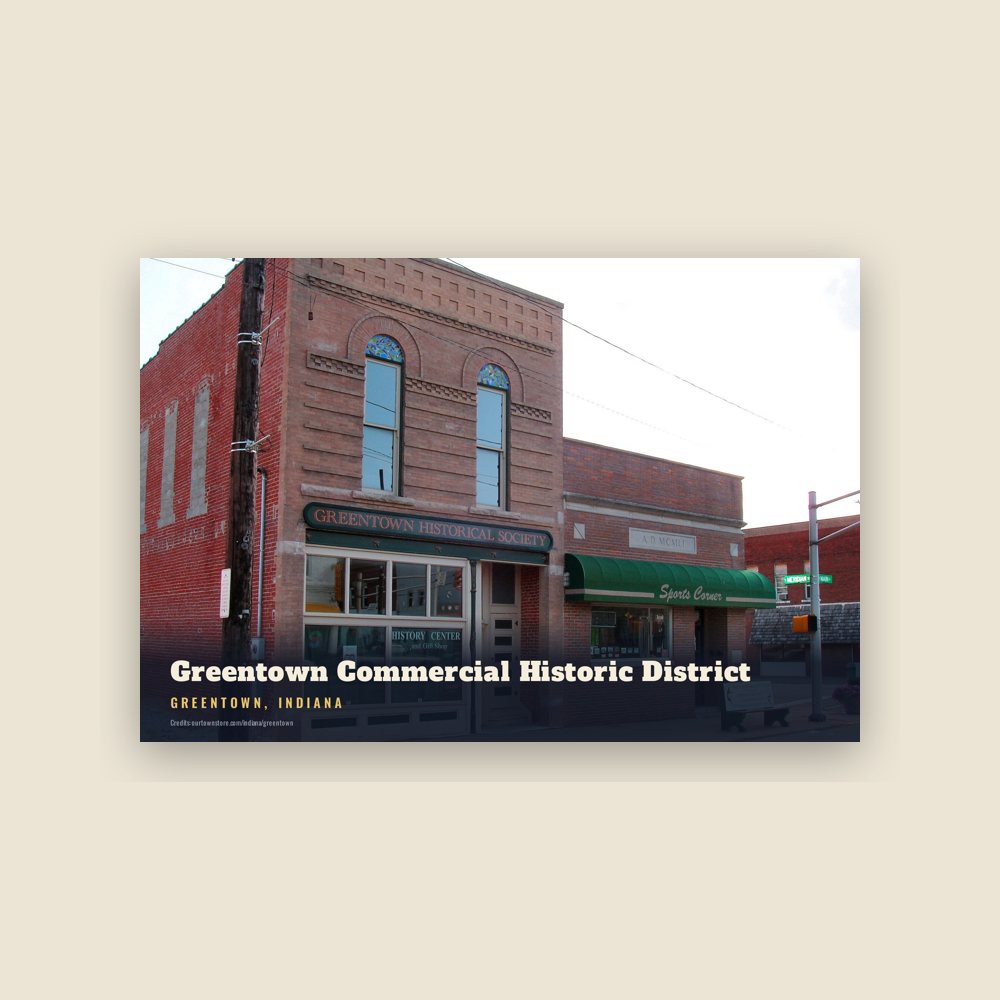
A short history of Greentown
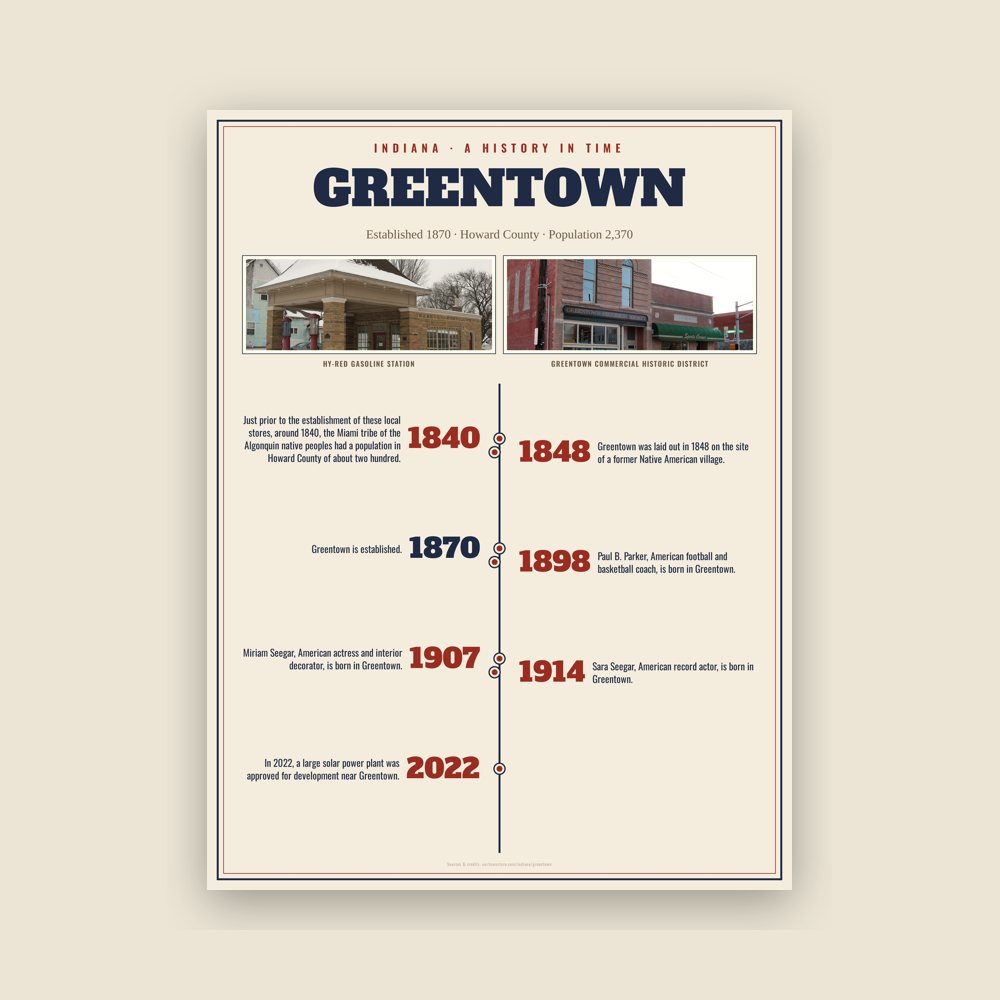
Greentown was laid out in 1848 on the site of a former Native American village. Its inception was largely due to the need for a nearby trading post by people living in the area. First was a merchant, L. W. Bacon, who built a log house on the northeast corner of Main and Merdian. Next was C. O. Fry, who built on the southwest corner of the intersection. Just prior to the establishment of these local stores, around 1840, the Miami tribe of the Algonquin native peoples had a population in Howard County of about two hundred. There was an established village where south Kokomo is now located, as well as villages south of present-day Cassville and Greentown. The frequently traveled paths were from Kokomo to Peru by way of the village of Cassville, and from Kokomo to Meshingomesia by way of a village south of Greentown.
There are several versions of how Greentown received its name. One of the more obvious versions is that Greentown was an area of luscious green grass. Another version deals with the fact that before the town was incorporated, that land was a part of a former township named Green Township. Green Township formed into both Liberty and Union Townships in 1860, and so even though Greentown wasn't incorporated until the 1870s people were still living there when it was Green Township, and may have possibly all opted to preserve Green Township in some way by naming their town after it. One other version is based on the idea of Greentown being an Indian settlement named after a Native American chief called Green.
Greentown was incorporated some time between 1870 and 1880 as it first appeared on the US census in 1880. The population started out at just over 200, and quickly reached a thousand. Over the years since, Greentown's population numbers have seen notable gains every couple censuses followed by smaller drops between, which has enabled the town to slowly grow over time. The population has remained at nearly 2,500 since the 1990s. Greentown is expected to annex more area when the sewage treatment plant is updated, bringing another gain.
In 2022, a large solar power plant was approved for development near Greentown. Some locals have contested this development, voicing concerns about noise and about the loss of farmland around a longtime farming community. Protesters have alleged that the county administrators and company representatives violated the law by holding illegal closed-door meetings, locking the public out of deliberations.
Adapted (trimmed) from the Wikipedia article Greentown, Indiana, revision 1378798847 by its contributors, licensed CC BY-SA 4.0.