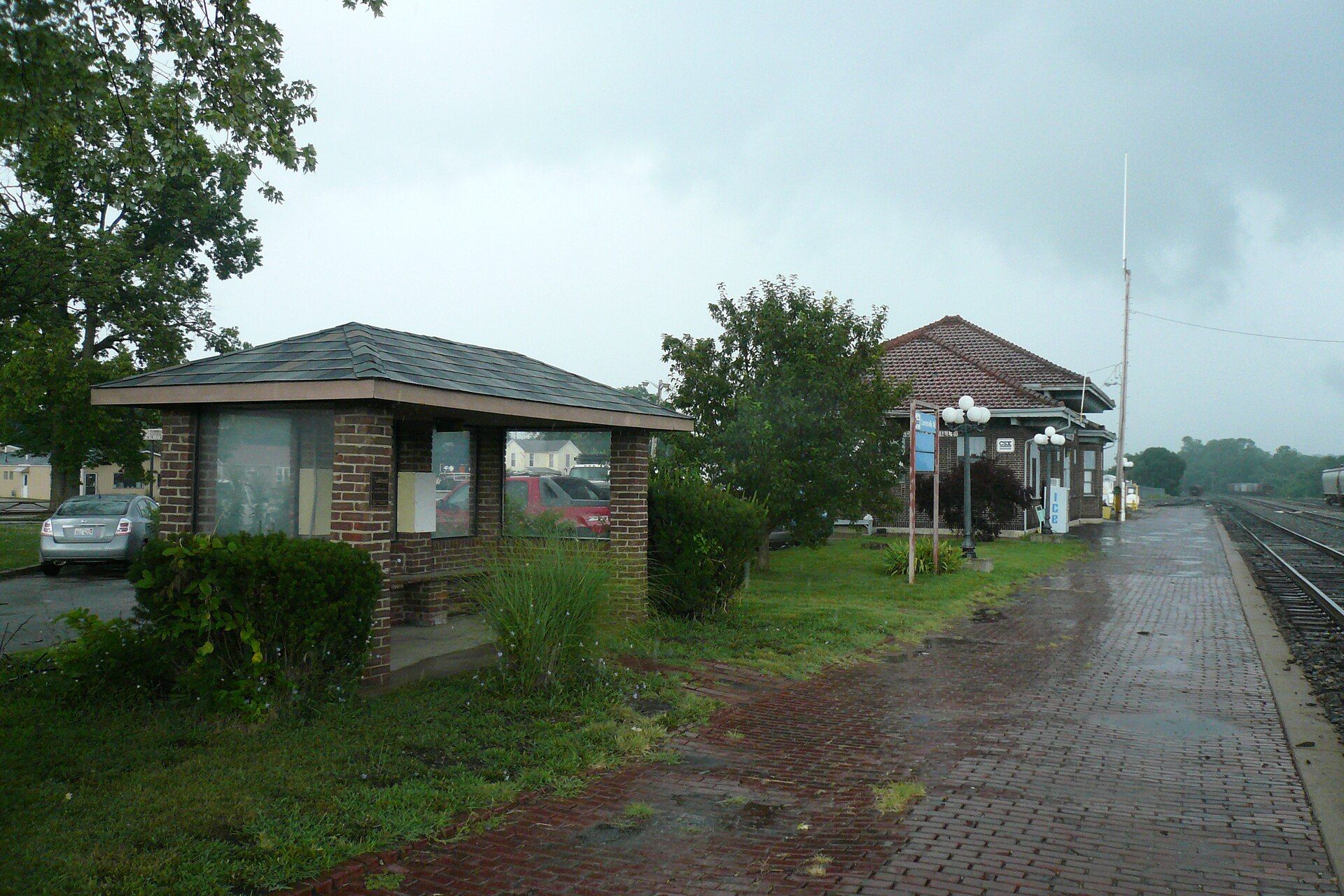
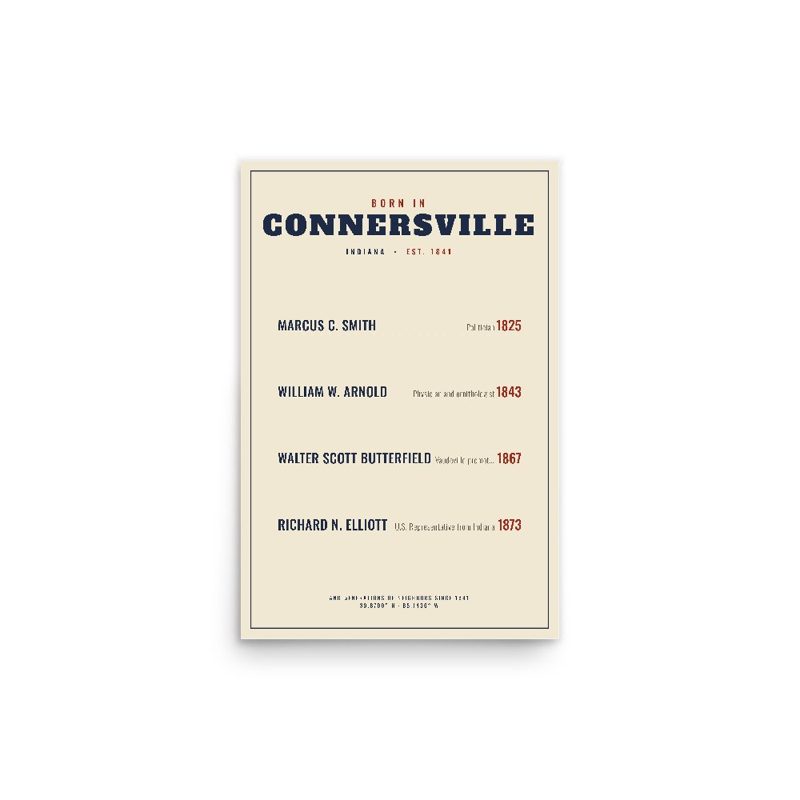
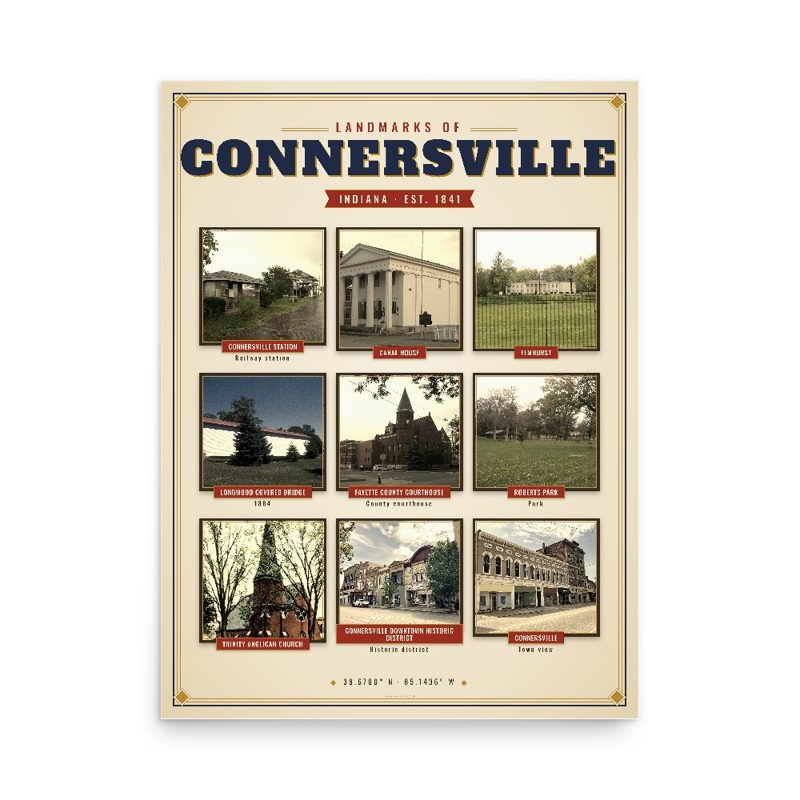
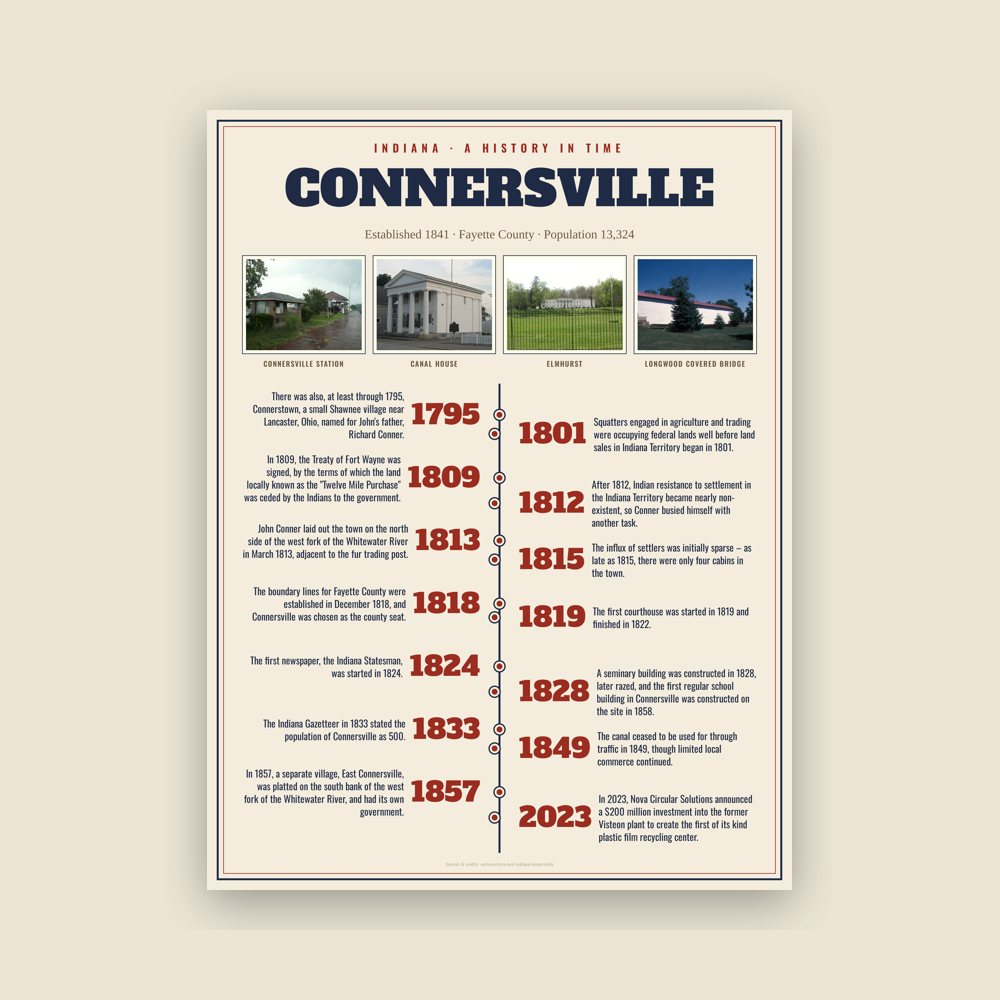
Connersville is named for settler John Conner, older brother of William Conner, an early Indiana settler and politician. There was also, at least through 1795, Connerstown, a small Shawnee village near Lancaster, Ohio, named for John's father, Richard Conner.
Read the full history
Whitewater Valley and pre-European inhabitants
The Whitewater River valley running north–south through eastern Indiana and southwestern Ohio was created by the Late Wisconsin Glaciation ending 13,600 years ago. Fayette County was at the southern fringe of the glaciation at that time. The Ice Age was punctuated by several prolonged warm periods during which the glaciers disappeared entirely from the temperate latitudes and a climate similar to modern times or even warmer prevailed. The flood waters produced resulted in lakes; breaching of the lakes resulted in rivers and streams carving its hills and valleys.
In the Northwest Territory during the latter half of the 18th century, the Miami Indians were dominant in the region, but the Potawatomi and Shawnee had a significant presence. Delaware Indians, displaced from their eastern homelands by European settlement, migrated west and settled along the forks of the Whitewater River. The Whitewater and Ohio River valleys had also been inhabited earlier by other Native Americans called mound builders for their characteristic large burial mounds still in evidence.
The geological aspects of the Whitewater River Valley contributed to early settlement after defeat of the Delaware Indians by General Anthony Wayne at Fallen Timbers in 1794, followed on August 3, 1795, by the Treaty of Greenville ceding most of Ohio and a sliver of southeastern Indiana to the United States. The valley, running south and southeasterly from east central Indiana to the Ohio River Valley, provided a convenient conduit for migration through Fort Washington (Cincinnati) from points east, settlements on the Ohio River, and settlers from Kentucky to northern and central Indiana Territory. Squatters engaged in agriculture and trading were occupying federal lands well before land sales in Indiana Territory began in 1801. An Indian trail paralleled the river from the Ohio Valley northward to the forks, then went along the East Fork to Eli Creek, thence taking a northwesterly direction passing through what was later Connersville, and then on to the Delaware villages strung along the White River from north of modern-day Indianapolis to modern Muncie.
Conner's Post
John Conner, his brother William, and others arrived in the Whitewater Valley from south central Ohio in 1802, establishing a fur trading post in an unpopulated area near what was later to become Cedar Grove on the Whitewater River (Franklin County) at the very fringe of the European penetration into the wilderness of Indiana. By 1808, as a result of reduction of Indian hunting grounds by treaty, the trading post, known as "Conner's Post", had been relocated 20 miles (32 km) north at the Whitewater River junction with an Indian trail between the Ohio River 70 miles (110 km) to the southeast and hunting grounds to the north. According to research by J. L. Heineman, the trading post was located in the middle of what is now Eastern Avenue, at the west end of Charles Street. At that time, the region was inhabited by Delaware Indians. In 1809, the Treaty of Fort Wayne was signed, by the terms of which the land locally known as the "Twelve Mile Purchase" was ceded by the Indians to the government. This tract included a strip twelve miles (19 km) in width lying west of the 1795 Greenville treaty line that ran from the midpoint of the Indiana/Ohio border southwest to the Ohio River, cutting off a thin wedge of southeastern Indiana. The strip included most of Fayette County except the extreme northern portion (part of the later "New Purchase"). Sales of public land by the United States government in Indiana began in 1801. In that year the Cincinnati, Ohio, Land Office began selling land in a wedge of government land in southeastern Indiana known as the "Gore" (organized as Dearborn County in 1803) which included all of what became Fayette County. Conner obtained title to his plat in 1811.
First 50 years – through the Civil War
The exodus of the Delaware Indians from Indiana after the War of 1812, completed by June 1813, deprived John Conner of his field for trading. After 1812, Indian resistance to settlement in the Indiana Territory became nearly non-existent, so Conner busied himself with another task.
John Conner laid out the town on the north side of the west fork of the Whitewater River in March 1813, adjacent to the fur trading post. The original plat was for 62 lots bounded by what are today Central Avenue to the west and Water Street to the east, Third Street to the south, and Sixth Street to the north. The first constructions in the town were a saw mill and grist mill north of town utilizing water power, and a general store and distillery in town. The influx of settlers was initially sparse – as late as 1815, there were only four cabins in the town. The boundary lines for Fayette County were established in December 1818, and Connersville was chosen as the county seat.
Conner served briefly as sheriff of the newly organized Fayette County. In 1820, he helped plat the new capital of Indianapolis, and in 1822 relocated his fur trading business to Noblesville, north of Indianapolis. He also served as state senator and representative. He died in Indianapolis in April 1826 and was buried there. No trace remains of his grave.
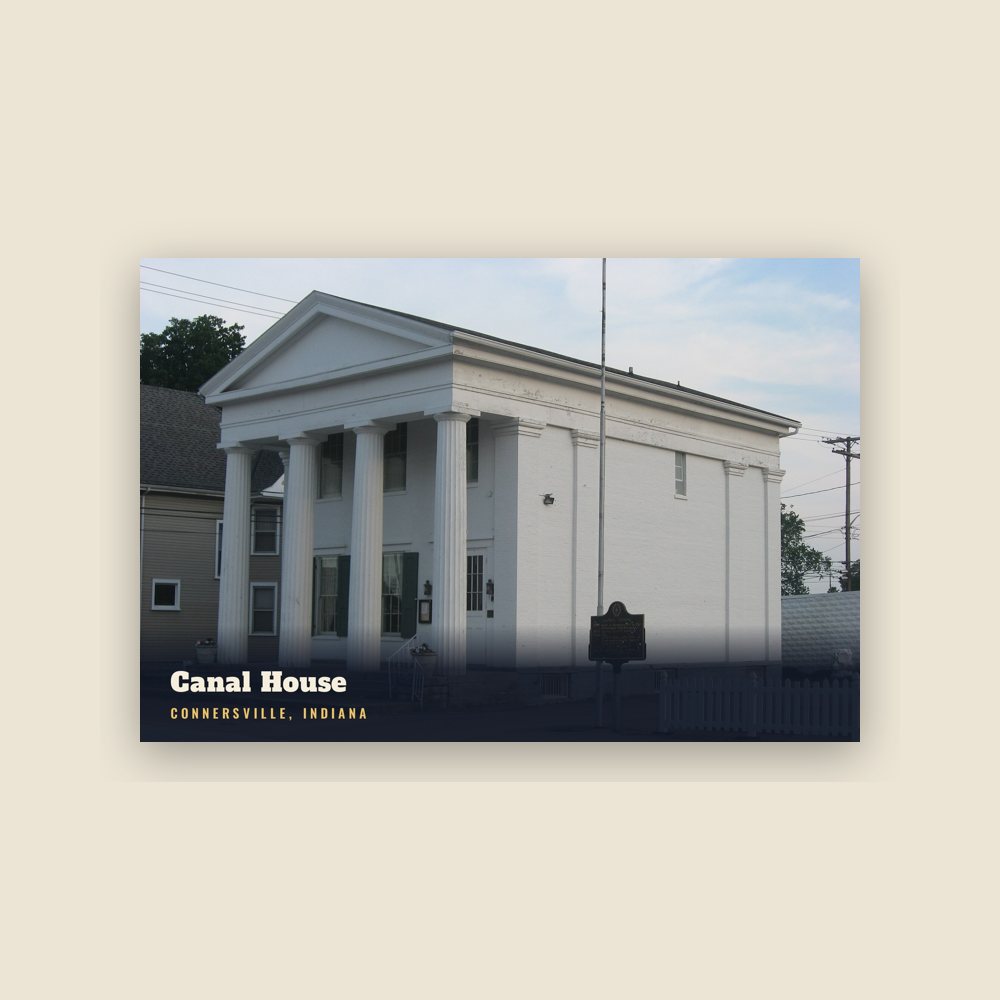
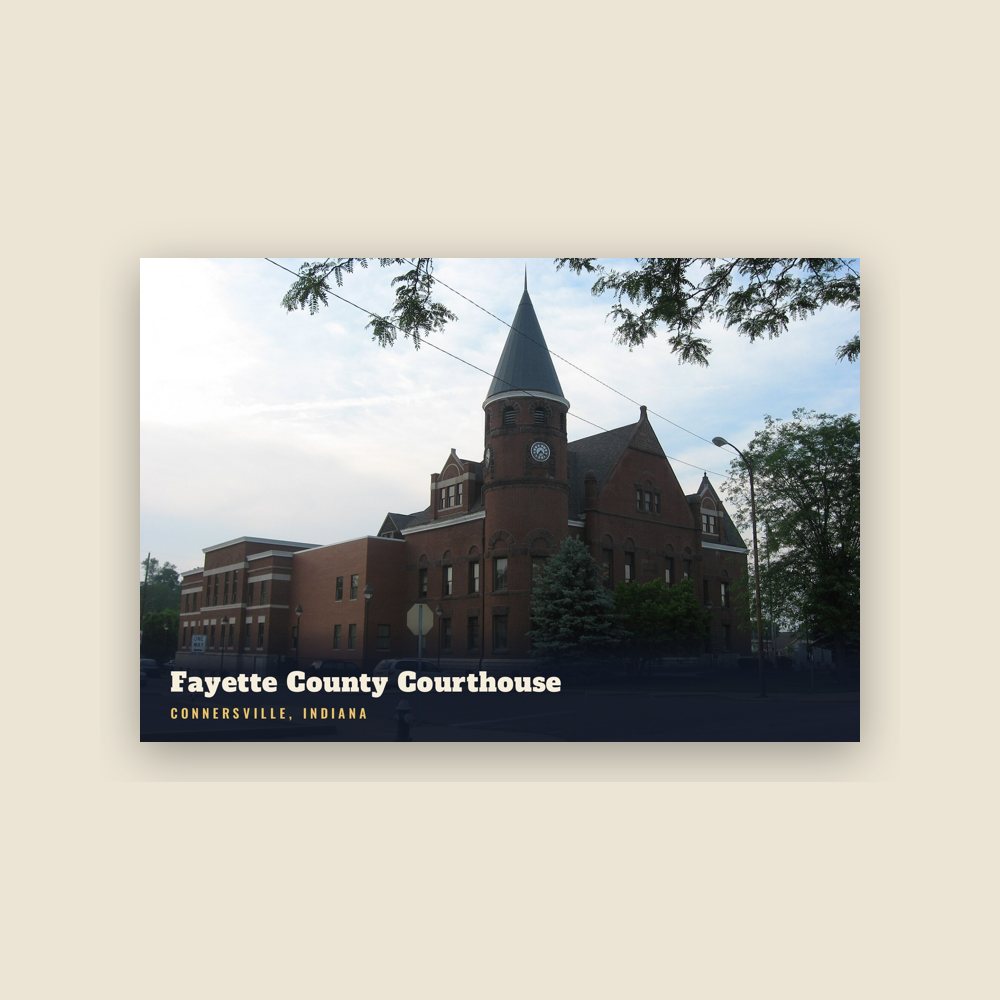
The first post office in Connersville opened in January, 1818. The first courthouse was started in 1819 and finished in 1822. The first newspaper, the Indiana Statesman, was started in 1824. The first church in the village was Presbyterian, constructed in 1824. A seminary building was constructed in 1828, later razed, and the first regular school building in Connersville was constructed on the site in 1858. The Indiana Gazetteer in 1833 stated the population of Connersville as 500. The village was incorporated as a town in 1841. Connersville served as an important link on the Whitewater Canal that opened in1847and connected the Whitewater River and the Ohio River. The canal ceased to be used for through traffic in 1849, though limited local commerce continued. The first railroad, the Cincinnati, Hamilton and Indianapolis Railroad, reached Connersville in 1862. It extended from Rushville through Connersville and Oxford to Hamilton, Ohio.
For many years prior to the Civil War, and even for some time after, the main industries of the town were milling, pork packing, and woolen manufacturing.
In 1857, a separate village, East Connersville, was platted on the south bank of the west fork of the Whitewater River, and had its own government. It was annexed by Connersville some time in the 1920s.
Early growth – pre-industrial age
The Roots blower, a type of air turbine, was invented by the Roots brothers in Connersville in the 1850s, patented in 1859, and manufactured in Connersville for over 150 years.
The town of Connersville became a chartered city in June 1869, and William H. Beck was chosen as its first mayor. The first high school opened in 1875. In 1882, James H. Fearis of Connersville started the Bell telephone exchange. The Connersville Electric Light Company commenced operations in August 1890 as the first supplier of electric power in the city. Central Avenue was paved with brick in 1902, and became the first paved street in the city.
Prior to the advent of automotive manufacturing, Connersville for decades was colloquially known as the "furniture and buggy town" because of the dominance of those two industries in the town.
During the school year 1906–07, Dr. W. Otto Miessner established the first public high school band in the U.S. at Connersville High School.
Automotive and industrial age to 1960s
In the early 20th century, the town became known as "Little Detroit" because of its importance to the automobile industry, with over 500,000 jeep bodies produced in the town during the Second World War. Automobile manufacturing in Connersville began as early as 1909 and included Auburn, Cord, Duesenberg, Ansted, Empire, Lexington, and McFarlan. The Willys MB Jeep body was manufactured in Connersville during the 1940s. Much of the western portion of town was occupied by light industry for the 150 years prior to 1990. Companies included Roots Blower (later Dresser Industries), Stant, McQuay-Norris, Design & Manufacturing Co. (D&M), H. H. Robertson, Visteon, and Philco Ford.
McQuay-Norris, manufacturer of auto parts based in St. Louis, got its start in Connersville in 1921 by the acquisition of Wainwright Engineering, a privately held local company manufacturing automotive engines. In 1969, it was acquired by Eaton, Yale & Towne, and closed its Connersville and Indianapolis plants in 1983.
Design & Manufacturing (D&M) company got its start when Rex Regenstrief purchased American Kitchens in 1958 and renamed the company. By 1972, D&M controlled 25% of the nation's dishwasher market. Design & Manufacturing's assets were sold to White Consolidated Industries in 1987 and the firm was dissolved in 1990.
Architectural Products Division of H. H. Robertson purchased land owned by the defunct Lexington Motor Car Company in February 1960. Robertson was a victim of hard times for the industry in the late 1980s and the Connersville plant was merged with operations in Pittsburgh, Pennsylvania, starting in 1986.
Decline from 1960s onward
The 1980s were the beginning of the end for Connersville automotive manufacturing, which had been on the wane for more than a decade. Due to the high cost of local union labor and economies of scale elsewhere, most industry departed in the 1980s and 1990s. Connersville union labor decreased from a high of 10,000 to about 600 workers in 2012. Connersville's role in automobile manufacturing ceased when the Visteon factory shut down in 2007. Part of the decline may be logistical – with the construction of the interstate highway system in the 1950s, Connersville found itself not directly in line with routes between major cities: Interstate 70 from Indianapolis to Columbus, Ohio, Interstate 74 from Indianapolis to Cincinnati, and U.S. Route 40 from Indianapolis to Richmond, none intersecting Connersville. The former Roots Blower/Dresser Industries, now Ingersoll Rand, retains approximately 200 full-time employees. Stant also remains with a nearly 300 employees. There are still some furniture making, machine shops, and other local manufacturing establishments.
In March 2014, the city declared a fiscal emergency when revenue fell short of expenses, and the city nearly fell into bankruptcy.
In 2023, Nova Circular Solutions announced a $200 million investment into the former Visteon plant to create the first of its kind plastic film recycling center. It is expected to employ close to 200 people by 2026.