It was during the operation of the mine and World War I that the population of Wenona reached an all-time high of 1892 inhabitants. Wenona is the birthplace of Victor Arden, pianist.
- CountyMarshall County
- Population974 (2020 U.S. Census)

Wenona, Illinois gifts and souvenirs: 19 designs made from Wenona's own map, landmarks and history, from $16 to $95. Printed to order and shipped free in the USA.
| Popular | Price |
|---|---|
| Wenona Hometown Ornament | $23 |
| Wenona Vintage Travel Poster | from $40 |
| Wenona Varsity Crewneck | from $57 |
| Wenona Est. Tee | from $33 |
| Wenona Town Line Mug | from $26 |
| Wenona Market Tote | $37 |
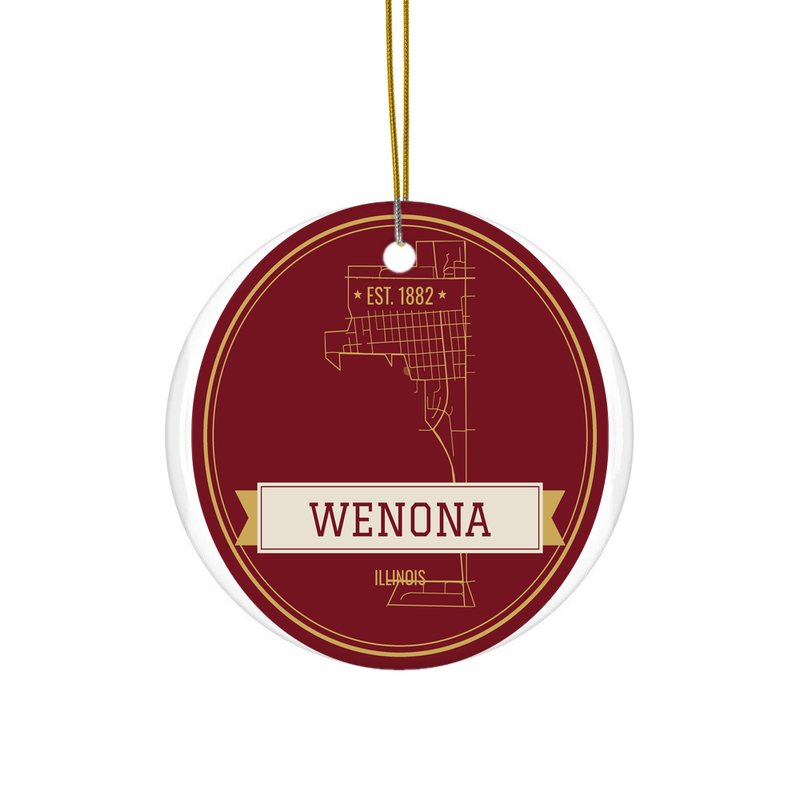
Ceramic keepsake, gold ribbon

Its landmark photo in a classic travel-poster layout

A local landmark photo as a gallery print
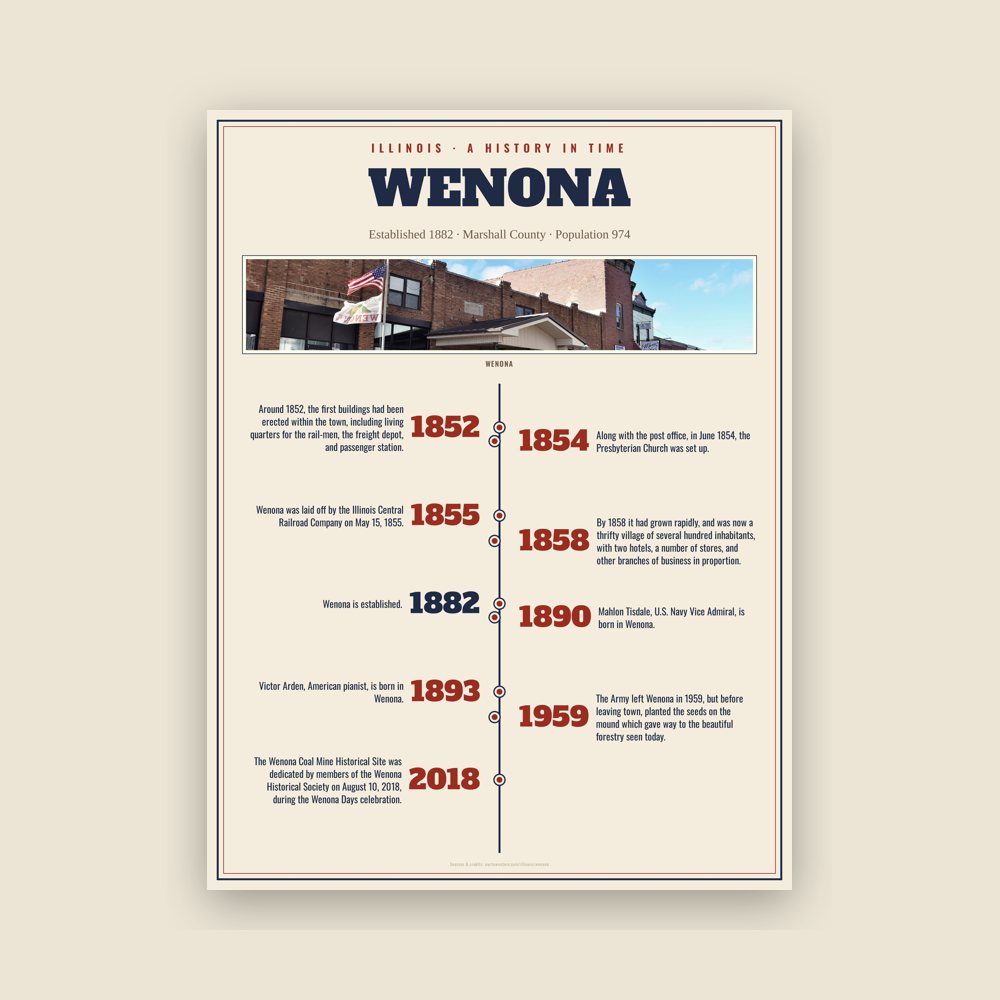
The town's story in dates, from its own records, for home or classroom

Heavy-blend fleece, street map printed on the back

Soft Bella+Canvas jersey

Kids' Bella+Canvas jersey, youth sizes

Bella+Canvas toddler jersey

Bella+Canvas baby bodysuit

Glossy ceramic, dishwasher safe

Weatherproof, for the front walk

24″×16″, printed coir-look fibers, rubber back

12″×12″ printed wood, ready to hang
Soft-touch, zip cover

A local landmark photo with the town name, 18″×18″

Sturdy all-over-print tote

Glossy top, cork back
Soft fleece, 50″×60″

20 oz, double-wall stainless
It was during the operation of the mine and World War I that the population of Wenona reached an all-time high of 1892 inhabitants. Wenona is the birthplace of Victor Arden, pianist.
Around 1852, the first buildings had been erected within the town, including living quarters for the rail-men, the freight depot, and passenger station. This same year, the house for Gr. W. Goodwell, Wenona's station agent and first postmaster, was completed. Along with the post office, in June 1854, the Presbyterian Church was set up. During the winter months of 1854, W.M Brown arrived in Wenona with a large stock of goods; a building was constructed to accommodate his sales. Wenona was laid off by the Illinois Central Railroad Company on May 15, 1855. At the time, the town had around nine buildings and fifty permanent citizens. By 1858 it had grown rapidly, and was now a thrifty village of several hundred inhabitants, with two hotels, a number of stores, and other branches of business in proportion.
A great amount of grain was annually shipped at this point, and a considerable amount of trade was carried on with the surrounding country. The largest single industry contributing to the growth and prosperity of Wenona was its coal mine, located in the northeast quarter of the town, east of the Illinois Central tracks. The mine was opened under the Hamilton-Hodge-Monser partnership and was incorporated November 9, 1882, as the Wenona Coal Company. The partnership was soon dissolved, and ownership passed on to E. L. Monser, with George S. Monser production manager and W. E. Monser sales manager. The vein of coal varied from 3 feet 6 inches (1.07 m) to 4 feet (1.22 m). Peak employment numbered 550 miners and the average payroll approximated $30,000 per month, paid to employees in gold coin for a number of years, later cash at the mine and finally by checks at the bank. The mine operated from 1882 to 1924, at which time it was closed never to reopen. A new union scale was said to have made it unprofitable for the company to continue mining such a thin vein.
It was during the operation of the mine and World War I that the population of Wenona reached an all-time high of 1892 inhabitants. It was said by old timers that on the day after pay-day at the mines, the Chicago & Alton depot was so crowded with people that the railroad could not accommodate its out-of-town passengers.
At the height of the Cold War, the highest spot in town played a role in US defense. Beginning in April 1958, atop the slag pile from the old Wenona coal mine, a radar station was developed which was equipped to detect incoming missiles and enemy airplanes potentially headed to Chicago or Milwaukee. The radar station was staffed by approximately 20 troops from the 45th AAA Brigade and the 105th Signal Corps Detachment. It could detect aircraft as far up as 75,000 feet (23,000 m) in any direction, and as far away as 200 nautical miles (370 km; 230 mi). The Wenona station was one of ten stations set up in Illinois, Michigan, and Wisconsin within 200 miles (320 km) of Chicago in the Chicago Air Defense System. The radar station included two metal buildings and the radar antenna. The base of the slag pile was surrounded by a six-strand barbed-wire fence. Prior to constructing the buildings on top of the slag pile, 30 feet (9 m) were graded off the top and a circular roadway was built around the slag pile from bottom to top. At least three men who served at the Wenona Radar Station settled in Wenona after completion. The Army left Wenona in 1959, but before leaving town, planted the seeds on the mound which gave way to the beautiful forestry seen today.
The Wenona Coal Mine Historical Site was dedicated by members of the Wenona Historical Society on August 10, 2018, during the Wenona Days celebration.
Adapted (trimmed) from the Wikipedia article Wenona, Illinois, revision 1378269711 by its contributors, licensed CC BY-SA 4.0.
We share a part of every Wenona sale with local partners, and we'd love to print from your collection. Old photographs, maps and postcards make the best keepsakes.
Partner with usA favorite landmark, your street, a school or team, an anniversary gift, a different product. Tell us and we'll get back to you by email.
Wenona's population was 974 in the 2020 U.S. Census, down from 1,056 in 2010.