A short history of Vandalia
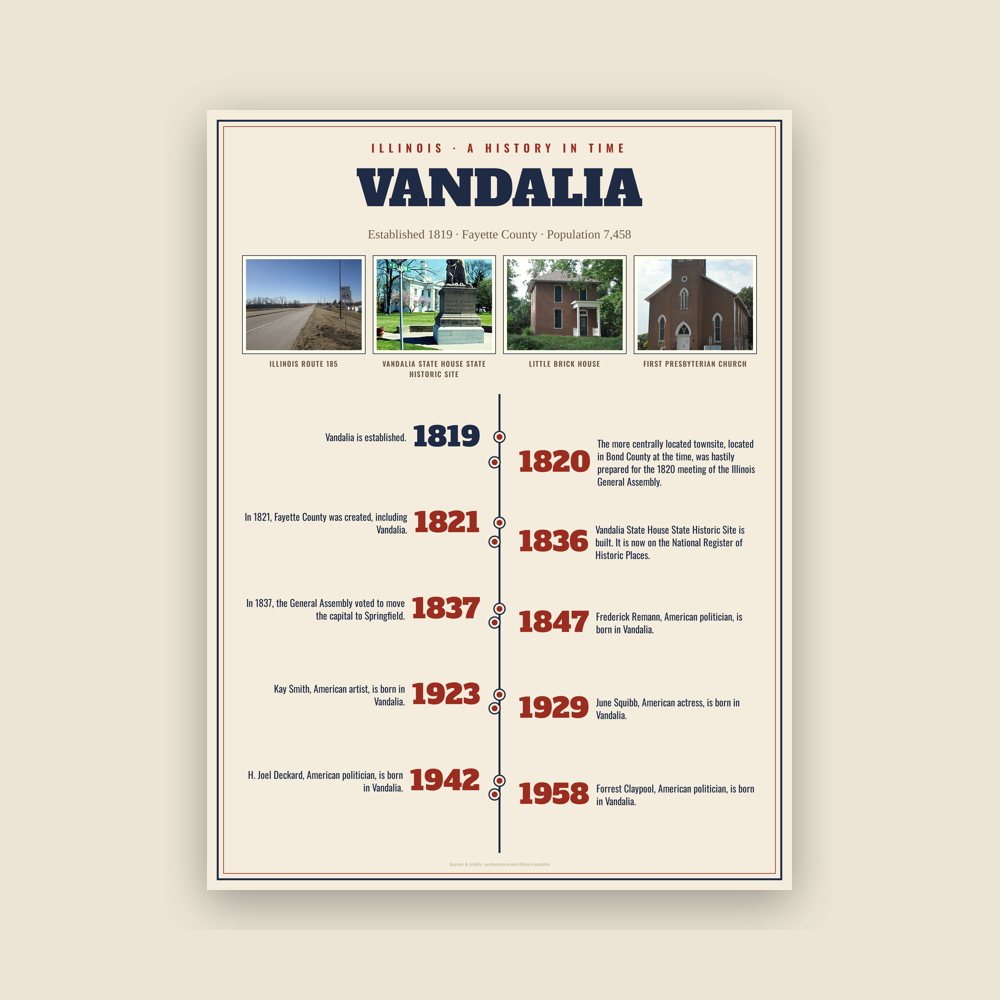
Vandalia was founded in 1819 as a new capital city for Illinois. The previous capital, Kaskaskia, was unsuitable because it was on the south-east border of the new state and under the constant threat of flooding. The more centrally located townsite, located in Bond County at the time, was hastily prepared for the 1820 meeting of the Illinois General Assembly. In 1821, Fayette County was created, including Vandalia.
The history of the name Vandalia is uncertain. Different theories can be found in almost all of the books written about Vandalia over the years. In her book Vandalia: Wilderness Capital of Lincoln's Land, Mary Burtschi tells of a conversation between one of the original surveyors of the town and a Vandalia resident. The surveyor, Colonel Greenup, explained that Van was suggested by one of the men. He recommended this as an abbreviation to the word vanguard meaning the forefront of an advancing movement. Another suggestion was made for the term dalia, derived from the Anglo-Saxon word dale which means a valley between hills. Greenup takes credit in the conversation for connecting the two terms to form the name Vandalia.
Another possible source of the name is the Vandalia colony, a failed attempt to establish a fourteenth colony in part of what is now West Virginia and Kentucky. The Vandalia colony was named in honor of Queen Charlotte, who claimed descent from the Wendish tribe of Obodrites, also called the Vandals.
Another theory put forth is that Vandalia was named by those who located the state capital in the town; according to the story, they mistakenly thought the Vandals were a brave Native American tribe, rather than of Germanic origins.
The law under which Vandalia was founded included a provision that the capital would not be moved for twenty years. Even before the end of this period, the population center of the state had shifted far north of Vandalia. In 1837, the General Assembly voted to move the capital to Springfield.
On November 21, 1915, the Liberty Bell passed through Vandalia on its nationwide tour, while being returned to Philadelphia, Pennsylvania from the Panama-Pacific International Exposition in San Francisco.
In the early 1960s the sociologist Joseph Lyford examined the social structure of Vandalia in a book-length study that revealed the essentially corporatist nature of decision-making in the city; this work was recently revisited by the Economist newspaper.
Adapted (trimmed) from the Wikipedia article Vandalia, Illinois, revision 1374951317 by its contributors, licensed CC BY-SA 4.0.