A short history of Pontiac
Settlement
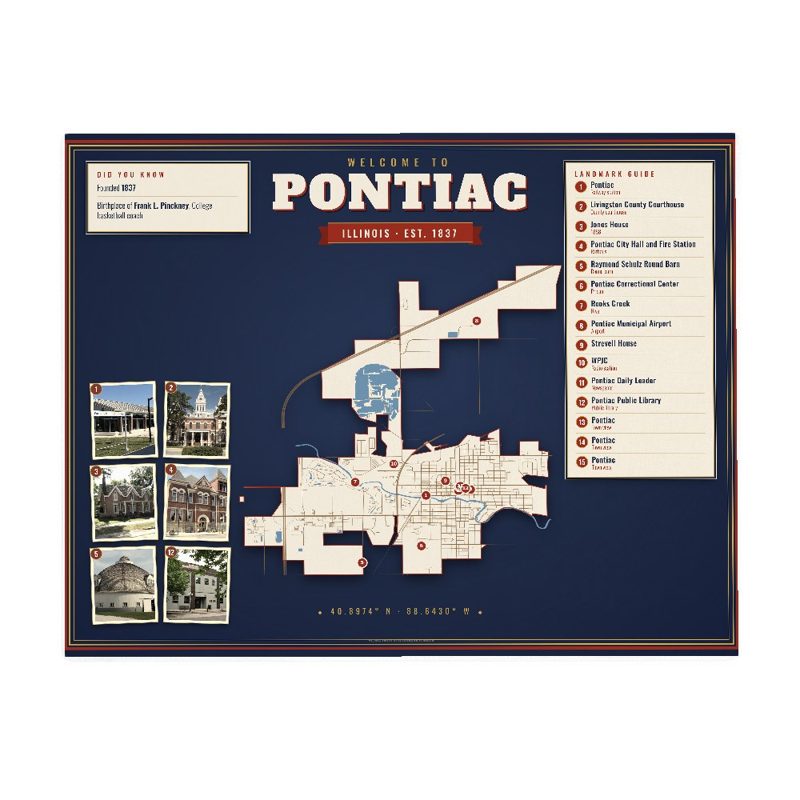
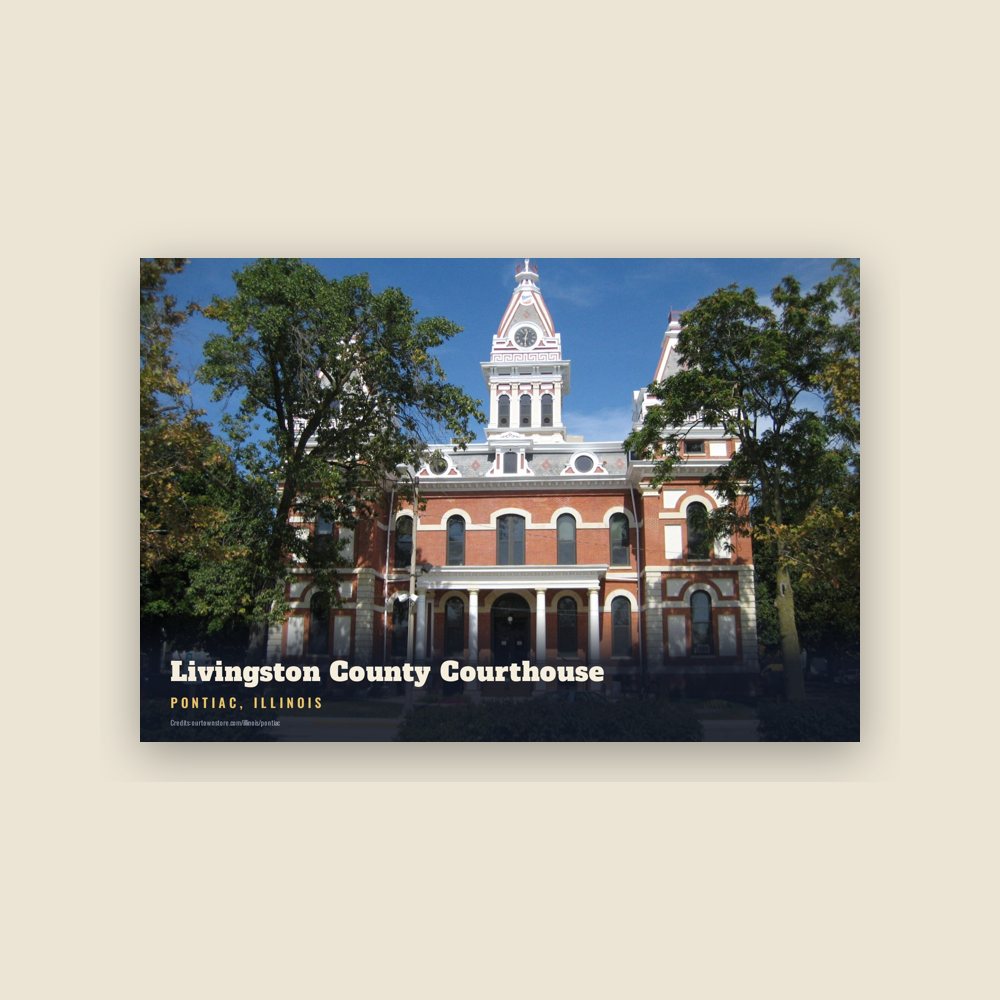
Pontiac was established on July 27, 1837, by Henry Weed and brothers Lucius and Seth M. Young, who aimed to create the county seat for the newly formed Livingston County. Jesse W. Fell named the post office "Pontiac" in honor of the Native American leader. The town was designed during a time of economic depression, and the founders promised land and financial contributions for essential infrastructure, such as a courthouse and a bridge across the Vermilion River. However, within weeks of the town's founding, the Young brothers died, and Weed soon drifted away, leaving others to fulfill the town's early promises. Before leaving the county, Weed had built the first house in Pontiac.
The town's layout was typical for mid-19th century Midwestern towns, centered around a public square. This design aimed to establish the town center and provide valuable land for future development. Isaac Wicher, the county surveyor, oversaw the layout, creating a plan with ninety-three blocks, most divided into eight lots. Early lots sold for as little as five dollars each, and the town extended across both sides of the Vermilion River. Similar square-centered towns from this era include Metamora, Lexington, and Clinton.
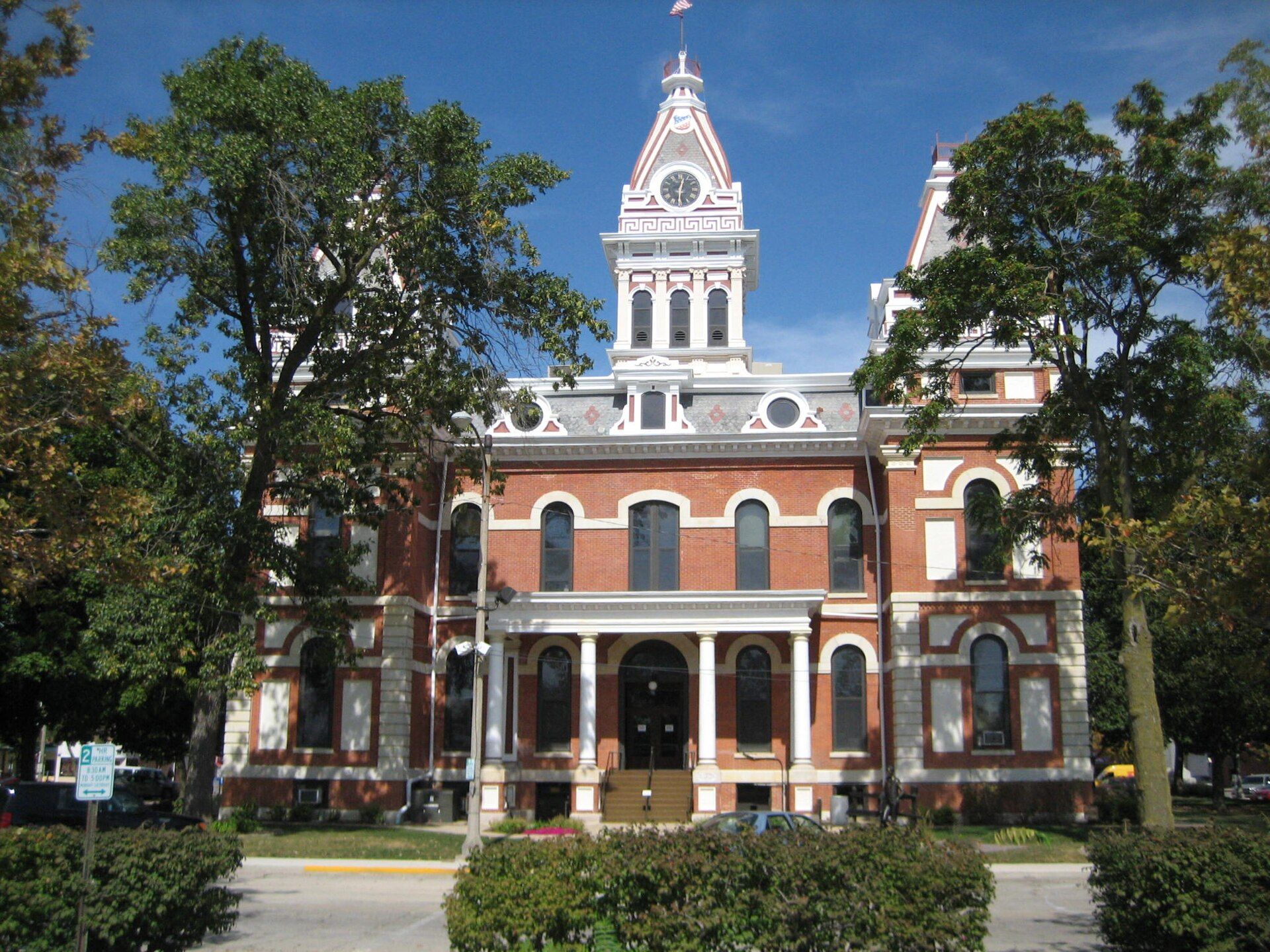
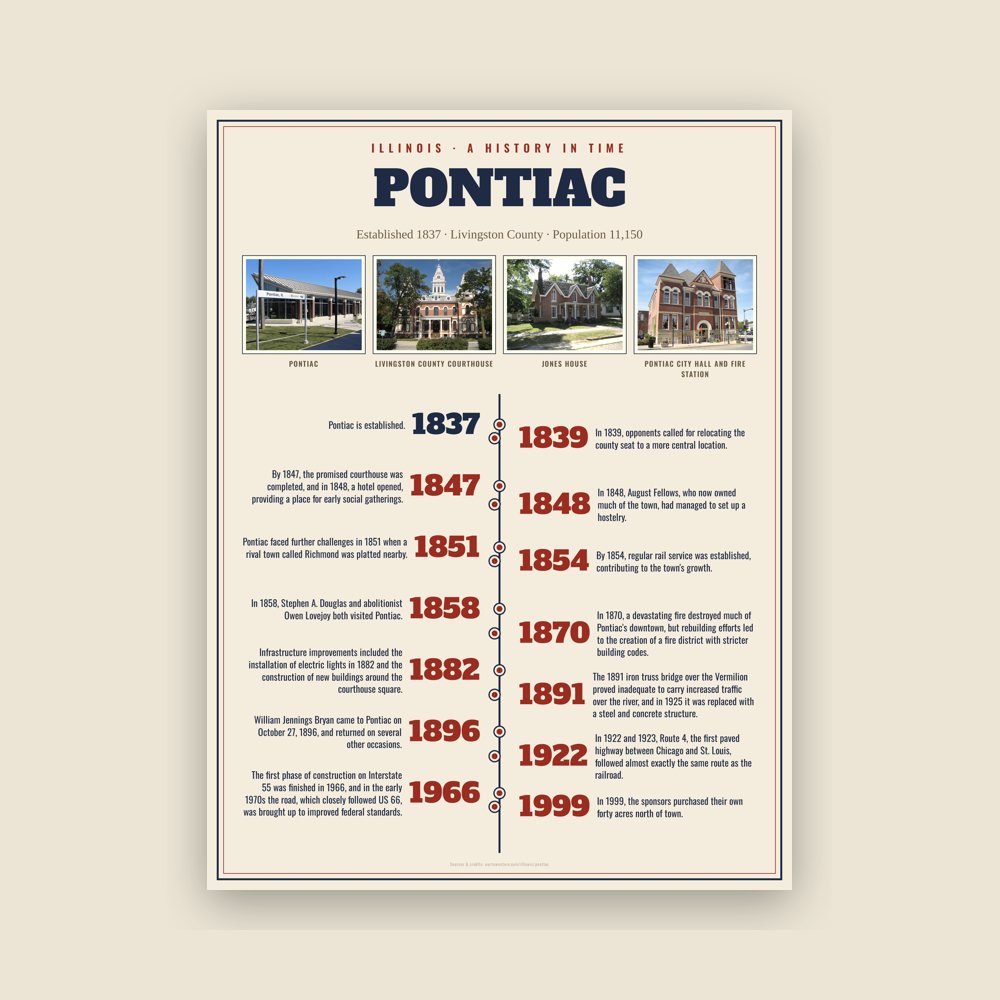
Initially, Pontiac had some advantages, including a good river crossing and a mill operated by James McKee. However, growth was slow, leading to challenges for Pontiac's status as the county seat. In the early 1840s it had only a half-dozen cabins and an unfinished courthouse, and everything was so scattered among "clumps of bushes" that the town was almost invisible. In 1839, opponents called for relocating the county seat to a more central location. They cited the town's underdeveloped infrastructure, but despite a vote in favor of relocation, the measure failed to achieve the required two-thirds majority. By 1847, the promised courthouse was completed, and in 1848, a hotel opened, providing a place for early social gatherings.
Read the full history
19th century growth
In 1848, August Fellows, who now owned much of the town, had managed to set up a hostelry. Some of the first church services in Pontiac were held at the tavern. In 1849 cholera swept through Pontiac, killing Fellows and two of his children. One early settler remembered that in Livingston County one person in two suffered from the disease. Fellow's widow, Maria Tracey Fellows, continued to run the hotel; she remarried Nelson Buck in 1850 and renamed the place Buck Hotel.
Pontiac faced further challenges in 1851 when a rival town called Richmond was platted nearby. Its backers believed the new railroad would bypass Pontiac, but the railroad tracks were routed through Pontiac instead, securing its place as the center of Livingston County. By 1854, regular rail service was established, contributing to the town's growth. In 1856, Pontiac was incorporated.
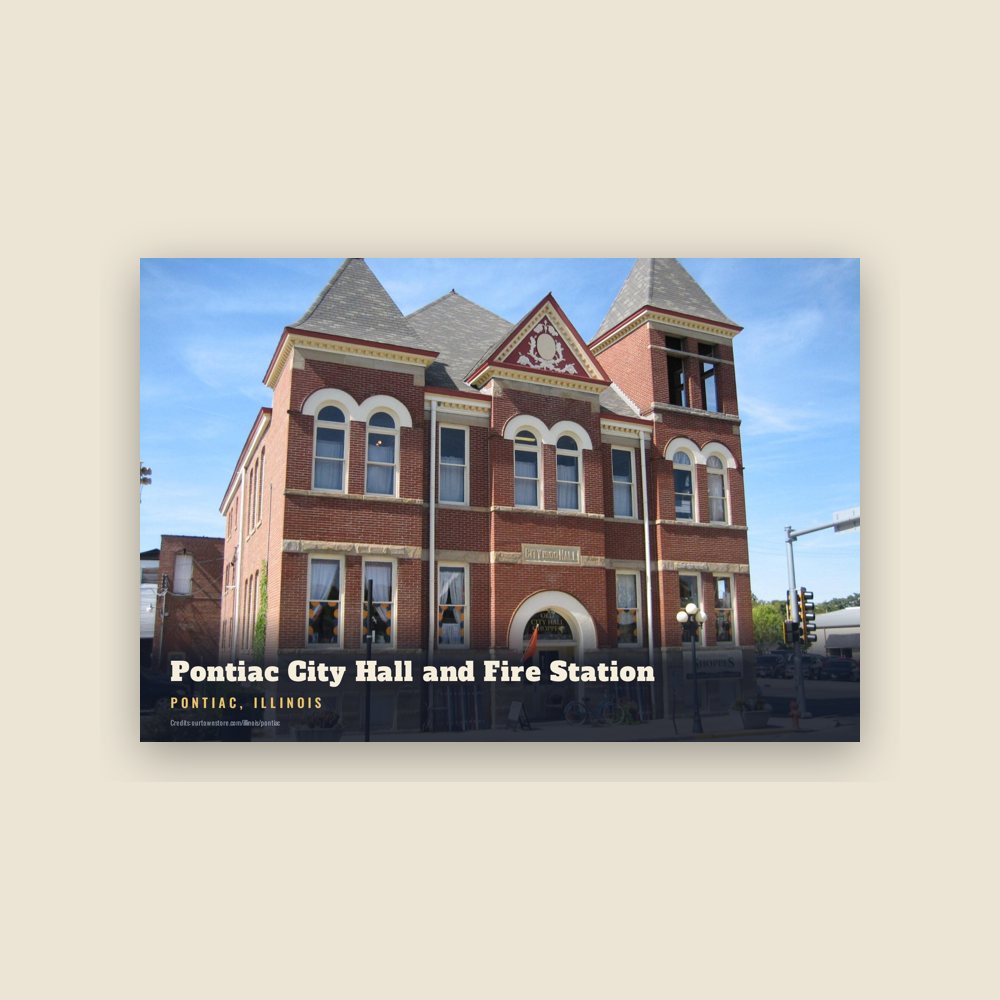
In the following years, Pontiac saw a surge in development, including the construction of the Reform School at Pontiac in 1870, which became the Illinois State Reformatory in 1892 and is now the Pontiac Correctional Center. Infrastructure improvements included the installation of electric lights in 1882 and the construction of new buildings around the courthouse square. In 1870, a devastating fire destroyed much of Pontiac's downtown, but rebuilding efforts led to the creation of a fire district with stricter building codes. By the 1880s, Pontiac had become a thriving town with a mix of brick commercial buildings and wooden residences, characteristic of many Midwest towns of that era.
Abraham Lincoln visited Pontiac in the 1840s and again in February 1855, when his train was snowbound on the nearby tracks, and he was taken by sled to spend the night at the home of John McGregor. On January 25, 1860, Lincoln was again in town when he addressed the Young Men's Literary Association. In 1858, Stephen A. Douglas and abolitionist Owen Lovejoy both visited Pontiac. When local people learned in 1880 that former president Ulysses S. Grant would pass through Pontiac on his way to visit his son, they begged the general to stay over for breakfast, and a large reception committee quickly arranged a celebration. William Jennings Bryan came to Pontiac on October 27, 1896, and returned on several other occasions. On June 3, 1903, during his whistle-stop tour through Central Illinois, Theodore Roosevelt spoke in Pontiac and unveiled the soldier's monument. He spoke there again in 1910.
20th century to present
In the American Midwest, new highways often parallel early railroads. This happened at Pontiac. The Chicago Mississippi, linking St. Louis with Chicago, was Pontiac's first railroad. In 1922 and 1923, Route 4, the first paved highway between Chicago and St. Louis, followed almost exactly the same route as the railroad. Local people called it the "hard road". The new state highway passed along Ladd Street and brought traffic through the center of Pontiac. The 1891 iron truss bridge over the Vermilion proved inadequate to carry increased traffic over the river, and in 1925 it was replaced with a steel and concrete structure. Also in 1925, the designation of the road was changed to U.S. Route 66, but this was only a change in name, as most of this famous highway simply borrowed the pavement of Route 4.
The Threshermen's Reunion started in a modest way in 1949 at Pontiac's Chautauqua Park next to the Vermilion River as a gathering of interested people who brought together a collection of old farm machinery. The assemblage of steam engines and the people who ran them grew in popularity. In 1999, the sponsors purchased their own forty acres north of town.
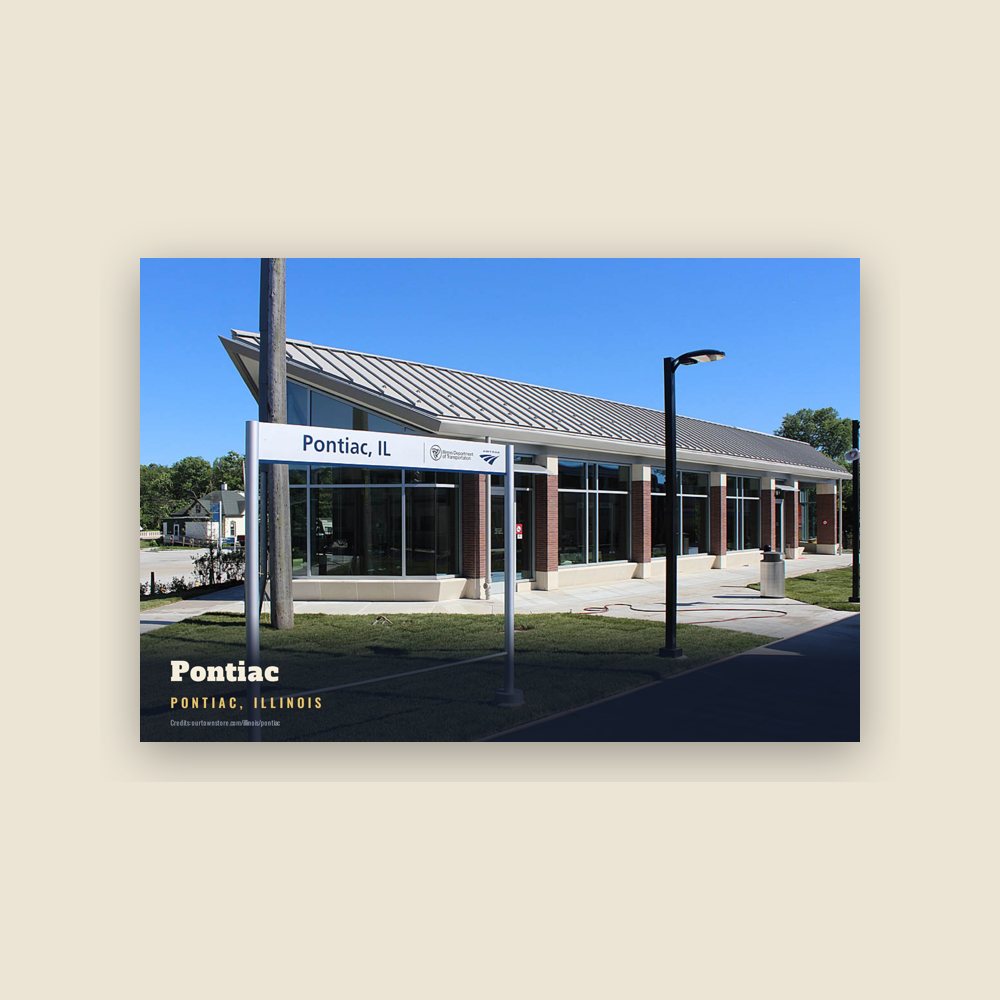
The first phase of construction on Interstate 55 was finished in 1966, and in the early 1970s the road, which closely followed US 66, was brought up to improved federal standards. Highway-oriented businesses soon clustered around these roads, at first on the north and south sides of Pontiac, and later near Exit 197, west of the old town center. Unlike many towns, Pontiac has continued to be serviced by railroad passenger service. In 1971, Amtrak took over the task of moving people between Chicago and St. Louis, and Pontiac has continued to be a stop.
Pontiac is home to the Illinois Route 66 Hall of Fame. It was previously located at Dixie Truckers Home in McLean, Illinois, but it was moved to a new, larger location in Pontiac when Dixie changed ownership.
Adapted (trimmed) from the Wikipedia article Pontiac, Illinois, revision 1374792317 by its contributors, licensed CC BY-SA 4.0.