A short history of Orangeville
Early history
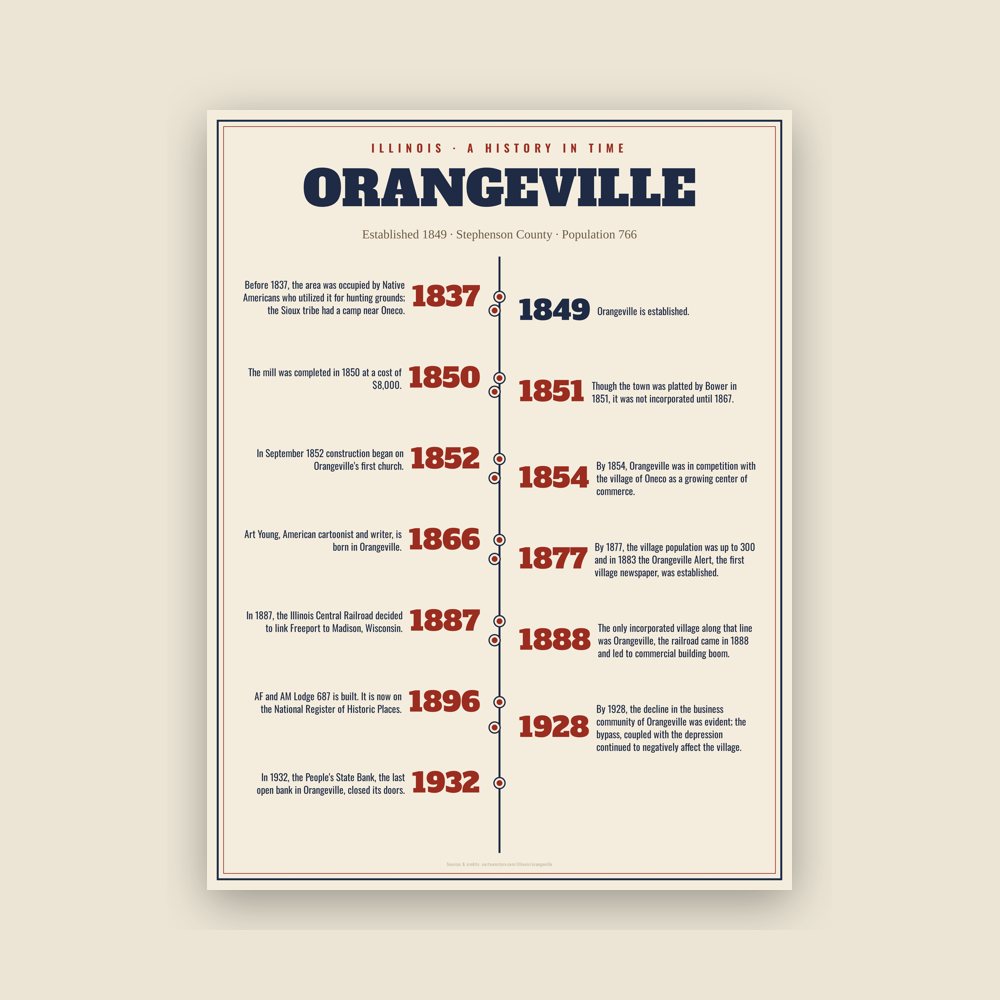
Before 1837, the area was occupied by Native Americans who utilized it for hunting grounds; the Sioux tribe had a camp near Oneco. Game that populated the Orangeville area included buffalo and deer. John H. Curtis purchased the 80 acres (32 ha) of land, which included the area that would eventually become Orangeville, on January 1, 1838, at the United States General Land Office in Dixon. Curtis constructed a dam on Richland Creek, and on the creek's west bank erected a gristmill and a saw mill. Curtis died in 1843 and both mills stood idle until John Bower arrived in 1846, with his family, after having visited the area the year before. Bower purchased the 80 acres (32 ha) and the mills.
Throughout the 1830s and 1840s farmers from New York and Pennsylvania, known as the Pennsylvania Dutch, arrived to settle the area around present-day Orangeville. Of the first 14 settlers to the area, 13 were Pennsylvania Dutch, the 14th was a German immigrant. A Dr. Thomas Van Valsah led a wagon train from Pennsylvania to Stephenson County in 1837.
The village of Orangeville was founded by John Bower, popularly confused as "Bowers." Bower came to Stephenson County in 1845 and, on October 16, 1846, bought the land that would be platted as Orangeville from for $950. Bower built the Union House in 1849 on a portion of what became Orangeville in 1851. Though the town was platted by Bower in 1851, it was not incorporated until 1867. A drawing of the plat was done by surveyor Marcus Montelius and indicated that Orangeville has always been known as Orangeville; several publications have asserted that the town began as Bowersville or Bowers Mills and underwent a name change in 1854. It is possible that the incorrect name Bowersville was a misremembered version of "Bower's mill". The plat also showed 48 original town lots.
At the outset, Bower brought "wagon loads" of lumber from Galena and Chicago to the settlement, and by 1849 he had reconstructed and improved the gristmill. The mill was completed in 1850 at a cost of $8,000. Charles Moore, who would become the first President of the village when it was incorporated, came to the town, lured by Bower's efforts, in 1849. George Hamilton built a store and soon farmers began to build houses, by 1850 a stagecoach served the area. In September 1852 construction began on Orangeville's first church.
By 1854, Orangeville was in competition with the village of Oneco as a growing center of commerce. That year, the federal government decided that population growth in the two villages warranted the establishment of a post office. On an appointed day, residents of both villages lined up on the sides of the street according to which town they supported as the location for the post office. Orangeville won by a narrow margin.
Read the full history
Arrival of the railroad
After its incorporation the village continued to prosper, the downtown district was mostly complete by the 1870s, with all commercial lots purchased and improved. Mel Trotter who established a chain of rescue missions during his lifetime, was born in the village on May 16, 1870, and lived there until he was five years old when his family moved to Polo, Illinois. By 1877, the village population was up to 300 and in 1883 the Orangeville Alert, the first village newspaper, was established. In 1887, the Illinois Central Railroad decided to link Freeport to Madison, Wisconsin. The only incorporated village along that line was Orangeville, the railroad came in 1888 and led to commercial building boom. This building boom directly resulted in 14 new buildings being erected downtown, all brick buildings downtown save the 1906 Wagner Building and the 1899 R.W. Moore Building were a result of the railroad. Between 1888 and 1914, numerous business developed along the corridor of Main and High Streets, those included: restaurants, drug stores, barber shops, banks, watch and clock repair shops, cigar factory, funeral parlor and casket factory, among several others.
Great Depression
In 1928, just before the onset of the Great Depression, Illinois State Highway 74 (later Illinois Route 26) was rerouted through the eastern part of Orangeville, bypassing the downtown business district. Though the downtown district no longer had a major thoroughfare passing through it, many of the business were able to survive, at least initially. By 1928, the decline in the business community of Orangeville was evident; the bypass, coupled with the depression continued to negatively affect the village. In 1932, the People's State Bank, the last open bank in Orangeville, closed its doors.
Adapted (trimmed) from the Wikipedia article Orangeville, Illinois, revision 1377333403 by its contributors, licensed CC BY-SA 4.0.