Morrisonville is a small town in Christian County, Illinois, United States. Morrisonville is the birthplace of Al Unser, baseball player.
- CountyChristian County
- Population997 (2020 U.S. Census)
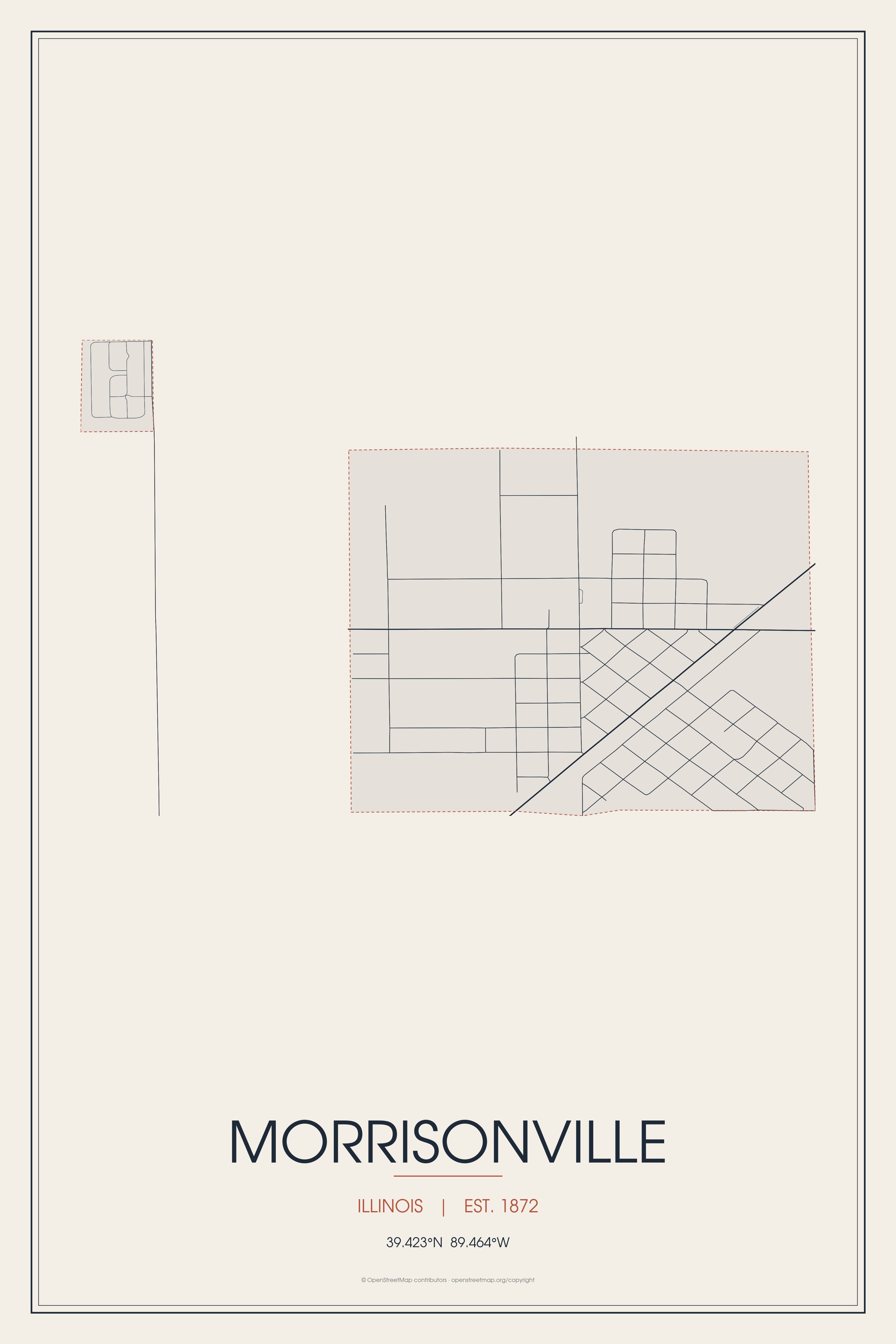
Morrisonville, Illinois gifts and souvenirs: 17 designs made from Morrisonville's own map, landmarks and history, from $16 to $95. Printed to order and shipped free in the USA.
| Popular | Price |
|---|---|
| Morrisonville Hometown Ornament | $23 |
| Morrisonville Varsity Crewneck | from $57 |
| Morrisonville Est. Tee | from $33 |
| Morrisonville Town Line Mug | from $26 |
| Morrisonville Market Tote | $37 |
Ceramic keepsake, gold ribbon
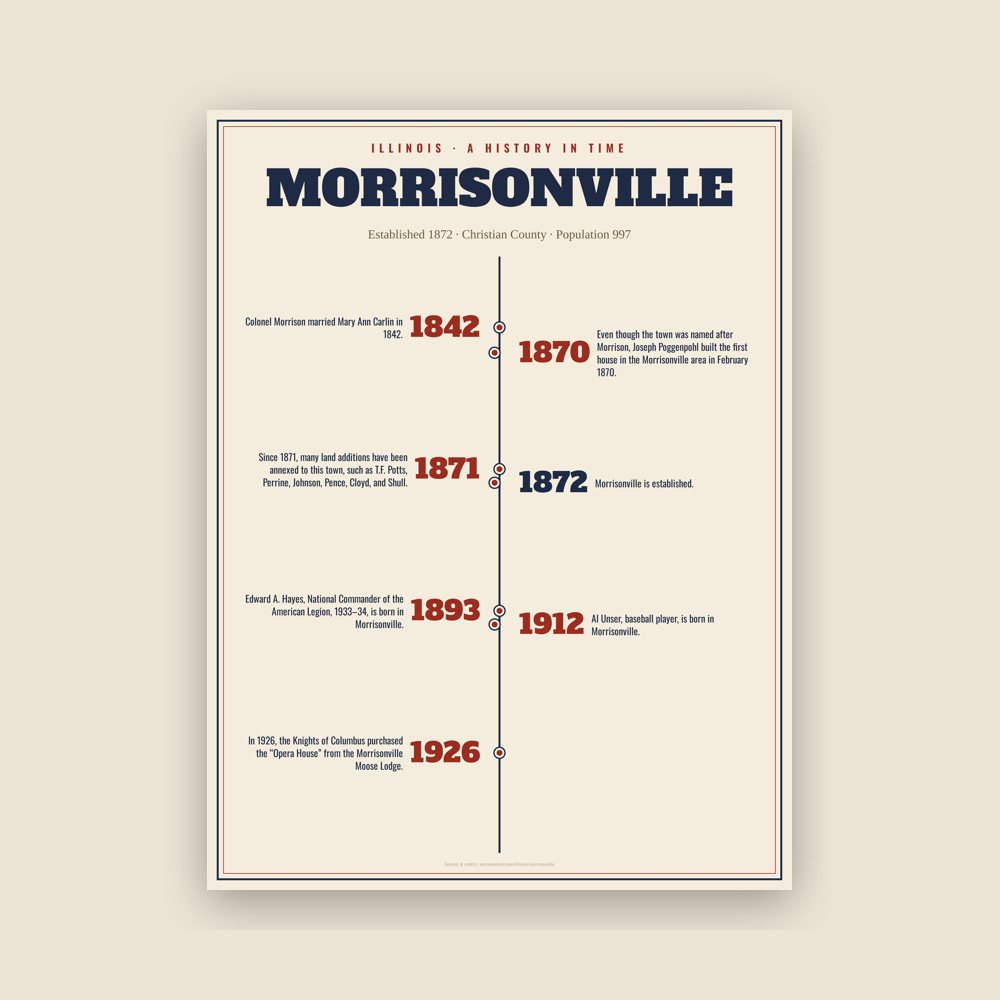
The town's story in dates, from its own records, for home or classroom
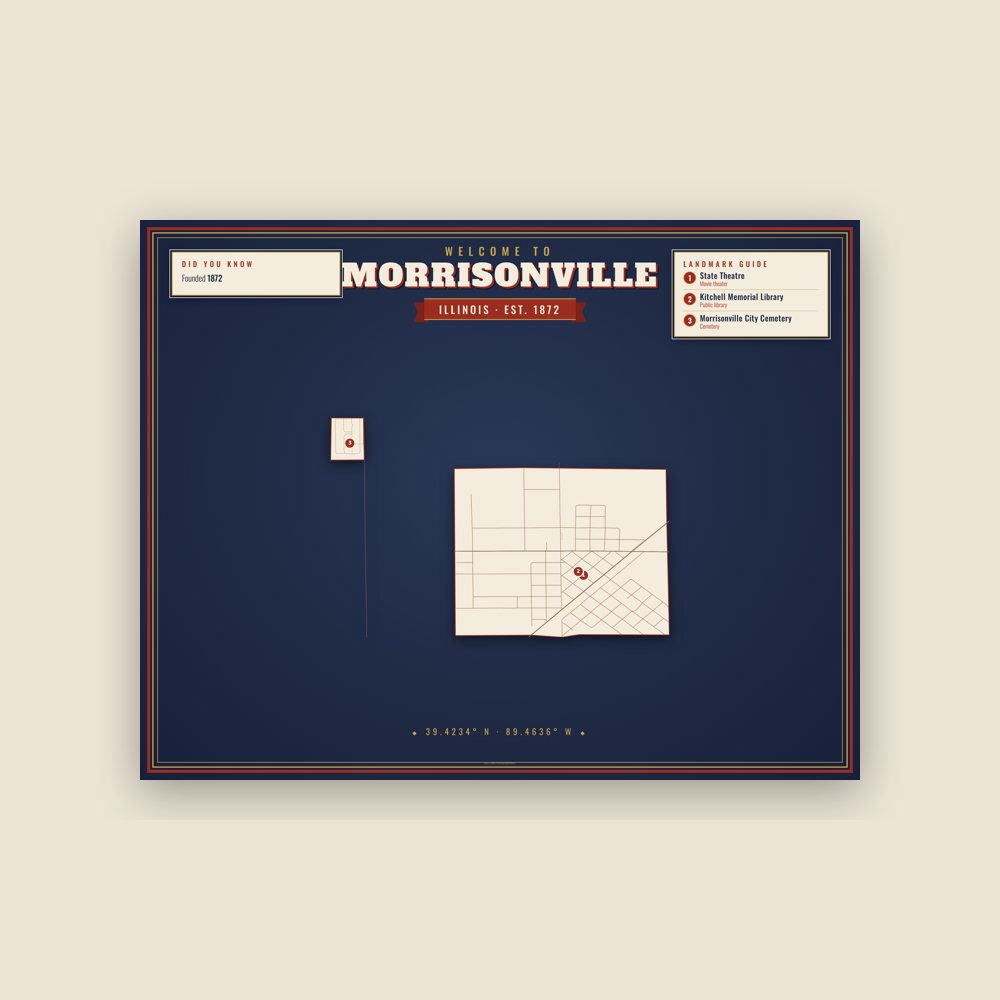
Map of local landmarks, washable fabric
Heavy-blend fleece, street map printed on the back
Soft Bella+Canvas jersey
Kids' Bella+Canvas jersey, youth sizes
Bella+Canvas toddler jersey
Bella+Canvas baby bodysuit
Glossy ceramic, dishwasher safe
Weatherproof, for the front walk
24″×16″, printed coir-look fibers, rubber back
12″×12″ printed wood, ready to hang
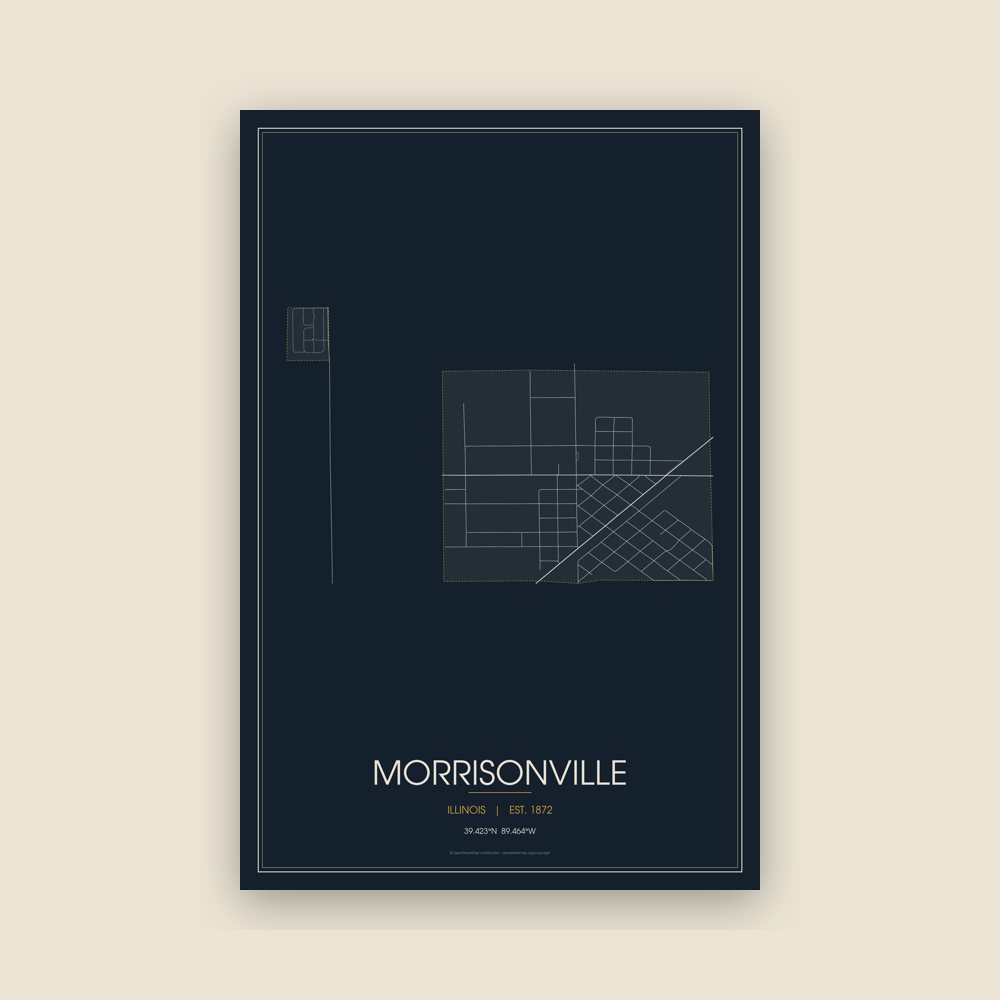
Soft-touch, zip cover
Sturdy all-over-print tote
Glossy top, cork back
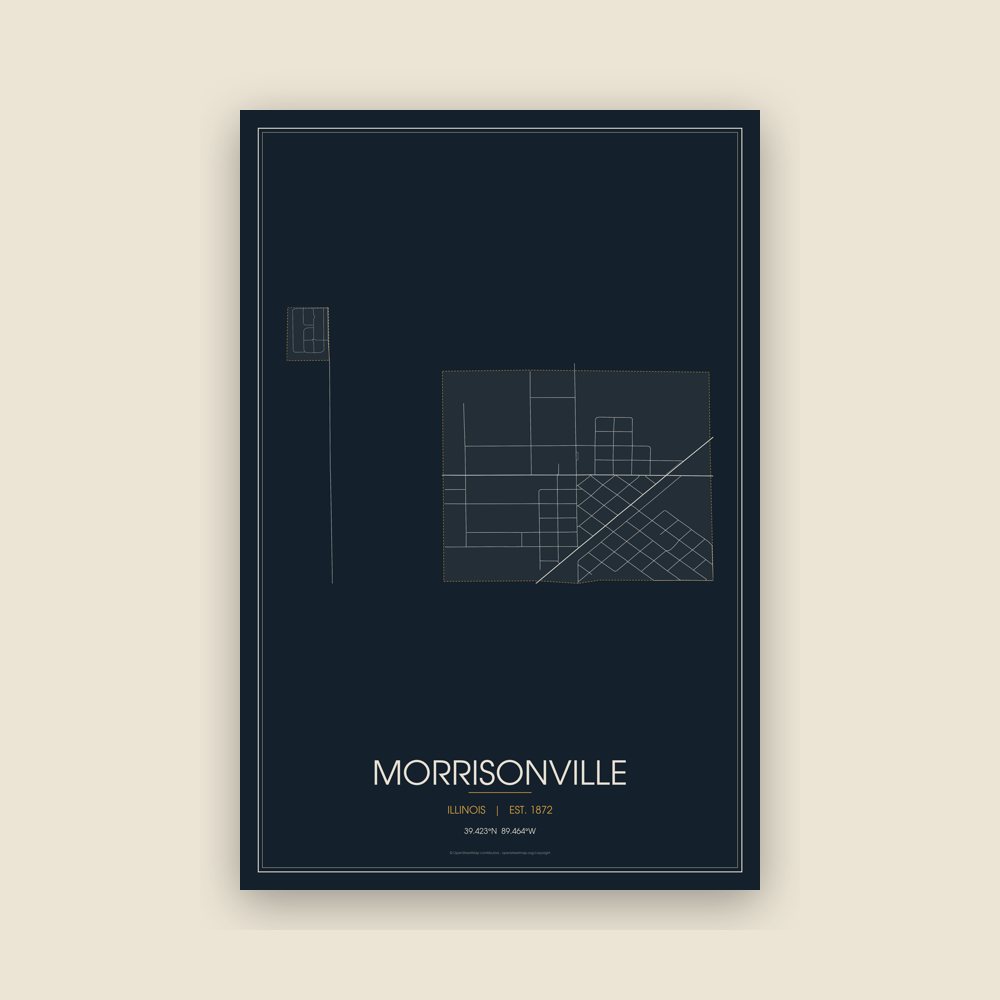
Soft fleece, 50″×60″
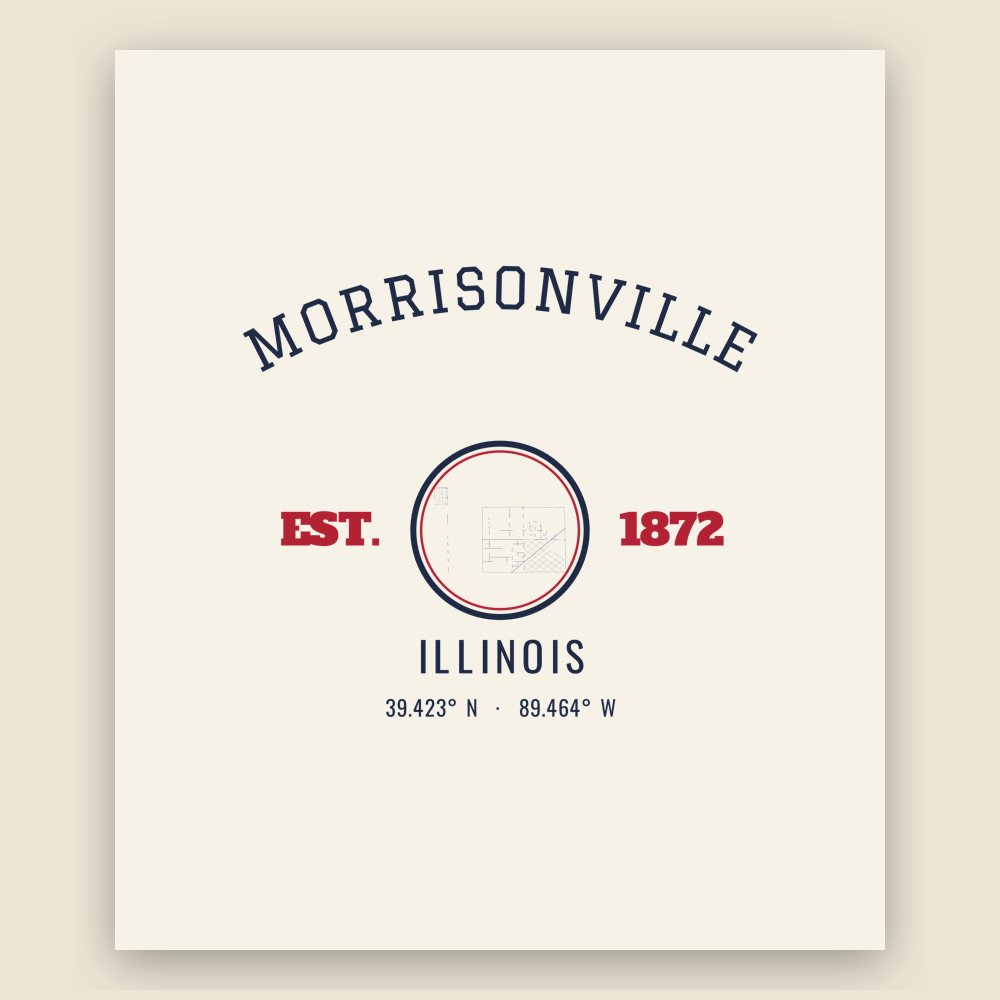
20 oz, double-wall stainless
Morrisonville is a small town in Christian County, Illinois, United States. Morrisonville is the birthplace of Al Unser, baseball player.
Population 2010: 1,056 → 2020: 997
From Wikidata (CC0).
Morrisonville is a small, rural town in Central Illinois. It is located 45 miles (72 km) south of the state's capital, Springfield. Morrisonville has a rich history dating back to a time when it was used as a hunting ground for Native American Indians.
Before settlers established a town, four Indian tribes lived on Morrisonville's land, the Sac, Fox, Pottawatomie, and Kickapoo. They competed with each other for buffalo, elk, and deer. Morrisonville was also part of the Black Hawk hunting ground.
Since 1492, six flags have flown over what is now Morrisonville, including Spain, France, Great Britain, Virginia, Indiana, and Illinois. Germans have also settled in this area. The Marsch's and Millburgs were directly from Germany and settled there.
The town was incorporated under the general city and village law in May 1872. The first board of trustees consisted of the following: C.M. Leiberman, Dr. C. Voorhees, W.T. Ricks, E.S. Shull, and J.R. Hall. Siras Irion was police magistrate.
There were a few events that led up to this, such as on June 14, 1851, when Thomas Carlin, a former governor of Illinois, paid $1.25 an acre for land that is now Morrisonville, and in the fall of 1869, when Colonel James Morrison laid out the plat for the town. Colonel Morrison married Mary Ann Carlin in 1842. Mary Ann Carlin's parents were Thomas A. Carlin and Rebecca Huitt Carlin. (Thomas Carlin established the town of Carrollton, Illinois, and the town of Carlinville is named in his honor.)
After Carlin purchased the land, he left it to his daughter, and she left it to her husband, Morrison, and then, when the town was established, it was named after him. In fact, on Perrine Street, there is still a house that Colonel Morrison built and lived in with his wife after the town of Morrisonville was established. Col. Morrison made an agreement with the railroad company that he would help build a new town if the railroad company would make Morrisonville a regular place to stop.
Even though the town was named after Morrison, Joseph Poggenpohl built the first house in the Morrisonville area in February 1870. Then, in May of the same year, the railroad was laid diagonally through Morrisonville. Once the railroad was established, Morrisonville became a regular stopping place for all trains and passengers. As soon as this happened, the town grew in population and business. After the first resident in the town proper, Richard McLean, built his house, people came here looking for a better living.
Since 1871, many land additions have been annexed to this town, such as T.F. Potts, Perrine, Johnson, Pence, Cloyd, and Shull. All of these streets were named after people who loved the land of Morrisonville and wanted to see it grow and prosper. Since its founding in 1872, people have found many ways to socialize, learn, live, and make a living in Morrisonville.
The first Morrisonville picnic was held on August 27, 1923, and it included a parade beginning on Sarpy Street, and marching to the City Park, speakers, a $1.00 prize for the tallest and shortest man, a fat man race, and free movies shown. Many people attended the event, as they still do today. It also includes the world's largest bull frog jumping contest.
A craze that hit Morrisonville in the mid-1880s was roller skating. In fact, it was so popular a building was built just for roller skating. It was later used as the Knights of Columbus hall. In 1926, the Knights of Columbus purchased the “Opera House” from the Morrisonville Moose Lodge. Many activities were held there, including dances, card parties, talent shows, church bazaar, and roller-skating.
Ever since the 1920s, the local lumber company (Morrisonville Lumber Company) has remained in the same location, and fire has destroyed two office buildings; one in the early 1920s, and one in 1974.
Through the years, Morrisonville has been known as a very religious community. Some churches in Morrisonville are the First Baptist Church, the First United Presbyterian Church, St. Maurice Church, and the United Methodist Church. Colonel Morrison donated the land for St. Maurice. The first church was a large frame building on the corner of Fuller and Third Streets, and costed $4,000.
In 1870, the first school was built. It also served as a Sunday school and a town hall. The present St. Maurice School was built in 1922, and contained a full basement and a large room across the entire front of the school. “Country children would drive a horse and buggy to school.”
Some of the first businesses to open in Morrisonville that are still open today are Becker's Clothing Store and Morrisonville Lumber Company.
When Morrisonville abandoned the old Village Hall/firehouse, the Morrisonville Historical Society was organized in an effort to raise funds for preservation of this historic building, and renovate it for a museum. They housed artifacts such as old clothing, dolls and doll furniture, a collection of typewriters, old school and business pictures, sports memorabilia, and Morrisonville's first jail cell.
Adapted (trimmed) from the Wikipedia article Morrisonville, Illinois, revision 1382527952 by its contributors, licensed CC BY-SA 4.0.
We share a part of every Morrisonville sale with local partners, and we'd love to print from your collection. Old photographs, maps and postcards make the best keepsakes.
Partner with usA favorite landmark, your street, a school or team, an anniversary gift, a different product. Tell us and we'll get back to you by email.
Morrisonville's population was 997 in the 2020 U.S. Census, down from 1,056 in 2010.