The first Euro-American settlers, primarily of Scotch-Irish descent, came to White County, Illinois between 1807 and 1809. The first settlements were near the Little Wabash River and Big Prairie, one of the numerous prairies in the county. Many came through the land office at Shawneetown, which was a port for flatboats which traveled the Ohio River. The second half of the 19th century saw the establishment of the towns of Norris City, Springerton including Mill Shoals. Once the home of a thriving barrel-making industry which depleted the nearby virgin forests Mill Shoals had primarily been an agriculture village until 1939 when oil was discovered in the area. In the early 1970s the oil industry declined steeply and thus returned Mill Shoals to its agricultural roots.
Read the full history
A Portrait of the Village of Mill Shoals in 1978
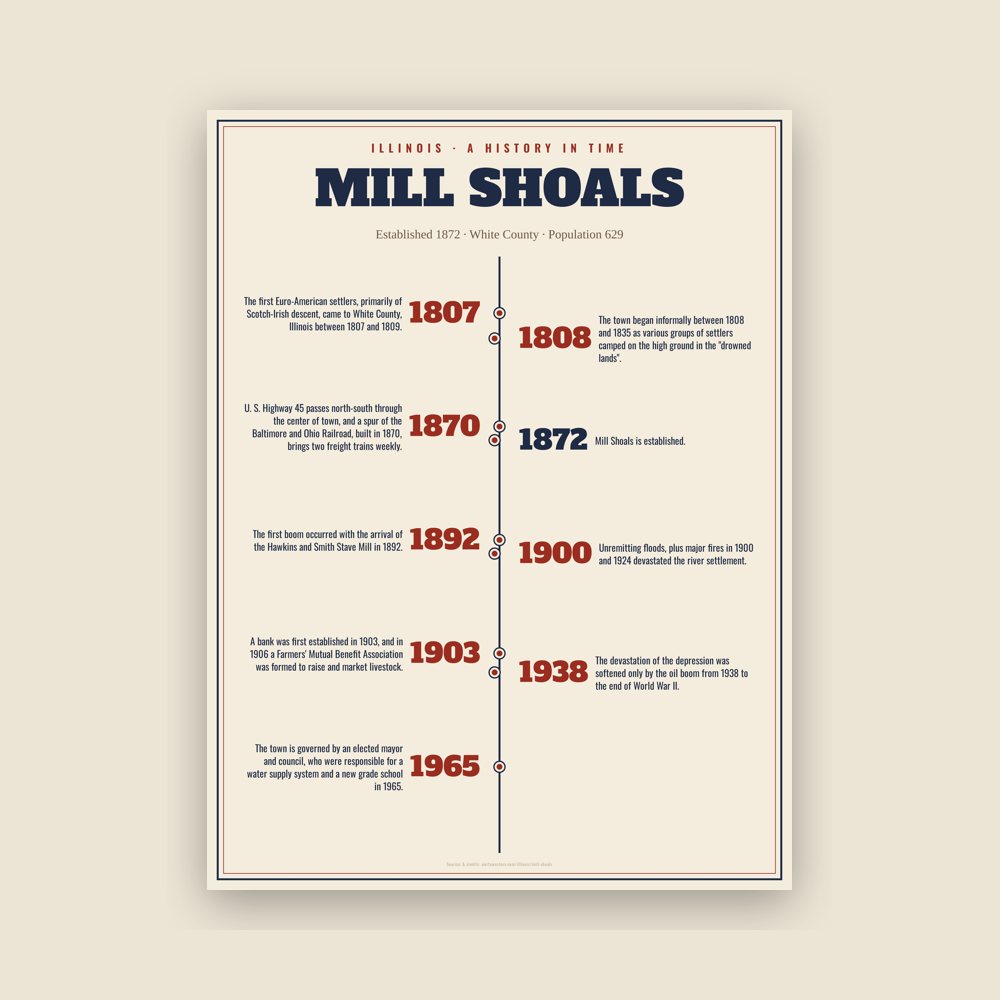
From the Institute of Cultural Affairs 1978 Human Development Project Report:"Mill Shoals is a representative mid-American small town with a population of 314 people situated in White County in southern Illinois. It is one of many secluded villages in the hills surrounded by fertile river bottomlands that make up the Wabash Meadows. U. S. Highway 45 passes north-south through the center of town, and a spur of the Baltimore and Ohio Railroad, built in 1870, brings two freight trains weekly. A county road connects Mill Shoals with Burnt Prairie five miles east along the old stagecoach trail that once connected Ohio River traffic from Shawneetown to central Illinois."
Incorporated in 1872, Mill Shoals takes its name from the water mill built by William Weed in 1835 on the shoals of the Skillet Fork River at the western boundary of the community. The town is governed by an elected mayor and council, who were responsible for a water supply system and a new grade school in 1965.
Mill Shoals sometimes refers to itself as the key ring capital of the world, an outgrowth of the ring binder, invented by Henry T. Adams of Mill Shoals in 1902, Besides the Adams Manufacturing Company is the Behimer and Kissner Grain Elevator and the more recent Grace Agricultural Products (chemical fertilizers). In addition there is a post office, a hardware store that doubles as an ice manufacturing source for the area, a grocery store, cafe, two service stations, two beauty shops, several private contractors, a funeral parlor, and five churches.
Mill Shoals has a high percentage of retired senior citizens. Most of the citizens who are employed work in nearby Fairfield. The town began informally between 1808 and 1835 as various groups of settlers camped on the high ground in the "drowned lands". Unremitting floods, plus major fires in 1900 and 1924 devastated the river settlement.
Railroad
During the first quarter of the 20th Century Mill Shoals. gradually moved east of the railroad tracks, away from the river. Thus Mill Shoals shifted from a 19th Century milling settlement on the shoals to a 20th Century way-station along the highway. Powerful but transitory economic resources have involved Mill Shoals in booms of productivity followed by periods of depression, depletion of strength and dispersion of employment.
Mill and Village Expansion
The first boom occurred with the arrival of the Hawkins and Smith Stave Mill in 1892. By the turn of the century the population had mushroomed to 1,500, and the town included a flour mill, saw mill, lumber factory, tile factory, canning factory, grain elevator, two hotels, opera house, saloon, pool room, drug store, hardware store, restaurant, two groceries, barber shop, two general stores, two doctors and a livery stable. A bank was first established in 1903, and in 1906 a Farmers' Mutual Benefit Association was formed to raise and market livestock. Besides this, Mill Shoals had a weekly newspaper, sidewalks, and obtained electric lighting before Fairfield, with the departure of the stave mill in 1909 a ten-year lull followed which is remembered by old-timers primarily for its great reunions and travelling circus.
1930s-1940s Oil Boom
The devastation of the depression was softened only by the oil boom from 1938 to the end of World War II. A long period of economic neglect has seen the growth of welfare dependency and the recent loss of the high school [Mills Prairie, on the Eastern outskirts of Mill Shoals] which had sustained the social life of Mill Shoals since it became a four-year school in 1945. As the nation becomes more dependent on local energy sources, Mill Shoals could well be near the center of a potential coal boom. The question for this community that has held on so tenaciously through boom times and hard times is how it can tie in to another boom and at the same time build a lasting foundation for continuous economic self-sufficiency in the future.