Read the full history
Marengo Ridge
The Marengo Ridge conservation area, located north of the town, was formed by the retreating of the Wisconsin glacier roughly 24,000 years ago. Native Americans lived around the area prior to European settlers. When early settlers came to the area it proved difficult to farm. As a result, numerous blocks of timber were spared and still remain on the landscape.
1835–1850
First settlers
The first European settler of Marengo was Calvin Spencer. He is the namesake of Calvin Spencer park. He arrived in the spring of 1835 with his wife and sister. In the autumn of that same year, Moses Spencer, the father of Calvin, also moved to Marengo with his wife who died shortly thereafter, becoming the first death in the town.
Marengo was first named Pleasant Grove after a grove of trees near the town site. The first post office was established in 1841, and was kept by Alfred King, at his residence, one mile west of the present city of Marengo. When the post office was established, it was called Marengo, commemorating the Battle of Marengo. When the township was organized by the county board, for convenience sake, the same name was given it as the post office held; hence the civil township, the village and its post office are all known by one and the same name, Marengo.
1850–1900
Marengo experienced a large growth during the post civil war years, and, by the turn of the century, the city had a rail connection to Chicago via the Chicago and north western, as well as electric interurban lines via the Elgin & Belvidere Electric Company and Woodstock and Sycamore Traction Company. It had a population of 2,005 people in the 1900 census. It became legally defined as a “city” in 1893.
Train station
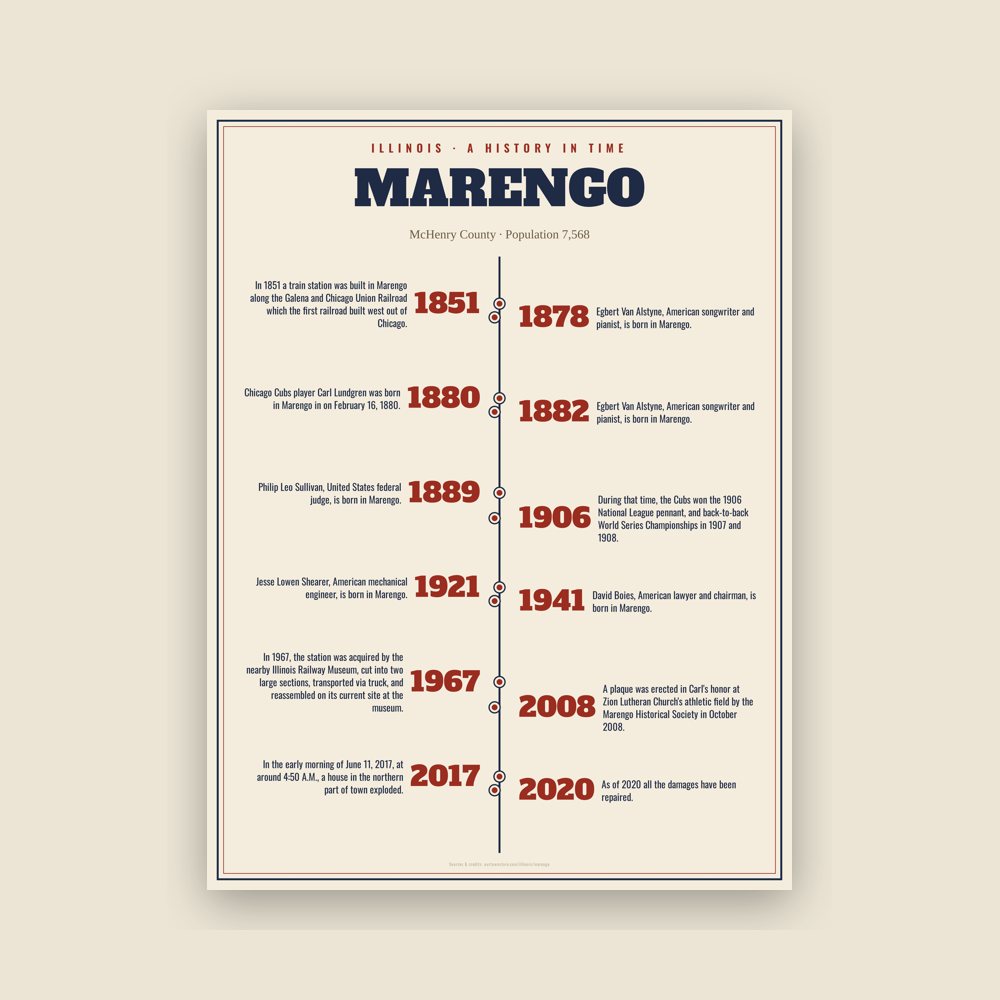
In 1851 a train station was built in Marengo along the Galena and Chicago Union Railroad which the first railroad built west out of Chicago. An addition enlarged the depot in the late 1800s, by which time it was owned by the Chicago and North Western Railway, and after that it remained used for purposes of freight until the mid 1960s, although passenger service to marengo ended in 1950.
In 1967, the station was acquired by the nearby Illinois Railway Museum, cut into two large sections, transported via truck, and reassembled on its current site at the museum. The depot still houses a working dispatcher's office, which is used by the Museum on many operating days, and a public waiting room. It is the oldest railway station in regular passenger use west of Pittsburgh.
Incorporation
1900–1950
“Marengo (…) is in the heart of a dairying and fruit-growing district; has a foundry, stove works, condensed milk plant, canning factory, water-works, electric lights, has six churches, good schools and two weekly newspapers.”
Carl Lundgren
Chicago Cubs player Carl Lundgren was born in Marengo in on February 16, 1880. In the early 1900s, he played for the Zion Lutheran Church's Athletic Field, then known as Shurtleff Flats or, more formally, the Athletic Association Park. He went on to play for the Cubs from 1902 to 1909. During that time, the Cubs won the 1906 National League pennant, and back-to-back World Series Championships in 1907 and 1908. He then began a second successful career, coaching at Princeton University, University of Michigan at Ann Arbor, and then his alma mater, the University of Illinois at the Urbana-Champaign Campus where Lundgren Hall is named in his honor.
Carl died unexpectedly from a heart attack on August 21, 1934, at his Marengo childhood home, 614 W. Grant Highway. Lundgren was buried in the Marengo city cemetery.
A plaque was erected in Carl's honor at Zion Lutheran Church's athletic field by the Marengo Historical Society in October 2008.
1950–2000
In the post World War Two years, Marengo continued to be a rural farming community, with some industry. By the 2000s, however much of the industry had left while the farming remained.
2000–present
In the modern times Marengo continues to grow, albeit slowly, while still retaining its rustic charm. It continues to have a farming economy, and an industrial one in the form of Mitsubishi Logisnext Americas and other local manufacturing companies. One of its biggest attractions are the gun stores, which attract individuals from Chicago and elsewhere to come purchase firearms. It also has many conservation areas that attract tourists and serve to protect the area's local fauna and wildlife.