A short history of Litchfield
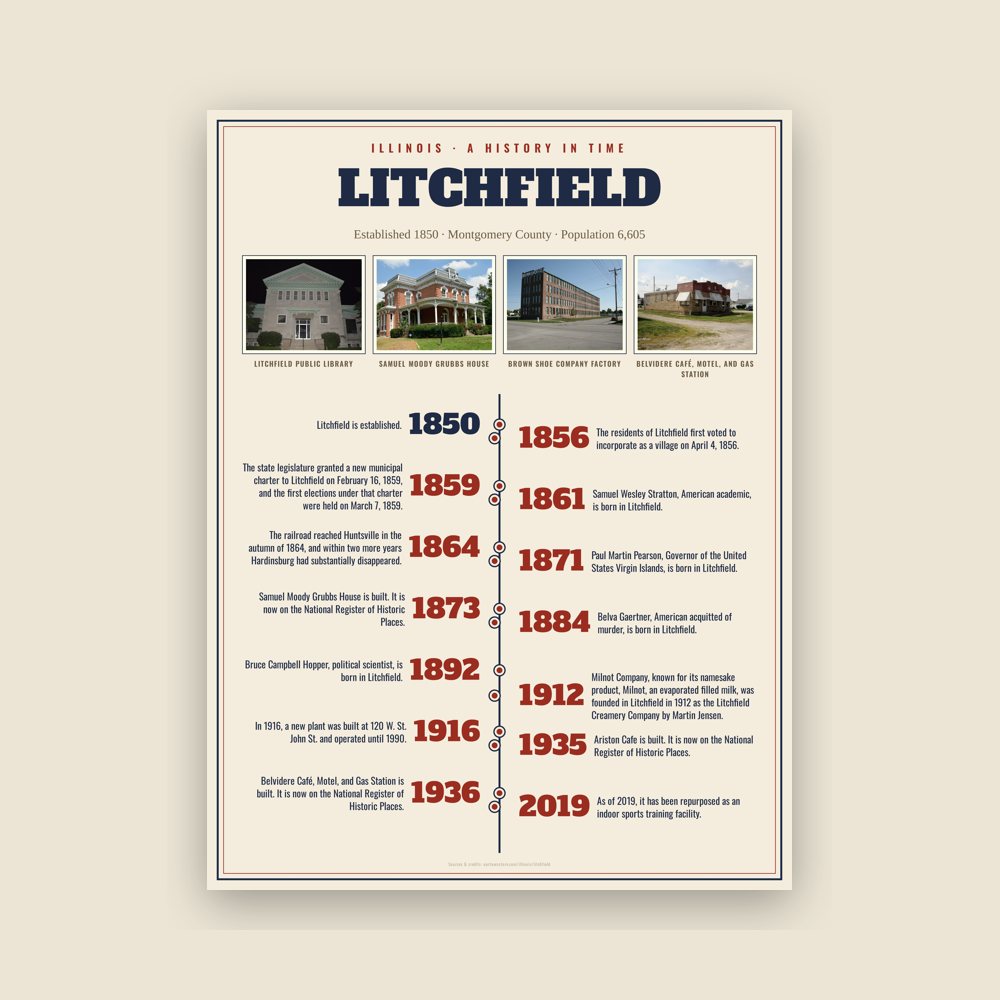
Earlier, Hardinsburg, about 2 miles (3 km) to the southwest, had been founded about 1850. Both towns were created in anticipation of the Terre Haute & Alton Railroad. Hardinsburg grew to about 50 people by 1854; but when it became clear that the railroad was going through Huntsville instead of Hardinsburg, many of the buildings in Hardinsburg were pulled across the prairie on runners to Huntsville beginning in January 1854, and most of the residents moved to the new site as well, becoming Litchfield's first residents. The railroad reached Huntsville in the autumn of 1864, and within two more years Hardinsburg had substantially disappeared.
The new town of Huntsville was renamed in November 1855 after Electus Bachus Litchfield, who with his brothers earlier that year had donated land and convinced the railroad of where to place its shops and terminals.
The residents of Litchfield first voted to incorporate as a village on April 4, 1856. However, the village trustees failed to complete the incorporation; the village charter was dissolved in autumn of 1857 and the trustees closed the books for that village government on January 22, 1858. The state legislature granted a new municipal charter to Litchfield on February 16, 1859, and the first elections under that charter were held on March 7, 1859.
Milnot Company, known for its namesake product, Milnot, an evaporated filled milk, was founded in Litchfield in 1912 as the Litchfield Creamery Company by Martin Jensen. In 1916, a new plant was built at 120 W. St. John St. and operated until 1990. As of 2019, it has been repurposed as an indoor sports training facility.
Adapted (trimmed) from the Wikipedia article Litchfield, Illinois, revision 1374531612 by its contributors, licensed CC BY-SA 4.0.