At the beginning of recorded American history, the Harrisburg area was inhabited by several Algonquian tribes, including the Shawnee and Piankashaw, who lived in the dense inland forests. Prior to the arrival of European settlers, the Piankashaw tribe was driven out by the more aggressive Shawnee. European settlement in Illinois began with the French from 1690 and reached its peak about 1750, mainly along the Mississippi River. American settlers arrived in 1790. The French came as merchants and missionaries, with farming supplementing the need for trade. The result had benefited both the settlers and the Native Americans. The American migration, however, followed treaties which resulted in land being distributed through American Law, ignoring previous indigenous rights. Encroachment ensued and caused hard feelings between the Native Americans and the settlers who moved into the interior and along migration routes. Many of the Indians allied themselves with the British to resist, though trade with the Americans was an important reason why the Native Americans remained largely peaceful.
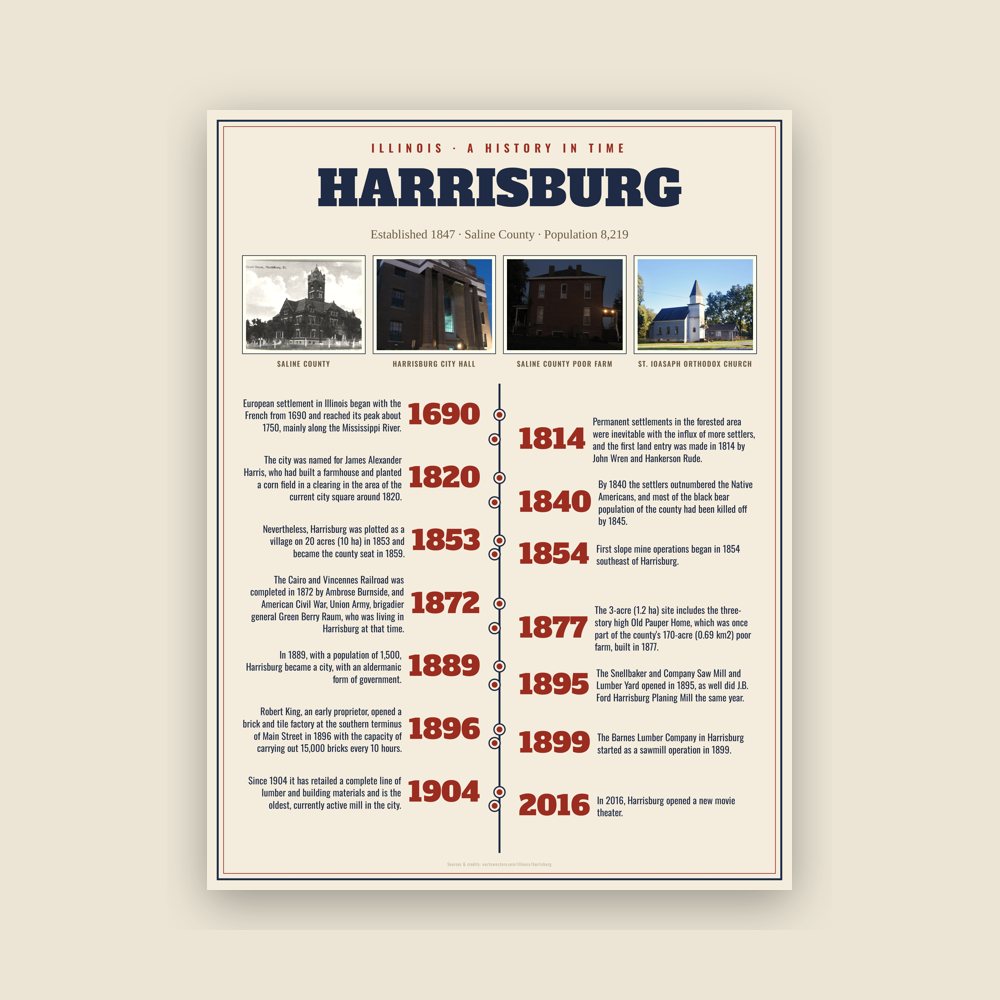
The town of Harrisburg was platted a few miles south of the junction of the Goshen and Shawneetown–Kaskaskia Trail, two of the first pioneer trade routes in the state. Prior to the War of 1812, most of the population of today's Saline County lived in cabins clustered around blockhouses to protect against Indian attack and dangerous wildlife such as cougars and bears. Permanent settlements in the forested area were inevitable with the influx of more settlers, and the first land entry was made in 1814 by John Wren and Hankerson Rude. By 1840 the settlers outnumbered the Native Americans, and most of the black bear population of the county had been killed off by 1845.
Read the full history
Founding
Harrisburg was plotted shortly after Saline County was established in 1847 from part of Gallatin County. The city was named for James Alexander Harris, who had built a farmhouse and planted a corn field in a clearing in the area of the current city square around 1820.
Harris along with John Pankey, James P. Yandell, and John X. Cain, donated land for the first additions of the town to a special committee at Liberty Baptist Church in 1852, after complaints that the county seat should be centralized in the county. The county seat then was in Raleigh. The county's two main population centers were divided by the Saline River and 14 miles (23 km) of thicket. There were no roads in the county and many residents from the areas of Carrier Mills and Stonefort became lost when traveling to the northern settlements of Raleigh, Galatia, and Eldorado. The designated town plat was considered due to its aesthetic properties, a 60-foot (18 m) sandstone bluff overlooking the Saline River valley called "Crusoe's Island". Although it was heavily timbered with oak and hickory with an impenetrable hazel underbrush, the site was at the geographical center of the county. A major legal battle took place within the county government because of voter fraud accusations by the people of Raleigh. Nevertheless, Harrisburg was plotted as a village on 20 acres (10 ha) in 1853 and became the county seat in 1859.
Industrial origins
Between 1860 and 1865 southern cotton became unavailable during the Civil War, Harrisburg was one of the few cities in the Upland South during this time to have woolen mills, making the town an industrial asset early on to Southern Illinois. Several planing mills and flour mills also dotted the city. The Cairo and Vincennes Railroad was completed in 1872 by Ambrose Burnside, and American Civil War, Union Army, brigadier general Green Berry Raum, who was living in Harrisburg at that time.
Robert King, an early proprietor, opened a brick and tile factory at the southern terminus of Main Street in 1896 with the capacity of carrying out 15,000 bricks every 10 hours. Harrisburg also saw the opening of several saw mills. The Snellbaker and Company Saw Mill and Lumber Yard opened in 1895, as well did J.B. Ford Harrisburg Planing Mill the same year. The mill had the capacity of producing 10,000 board feet (23.6 m3) of lumber every 10 hours. The Barnes Lumber Company in Harrisburg started as a sawmill operation in 1899. Since 1904 it has retailed a complete line of lumber and building materials and is the oldest, currently active mill in the city.
The Woolcott Milling Company, operated by J.H. Woolcott and J.C. Wilson built a flour mill in 1874, on the now defunct south Woolcott Street, with rail spur, behind the current Parker Plaza, that had 23 grain elevators and the capacity of carrying out 200 barrels of flour in a 24-hour period and up to 400 by 1907, with a new 75,000-US-bushel (2,600,000 L) tower. The exchange market was located in Carrier Mills. Located on Commercial Street across the tracks from the train depot, The Southern Illinois Milling & Elevator Company was incorporated on July 29, 1891, by Philip H. Eisenmayer, with a capital stock of $50,000. The company had two elevators, erected at a cost of $125,000, one of which had a capacity of 25,000 US bushels (881,000 L) and the other a capacity of 100,000 bushels. Their milling capacity was six hundred barrels per day. Twenty-five men were employed in the operations of the mill and elevators, in addition to a force of from six to eight men regularly employed in the cooperage department.
During the Reconstruction Era, when economic conditions made impractical the growing of cotton, lumbering and tobacco growing (which pioneers found profitable commercially), grain farming by crop rotation, dairying, reforestation, merchandising and manufacturing, and Coal mining especially, began to occupy the city. In 1889, with a population of 1,500, Harrisburg became a city, with an aldermanic form of government. It adopted the commission form in 1915. Despite these early industrial advantages over other cities in the region, the Sanborn Map Company still referred to the water facilities and road conditions within the city limits, "Not good, and not paved" up to 1900.
Coal and rail era
First slope mine operations began in 1854 southeast of Harrisburg. During the early years, the coal was transported by wagon to local homes and businesses for heating. Coal Mining became an important industry for the post-Antebellum, now Gilded Age city. The Cairo and Vincennes Railroad was completed in 1872 and provided transportation for coal and the miners who tired away underground. After a series of corporate transactions brought the Cairo and Vincennes Railroad into the hands of the Cleveland, Cincinnati, Chicago & St. Louis Railway around 1890, with Illinois state representative Charles P Skaggs as mayor, Harrisburg evolved into one of the leading coal-mining centers of the Midwest. Harrisburg was a strategic spot on the railroad route with a large hump yard, making it the focal point for the most productive coal field operations. Some of the most profitable coal companies that operated around Harrisburg were Big Creek Coal, Harrisburg Coal and O'Gara Coal. Each one with their own sizable rail yards. O'gara was a Progressive Era coal company owned by Thomas J. O'gara of Chicago. He purchased and annexed 23 privately owned mines in the Harrisburg coal field which equaled 50,000 acres (200 km2) of land. The Company based its headquarters in Harrisburg in 1905. O'gara only owned 12 operating mines, all in Saline County, but they had an annual output of 7,000,000 tons. 6,000 men were employed in a field capacity and the pay roll disbursement was $150,000 per month. The company paid $10,000 monthly royalty. H. Thomas was the company's general manager of mines, Ed Ghent its chief engineer and D. B. McGehee the assistant general manager.
By 1905, several small slope mines and 15 shaft mines operated in the county. Most were along the railroad line. Large numbers of immigrants from England, Wales, and eastern Europe, looking for work, detrained at the Harrisburg Train Depot; crowding around quickly expanding mining villages directly outside the city, such as Muddy, Wasson, Harco and Ledford. The city's population quickly expanded from 5,000 to 10,000 in a few years. By 1906, the Big four/CCC&STL Railroad became the New York Central, and Saline County was producing more than 500,000 tons of coal annually with more than 5000 miners at work. In 1915 the Ringling Brothers Circus made an appearance in Harrisburg. In 1913, the Southern Illinois Railway and Power Company operated an interurban trolley line, that ran from downtown Eldorado, into Muddy, Wasson, Beulah Heights, through downtown Harrisburg, Dorrisville, Ledford and into downtown Carrier Mills, all of which had larger residential areas than present. In 1917 there were plans to extend the line westward to Marion and Carbondale to connect to the Coal Belt Co. line, and then run it towards St. Louis. The trolley wire through the county was 16 feet (5 m) high. It was an off branch of the Cairo and Vincennes Railroad. The corporation erected the first electrical generating plant in Muddy, Illinois.
The Central Illinois Public Service Company purchased the Muddy Power Station in 1916. It had a generating capacity of 7,500 kilowatts. After removing an original 2,500-kilowatt unit, the company added two 5,000-kilowatt turbine-generators and one 10,000 kilowatt unit, bringing the stations total capacity to 25,000 kilowatts in 1922. Electricity generated at the station was distributed over 66-kv, double circuit steel tower transmission lines extending to West Frankfort to the west, the Ohio River to the east, and Olney to the north. The plant had two impounding reservoirs which covered 80 acres (32 ha) and held 320 million gallons of water.
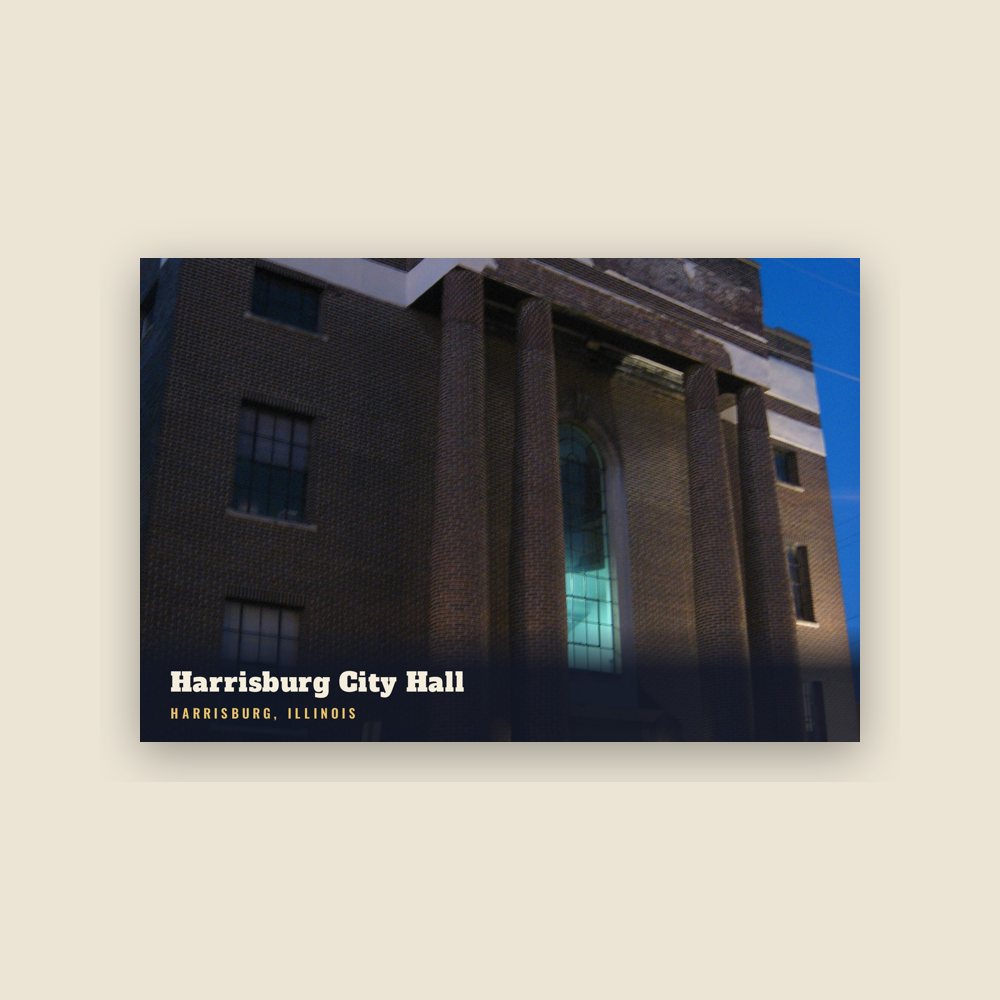
The community benefited from the prosperity of the Roaring Twenties, flaunting the most extravagant displays of wealth in the city's history. The 230-foot (70 m) neon red tower belonging to the WEBQ-A.M. radio station was the tallest structure in the city and could be seen for miles. Harrisburg had just finished the new three-story Horning Hotel around 1920, and two new theaters with a combined total of 1,600 seats: the Orpheum and the Grand the same year. The eight-story Harrisburg National Bank building, the O'Gara Coal Headquarters, the Cummins Office building, and the four-story Harrisburg Hospital were all built in 1923. The new four-story Harrisburg City Hall building was constructed in 1927, and a complex highway system was constructed through the city, with Illinois Route 13 and Illinois Route 34 constructed in 1918; U.S. Route 45 and Illinois Route 145 constructed in 1925–1926. During this time the city expanded to 15,000 people. The annexation of Dorrisville and Dorris Heights created blue collar, multiple, and single family homes filling in between. On Vine Street south of the town square was "Wiskey Chute", a saloon vice district for local miners. It was also during this time that the town was home to prohibition-era bootlegger Charles Birger, whose gang was said to have protected local business owners better than the law enforcement. For a time, the gangster's prized Tommy gun was displayed in a glass case in the City Hall. The geography around Harrisburg changed indefinitely, with coal areas producing a surface mining landscape the size of San Jose, California, roughly 172 sq mi (450 km2), aptly named the Harrisburg Coal Field. The field completely encased the towns of Carrier Mills and Harrisburg, while creating partial borders to Stonefort, Galatia, and Raleigh. Near the mines were gob piles that spontaneously combusted. The horizon around the city for many years flickered with burning coal refuse.
Slow economic decline
Harrisburg reached its peak population of 15,659 in 1930, making it the 20th most populated city outside the Chicago Metropolitan Area, in Illinois, and the most populous city in Southern Illinois outside the metro-east. If the city combined the service communities bordering Harrisburg such as Ledford and Muddy, the population would have been even greater at 26,000, and Saline County as a whole reached nearly 40,000 people. Even with the economic downturn during the Great Depression, with business owners and industrial firms closing shop, the city continued to thrive due to its enormous coal industry. On June 17, 1936, Eleanor Roosevelt visited Harrisburg to observe work of the WPA and delivered a speech in the packed high school gymnasium. The heyday ended quickly when the Ohio River flood of 1937 left 4,000 within the city homeless and 80% of the city inundated. Many flooded mines were deemed condemned which left the local economy crippled. In 1938, the state of Illinois had completed one of the largest operations of its kind ever attempted in the United States, the removal of more than two and a half billion gallons of flood water from Sahara mine No. 3.
Soon the Southern Illinois Railway and Power company was bought by the Central Illinois Public Service Company. The inter-urban line was abandoned in 1933 after 20 years of service. After the decommission of the Interurban line, Harrisburg opened the Harrisburg-Dorrisville Bus Co., which was a private predecessor bus company to the current Rides Mass Transit District which was opened in 1980. Between 1930 and 1940 the city lost 27% of its overall population.
Immediately after World War II new coal companies, Peabody, Bluebird, and Sahara, started mining within the city. The war created a great demand for energy, which was satisfied by expanded strip mining operations throughout the Harrisburg Coal Fields. Shortly after World War II, it became clear that coal was losing favor to other energy sources such as oil and natural gas. In contrast to other cities in the United States that prospered in the post-war boom, the fortunes of Saline County began to quickly diminish. Harry Truman stopped briefly in Harrisburg during his whistlestop tour on September 30, 1948, giving some hope for economic recovery for the region. Without hesitating, the long parade of police, buses, and accompanying cars sped through town. Poplar Street, at that time the main drag through town, was crowded with multitudes of persons for its entire length. It was reported by the Daily Register newspaper that cars were lined along Route 13 all the way from Marion and on to Eldorado on Route 45. In 1950 Illinois Assistant State Attorney General George N. Leighton represented parents in a proceeding which desegregated the public schools of Harrisburg. On December 1, 1953, WSIL-TV 3 was founded and based out of the city. The station built the 503 ft (153 m), WSIL tower in downtown which was one of the tallest television towers in the state at the time and is still the tallest structure in the city.
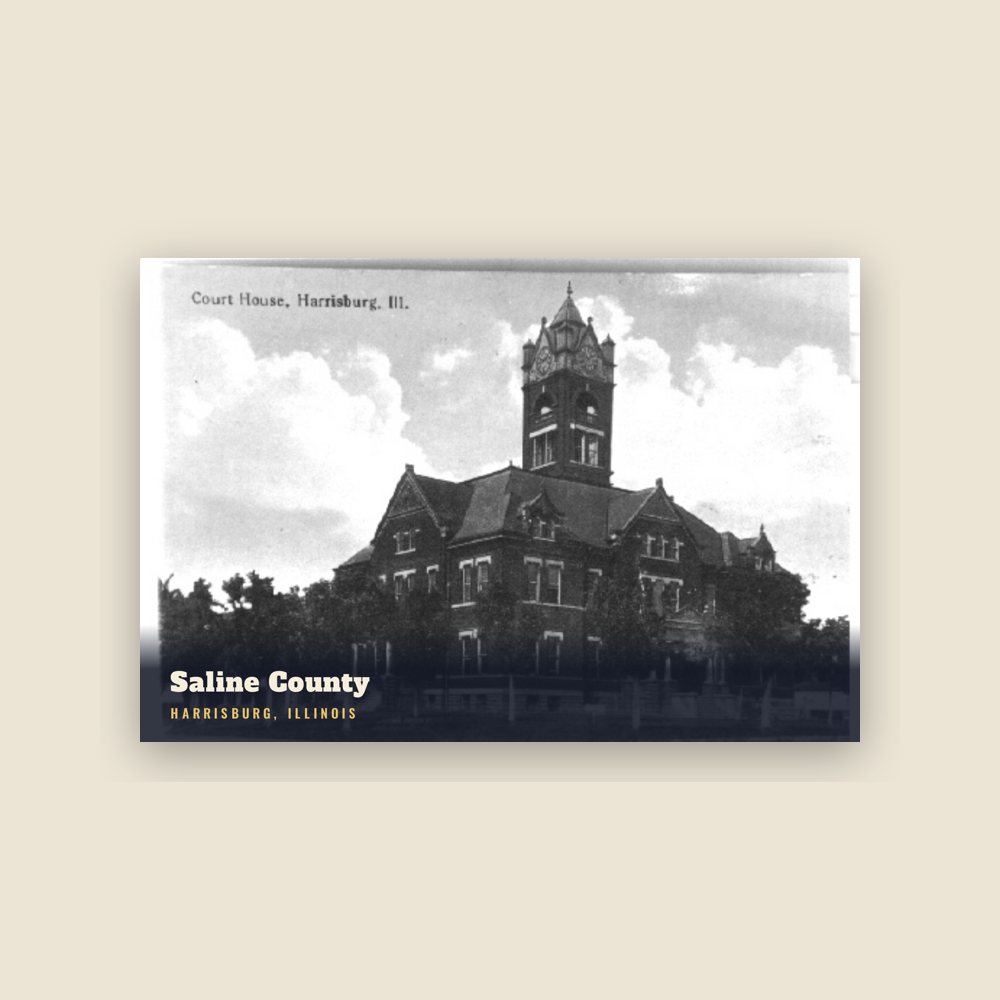
By 1957, the Egyptian was the last passenger train to travel through the city. Between 1940 and 1960 Harrisburg lost another 20% of its population due to economic standstill. With only 9100 people left in the city that once had 16,000, then Senator John F. Kennedy made a campaign stop on October 3, 1960. Speaking at the Saline County Court House he said "This district, which is built on the land and which has been nourished by the land, personifies the kind of problems which I think the United States is going to face in the 1960s. This district has depended in the main for its resources, its growth, its wealth, upon the minerals underground and upon the food that is grown on the ground. And those are those industries that have faced serious problems in the 1950s."
"Farmers could farm and work in the cities and towns, but this year we have the highest unemployment that we have had in any months of August and September, the three Augusts and Septembers preceding the recession of 1949, 1954, and 1958, and this district knows this problem well, because this district has lost 60,000 people in the last 10 years."
By 1968, with hopes of bringing a new influx of coal mining into the city, Sahara Coal Company ordered the Bucyrus-Erie "GEM of Egypt" strip mine shovel, one of the largest in the world at 8 stories high and weighing 1,000 tons. It took three men to operate it, and its bucket capacity was 30 cubic yards. Even with such great efforts coal mining continued to dwindle within the community. The train depot was razed in 1972 and all coal freight was ordered out of the Harrisburg Hump Yard by 1973. During the 1970s and 1980s, many of the city-square storefronts and mini-plazas became vacant and were slowly abandoned as large chain stores and strip malls on Commercial Street became the dominant venues for shopping and entertainment, hoping to bring an influx of travelers from the main highway.
The Clean Air Act Amendments of 1990 legislation forced many utility companies in the United States to switch to low-sulfur coal. In response Harrisburg's already waning economy took a severe downturn. The freight yard had closed in 1982; Sahara Coal Company shut down operations in 1993, and 865 jobs were lost in the county that year. This ended the reign of big coal in Harrisburg, a way of life for residents for over 100 years. The Cairo and Vincennes Railroad/Cleveland, Cincinnati, Chicago and St. Louis Railway system tracks were taken up in the late 1980s and replaced by the Tunnel Hill State Trail in 1996.
Post-coal economy
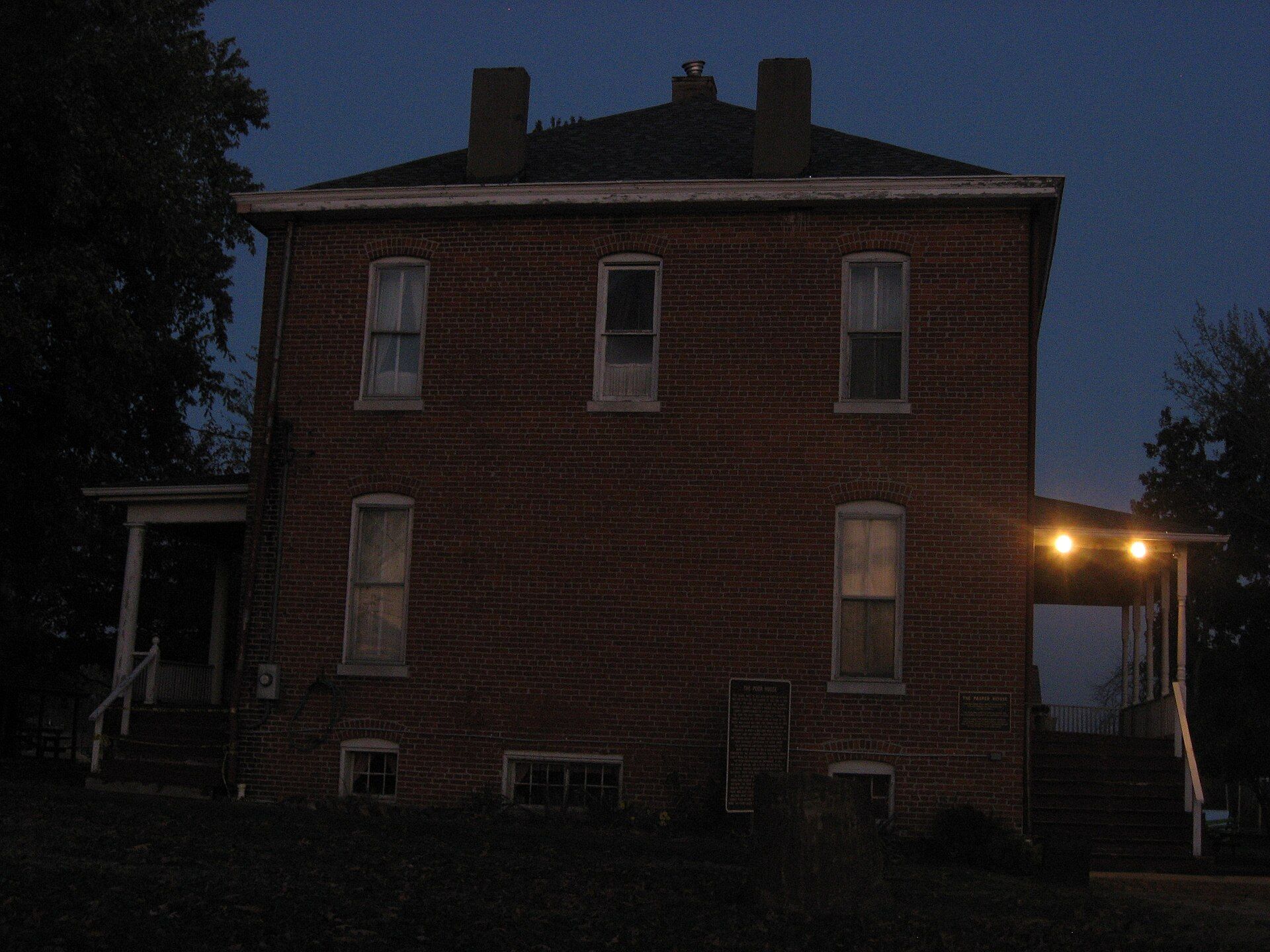
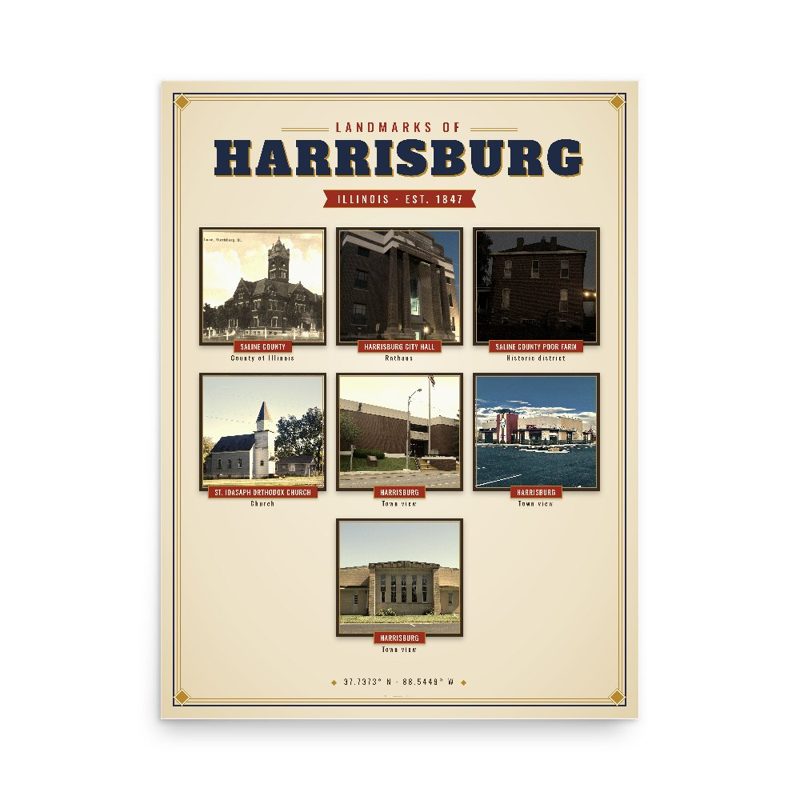
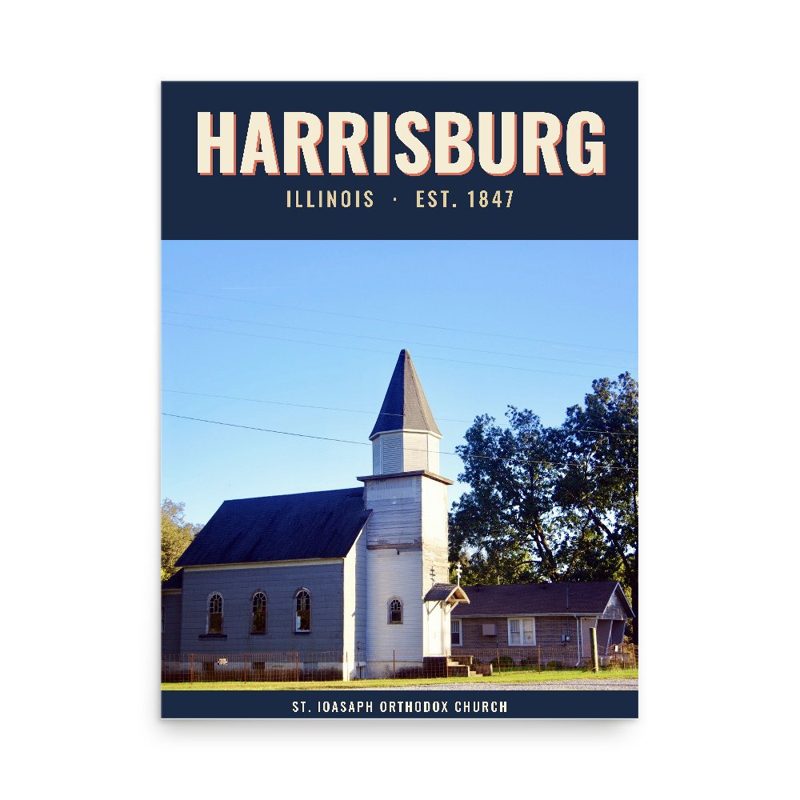
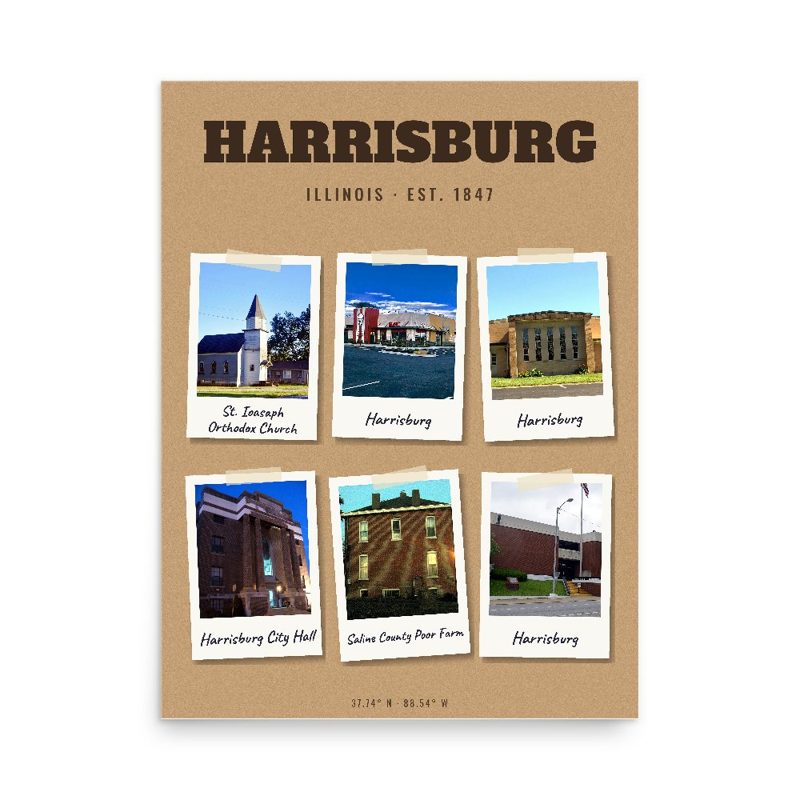
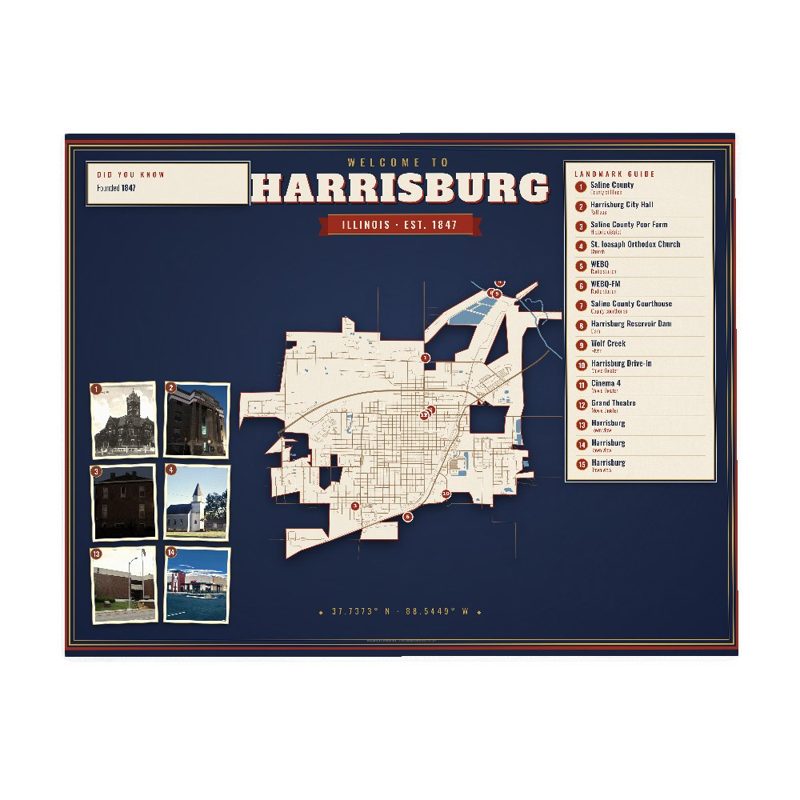
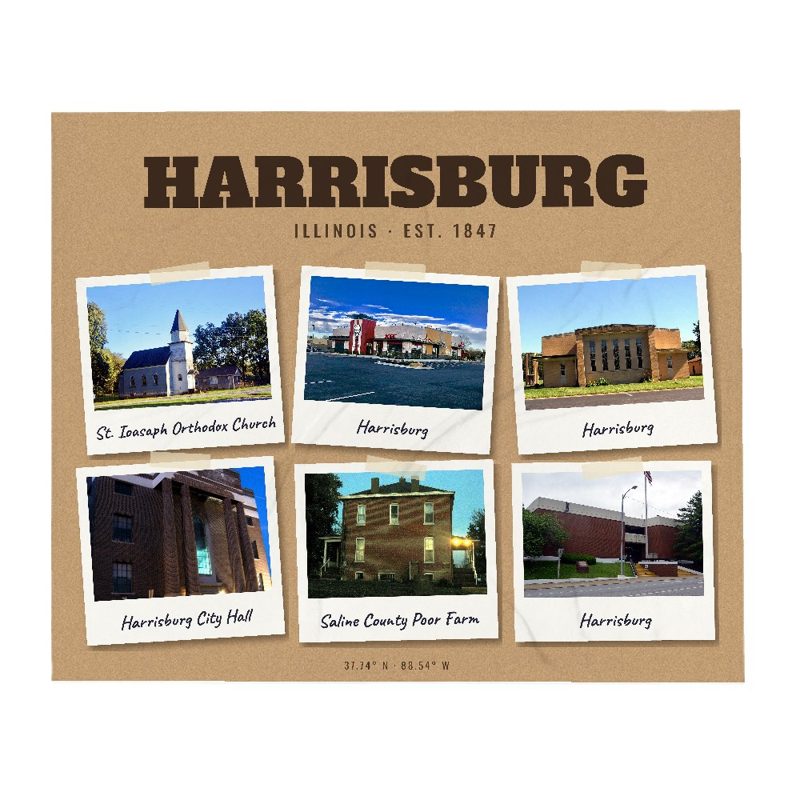
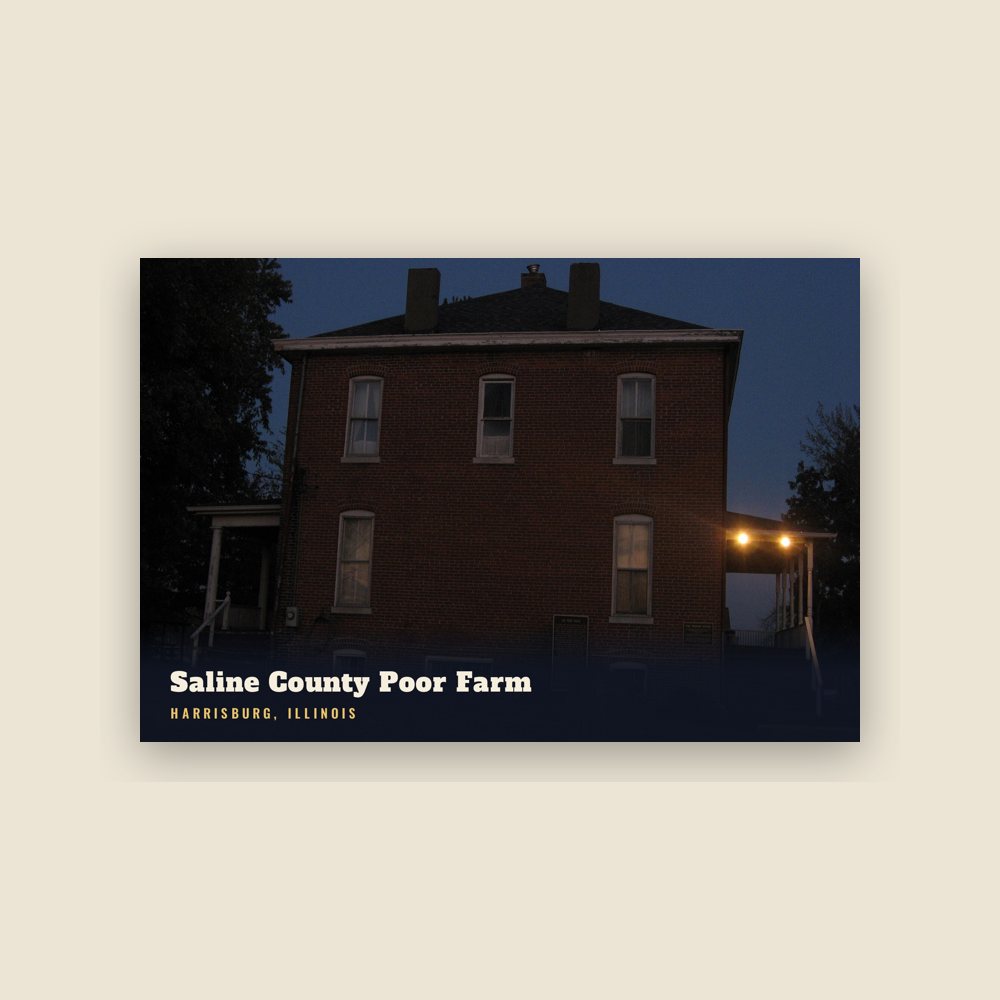
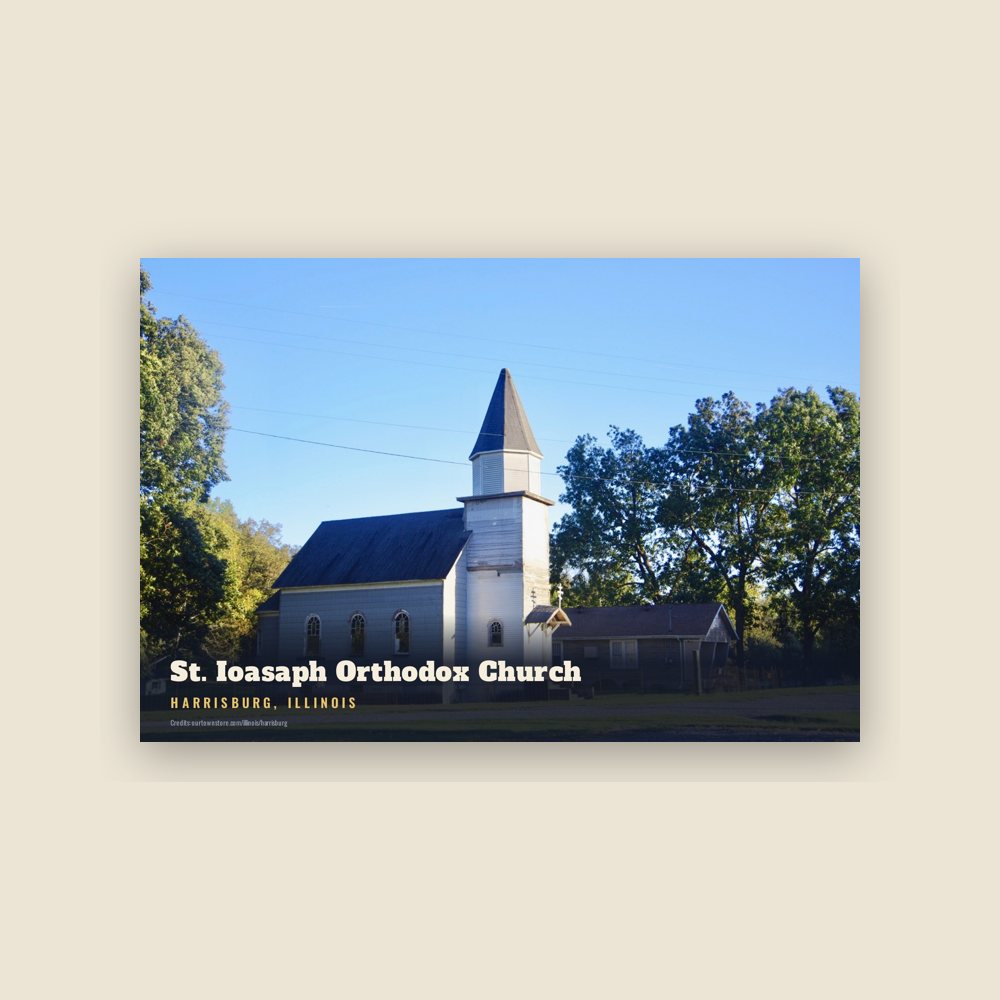
Soon Pioneer history was showcased at the Saline County Area Historical Museum on the city's southern edge. The 3-acre (1.2 ha) site includes the three-story high Old Pauper Home, which was once part of the county's 170-acre (0.69 km2) poor farm, built in 1877. The site also features a variety of cabins, a one-room school house, a small church and other historic buildings that have been acquired, moved to the site and restored.
The Harrisburg-Raleigh Airport is located approximately four miles north of Harrisburg on Highway 34. The Harrisburg-Raleigh Airport Authority operates the airport. The Airport has two runways–32/14 and 6/24. Runway 24 includes a 1,000-foot (300 m) extension, bringing the runway to 5,000 feet (1,500 m) with a GPS-RNAV approach.
Two industrial zones were set up within the township in 1974 by the Saline County Industrial Development Co., one located in Dorrisville, and the other located near the Harrisburg-Raleigh Airport. The one in Dorrisville had the advantage of rail spur prior to the removal of the New York Central tracks. A Tax Increment Finance district was built on the property of the old rail yard north of the city where the Harrisburg Professional Park was built.
The 2000s saw a slight economic boom to the city. The industrial base within the city, while most were not coal-related, gave opportunity to a number of city residents. American Coal and Arclar, the only two coal mines in the county were producing low sulfur coal as an energy resource. Kerr-McGee Coal Corporation's Galatia Complex was purchased by the American Coal Company in 1998. American Coal employed about 580 workers, while Arclar employed 175 persons. Nationwide Glove Factory employed 225 persons, and American Needle was the second-largest non-coal company with 125 workers. Southern Truss and Harrisburg Truss companies employed together 100 employees manufacturing building components. In 2008 construction on the Harrisburg Wal-Mart Supercenter was completed. Wal-Mart will give $21,950 in grants to the Anna Bixby Women's Center, Bridge Medical Clinic, CASA of Saline County, Harrisburg District Library, Harrisburg Police Department, Harvest Deliverance Center Food Pantry, Regional Superintendent of Schools, Saline County Senior Citizens Council and Saline County Sheriff's Department. The building is 184,000 square feet (17,100 m2) and added 150 new jobs to the county. The Supercenter became the second-largest employer in the city, with 340 employees on its payroll. A new strip mall was completed on the south side of town, and Parker Plaza, the oldest shopping center in town was renovated with a new facade to promote commercial growth in the city.
Things slowly took a turn for the worse when former Illinois Governor Rod Blagojevich's decision to move a division of I-DOT to Southern Illinois was overturned by his successor Pat Quinn. Blagojevich's decision outraged lawmakers in Springfield. A lawsuit was filed to stop the move to Harrisburg. Matters were exacerbated when videos of the new home for the IDOT traffic safety division being surrounded by water surfaced on YouTube in late 2007.
The early 2010s saw a series of unfortunate economic events for the city. In December 2010, Harrisburg's AMC, formerly Kerasotes' Cinema 4 theater, closed. This was the first time Harrisburg had been without a cinema since 1920. After release of the 2010 census, in February 2011, the city learned that its population had dropped to a low of 9,017 people, an 8.5 percent decrease. It was the lowest population since the pre-coal boom of 1900. Harrisburg also suffered from numerous scandals involving the school district and police department. In 2011, the Chief Deputy of the Saline County Sheriffs Department was sentenced to prison for sexually abusing a high school student who was working as an intern. The biggest hit was in late February 2012, an EF4 tornado hit Harrisburg during the 2012 Leap Day tornado outbreak. The southern part of the city was heavily damaged, with houses and businesses destroyed, many of which were completely leveled. Eight people were killed and 110 were injured by that tornado. In November 2012 a decision was made to close Willow Lake Mine, one of the last remaining mines in Saline County, putting 400 employees out of work.
In 2016, Harrisburg opened a new movie theater. In 2018 Mason Ramsey, a boy from Golconda, went viral after yodeling his rendition of Hank Williams' "Lovesick Blues" in the Harrisburg Walmart. Within a few days videos of his performance collectively garnered over 25 million views and he became a viral sensation and Internet meme.
Harrisburg continues to be the retail hub of Saline County. It holds the nearest shopping centers, restaurants, churches, gas stations, banks, and other commerce within miles. However, industrial jobs are scarce.